
Usage Billing Part 4: Detection, Isolation, Reprocessing, and Reconciliation

Part 1 covered duplicate ingestion and resumable close in a single PostgreSQL ledger. Part 2 rebuilt projections from an Event Store. Part 3 split billing into five services and used Outbox and Inbox records to survive partial failure.
The storage models differ, but operators must answer the same questions. How far did processing get? Which durable facts remain? Which reprocessing method is safe? What evidence proves the system is healthy again?
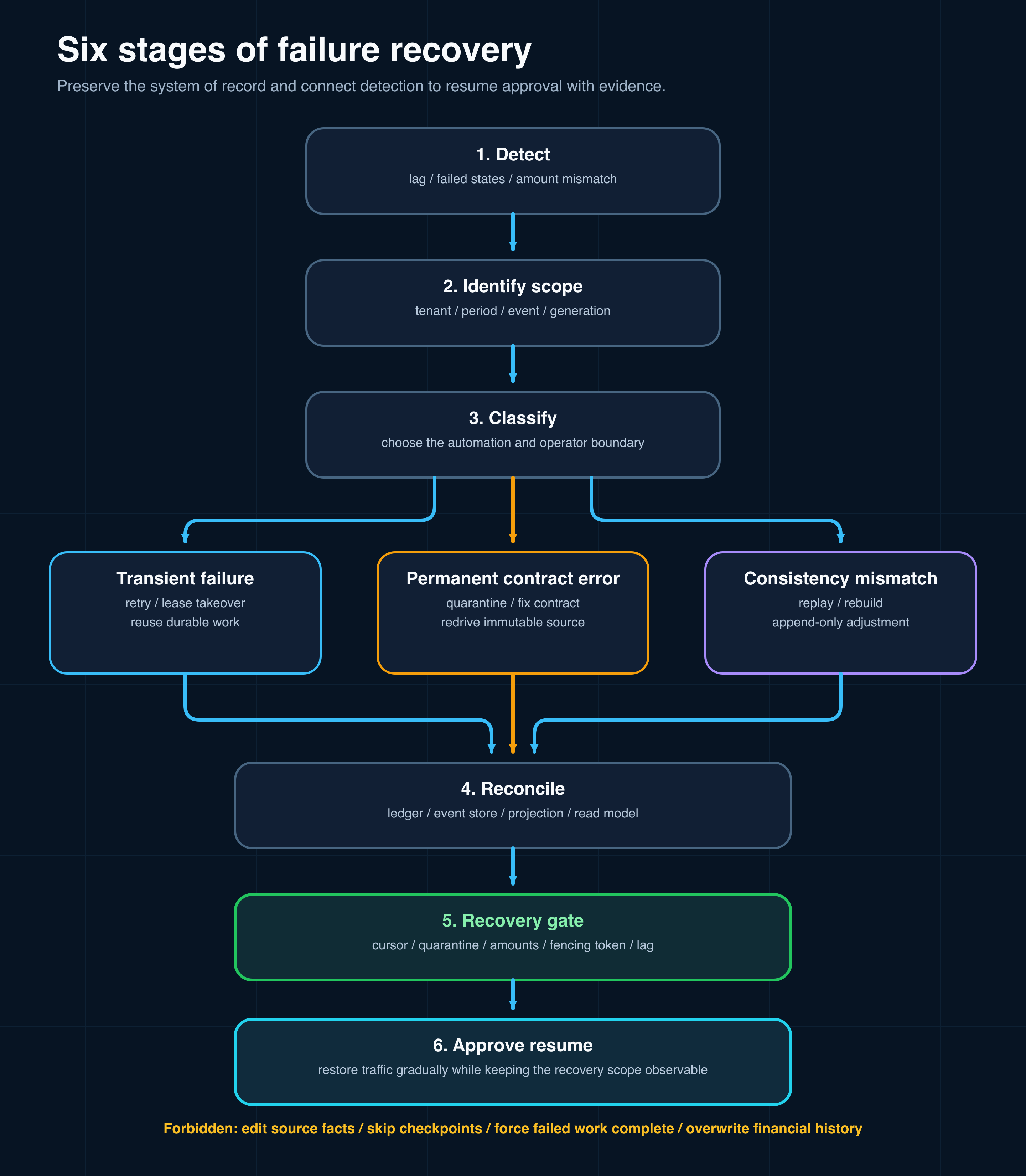
This article turns the failure paths exercised by those three examples into one operations runbook. It does not propose a universal monitoring product or recovery framework. It organizes recovery as detect → identify scope → classify → isolate and recover → reconcile → approve resume.
Define healthy billing with invariants, not throughput
Section titled “Define healthy billing with invariants, not throughput”A normal HTTP success rate and low Kafka lag do not prove that billing is correct. Define health through business invariants.
| Boundary | Healthy condition | Failure signal |
|---|---|---|
| Ingestion | One producer event affects money once | Same ID with another digest, a receipt held too long |
| Pricing | Evidence exists for the price active at occurrence time | Missing or overlapping intervals, unapproved version |
| Close | Every fact before the cursor is aggregated once | Failed batch, stale lease, stalled cursor |
| Event Store | Stream versions and the hash chain are continuous | Version gap, hash mismatch, failed upcast |
| Projection | A verified ACTIVE generation reaches the target position | FAILED generation, growing lag, amount mismatch |
| Service delivery | An Outbox event passes an Inbox decision before one effect | Old RETRY_WAIT, DEFERRED, or quarantine growth |
| Financial result | Usage, charge, invoice, and projection amounts trace to source events | Unexplained amount, edited line, reconciliation difference |
Build alerts around these invariants. Signals such as oldestRetryAge, projectionLag, quarantineCount, and
reconciliationDifference are more useful to recovery decisions than a generic error-log count.
1. Record the signal and the affected scope together
Section titled “1. Record the signal and the affected scope together”Reprocessing everything after the first alert also touches healthy tenants and periods. Pin the recovery unit first.
RecoveryScope = { incidentId, detectedAt, design: LEDGER | EVENT_SOURCED | MICROSERVICES, tenantIds, billingPeriods, producerEventIds, aggregateKeys, streamVersionRange, projectionGeneration, topicPartitionsAndOffsets, observedHighWatermark}When the scope is uncertain, widen observation rather than mutation. Trace source event IDs into usage facts, charges, invoice lines, and projection rows. Locate the last verified cursor, stream version, or checkpoint. Those values define where recovery starts and the high watermark it must reach.
2. Classify the failure into three operational paths
Section titled “2. Classify the failure into three operational paths”Retry count is not a sufficient classifier. The same exception can require a different response depending on which durable facts remain.
| Class | Examples | Durable evidence | Allowed recovery |
|---|---|---|---|
| Transient failure | Database connection, broker path, worker crash | Receipt, Outbox, Inbox, checkpoint, lease | Take over the same work, redeliver the same envelope, resume at the checkpoint |
| Permanent contract error | Unsupported schema, missing field, same ID with another digest | Immutable source event, reason, quarantine, redrive audit | Isolate from healthy flow, fix the contract, redrive the same source |
| Consistency mismatch | Projection difference, invalid snapshot, incorrect finalized amount | Event Store, ledger links, previous generation, reconciliation finding | Replay, rebuild, append-only adjustment |
Quarantining every transient failure creates unnecessary operator work. Retrying a permanent contract error forever blocks healthy events. Redelivering a consistency mismatch leaves already-created bad money in place. Persist the classification as an input to the recovery command.
Compare the three billing designs in the interactive companion
3. Isolate the failed scope while healthy work continues
Section titled “3. Isolate the failed scope while healthy work continues”Isolation is not deletion. It separates failed work from healthy flow while retaining the evidence needed for diagnosis and reprocessing.
- Keep a failed batch as
FAILEDwith its last cursor so another owner can take it over. - Mark a corrupt or non-upcastable projection generation
FAILEDwhile the previous ACTIVE generation remains visible. - Record tenant, event ID, digest, schema version, and reason for a poison event in quarantine.
- Keep an out-of-order event
DEFERREDand create no business effect until the expected version arrives. - Persist a reconciliation difference as a finding and distinguish automated correction from operator approval.
An isolation record should point to the immutable source with an identifier and digest. Do not treat an editable copy of the payload as the source. This evidence proves that a later redrive used the same original after the contract was fixed.
4. Choose recovery from the durable evidence that remains
Section titled “4. Choose recovery from the durable evidence that remains”Transient failure: take over existing work instead of creating new work
Section titled “Transient failure: take over existing work instead of creating new work”val work = repository.claimExpiredOrPending(scope, ownerToken)
when (work.state) { PENDING, RETRY_WAIT, CLAIMED_WITH_EXPIRED_LEASE -> { executeFrom(work.checkpoint) repository.complete(work.id, ownerToken) } COMPLETED -> return work.savedResult else -> keepIsolated(work)}Owner and fencing tokens prevent a late former worker from completing the current owner’s work. A broker retry sends the existing Outbox envelope instead of creating another event. A lost HTTP response reuses the stored result for the same idempotency key and fingerprint.
Permanent contract error: fix the contract, then redrive the immutable source
Section titled “Permanent contract error: fix the contract, then redrive the immutable source”1. Inspect the quarantine reason and original digest.2. Fix the decoder, upcaster, or producer contract and pass regression tests.3. Read the same original envelope from the external retained source.4. Record a redrive audit with operator, reason, and incident ID.5. Deliver it again so Inbox links the old quarantine to the new decision.6. Confirm that the error does not recur and healthy events keep advancing.Editing a quarantined payload before processing breaks the link between source and recovery result. Issuing an arbitrary new event ID also bypasses the original deduplication and audit trail.
Consistency mismatch: distinguish replay, rebuild, and adjustment
Section titled “Consistency mismatch: distinguish replay, rebuild, and adjustment”| Mechanism | Use when | Changes | Must preserve |
|---|---|---|---|
| Replay | The Event Store is valid and only aggregate state must be recomputed | In-memory state or a new snapshot | Source event order and hashes |
| Projection rebuild | A read model is corrupt or its handler changed | A new projection generation | Previous ACTIVE generation, checkpoints, failed generation |
| Append-only adjustment | A finalized charge or invoice amount must be corrected | A new adjustment and correction line | Original amount, source links, correction reason |
Stop replay if an Event Store hash is invalid. First restore the history or establish a trusted backup boundary. When the Event Store is valid but a projection differs, do not edit source events. Build a new generation, verify it, and switch ACTIVE atomically.
5. Reconciliation is the approval condition, not cleanup after recovery
Section titled “5. Reconciliation is the approval condition, not cleanup after recovery”A successful recovery command only says the command ran. Resume approval requires evidence that independent storage boundaries explain the same business facts.
val evidence = RecoveryEvidence(    sourceHighWatermark = source.highWatermark(scope),    processedCursor = consumers.minimumCursor(scope),    unresolvedQuarantine = quarantine.countOpen(scope),    ledgerAmount = ledger.sum(scope),    projectionAmount = projection.sum(scope),    invoiceAmount = invoices.sum(scope),    currentFencingToken = leases.currentToken(scope),    observedLag = consumers.maxLag(scope),)
require(evidence.processedCursor >= evidence.sourceHighWatermark)require(evidence.unresolvedQuarantine == 0L)require(evidence.ledgerAmount == evidence.projectionAmount)require(evidence.ledgerAmount == evidence.invoiceAmount)require(evidence.currentFencingToken == recoveryCommand.fencingToken)require(evidence.observedLag <= recoverySlo.maxLag)
Reconcile by source event ID and price version before comparing period totals. Equal totals can hide two offsetting errors.
First prove the usage fact → charge → invoice line → projection chain, and then aggregate the verified records.
6. Restore traffic in stages
Section titled “6. Restore traffic in stages”Passing the recovery gate does not require opening all traffic immediately.
- Resume the affected tenant or partition at a limited rate.
- Confirm that new
FAILED,DEFERRED, quarantine, and reconciliation findings do not increase. - Confirm that cursors advance and lag converges within its normal range.
- Reconcile once more and attach before-and-after evidence to the incident.
- Expand the scope gradually and record final resume time.
This may look slower than restarting a service. In billing, however, preventing silent propagation of incorrect money is more important than a fast but unverified resume.
Actions a recovery tool must forbid
Section titled “Actions a recovery tool must forbid”| Forbidden action | Why it looks attractive | Long-term risk |
|---|---|---|
| Delete Outbox or quarantine rows | Backlog and error counts fall | Delivery loss and destroyed evidence |
| Advance a checkpoint or cursor manually | Lag approaches zero immediately | Unprocessed events are skipped permanently |
Force failed work to COMPLETED | The worker moves forward | Status no longer matches the business result |
| Edit an existing charge or invoice line | The current total appears correct | Original decision and correction cannot be explained |
| Skip snapshot validation | Replay starts faster | Corrupt or stale state becomes the baseline |
| Republish a poison event with a new ID | Inbox deduplication no longer blocks it | Source-to-redrive audit linkage is lost |
Operations tooling should not bypass these rules. Separate inspection from mutation, and require incident ID, operator, reason, target scope, and fencing token for every recovery command.
Recovery cost remains in every architecture
Section titled “Recovery cost remains in every architecture”| Design | Simpler recovery boundary | Additional operational boundary |
|---|---|---|
| Single PostgreSQL ledger | One transaction and an explicit cursor | Long-running batches, receipt takeover, period reconciliation |
| Event Sourcing | Rebuild state and projections from immutable events | Snapshot validation, upcasters, generation switch, replay cost |
| Microservices | Independent deployment and fault isolation | Outbox, Inbox, lag, schema contracts, quarantine, cross-service reconciliation |
The ability to reprocess does not by itself make a system recoverable. The input must be immutable, repeated effects must be contained, progress must be restartable, and results must be independently reconcilable.
Series conclusion
Section titled “Series conclusion”- Usage Billing Part 1: Duplicate Ingestion, Resumable Closing, and the Ledger
- Usage Billing Part 2: Event Sourcing, Replay, and Projection Operations
- Usage Billing Part 3: Microservices, Outbox, and Inbox
- Usage Billing Part 4: Detection, Isolation, Reprocessing, and Reconciliation
- Interactive companion for the complete evolution
The shared rule across all four parts is simple: do not rewrite source facts, resume from durable processing evidence, and declare completion only through independent reconciliation. The implementation changes, but this rule lets an operator recover from evidence instead of guessing.
Code and resources
Section titled “Code and resources”- Ledger-based usage billing example: Explains receipts, price versions, close cursors, and append-only corrections.
- Event-sourced usage billing example: Explains event hashes, snapshots, projection generations, and replay boundaries.
- Microservices composition example: Explains Outbox, Inbox, poison events, process restart, and broker-path recovery across five services.
ReconciliationPostgresIntegrationTest.kt: Verifies that differences between the ledger and derived results remain explicit findings.ProjectionRecoveryPostgresIntegrationTest.kt: Verifies that a failed generation is never exposed and only a verified generation becomes ACTIVE.RestartIntegrationTest.kt: Verifies restart from PostgreSQL Inbox, Outbox, and checkpoint state.PoisonIntegrationTest.kt: Verifies permanent contract-error isolation, healthy-event progress, and redrive auditing.
Comments
Leave a note or reaction with your GitHub account.