A Barcode and QR Contract Unlike OCR: Preserve Values, Formats, and Regions

A visitor-pass image can contain a person’s name and company, a face, and an access QR code. OCR and a QR decoder may
both return a text field, but the fields do not carry the same meaning.
OCR asks, “How much human-readable text did we obtain from this area?” Barcode and QR extraction asks, “Which payload and standard format did this symbol decode to?” OCR therefore cares about reading quality and page structure, while barcode extraction needs the value, symbology, provider, and optionally the location of the symbol.
This article follows the visitor-pass scenario in the
bluetape4k-image Spring Boot Image Intelligence API.
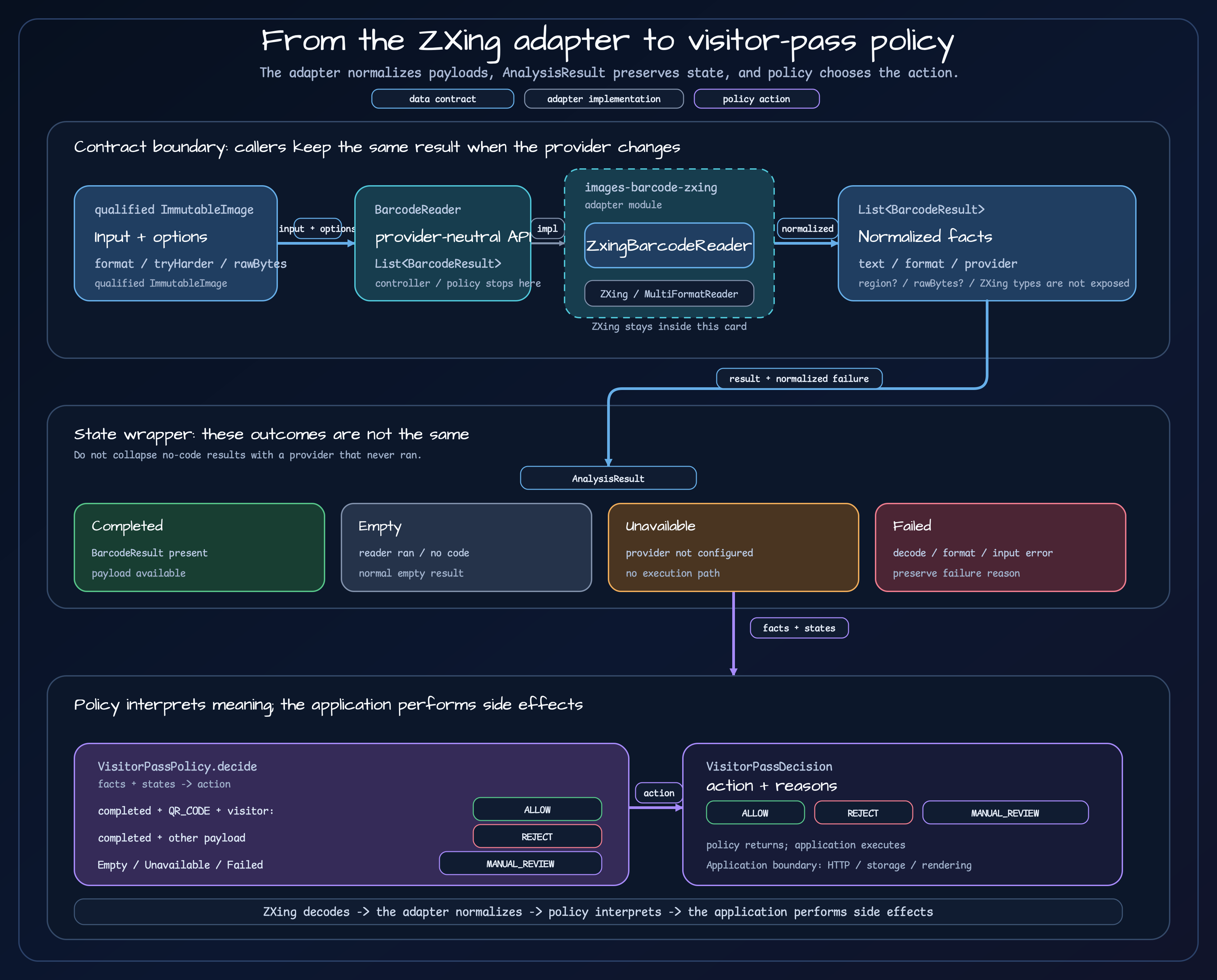
The important boundary is not a particular decoder. BarcodeReader returns provider-neutral facts, and
VisitorPassPolicy interprets those facts as business rules.
One image can carry different questions
Section titled “One image can carry different questions”The integrated example sends the same ImmutableImage to OCR, detection, and barcode paths. What they share is the input
and request lifetime, not the meaning of their results.
| Path | Representative result | Meaning of “nothing found” | Role of confidence |
|---|---|---|---|
| OCR | text, pageCount | No readable characters were found | May describe text or region quality, depending on the provider |
| Object detection | label, category, confidence, detector | No target object was found | A detector-reported score for policy to interpret |
| Barcode or QR | text, format, provider, optional region | No code was decoded | Often null because many decoders do not expose a stable score |
Do not concatenate a barcode result as if it were an OCR string, or turn “no code found” into “the image is invalid.” Preserve each analysis result as its own contract, then let the application decide whether a visitor pass is allowed or needs review.
Callers should know only BarcodeReader
Section titled “Callers should know only BarcodeReader”The provider-neutral API starts with a small BarcodeReader functional interface.
fun interface BarcodeReader { fun readBarcodes( image: ImmutableImage, options: BarcodeOptions, ): List<BarcodeResult>}Whether the implementation calls a blocking decoder, a native runtime, or a remote service, callers receive
BarcodeResult values. A coroutine path can use suspendExtractBarcodes with a selected dispatcher. If an application
replaces ZXing later, its controller and policy do not need to depend on ZXing types.
Extraction constraints live in BarcodeOptions.
val qrOptions = BarcodeOptions(    formats = setOf(BarcodeFormat.QR_CODE),    tryHarder = true,    includeRawBytes = false,)
val results = image.extractBarcodes(reader, qrOptions)
An empty formats set requests every format supported by the provider. tryHarder is a decoder hint, and
includeRawBytes is an opt-in for retaining raw payload bytes only when they are needed. minimumConfidence filters
results that have a score, but it keeps results whose confidence is null; many barcode libraries do not expose a stable
score.
A result is a bundle of decoding facts
Section titled “A result is a bundle of decoding facts”BarcodeResult keeps the facts callers need without requiring them to parse provider-specific strings again.
BarcodeResult( text = "visitor:PASS-001", format = BarcodeFormat.QR_CODE, provider = BarcodeProviderIdentity( name = "ZXing", version = "3.5.4", backend = "zxing-core", metadata = mapOf("decoder" to "MultiFormatReader"), ), region = BarcodeRegion( points = listOf( BarcodePoint(412.0, 188.0), BarcodePoint(628.0, 188.0), BarcodePoint(628.0, 404.0), ), coordinateSpace = BarcodeCoordinateSpace.PIXEL, ),)| Field | Contract |
|---|---|
text | A non-blank decoded payload such as visitor:PASS-001. |
format | A provider-neutral symbology such as QR_CODE, CODE_128, or EAN_13. |
provider | Diagnostic name, version, backend, and string metadata; it does not expose a provider object. |
region | Optional finder/result points and an optional bounding box, together with PIXEL or NORMALIZED coordinates. |
confidence, quality | Optional values populated only when the decoder provides them. Their absence is not a failure. |
rawBytes | An optional payload retained only when requested and available. |
rawBackendFormat, metadata | Backend format and string metadata that a normalized mapping might otherwise lose. |
The points in a BarcodeRegion do not have to form a closed polygon. A provider can return result points without a
bounding box; a box is added only when a positive width and height can be calculated from at least two points. Normalized
coordinates must stay within 0.0..1.0; pixel coordinates cannot be negative. These checks make the location safe for a
later renderer or policy to interpret. They are data constraints, not rendering instructions.
The public API choice must be kept separate from the library model. The current integrated example exposes only these
three fields in BarcodeResponse:
internal data class BarcodeResponse( val text: String, val format: BarcodeFormat, val provider: String,)The underlying BarcodeResult can contain region, confidence, and rawBytes, but the current HTTP response is
deliberately narrowed to text, format, and provider. Exposing a region in a public DTO is a separate API decision
that must consider display needs, privacy, payload size, and version compatibility. This article says that the library
model preserves a region; it does not claim that the current example returns one.
Use ZXing as the adapter
Section titled “Use ZXing as the adapter”ZXing is an open-source barcode image-processing library implemented in Java that
decodes multiple 1D and 2D formats. The images-barcode-zxing provider
used here maps ZXing text, formats, result points, bounding boxes, raw bytes, and metadata into the provider-neutral
BarcodeResult. ZXing decodes the payload; it does not decide whether a visitor pass is ALLOW or REJECT.
The integrated example’s barcode provider is a thin adapter that receives BarcodeReader and BarcodeOptions.
internal class ZxingBarcodeAnalysisProvider(    private val reader: BarcodeReader,    private val options: BarcodeOptions = BarcodeOptions(),    private val dispatcher: CoroutineDispatcher,) : BarcodeAnalysisProvider {    override val id: String = "zxing"
    override suspend fun analyze(image: ImmutableImage): List<BarcodeResult> =        image.suspendExtractBarcodes(reader, options, dispatcher)}
The concrete ZxingBarcodeReader uses the ZXing dependency only inside the images-barcode-zxing module. A format from
ZXing’s MultiFormatReader is mapped to BarcodeFormat, result points become a pixel BarcodeRegion, and the provider
identity records ZXing, its version, zxing-core, and MultiFormatReader as string metadata. The core API and Spring
service never need to know about ZXing’s Result or exception types.
The adapter also fixes the meaning of failures:
- A ZXing
NotFoundExceptionmeans that no code was found, so the reader returns an empty list. - Checksum, format, reader, and runtime decode errors become
BarcodeException(DECODE_FAILED). - If none of the requested formats is understood by ZXing, the reader returns
UNSUPPORTED_FORMAT. - Malformed image bytes can be normalized as
MALFORMED_INPUT.
“There was no barcode” and “the decoder could not run or decode” must not become the same exception or the same empty list.
Empty, Unavailable, and Failed are different responses
Section titled “Empty, Unavailable, and Failed are different responses”The integrated example wraps analysis in these states:
| State | Meaning | Barcode example |
|---|---|---|
Completed | The reader ran and returned one or more BarcodeResult values | A QR_CODE with visitor:PASS-001 |
Empty | The reader ran but found no code | The pass has no QR, or it is too small to decode |
Unavailable | The provider is not configured or cannot be used | No zxing bean or profile is available |
Failed | The reader ran but hit an input, decode, or runtime error | DECODE_FAILED, UNSUPPORTED_FORMAT |
The current public response can be summarized like this:
{ "status": "COMPLETED", "provider": "zxing", "items": [ { "text": "visitor:PASS-001", "format": "QR_CODE", "provider": "ZXing" } ], "reasonCode": null}When no code is found, the response is status: "EMPTY" with items: []. When the provider is missing it is
UNAVAILABLE with a reasonCode; when decoding fails it is FAILED with a reasonCode. If every case is serialized as
items: [], policy can no longer distinguish “there was no QR” from “the QR could not be checked.”
This is the same state-separation principle used for OCR in Part 3, but the business meaning of Empty depends on the
analysis type. An empty OCR result may mean no readable text, while an empty visitor-pass barcode result may mean that a
required access identifier is absent. A shared state wrapper does not make the final reason or action universal.
Decoding returns facts, not allow or reject
Section titled “Decoding returns facts, not allow or reject”Visitor-pass policy interprets part of the decoded value as a business rule.
private fun BarcodeResult.isVisitorQr(): Boolean =    format == BarcodeFormat.QR_CODE && text.startsWith("visitor:")
val barcodes = results.barcode.completedValue().orEmpty()if (results.barcode is AnalysisResult.Completed && barcodes.any { !it.isVisitorQr() }) {    return decision(VisitorPassAction.REJECT, "INVALID_VISITOR_QR")}
if (results.barcode is AnalysisResult.Failed || results.barcode is AnalysisResult.Unavailable) {    return VisitorPassDecision(VisitorPassAction.MANUAL_REVIEW, listOf("BARCODE_DEGRADED"))}
Decoding visitor:PASS-001 does not immediately produce ALLOW. The example policy first checks for sensitive regions
and rejects a completed barcode that is not a visitor QR. If OCR, detection, or barcode is Failed or Unavailable, it
chooses MANUAL_REVIEW instead of auto-approving. Only one face, one visitor QR, and non-blank OCR text together satisfy
the final ALLOW conditions.
BarcodeReader does not return REJECT or MANUAL_REVIEW. It preserves payload, format, provider, and region, then
normalizes execution state. HTTP status, original-image quarantine, QR expiry, the manual-review queue, and audit history
belong to the application. Keeping those responsibilities separate lets decoder replacement and visitor-pass policy
changes be tested independently.
What to verify in tests and operations
Section titled “What to verify in tests and operations”The current source and example support tests for these contracts:
- a no-code image returns
emptyList()instead of an exception; - requested format hints map to
BarcodeFormat; - decode and unsupported-format errors normalize to
BarcodeExceptionreasons; - provider identity and pixel regions survive in the result;
Empty,Unavailable, andFailedremain distinct in the public response and policy reasons;VisitorPassPolicydoes not auto-approve an invalid QR, a degraded lane, or a QR count mismatch.
The example does not promise the following:
| Not guaranteed | Application decision |
|---|---|
| A confidence or quality score from every provider | Threshold, recapture, and review rules when scores are absent |
| Multi-barcode results from every image | A decoder capability, result-order, and duplicate policy for multiple codes |
| A region in the current public DTO | Coordinate exposure, privacy, payload size, and API versioning |
| Production quality for ZXing | Provider versions, timeouts, process/native isolation, and observability |
The current ZXing path focuses on the single-result MultiFormatReader path. If an image must yield several codes, design
a separate multi-barcode capability and test contract. “Supports barcode” alone does not promise every symbology,
orientation, damage level, or duplicate-result behavior.
Continue the series
Section titled “Continue the series”Part 5 explains why OCR and barcode or QR paths need different result and empty-result contracts even when they start from the same image.
- Part 1: Extracting Multiple Signals from One Image
- Part 2: Qualify the Input Before Image Analysis
- Part 3: Connect OCR Results to the Combined Response
- Part 4: Separate Detection Facts from Processing Policy
- Part 5: A Barcode and QR Contract Unlike OCR
- Part 6: Turn Parallel Execution and Partial Failure into an API Contract
- Part 7: An Integrated Visitor-Pass Image Processing API
Part 6 will narrow parallel execution, cancellation propagation, and partial-failure aggregation into one response contract. Part 7 will connect input qualification, provider selection, and visitor-pass policy across the complete example.
Implementation and further reading
Section titled “Implementation and further reading”- Spring Boot Image Intelligence API README: the execution path from shared input qualification through OCR, detection, barcode, and visitor-pass policy
BarcodeReader.kt: the provider-neutral readerImmutableImageBarcodeExtensions.kt: blocking and suspend barcode-extraction extensionsBarcodeModels.kt: format, options, provider identity, region, and result contractsZxingBarcodeReader.kt: ZXing adapter and failure normalizationImageAnalysisProviders.kt: the example’s barcode-provider boundaryApiModels.kt: current publicBarcodeResponseand state wrapperVisitorPassPolicy.kt: policy that turns decoded facts into business actions- Operating an OCR service in production: native OCR and input/failure boundaries
This article is not a production barcode product or a promise of every decoder capability. It is a starting point for extending provider-neutral results and explicit states into application contracts.
Comments
Leave a note or reaction with your GitHub account.