
Separate Detection Facts from Processing Policy: The Boundary Between Facts, Actions, and Review
Suppose a visitor-pass image contains exactly one detected face. Is that enough to show the original image? Should the preview blur the face, should the original move to a quarantined area, or should a person review it first?
A face detection does not answer those questions. A detector reports what it observed in the image. Processing policy
interprets those facts in the context of business risk and input state. If both responsibilities are mixed into one class
or one result field, changing the model forces a policy rewrite, and changing the policy destabilizes the analysis
contract.
This article follows the visitor-pass scenario in the
bluetape4k-image Spring Boot Image Intelligence API.
Instead of repeating the OCR Completed, Empty, Unavailable, and Failed states from Part 3, it focuses on the
boundary required when that response’s detection result enters visitor-pass policy.
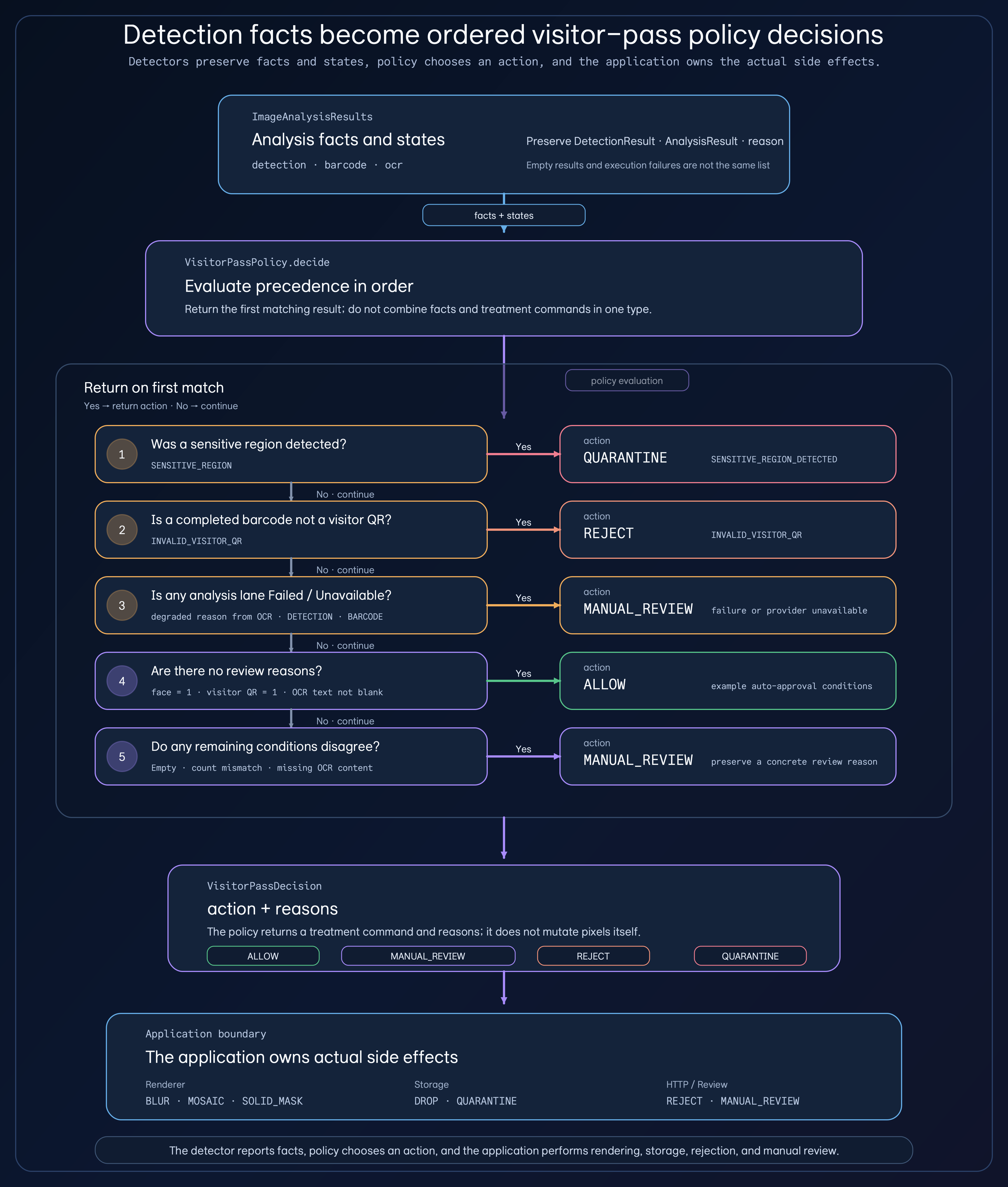
The rule is simple: the detector preserves facts, policy selects an action, and the application owns rendering, storage, rejection, and manual-review side effects.
A detector returns facts, not treatment commands
Section titled “A detector returns facts, not treatment commands”The integrated example’s detection boundary is ImageDetector. Given an image and DetectionOptions, it returns a list
of DetectionResult values.
fun interface ImageDetector { fun detect(image: ImmutableImage, options: DetectionOptions): List<DetectionResult>}The adapter may be a deterministic fake, a native-runtime or remote service, or a model-backed implementation. The core image module does not bundle a particular ML runtime or model manifest.
A single detection can be represented like this:
DetectionResult( label = "face", category = DetectionCategory.FACE, confidence = 0.96, detector = DetectorIdentity(name = "fixture-detector"), region = faceRegion,)The fields communicate the following facts:
| Field | Meaning |
|---|---|
label | A stable label exposed to callers |
category | A common category such as FACE, PERSON, OBJECT, TEXT, LOGO, LANDMARK, or SENSITIVE_REGION |
confidence | The 0.0..1.0 probability value reported by the detector |
detector | Adapter or model-family name, with optional version and backend metadata |
region | Optional rectangle, polygon, polyline, or raster-mask geometry |
rawBackendLabel | The label returned by the backend |
metadata | Runtime-neutral string metadata |
region can use original-pixel coordinates or normalized 0.0..1.0 coordinates. The mapping preserves the original
backend label while exposing a stable category, so applications can apply policy without parsing provider-specific
strings.
The important detail is what this model does not contain: a treatment command. DetectionResult says that a face was
reported in a region with a confidence value. It does not choose among BLUR, MOSAIC, REJECT, QUARANTINE, and
MANUAL_REVIEW. The comments in
ImageDetection.kt
keep detection facts and treatment actions as separate responsibilities.
Confidence is not a verdict
Section titled “Confidence is not a verdict”DetectionOptions is a deterministic filter for selecting detection results.
val options = DetectionOptions(    minimumConfidence = 0.80,    categories = setOf(DetectionCategory.FACE),    labels = setOf("face"),)
val faces = image.detectRegions(detector, options)
It removes results below minimumConfidence and can apply category and label conditions. This is a boundary that narrows
the result set requested by the caller; it is not a guarantee of detector accuracy.
Two error modes still remain:
- False positive: a non-face region can be reported as a face.
- False negative: an actual face or sensitive region can be missed.
The same 0.80 threshold carries different risk for a visitor-pass preview, original-image storage, and an access
approval path. Application policy must therefore decide the threshold, whether to request a new capture, when to require a
second person, and which fallback is conservative. Returning confidence does not automatically grant approval.
The detection module verifies confidence, category, and label filters plus pixel/normalized geometry conversion in
ImageDetectionTest.kt.
Those tests prove the filter and coordinate-conversion contracts, not the real-world accuracy of a particular ML model or
the risk level of a business route.
VisitorPassPolicy turns facts into a business decision
Section titled “VisitorPassPolicy turns facts into a business decision”The visitor-pass example sends OCR, detection, and barcode results to VisitorPassPolicy after all analysis paths have
reported their states. The policy is a separate stage in the integrated service, not part of an analysis adapter.
Its example decision order is:
| Condition checked first | Example action | Reason |
|---|---|---|
SENSITIVE_REGION detected | QUARANTINE | Classify input containing a sensitive region as requiring isolation. |
| A completed barcode is not a visitor QR | REJECT | Reject a value that violates the visitor-pass identifier contract. |
OCR, detection, or barcode is Failed or Unavailable | MANUAL_REVIEW | Do not auto-approve when facts are missing or a provider is unavailable. |
| Exactly one face, exactly one visitor QR, and valid OCR | ALLOW | All example conditions for automatic approval are satisfied. |
| Any other empty result or count mismatch | MANUAL_REVIEW | Leave the case for review instead of declaring that the detector was wrong. |
The precedence can be reduced to this core path:
val detections = results.detection.completedValue().orEmpty()if (detections.any { it.category == DetectionCategory.SENSITIVE_REGION }) {    return decision(VisitorPassAction.QUARANTINE, "SENSITIVE_REGION_DETECTED")}
val barcodes = results.barcode.completedValue().orEmpty()if (results.barcode is AnalysisResult.Completed && barcodes.any { !it.isVisitorQr() }) {    return decision(VisitorPassAction.REJECT, "INVALID_VISITOR_QR")}
val degradedReasons = buildList {    addDegradedReason(results.ocr, "OCR")    addDegradedReason(results.detection, "DETECTION")    addDegradedReason(results.barcode, "BARCODE")}if (degradedReasons.isNotEmpty()) {    return VisitorPassDecision(VisitorPassAction.MANUAL_REVIEW, degradedReasons)}
If the face count, visitor-QR count, and OCR content all satisfy the final conditions, the policy returns ALLOW.
Otherwise it returns MANUAL_REVIEW with specific reasons. This order is a rule for the visitor-pass example, not a
universal policy to copy into address masking for shipping labels or mandatory-display checks for product labels.
See the complete implementation in
VisitorPassPolicy.kt.
Do not collapse Empty and Failed into the same empty list
Section titled “Do not collapse Empty and Failed into the same empty list”An empty detection result and a detector that could not produce a result are different facts.
| Detection state | Actual meaning | Example visitor-pass reason |
|---|---|---|
Completed + empty list | The detector ran but found no target | FACE_COUNT_REQUIRES_REVIEW |
Failed | A timeout or provider exception prevented a result | DETECTION_FAILED |
Unavailable | The detector provider is not configured or cannot be used | DETECTION_UNAVAILABLE |
If both states serialize as regions: [], policy cannot distinguish “no face was found” from “the face could not be
checked.” The example tests pin that difference directly:
val empty = policy.decide(results(detection = empty("detector")))val failed = policy.decide(results(detection = failed("detector")))
empty.reasons shouldBeEqualTo listOf("FACE_COUNT_REQUIRES_REVIEW")failed.reasons shouldBeEqualTo listOf("DETECTION_FAILED")
If OCR or barcode fails, the detection results already obtained are not discarded. This connects to the integrated contract from Part 3 and the parallel-failure contract planned for Part 6. Policy is not recovering a partial result here; it is reading the preserved state as an input to a business decision.
Blur, mosaic, reject, quarantine, and manual review are action contracts
Section titled “Blur, mosaic, reject, quarantine, and manual review are action contracts”The moderation model in bluetape4k-images provides a separate contract between detector facts and treatment actions.
Representative actions that policy can select include:
SensitiveTreatmentAction.ALLOWSensitiveTreatmentAction.MOSAICSensitiveTreatmentAction.BLURSensitiveTreatmentAction.SOLID_MASKSensitiveTreatmentAction.DROPSensitiveTreatmentAction.REJECTSensitiveTreatmentAction.QUARANTINESensitiveTreatmentAction.MANUAL_REVIEWBLUR does not mean that pixels have already been blurred. It is a decision that the policy selected blur treatment.
SensitiveTreatmentParameters can carry renderer-neutral values such as blurRadius, blurSigma,
mosaicBlockSize, maskOpacity, reviewPriority, and rejectReason.
SensitiveTreatmentParameters( blurRadius = 12.0, blurSigma = 3.0, metadata = mapOf("renderer" to "local-blur"),)The policy module does not run detector inference or render pixels. After it selects BLUR, the application boundary
must decide which renderer to call, where to store the original, which HTTP contract represents REJECT, and what
metadata enters the manual-review queue.
SensitiveModerationPolicy selects the first matching rule for each detection. When several decisions exist, it records
the result selected by action precedence, level, and confidence in the report. For an unknown category or a category with
no matching rule, the failClosed factory can use a fallback rule that selects QUARANTINE.
That fail-closed fallback is not a global default every service must adopt. The application must make explicit, based on data classification and route risk, which inputs are isolated automatically, sent to manual review, or returned for a new capture.
Read the detailed model and policy contracts in
SensitiveContentModels.kt
and
SensitiveContentPolicy.kt.
The provider and policy do not need to ship together
Section titled “The provider and policy do not need to ship together”The integrated example’s demo profile uses fixture providers with fixed OCR and detection results, while the QR path
runs the real ZXing provider. The purpose is not to imitate an ML model. It is to reproduce these boundaries:
- Passing the same
ImmutableImageto each provider - Preserving detector facts in the integrated response as
detection.regions - Giving
VisitorPassPolicyfacts and other analysis states from which to select an action - Keeping provider absence or failure as policy input instead of hiding it
Therefore confidence = 0.99 in the demo is not a production-detector quality metric. A real application must own the
ImageDetector adapter, model version, quality measurement, drift monitoring, provider timeout, and process isolation
separately. Replacing a detector can preserve the policy input contract, and replacing visitor-pass policy with shipping-
label policy does not require rewriting the detector runtime.
What this boundary guarantees—and what it does not
Section titled “What this boundary guarantees—and what it does not”| Boundary provided by the example | Decisions still owned by the application |
|---|---|
Preserve label, category, confidence, geometry, and detector in DetectionResult | Model selection, training, accuracy targets, and drift response |
Filter confidence, category, and label with DetectionOptions | Threshold tuning, false-positive/false-negative cost, and route risk |
Convert facts to ALLOW, REJECT, QUARANTINE, or MANUAL_REVIEW in VisitorPassPolicy | Actual HTTP rejection, storage quarantine, review queue, and audit history |
| Return moderation actions and renderer-neutral parameters | Blur, mosaic, and mask renderers plus original-image access control |
| Provide reproducible tests with fake providers | Production ML runtime, GPU/native operations, and performance targets |
This is why analysis results and business policy should not be combined into one type. A detector adapter owns the shape and quality of facts; policy owns how those facts become a business decision. Keeping the boundary lets model replacement, policy changes, and security review remain separate changes.
Continue the series
Section titled “Continue the series”Part 4 explains the boundary that passes detection facts from the integrated response into business policy.
- Part 1: Extracting Multiple Signals from One Image
- Part 2: Qualify Before You Analyze
- Part 3: Connect OCR Results to the Combined Response
- Part 4: Separate Detection Facts from Processing Policy
- Part 5: A Barcode and QR Contract Unlike OCR
- Part 6: Turn Parallel Execution and Partial Failure into an API Contract
- Part 7: An Integrated Visitor-Pass Image Processing API
Part 5 will explain why QR and barcode paths have result and empty-result contracts that differ from OCR. Part 6 will narrow parallel execution, cancellation propagation, and partial-failure aggregation into one response contract.
Implementation and further reading
Section titled “Implementation and further reading”- Spring Boot Image Intelligence API README: the full execution path from shared input validation through three analysis paths, partial results, and visitor-pass policy
ImageDetection.kt:ImageDetector,DetectionResult, geometry, and filtering contractsVisitorPassPolicy.kt: application policy that turns visitor-pass facts into actions and reasonsVisitorPassPolicyTest.kt: sensitive-region precedence, invalid QR, degraded lane, empty versus failed detection, and allow conditionsSensitiveContentPolicy.kt: action precedence and fail-closed fallback- Operating an OCR service in production: native OCR and input/failure boundaries
This article is not a complete production ML detector or privacy-processing product. It is a starting point for extending the example’s facts, policy, and tests into explicit application contracts.
Comments
Leave a note or reaction with your GitHub account.