
Usage Billing Part 3: Microservices, Outbox, and Inbox

Part 1 kept idempotency, occurrence-time pricing, resumable close, and the immutable ledger in one PostgreSQL database. Part 2 made the Event Store the system of record and explained replay and projection rebuilding.
Now assume pricing, usage acceptance, rating, invoicing, and queries must deploy independently. Five databases alone do not solve the problem. A business effect and the notification that triggers the next service can no longer share one database transaction.
This article uses the
bluetape4k-workshop usage-billing microservice composition
to explain service ownership, Outbox and Inbox, at-least-once delivery, reordered versions, and poison-event recovery. It does
not claim end-to-end exactly once. It ensures that each service retains enough durable evidence to detect and recover from
duplicates and partial failure.
Split by data ownership, not by feature count
Section titled “Split by data ownership, not by feature count”Each service owns its PostgreSQL database and integration decoder. No service reads another service’s tables.
Start with the deployment view. All five services run independently on Spring Boot 4 and a Java 25 runtime, and each uses an Exposed repository to modify only its own PostgreSQL database. Kafka transports published events to downstream services, but it does not own financial records. When delivery stops, each service can still decide processing state from its local Inbox, Outbox, and business records.
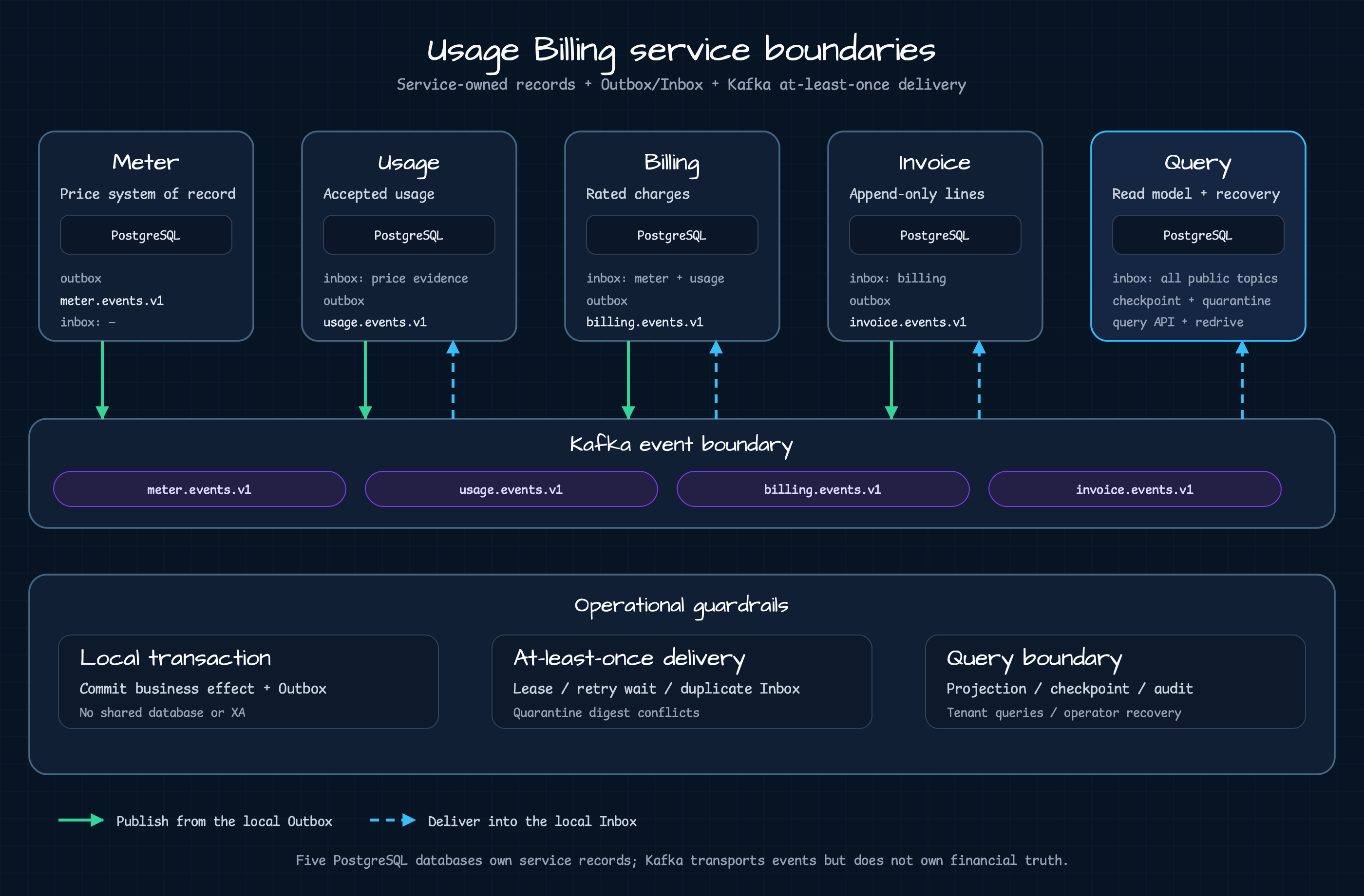
| Service | Durable system of record | Input | Published fact |
|---|---|---|---|
| Meter | Immutable price versions and command receipts | ActivatePriceCommand | PriceActivated |
| Usage | Usage facts and accepted price evidence | PriceActivated, AcceptUsageCommand | UsageAccepted |
| Billing | Replicated price evidence and immutable charges | PriceActivated, UsageAccepted | ChargeRated, AdjustmentPosted, BillingPeriodClosed |
| Invoice | Immutable invoice lines and source-event links | ChargeRated, AdjustmentPosted | InvoiceIssued, InvoiceCorrectionIssued |
| Query | Inbox, projections, checkpoints, quarantine, redrive audit | Public events from the other services | Tenant summaries and recovery diagnostics |
Meter owns original prices, but Billing does not query Meter synchronously while rating usage. It consumes PriceActivated,
stores local evidence, and rates only from that evidence. This prevents a temporary network fault from enclosing the entire
billing operation, while adding responsibility for delayed or missing replicas.
The interactive visualization shows each service’s Inbox, Outbox, and recovery steps in more detail.
Commit the local effect and Outbox together
Section titled “Commit the local effect and Outbox together”Writing local state and then failing to send to Kafka leaves the next service unaware of a successful operation. Sending first and then rolling back local state publishes a fact that never existed. The Outbox closes this gap by committing the business effect and its event in one local transaction.
transaction {    receipt = commandReceipts.acquire(command.idempotencyKey, command.fingerprint)    if (receipt is Replay) return receipt.savedResult
    priceVersion = prices.append(command)    envelope = PriceActivated.from(priceVersion)    outbox.append(envelope, state = PENDING)    commandReceipts.complete(receipt.ownerToken, resultFor(priceVersion))}
The publisher claims a PENDING row with a lease and owner token, sends it, and records PUBLISHED only with that token. A
transport failure moves it to RETRY_WAIT. If Kafka accepts the event immediately before the process stops, the local row may
remain CLAIMED; its lease expires and the same event is sent again. Duplicate delivery is the normal recovery path.
Inbox distinguishes a duplicate from a conflict
Section titled “Inbox distinguishes a duplicate from a conflict”A consumer decides (tenantId, eventId, payloadDigest) before changing business data.
transaction {    decision = inbox.decide(        tenantId = envelope.tenantId,        eventId = envelope.eventId,        payloadDigest = envelope.payloadDigest,        aggregateVersion = envelope.aggregateVersion,    )
    when (decision) {        APPLIED -> {            localEffect.apply(envelope)            outbox.append(nextEvent(envelope))        }        DUPLICATE -> Unit        DEFERRED -> scheduleAfterMissingVersion(envelope)        QUARANTINED -> recordPermanentFailure(envelope)    }}
The same ID and digest is DUPLICATE; it can complete successfully without applying money twice. The same ID with a different
digest is a correctness conflict: either the producer reused an identity for different content or the payload changed in
transit. It must be QUARANTINED.
| Inbox result | Meaning | Next action |
|---|---|---|
APPLIED | First valid event with all prerequisites | Commit the local effect and next Outbox event together |
DUPLICATE | Same ID and digest, or an already applied older version | Finish without creating new money |
DEFERRED | Price evidence or a prior aggregate version is missing | Retry after the prerequisite arrives |
QUARANTINED | Same ID with another digest, or a permanent contract error | Isolate it from healthy traffic and record an operator case |
Wait for reordered versions instead of guessing
Section titled “Wait for reordered versions instead of guessing”Kafka can preserve order for a key within a partition, but it cannot prove ordering across every redrive, topic migration, and
operator action. When aggregate version 2 reaches Billing before version 1, the example returns DEFERRED; it does not rate
with guessed state.
After the missing version arrives, the same Inbox record can be decided again. Skipping a version or rating with the current price removes the evidence needed to determine which amount is correct later. Observe aggregate key, expected version, received version, and gap age together.
Route transient faults and permanent contract errors differently
Section titled “Route transient faults and permanent contract errors differently”If every exception is retried through Kafka, one unprocessable event can block a partition forever. If every exception is quarantined, a temporary database outage becomes a manual incident.
| Failure | Classification | Automatic protection | Recovery |
|---|---|---|---|
| Kafka send failure or temporary database error | Transient | Preserve Outbox as RETRY_WAIT or propagate for redelivery | Retry the same event from local durable state |
| Service process restart | Transient | Preserve Inbox, Outbox, pricing evidence, and checkpoint in PostgreSQL | Resume after lease expiry from persisted state |
| Aggregate version gap | Ordering wait | Block rating as DEFERRED | Re-evaluate after the prior version arrives |
| Unsupported event type or schema, missing required field | Permanent contract error | Quarantine the event while unrelated valid records continue | Repair decoder, upcaster, or producer contract, then redrive |
| Same event ID with another digest | Consistency conflict | Isolate before applying the business effect | Compare the producer record with an external retained source |
Query’s redrive API does not edit or recreate the source event. It records the operator, correlation ID, and requested action. An external retained source must provide the immutable original envelope for actual replay. This prevents a “recovery” from rewriting a financial fact.
Delivery success is not the recovery gate
Section titled “Delivery success is not the recovery gate”An empty Outbox after broker connectivity returns is insufficient. Verify the complete boundary:
- Identify the affected topics, tenants, aggregate keys, and event IDs.
- Inspect each service’s Outbox backlog, oldest retry, Inbox result, and quarantine reason.
- Retry transient faults with the existing Outbox row and envelope; isolate permanent faults from healthy events.
- Verify that every deferred version gap closes and checkpoints reach the target position.
- Reconcile Usage facts, Billing charges, Invoice lines, and Query totals by source event ID.
- Declare recovery complete only after quarantine and redrive audit are closed and new lag remains within its target.
Do not delete Outbox rows to make the backlog zero, edit Inbox state to APPLIED, or mutate charges and invoice lines. When
money needs correction, append AdjustmentPosted and a new invoice correction line linked to the original event.
Microservices are close to the last option
Section titled “Microservices are close to the last option”If independent deployment, ownership, and scaling boundaries are not required, Part 1’s single PostgreSQL ledger is simpler. If historical replay and multiple projections matter without service separation, Part 2 may be the better fit.
Five services require the team to operate topics, lag, schema compatibility, Outbox, Inbox, quarantine, redrive, and cross-service reconciliation. Distribution does not justify that cost by itself. Choose it when the organization truly owns, deploys, and recovers those data boundaries independently.
Continue the series
Section titled “Continue the series”- Usage Billing Part 1: Duplicate Ingestion, Resumable Closing, and the Ledger
- Usage Billing Part 2: Event Sourcing, Replay, and Projection Operations
- Usage Billing Part 3: Microservices, Outbox, and Inbox
- Usage Billing Part 4: Detection, Isolation, Reprocessing, and Reconciliation
- Integrated interactive visualization
Part 4 will combine the failure handling from all three architectures into one operational runbook: what to retry, what to isolate, when to replay, rebuild, or adjust, and which evidence permits traffic to resume.
Implementation and related resources
Section titled “Implementation and related resources”- Usage-billing microservice composition README: Service ownership, staged extraction, executable failure scenarios, and their operational meaning.
- Original service-boundaries diagram: The service, database, and Kafka boundaries preserved by this article’s dark overview.
MeterCommandService.kt: Commits price version, command receipt, and Outbox in one local transaction.BillingInboxService.kt: Decides duplicates, digest conflicts, version gaps, and local charge creation.QueryRecoveryService.kt: Shows the audited redrive request boundary without mutating source events.BrokerPathRecoveryIntegrationTest.kt: Cuts the single-broker TCP path with Toxiproxy and verifies delivery of the same Outbox row after recovery.PoisonIntegrationTest.kt: Verifies permanent-error isolation, continued healthy processing, and redrive auditing.

Comments
Leave a note or reaction with your GitHub account.