
[Operations 10] Apply Only the Latest Calculation to an Appointment

A solver may take long enough for the clinic facts behind it to change. A doctor absence can be added, equipment availability can be revised, or a new scheduling-policy generation can become active while the solver is still running. Saving the result just because it finished later can let an older calculation overwrite a newer appointment state.
“Latest” is not a wall-clock claim here. It means that the source version used to calculate the result still equals the source version observed when the service is about to apply it. If the versions differ, the safe result is to discard the old calculation, schedule a new one, or leave the item for operational review.
The conclusion is simple:
The solver creates a scoped snapshot, a
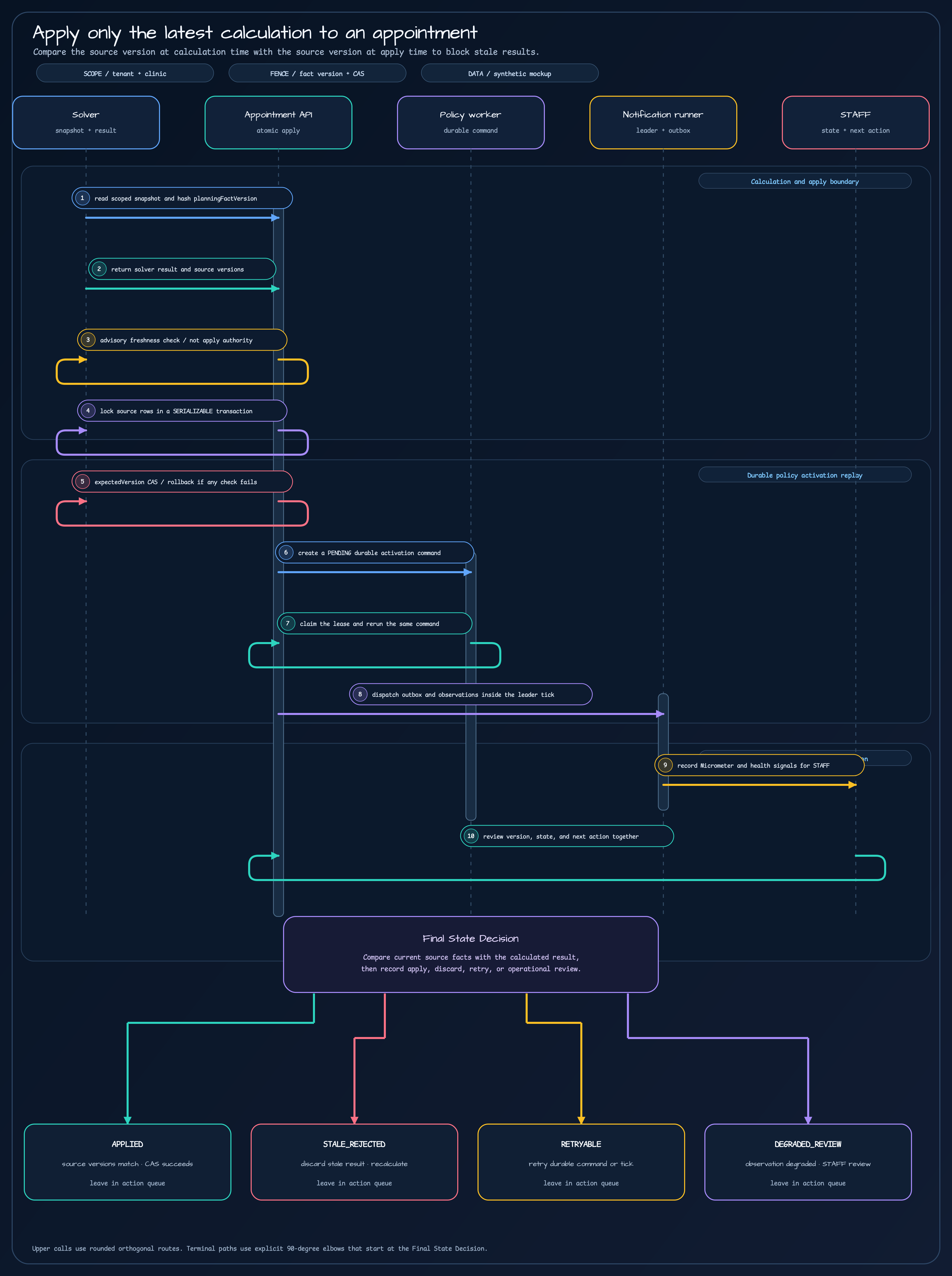
planningFactVersion, and appointmentsourceVersions. The API’s freshness check is advisory only.applyOptimizedAssignmentsis the authority: it opens aSERIALIZABLEtransaction, locks the source rows, and performs expected-version CAS updates. Policy activation uses aPENDINGdurable command and a lease for safe replay. Notification work keeps outbox dispatch, leader ticks, Micrometer, and health signals separate. Every path ends in an explicit Final State Decision: apply, stale rejection, retry, or operational review.
The diagram and operations screen are synthetic design visuals, not captures of patient or clinic data. They separate the concurrency boundaries implemented in the repository from SLOs, failure drills, and runbooks that still need production validation.
“Latest” means matching source versions, not a later finish time
Section titled ““Latest” means matching source versions, not a later finish time”Suppose the solver reads Monday’s doctor schedules and equipment facts, then starts searching. A maintenance interval is registered before the search finishes. The returned schedule may have an excellent score, but it is no longer a result for the current rules.
The implementation carries the distinction in three values:
| Value | Meaning | When it is checked |
|---|---|---|
planningFactVersion | A normalized digest of the clinic, doctor, equipment, closure, and time-slot facts read by the solver | When the result is created |
sourceVersions | The versions of the appointment source rows included in the result | When the result is created and immediately before apply |
| Current snapshot | A fresh digest loaded inside the apply transaction | At the apply boundary |
PlanningFactVersionHasher does not depend on database iteration order or toString(). It writes typed fields and collections in a
canonical order before calculating SHA-256. The same facts produce the same version; an added, changed, or removed fact changes it.
Null, empty, and valued fields are framed differently. This is evidence that the calculation inputs are the same, not a guessed
sequence number for “newest.”
The advisory check is a signpost; the fence owns the write
Section titled “The advisory check is a signpost; the fence owns the write”SolverService.isSourceVersionCurrentAdvisory tells a caller whether the current snapshot and appointment versions match the result.
That answer is useful for a dashboard, but it is not a write permission: another writer can consume a version after the check returns.
The write path is applyOptimizedAssignments:
transaction(transactionIsolation = Connection.TRANSACTION_SERIALIZABLE) {    val current = loadSnapshotInCurrentTransaction(scope, dateRange)    if (current.planningFactVersion != result.planningFactVersion) {        throw StaleSolverResultException    }
    appointmentRepository.lockLegacySourceVersions(scope, result.sourceVersions)
    result.appointments.forEach { appointment ->        val applied = appointmentRepository.updateLegacyAssignment(            scope = scope,            appointmentId = appointment.id!!,            expectedVersion = result.sourceVersions[appointment.id]!!,            doctorId = appointment.doctorId,            appointmentDate = appointment.appointmentDate,            startTime = appointment.startTime,            endTime = appointment.endTime,        )        if (!applied) throw StaleSolverResultException    }}
The order matters:
- Reload the scoped snapshot inside the transaction.
- Reject the result if its
planningFactVersiondiffers. - Lock the source rows and reload the snapshot again. A competing writer may have won while the lock was being acquired.
- Apply every appointment with an expected version. One failed CAS rolls the whole transaction back and returns
false.
So true from the advisory check means only “the values matched at that instant.” Apply authority exists only after lock, recheck, and
CAS succeed together. Without that separation, two solver results that finish close together can overwrite each other in the wrong
order.
A stale result is a reason to recalculate, not a generic failure
Section titled “A stale result is a reason to recalculate, not a generic failure”When a version fence rejects a result, the system has safely refused to write an old calculation. Calling that a generic outage can lead STAFF to retry the same result, which is exactly the unsafe action the fence prevented.
The operations view should show at least:
- the result’s
planningFactVersionbeside the current snapshot version; - how many source appointment versions were checked and whether any CAS failed;
- tenant, clinic, and date range;
- calculation time, apply time, solve duration, and feasibility;
- why “discard and recalculate” is allowed and what the last attempt returned.
A good score is not enough. It describes the quality of the calculated plan, not whether the plan still describes the current clinic facts. STAFF should see the version comparison before the score.
Policy activation is a durable command, not an in-memory task
Section titled “Policy activation is a durable command, not an in-memory task”Policy activation has the same race. A person may schedule a policy while another draft or generation changes before the effective time. Running an in-memory task could activate an old draft or preview.
SchedulingPolicyCommandService.schedule validates approvals and preview evidence, then persists a PENDING durable activation
command. The command records scope, definition revision, expected active revision, tenant and clinic generations, preview evidence,
and the next attempt time. A worker restores execution from this row instead of trusting an HTTP payload or process memory.
executeClaimedScheduled claims a due command with a lease and rechecks the following values:
| Value | If it is stale |
|---|---|
Command state and nextAttemptAt | Skip it until it is due |
| Definition revision and lifecycle | Return an idempotent completion or a stale result |
| Tenant and clinic generation | Do not activate over a newer policy change |
| Preview evidence token | Fail closed when it is incomplete or points to another revision |
| Lease owner and expiry | Never overwrite another worker’s claim |
Successful activation updates the scope head and generation, completes the command, and publishes its outbox event in one transaction.
Re-reading the same command returns its completed result instead of incrementing the generation twice. STALE, FAILED, CANCELLED,
and MISSED remain different operational states; “retryable” and “someone must investigate” are not one button.
Notification work needs boundaries before it needs more retries
Section titled “Notification work needs boundaries before it needs more retries”The notification module does not hide every responsibility inside one scheduler. Each runner has a separate boundary:
| Work | Current boundary | What STAFF reads |
|---|---|---|
| Outbox dispatch | Bounded dispatchOnce() every second and an immediate application-ready tick | pending count, oldest active age, delivery attempts |
| Observation refresh | A separate snapshot refresh every ten seconds | provider/member circuit and backlog age |
| Reminder recovery | The full triggerOnce() wrapped in a leader action; tick failures are absorbed | leader acquisition and recovery outcome |
| Retention | Bounded hourly cleanup with success/failure health signals | old rows and retention failures |
Leader election reduces duplicate work but is not the only authority. The leader wraps the action; database leases and fencing still decide which worker may claim and complete an outbox row. A Redis lock must not replace the database lease.
NotificationOutboxMetrics records pending, oldest active age, delivery attempts and latency, retries, suppressions, exhausted work,
recovered leases, and reminder recovery with Micrometer. NotificationOutboxHealthIndicator distinguishes schema, claim, and key-ring
problems that affect readiness from provider circuits, backlog age, and retention failures that should be read as degraded operation.
That separation prevents a delayed notification observation from being misread as an appointment-application failure.
One action-queue row needs version evidence and a next action
Section titled “One action-queue row needs version evidence and a next action”“Three stale results” is not enough information for STAFF. Each action-queue row needs the calculation or policy version, current version, state, and next action. Patient names and raw payloads are not required for that decision and should remain hidden.
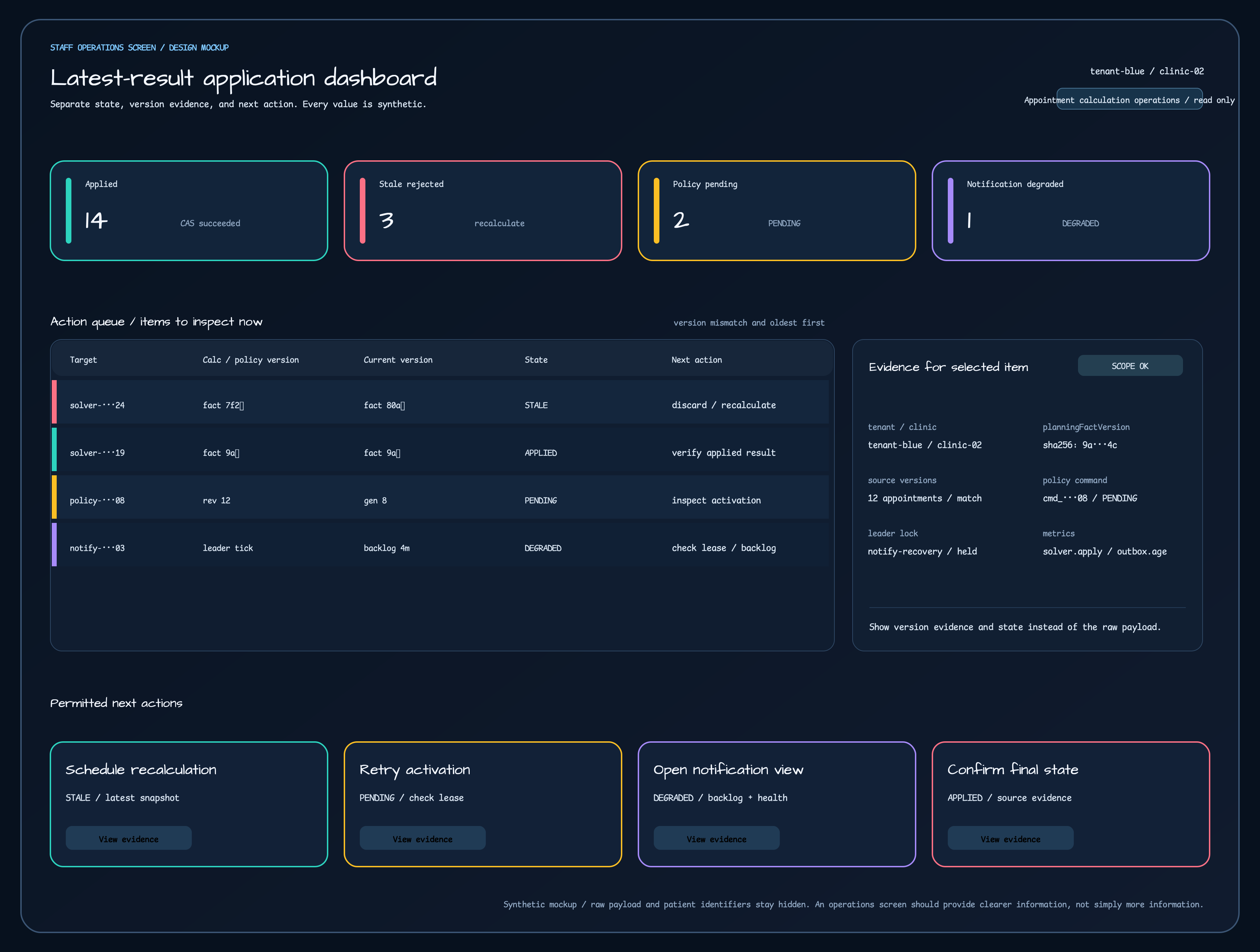
Synthetic data only. The queue separates an applied row, a stale result to recalculate, a durable command to inspect, and a notification observation to investigate. An operations screen should provide clearer information, not simply more information.
Read the states this way:
| State | What the system has done | STAFF’s next action |
|---|---|---|
APPLIED | Source snapshot matched and every CAS succeeded | Verify the applied result and audit record |
STALE_REJECTED | Rolled back and stored no old result | Schedule a calculation from the latest snapshot |
RETRYABLE | Kept evidence for a durable command or notification tick retry | Inspect lease, next time, and failure code |
DEGRADED_REVIEW | Provider circuit, backlog, or retention observation is degraded | Open notification evidence and health details |
These states cannot substitute for one another. Turning STALE_REJECTED into RETRYABLE can retry the same old result, while treating
DEGRADED_REVIEW as an appointment failure can roll back a valid appointment because notification observation was delayed. The screen
must explain both why the state exists and which action is allowed now.
Read implementation and operational readiness separately
Section titled “Read implementation and operational readiness separately”The current evidence divides into these boundaries:
| Category | What is verified here |
|---|---|
| Implemented now | The solver canonicalizes planning facts, creates a version, and returns source versions with the result |
| Implemented now | Advisory freshness is separate from serializable transaction, source locking, and expected-version CAS application |
| Implemented now | Policy activation uses PENDING durable commands, leases, revision/generation/preview checks, and idempotent completion |
| Implemented now | Outbox dispatch, reminder leader action, observation refresh, retention, Micrometer, and health signals are separate |
| Requires production proof | Recovery time, SLOs, alert thresholds, and rollback behavior during real PostgreSQL, Redis, broker, and provider failures |
| Still needs an operations runbook | STAFF drills for stale-result recalculation, policy activation replay, and degraded notification observation |
Passing local tests does not automatically prove production readiness. An external provider also means the appointment service cannot promise exactly-once delivery by itself. The screen and runbook should keep “implemented” and “awaiting production proof” as different states.
Five questions before the Final State Decision
Section titled “Five questions before the Final State Decision”Before STAFF presses an action button, the screen should answer:
- Does the tenant, clinic, and date range match the selected operations scope?
- Are the calculation-time
planningFactVersionand current snapshot version visible side by side? - Did another writer consume any appointment source version, and if so, was the whole apply rolled back after a CAS failure?
- For a policy command, do the definition revision, generation, preview evidence, and lease owner describe the same execution?
- For a notification issue, did STAFF inspect provider circuit, backlog age, retention failure, and leader-tick evidence separately from appointment application?
If any answer is missing, leave the item in DEGRADED_REVIEW instead of pressing apply, activate, or retry immediately. Reliability comes
from explaining which result was not applied and what must be checked next.
Sources
Section titled “Sources”- Operations 9: Retries and Replay Must Change an Appointment Only Once
- Operations 8: Data Boundaries for Running Multiple Clinics in One Appointment Service
- Operations 6: Why Notifications and Reminders Are Separate Services
- Implementation 4: Real-Time Slot Search and Global Optimization Solve Different Problems
SolverService.ktPlanningFactVersionHasher.ktSchedulingPolicyCommandService.ktSchedulingPolicyPreviewService.ktNotificationSchedulingRunners.ktNotificationOutboxMetrics.ktNotificationOutboxHealthIndicator.kt- Production hardening readiness design
- Leader and Micrometer boundary design
Comments
Leave a note or reaction with your GitHub account.