
[Design 4] Why a Package Product Becomes an Execution Graph

It is easy to describe a package product as “a discounted bundle of consultation, examination, treatment, and follow-up care.” That model breaks as soon as the first booking is attempted. One item may have to finish before another starts. Some items can share a visit, while others must happen on separate days even though they belong to the same product. Each item can also require a different practitioner, device, room, and preparation, treatment, or recovery interval.
In the previous article, Patient A bought an N-visit product, confirmed one visit, and kept tracking the remaining fulfillment obligations. This time, the same Patient A buys a package that follows consultation → examination → treatment → follow-up. The names and clinic policies are generalized; the article keeps the scheduling behavior that matters.
Product list ≠ product BOM ≠ visit commitment
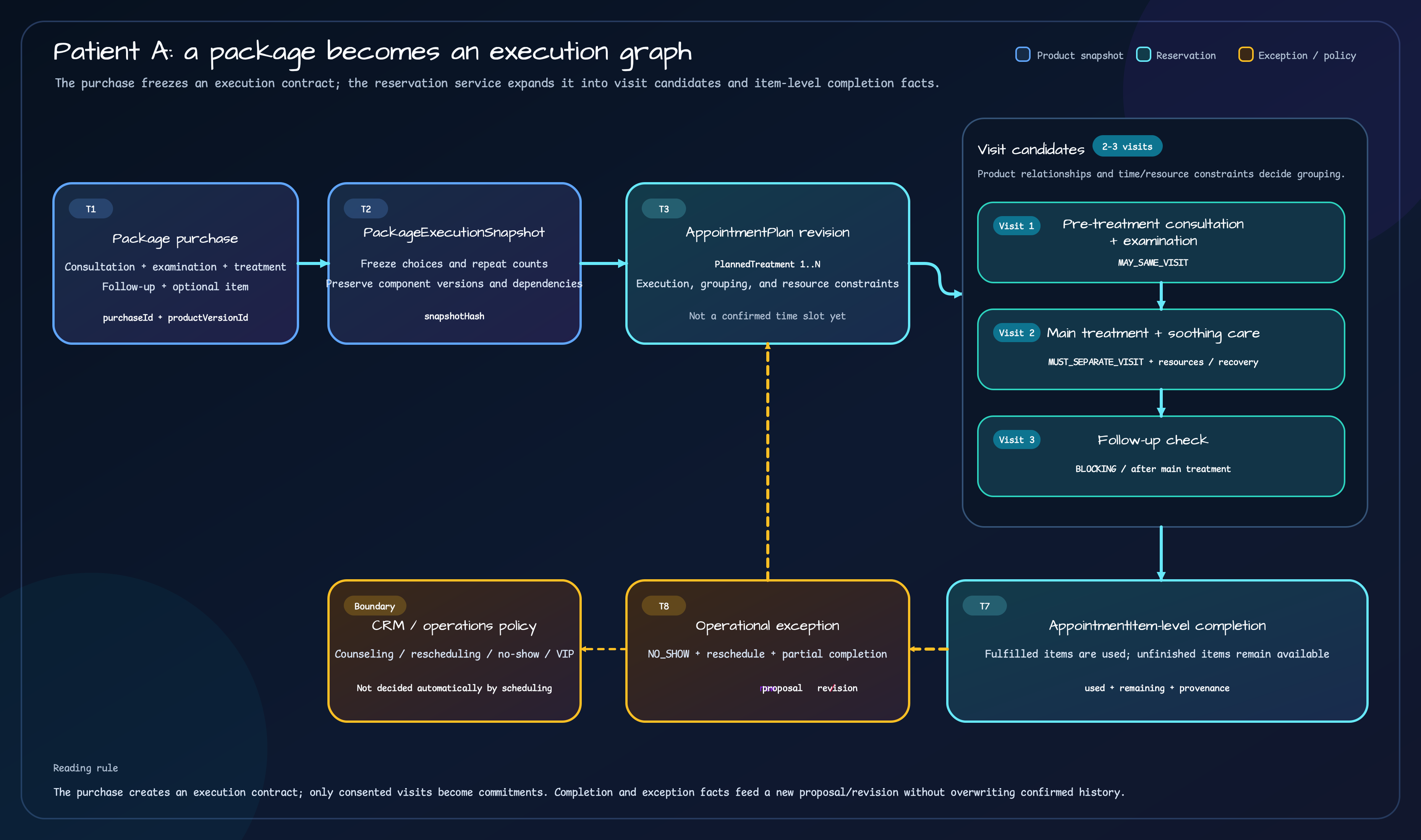
The package definition from product development is not data that the appointment service can write directly to a calendar. The purchase must first freeze its choices and product versions, then expand them into executable items and relationships. The result becomes an AppointmentPlan and its PlannedTreatment records. One visit agreed by the patient and clinic is a group of selected AppointmentItem records from that plan.
A product list stops at the first booking
Section titled “A product list stops at the first booking”Assume Patient A’s package follows the timeline below. The names and relationships are an anonymized business example based on the published package companion, not a real clinic’s treatment schedule or operating threshold.
| Time | Patient A’s action or event | Business meaning | What the appointment service preserves |
|---|---|---|---|
| T1 | Buys the package | A contract to use several component products exists | Purchase ID and package/component product versions at purchase time |
| T2 | Choices and repetition counts are fixed | The system has an execution contract, not a promise to read the latest catalog later | Selected component versions and a product BOM snapshot |
| T3 | A purchase-completed event arrives | Input for translating the product graph into an appointment plan | Event producer, schema version, and snapshot hash |
| T4 | The plan is expanded | Treatment obligations and predecessor relationships become explicit | AppointmentPlan, PlannedTreatment, and dependencies |
| T5 | Possible visits are proposed | Resource capacity and intervals decide what can share a visit | AppointmentProposal and per-item resource candidates |
| T6 | Patient and clinic agree on a schedule | A specific time, set of items, and resources become a commitment | A CONFIRMED proposal revision and AppointmentItem records |
| T7 | An item completes or the schedule breaks | Completed facts and future work must be separated for follow-up planning | Completion provenance, unfinished items, and new proposal history |
If T1 becomes one Appointment row, there is nowhere to represent T2’s choices, T4’s dependencies, or T5’s resource conflict. If the entire package is stored as one duration, the scheduler cannot place a consultation room, procedure room, and recovery space in different time ranges. A package is a sales unit, but scheduling has to read it again as a graph of execution units.
Patient A’s package starts with four core stages and an optional item
Section titled “Patient A’s package starts with four core stages and an optional item”For this example, Patient A’s package contains four core stages and one optional item:
| Execution item | Composition mode | Visit relationship | Execution conditions and resources |
|---|---|---|---|
| Pre-treatment consultation | REQUIRED | First visit | Consultant, consultation room, consultation time |
| Pre-treatment examination | REQUIRED | May share the consultation visit or use a separate visit | Examiner, examination space, examination time, completed consultation |
| Main treatment | REQUIRED | Separate visit after the examination | Practitioner, dedicated device, procedure room, recovery space |
| Soothing care | OPTIONAL | May share the treatment visit | Care specialist, care device, care room |
| Follow-up check | REQUIRED | Separate visit after the treatment | Attending practitioner, treatment room, completed predecessor |
Here, REQUIRED and OPTIONAL describe product composition. “First visit,” “separate visit,” and “may share a visit” are visit-grouping constraints. “The consultation must complete before the examination, and the examination before the main treatment” are execution dependencies. If all three axes collapse into an isPackage flag, the system cannot explain which rule came from the product and which rule was applied while scheduling.
Repeated, composite, and M-of-N packages are different graphs
Section titled “Repeated, composite, and M-of-N packages are different graphs”The published companion compares three package types. They all freeze product versions at purchase time, but their execution nodes and choice rules differ.
| Type | Example | Shape of the execution graph | Fact scheduling must preserve |
|---|---|---|---|
| Repeated product | Five sessions of one care product | One component product version expands to five nodes with quantity=5 | Each session’s interval and completion status remain separate |
| Composite package | Consultation + examination + treatment + soothing care + follow-up | Distinct versions connect through required, optional, and predecessor edges | Same-visit eligibility and resources differ by item |
| Choose M of N | Choose two of three candidates | The selected nodes enter the product BOM only after the patient’s choice is fixed | An invalid choice count never becomes an execution contract |
The repeated form extends the remaining-fulfillment idea from the N-visit article into multiple package nodes. The composite form is not a wish list; it is a DAG with completion and visit-separation rules. In an M-of-N package, the patient’s choice must be fixed at purchase time. The appointment service must not look up the latest catalog later and insert a different item.
Use the Package Product Composition companion to compare the three types interactively. The companion helps readers inspect the approved design; it does not replace the normative Markdown or the clinic-appointment source repository.
Nodes and edges carry business meaning
Section titled “Nodes and edges carry business meaning”The current catalog projection’s CatalogBomItem is more than a product-name list. It carries repetition count, expected capacity time per session, minimum/preferred/maximum intervals between sessions, and required practitioner capabilities, equipment, and room types. CatalogBomDependency preserves direction and interval between items.
The package design keeps three axes separate:
| Axis | Representative values | Question it answers |
|---|---|---|
| Execution dependency | BLOCKING, NON_BLOCKING | Must a later item wait when its predecessor has not completed? |
| Visit grouping | MUST_SAME_VISIT, MAY_SAME_VISIT, MUST_SEPARATE_VISIT | Can two items be placed in one visit? |
| Resource and time | Practitioner, equipment, room, preparation/treatment/recovery | Is there real capacity for the candidate time? |
Soothing care may share the treatment visit, but it cannot become a confirmed visit before the treatment’s own constraints are satisfied. The follow-up check requires treatment completion and an interval, so it is not silently folded into the same item. A single durationMinutes plus dependsOn cannot express both “may share a visit” and “must wait for completion.”
Storing a package-wide total duration may be useful for display, but it cannot be the source for scheduling. Items grouped into one visit still keep their own preparation, treatment, recovery, and resource intervals. Items placed on different days must not be added together and turned into one slot.
The core stages become two or three visits
Section titled “The core stages become two or three visits”Patient A can enter a preferred date, but that does not confirm all five execution items in one booking. The appointment service combines clinic policy, patient preference, actual resources, and dependencies to produce visit candidates.
| Visit candidate | Items that may be included | Why it is separated |
|---|---|---|
| Visit 1 | Pre-treatment consultation + examination | They can share a visit when the consultation result and examination resources are available |
| Visit 2 | Main treatment + selected soothing care | They can share a visit when their time and resources are compatible |
| Visit 3 | Follow-up check | It needs treatment completion and a later interval |
If the clinic’s safety and resource rules allow the consultation, examination, and main treatment on the same day, they can share one visit candidate. Each item still remains a separate AppointmentItem record referring to its own PlannedTreatment; practitioner, equipment, and room allocations are calculated per item. Appointment represents one visit, while AppointmentPlan represents the full execution obligations derived from the purchase. That boundary is the point.
When the patient rejects a proposal or a new resource allocation conflicts, the service does not delete the existing confirmed commitment first. It validates a new proposal revision and allocation, and replaces the confirmed proposal only after patient consent. If that transaction fails, the existing confirmedProposalId and resource allocation remain active.
Failures narrow the affected graph instead of rewriting it
Section titled “Failures narrow the affected graph instead of rewriting it”The graph model is most visible in exceptions. If a failure rewrites the purchase snapshot or completion facts, the service can no longer explain which promise Patient A received and which items were completed.
| Situation | Fact to preserve | Next handling |
|---|---|---|
| M-of-N count is invalid | Patient’s candidate choices and product version | Reject the product BOM publication at product/purchase time; create no appointment plan |
A BLOCKING predecessor is unfinished | Predecessor status and successor edge | Hold only that path for review or later planning; independent items can continue |
| Resource conflict or clinic disruption | Existing confirmed proposal and allocations | Create another candidate while protecting the existing commitment until consent |
| Only part of a visit completes | Clinical provenance for completed PlannedTreatment items | Keep completed items and create later AppointmentItem attempts for unfinished work |
| The package version changes | Purchase-time package/component versions and product BOM | Add a new revision only through the product team’s transition mapping, approval, and consent |
An existing purchase must not follow the latest catalog merely because a package version changed. A new version is the source for later purchases. The existing purchase keeps its package version, component versions, choices, and product BOM. If a migration is necessary, the product-management service publishes the transition mapping and consent evidence. The appointment service verifies those facts and carries only unfinished items into a new revision. Completed items and an already agreed visit remain protected.
Service ownership must travel with the graph boundary
Section titled “Service ownership must travel with the graph boundary”The appointment service does not own every fact in the execution graph. Each service owns its source-of-record data; the appointment service keeps immutable snapshots needed for scheduling decisions and emits objective events.
| Domain area | Source-of-record facts | Appointment-service responsibility |
|---|---|---|
| Product management and development | Product versions, component graph, BOM, choice and repetition rules | Use validated catalog projections and purchase-time BOM provenance for scheduling decisions |
| Commerce and purchasing | Purchase contract, choices, refunds, source purchase ID | Create one plan identity per purchase-completed fact and reflect cancellation scope |
| Appointment service | AppointmentPlan, PlannedTreatment, proposals, holds, commitments, allocations | Own time, capacity, consent, state, history, and objective appointment events |
| Clinical and treatment | Actual start, completion, and partial completion | Publish completion evidence that determines the next eligible work |
| Customer support and CRM | Customer profile, counseling, complaints, compensation, service-tier decisions | Consume objective no-show, delay, and rescheduling facts for counseling decisions |
| Notification and statistics consumers | Contact consent, delivery history, projections, metrics | Process outbox and read models outside the appointment transaction |
The appointment service therefore does not decide compensation or a VIP tier. If those policies are needed, CRM, product, or clinic operations must define their responsibility and evidence. The appointment service records only the inputs and outcomes needed to protect confirmed commitments, enforce safety ceilings, and order proposals fairly. Concrete no-show follow-up and priority rules belong to a later operations article in this series.
Read current implementation and approved design separately
Section titled “Read current implementation and approved design separately”Model names alone do not prove that every package path is already running in production. The article keeps the evidence labels visible.
| Evidence label | Scope confirmed for this article | Question for the reader |
|---|---|---|
| Current implementation | Versioned ProductCatalogDefinition projections, BOM items and dependencies, repetition/time/resource/interval fields, and PurchaseCompletedHandler validation with plan creation, duplicate, stale, and quarantine results | Can the same contract be found in the develop source and tests? |
| Approved design | Package composition graph, choice-fixed PackageExecutionSnapshot, visit-grouping constraints, AppointmentItem and ResourceAllocation, proposal/consent, and plan revisions | Is a design document being mistaken for an already deployed API? |
| Awaiting operations | Broker, clinical, and commerce event integration, notification outbox canary, and production backfill, replay, and recovery proof | Has delivery and recovery been proven in the real environment? |
| Roadmap | A patient channel for choosing later proposals, concrete no-show penalties, and an explainable VIP priority policy | Have undecided policies been promised as current product behavior? |
The current implementation supplies the foundation that connects purchases and catalog projections to plans. The approved package design defines where product BOMs, visit candidates, per-item resources, consent, and revisions extend that foundation. Keeping the two scopes separate lets the article describe implemented facts and future contracts without blending them.
What comes next
Section titled “What comes next”Creating the package graph does not automatically place visits on Patient A’s calendar. The next article, How a Product BOM Becomes an AppointmentPlan and a Visit, follows how the product BOM in a purchase event becomes an AppointmentPlan revision, PlannedTreatment records, one Appointment, and several AppointmentItem records. The next question is where plan creation, visit confirmation, and clinical completion must remain separate.
Revisit the visual companions
Section titled “Revisit the visual companions”These companions supplement the normative Markdown and the clinic-appointment source repository. Their published snapshot and source commit are linked from each companion.
- Package product composition
- Expanding a product BOM into scheduling
- Classifying product scheduling behavior
- Appointment plans and capacity
- Clinic appointment visual companion index
Evidence links
Section titled “Evidence links”- clinic-appointment repository
- Package execution graph and visit commitment design
- Product catalog definition
- AppointmentPlan model
- AppointmentPlan revision model
- Purchase-completed event handler
- Product, purchase, and reservation data flow
Comments
Leave a note or reaction with your GitHub account.