
Extracting Multiple Signals from One Image: Boundaries for OCR, Object Detection, and QR Processing

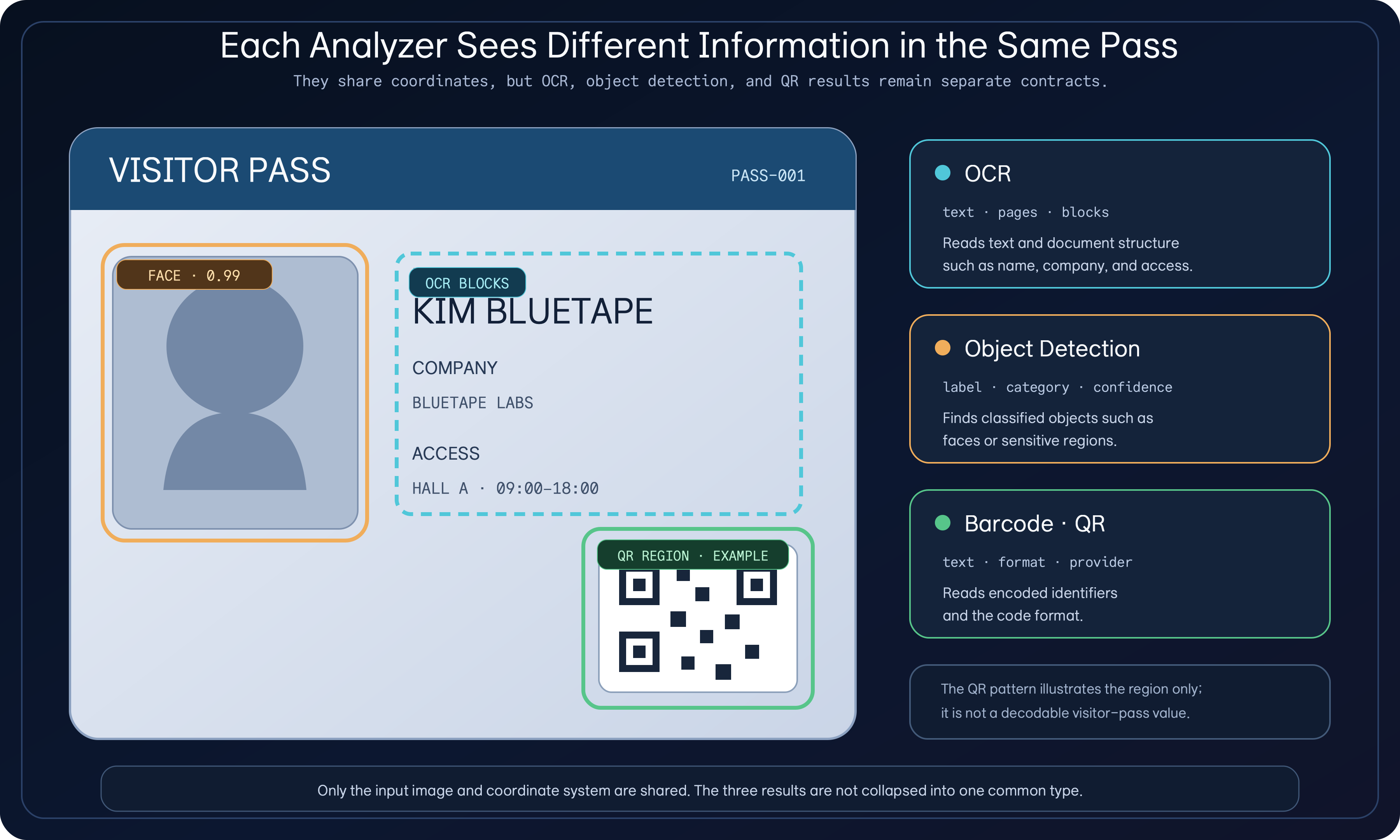
A single visitor pass can contain a name and company, a portrait, and an access QR code. The image is one input, but the service needs more than one answer.
This article is not a feature list for OCR, object detection, and QR decoding. It explains where to qualify the input, how to preserve useful results when one path fails, and how to keep detected facts separate from business decisions when three independent analyzers read the same image.
The example uses the
bluetape4k-image Spring Boot Image Intelligence API.
A visitor pass is the representative scenario, but the goal is not an all-purpose visitor-pass product. The focus is an
executable, reusable baseline for qualification, parallel processing, partial failure, and policy separation.
One image rarely contains only one kind of information
Section titled “One image rarely contains only one kind of information”When an image API starts from a single feature name, its response naturally narrows to that feature. An OCR API returns text, a barcode API returns a code value, and an object-detection API returns labels and confidence scores. Real business inputs, however, rarely arrive already separated by feature.
| Scenario | What OCR reads | What object detection finds | What barcode or QR reads | Example policy |
|---|---|---|---|---|
| Visitor or access pass | Name, company, purpose | Face or sensitive regions | Access identifier | Allow, manual review, restrict public preview |
| Shipping label | Recipient, address, item | Handling marks or document regions | Tracking number | Mask address, request another photo |
| Product label | Product name, ingredients, expiry | Logo or product region | Product code | Review required labels, hold registration |
All three scenarios lead to the same question: “How should a service extract different kinds of information from one image?” It is more natural for independent analyzers to read the same qualified image and combine their results later than for one feature to become an internal step of another.
OCR accuracy, detector selection, and QR error correction remain separate concerns. Part 1 begins with the boundaries required to connect all three capabilities to one API rather than with the internals of each algorithm.
Fix the processing boundaries with a visitor-pass scenario
Section titled “Fix the processing boundaries with a visitor-pass scenario”The representative scenario is visitor-pass intake for an event venue. After a user uploads the pass, the service tries to obtain four things:
- Use OCR to determine whether readable text such as the visitor’s name and company exists.
- Use object detection to determine whether there is one face and whether the image includes sensitive regions.
- Decode QR data and determine whether there is one access identifier beginning with
visitor:. - Pass the three results to visitor-pass policy and choose
ALLOW,MANUAL_REVIEW,REJECT, orQUARANTINE.
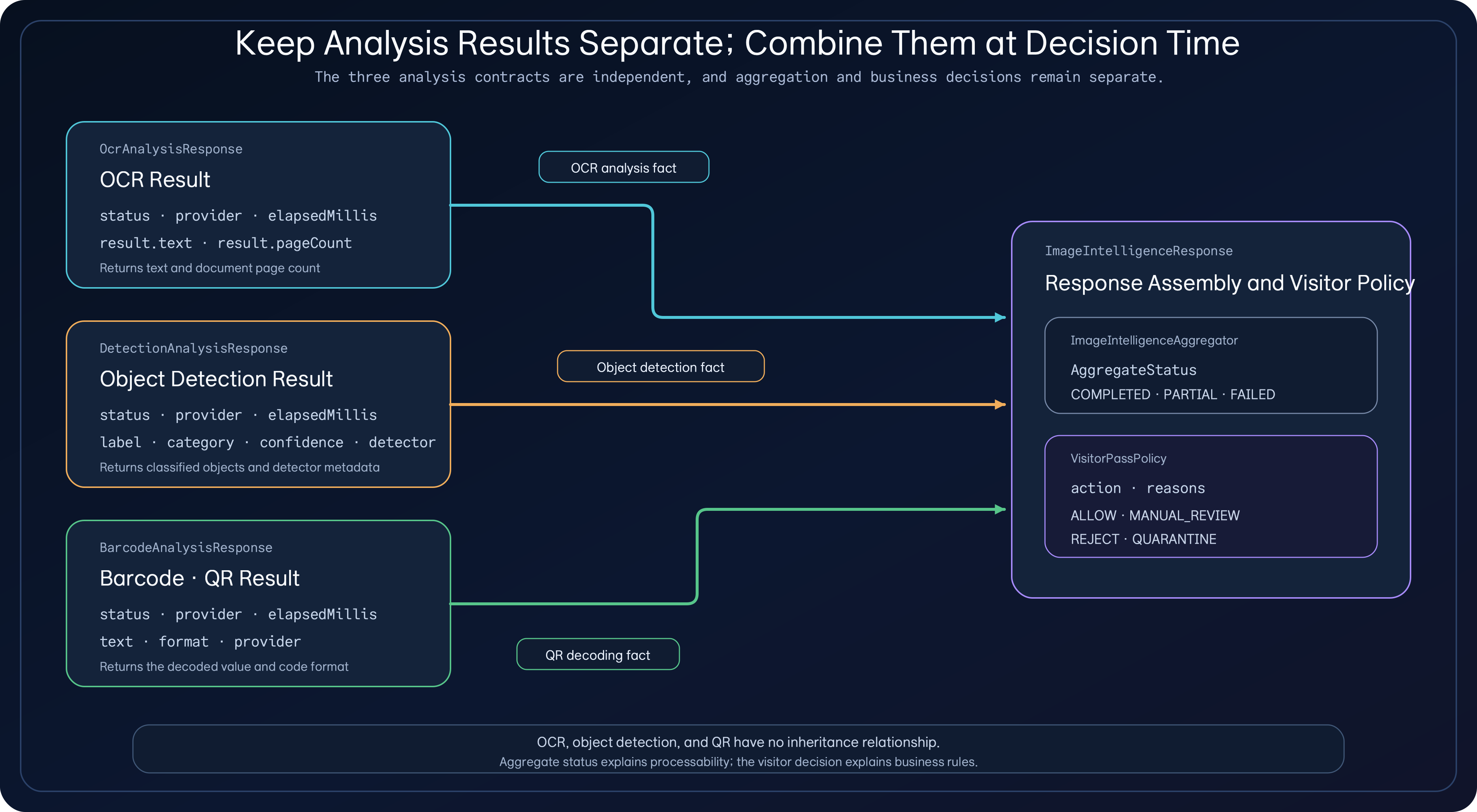
Steps 1 through 3 produce analysis facts from the image. Step 4 is a business decision made by the service. Reading
visitor:PASS-001 from a QR code is not enough to allow access. Policy must also consider the face count, OCR result,
sensitive regions, and any processing failures.
The processing paths share input, not answers
Section titled “The processing paths share input, not answers”An integrated API does not need to force all three results into one common type. What they share is a qualified input image and a request lifetime. Their result fields and the meaning of “nothing found” remain specific to each path.
| Processing path | Representative result in the current API | Meaning of an empty result | Unavailable | Failed |
|---|---|---|---|---|
| OCR | text, pageCount | No readable text | OCR provider not configured | Timeout or provider exception |
| Object detection | label, category, confidence, detector | No object found | Detector not configured | Detector execution failed |
| Barcode or QR | text, format, provider | No code found | Reader not configured | Decoder execution failed |
| Policy | action, reasons | Not applicable | Insufficient analysis evidence | Defer automatic decision to review |
Lower-level bluetape4k-image results may include coordinate regions and richer structures. The current integrated example,
however, exposes only the fields shown above in its HTTP response. Instead of copying every library value into the API
contract, it selects the data its consumers need.
Qualify the input first and decode it once
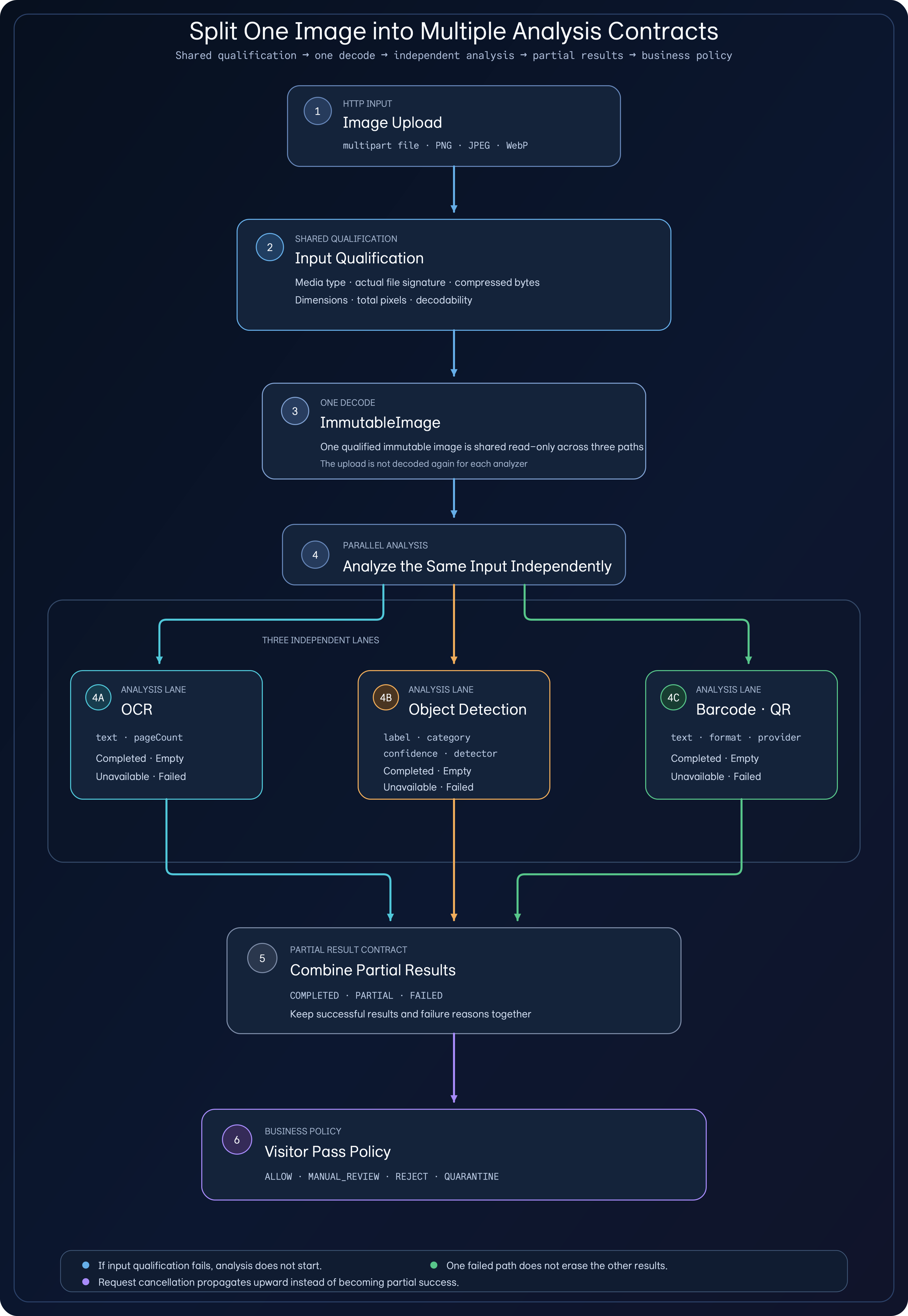
Section titled “Qualify the input first and decode it once”Before running three analyzers in parallel, the service determines whether the uploaded image is eligible to begin analysis.
ImageUploadQualifier
checks for an empty file, declared media type, compressed byte size, actual file signature, decodability, dimensions, and
total pixel count.
The boundary must also state what this step does not decide. Whether OCR can read the text, whether the image contains a face, and whether it contains a QR code are analysis outcomes, not upload-qualification rules. Moving them into shared qualification would turn legitimate OCR or QR results into input errors.
val qualified = qualifier.qualify(upload)
val results = workflow.analyze(    image = qualified.image, // ImmutableImage decoded once)
After qualification, the bytes are decoded once into an ImmutableImage. OCR, object detection, and QR processing read the
same immutable image object. They do not reread the multipart upload or decode the same image independently.
Operating an OCR service in production explains why compressed bytes and decoded pixel size need separate limits, along with the operational constraints of native OCR engines such as Tesseract. For multipart and in-memory input boundaries from an API-design perspective, see Kotlin API input boundaries.
Run independent work in parallel and retain each result
Section titled “Run independent work in parallel and retain each result”After qualification,
ImageIntelligenceWorkflow
uses suspendParallelFlow from bluetape4k-workflow to run three tasks. The following pseudocode reduces the implementation
to its essential structure:
suspendParallelFlow("image-intelligence-analysis") { execute("ocr") { context["analysis.ocr"] = runOcr(image) WorkReport.success(context) } execute("detection") { context["analysis.detection"] = runDetection(image) WorkReport.success(context) } execute("barcode") { context["analysis.barcode"] = runBarcode(image) WorkReport.success(context) }}Each path has its own timeout and Semaphore. A slow OCR provider should not force the QR provider to use the same
concurrency limit. These settings are more than performance decoration: they protect native resources and CPU workloads with
different cost profiles.
The meaning of WorkReport.Success deserves special attention. It does not mean “all three analyzers produced values.” It
means “the workflow task recorded the promised result contract in WorkContext.” An OCR path can record
AnalysisResult.Failed and still return WorkReport.Success because it successfully delivered that failure result.
Do not disguise partial failure as normal success
Section titled “Do not disguise partial failure as normal success”Each processing path distinguishes four outcomes:
Completed: The analyzer produced a value.Empty: The provider ran successfully but found nothing.Unavailable: The provider is not configured or cannot currently be used.Failed: The provider ran but could not produce a result because of a timeout or execution error.
If Empty and Failed both become an empty array, policy cannot distinguish “the image has no QR code” from “the service
could not inspect the QR code.” Those cases can lead to different approval decisions, so the API preserves both states.
ImageIntelligenceAggregator
aggregates the three results as follows:
| Aggregate status | Example paths | Interpretation in the current visitor-pass policy |
|---|---|---|
COMPLETED | All paths are Completed or Empty | ALLOW when all required visitor-pass information is valid |
PARTIAL | OCR Failed; object detection and QR Completed | Preserve successful results and return MANUAL_REVIEW |
FAILED | No usable result remains | Preserve failure reasons and return MANUAL_REVIEW |
Aggregate status and business decision are not the same value. Even when every path runs normally and the aggregate status is
COMPLETED, policy chooses REJECT if the QR value does not begin with visitor:. Conversely, an aggregate status of
FAILED does not automatically become HTTP 500 or an arbitrary rejection. The current policy returns MANUAL_REVIEW with
specific reasons so that a person can inspect the request.
External request cancellation is another kind of event.
GuardedAnalysisRunner
converts only its own timeout into a path-specific Failed(timeout) result and rethrows cancellation from the parent
coroutine. Wrapping a cancelled request as three failed analyses would mix the work lifecycle with business results.
Separate detected facts from business policy
Section titled “Separate detected facts from business policy”Finding a face region is an analysis fact. Whether the service blurs the face, restricts access to the original, or routes the pass to manual review is a policy decision.
VisitorPassPolicy
combines sensitive regions, QR format and prefix, face count, OCR content, and path failure states. Because policy is not
embedded in an analysis provider, a shipping-label or product-label service can keep the same OCR, detection, and QR
orchestration while replacing only its decision rules.
The separation also helps with privacy controls. A detector can report the presence and location of a face, while policy and post-processing decide whether to blur it in an API preview or restrict the original behind separate authorization. Replacing an analysis model and changing a privacy policy do not have to become the same deployment unit.
The example’s demo profile uses deterministic fixtures for OCR and object detection. Only the QR path runs a real
ZxingBarcodeReader. This combination reproduces orchestration and failure contracts; it does not prove the accuracy or
throughput of a production ML detector. A real service still needs a production ImageDetector, quality measurement, model
versioning, and drift monitoring.
What this example provides—and what it does not
Section titled “What this example provides—and what it does not”The example is not a finished product for a particular business. It is an executable baseline composed from four boundaries:
| Reusable baseline | Decisions left to the service |
|---|---|
| Upload qualification and one-time decoding | Malware scanning, retention and deletion, per-tenant quotas |
| Independent OCR, detection, and QR execution | Production OCR and ML providers, model quality thresholds |
Preservation of Completed, Empty, Unavailable, and Failed | Retries, circuit breakers, process isolation |
| Separation of analysis facts and visitor-pass policy | Encryption, masking, access control, audit history |
Choosing an image backend is a separate decision. From pure JVM to libvips compares processing cost and operational constraints with measured results. Running three analyzers in parallel does not make decoding and preprocessing costs disappear.
Where the series goes next
Section titled “Where the series goes next”Part 1 established the overall processing boundaries. The remaining articles narrow each boundary to implementation and test behavior:
- Part 1: Extracting Multiple Signals from One Image
- Part 2: Qualify Before You Analyze
- Part 3: Connect the OCR Path to an Integrated Response
- Part 4: Separate Detection Facts from Processing Policy
- Part 5: A Barcode and QR Contract Unlike OCR
- Part 6: Turn Parallel Execution and Partial Failure into an API Contract
- Part 7: An Integrated Visitor-Pass Image Processing API
Part 2 will examine how the input boundary distinguishes a declared MIME type from the actual signature, a small compressed file from an excessive decoded pixel count, and a readable image header from a full decode failure.
Implementation and related resources
Section titled “Implementation and related resources”When reading the implementation, start with the README and then follow the input, orchestration, provider, and policy boundaries:
- Spring Boot Image Intelligence API: Run instructions, response states, profiles, and operational non-goals.
ImageUploadQualifier.kt: Media-type checks, byte and pixel budgets, and the decoding boundary.ImageIntelligenceWorkflow.kt: Parallel execution of the three analysis tasks and result-key collection.ImageAnalysisProviders.kt: Fixture, Tesseract, object-detection, and ZXing provider boundaries.VisitorPassPolicy.kt: Conversion from analysis facts into allow, review, reject, or quarantine decisions.- Operating an OCR service in production: Large-image limits, native OCR, and failure response contracts.
- From pure JVM to libvips: A comparison of image-processing backends by performance and operational constraints.
- Kotlin API input boundaries: Multipart, byte budgets, and in-memory input at API boundaries.
Comments
Leave a note or reaction with your GitHub account.