
Bluetape4k Exposed Part 5: Production Examples with Cache and Multi-Tenancy

The final post in this series looks at production examples. The part I cared about most in bluetape4k-exposed was
keeping Exposed’s SQL DSL and explicit transaction control while making repeated operational features easier to attach
from service code. Cache strategies, multi-tenancy, outbox, and idempotency can all be built by hand. The problem is
that once they are built by hand, repository, service, interceptor, scheduler, and metric code spread quickly.
I organized these features as extensions that fit naturally into applications already using Exposed. Spring Boot reduces configuration, the cache modules turn read/write strategies into repository API choices, and the multi-tenant examples collect schema or database switching at transaction entry points. Outbox and idempotency follow the same direction. The goal is not to build a large framework around operational behavior, but to layer it thinly on Exposed transactions so it can be tested and benchmarked immediately.
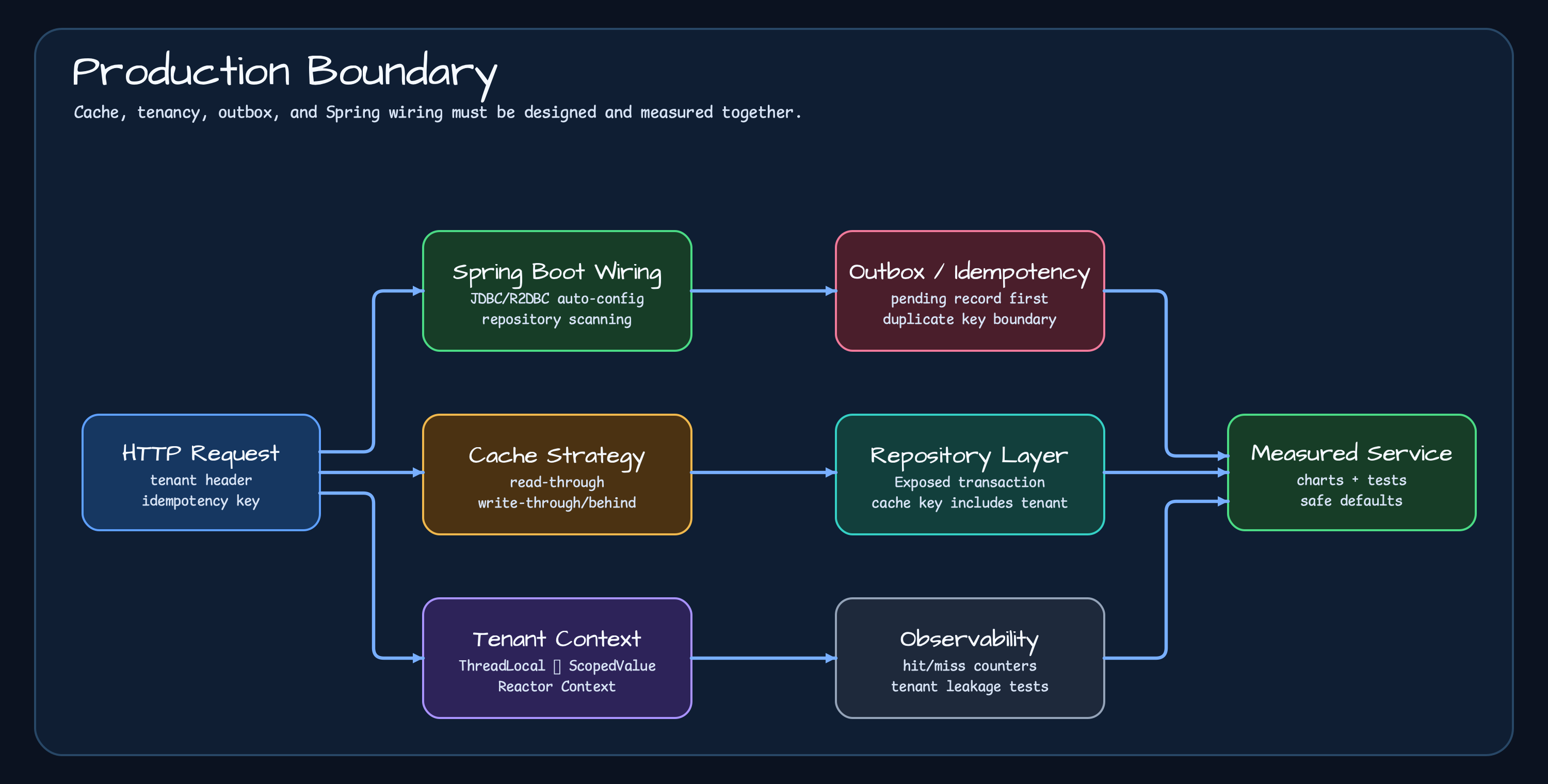
Spring Boot Auto-Configuration
Section titled “Spring Boot Auto-Configuration”The first piece is Spring Boot auto-configuration. In a real application, Exposed Database, transaction manager,
repository scanning, and entity wiring are easy to hand-wire once. After the service count grows, that setup code starts
being copied. I added Spring Boot auto-configuration to reduce that repetition.
| Extension | Role |
|---|---|
exposed-spring-boot-jdbc | Spring Data JDBC-style repositories based on Exposed DAO entities |
exposed-spring-boot-r2dbc | Coroutine repositories based on Exposed R2DBC DSL |
batch-exposed | Spring Batch integration with Exposed |
exposed-spring-modulith | Spring Modulith JDBC event publication based on Exposed |
The JDBC side supports Spring Data-style repositories and PartTree queries.
interface UserRepository : ExposedJdbcRepository<User, Long> { fun findByName(name: String): List<User> fun findByAgeGreaterThan(age: Int): List<User> fun findByEmailContaining(keyword: String): List<User>}The R2DBC side puts coroutine repositories and Flow streaming at the front.
interface UserRepository : ExposedR2dbcRepository<User, Long> { suspend fun findByName(name: String): List<User> suspend fun countByAge(age: Int): Long}The point is to provide familiar Spring Data-like ergonomics without losing Exposed DSL and transaction control. The repository interface stays thin, while query shape and transaction choice still belong to Exposed. Service code can stay simple like a Spring Boot application, and performance-sensitive paths can still drop directly to SQL DSL.
Cache Strategy: Separate Cache Aside from CacheWriteMode
Section titled “Cache Strategy: Separate Cache Aside from CacheWriteMode”Cache behavior becomes especially visible when it is placed on top of an Exposed repository. Service code calls the same
repository API, while the layer underneath can switch among local cache, Redis, near cache, read-through, write-through,
and write-behind strategies. exposed-cache gives Caffeine, Lettuce, and Redisson cache repositories common interfaces
and configuration.
The benefit is simple. A service does not need to copy cache-aside code everywhere just to improve performance. Read-heavy services can use near cache to reduce DB and Redis round trips. Services with write bursts can use write-behind to shorten request time, as long as the workload can accept eventual persistence.
| CacheMode | Meaning |
|---|---|
LOCAL | In-process cache such as Caffeine. Fast, but not shared across JVMs |
REMOTE | Remote cache such as Redis. Shared across instances |
NEAR_CACHE | L1 local + L2 Redis. Reduces network round trips for hot reads |
The easy part to mix up is Cache Aside versus CacheWriteMode. Cache Aside usually means service code handles both DB
and cache directly: after saving to DB it invalidates or puts the cache, or on cache miss it reads from DB and fills the
cache. The CacheWriteMode in JdbcCacheRepository and R2dbcCacheRepository is different. The repository API owns the
DB write as well. Callers may call put() or save() on the cache repository, but the selected mode decides how the
backing DB operation is handled.
Read the write modes this way.
| CacheWriteMode | Read | Write |
|---|---|---|
READ_ONLY | Reads from DB on miss and caches the result | Updates cache only. Do not expect DB persistence |
WRITE_THROUGH | Read-through | Writes to cache and DB synchronously |
WRITE_BEHIND | Read-through | Accepts the write into a queue, updates cache, and flushes DB asynchronously |
The implementation follows that model. Simplified, WRITE_THROUGH handles cache and DB in the same call, while
WRITE_BEHIND queues the DB write and updates cache immediately.
when (config.writeMode) { CacheWriteMode.WRITE_THROUGH -> { cache.put(key, entity) writeToDb(id, entity) } CacheWriteMode.WRITE_BEHIND -> { writeBehindQueue.trySend(id to entity).getOrThrow() cache.put(key, entity) } else -> cache.put(key, entity) // READ_ONLY}So WRITE_THROUGH does not mean “the cache knows, but the DB does not.” The cache repository is the API shape, but the
repository also owns persistence. Mixing this up with Cache Aside easily creates the wrong question: “Do I still need to
save to DB separately from the service?”
The benchmark follows the same distinction. bluetape4k-workshop/spring-boot/cache-benchmark compares seven cache
profiles with H2 and Redis Testcontainers. The values below were remeasured on 2026-07-27 with Apple M4 Pro and
Java 21.0.12 using a JMH-style benchmark.
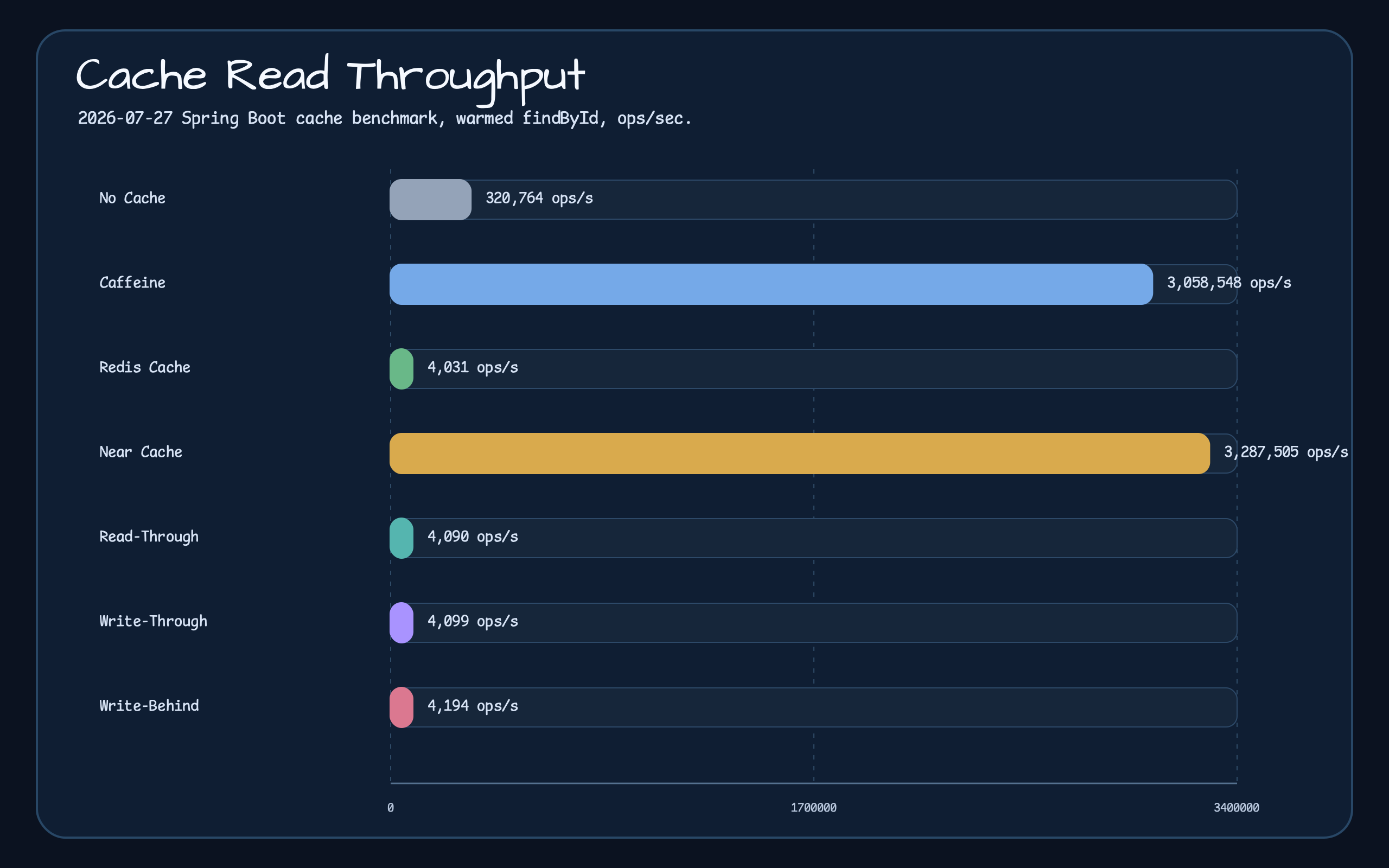
| Profile | Read ops/s | vs baseline |
|---|---|---|
| No Cache | 320,764 | 1x |
| Caffeine | 3,058,548 | 9.5x |
| Redis Cache | 4,031 | 0.013x |
| Near Cache | 3,287,505 | 10.3x |
| Read-Through | 4,090 | 0.013x |
| Write-Through | 4,099 | 0.013x |
| Write-Behind | 4,194 | 0.013x |
These values include both cache-hit cost and the local H2 or Redis Testcontainers round trip. They do not represent production capacity; measure again with the network and database used by the service.
Writes require completion boundaries, not a single ranking. A Write-Behind request accepted into the queue, a Write-Through call persisted to the DB, and a Write-Behind queue fully drained do not finish the same amount of work.
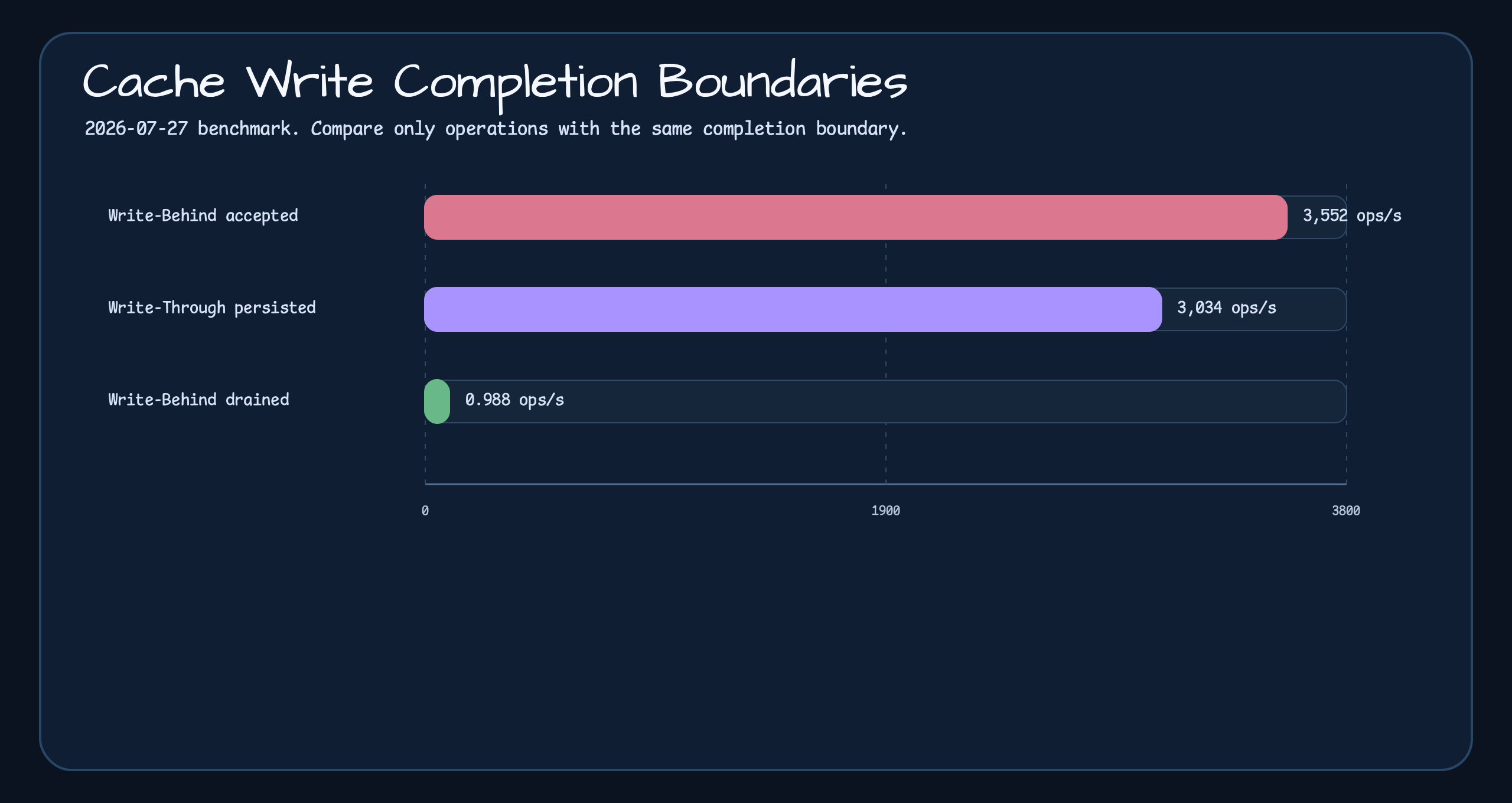
| Profile and measurement point | Completion boundary | Write ops/s |
|---|---|---|
| Write-Behind existing-ID update | Cache accepted; DB write remains queued | 3,551.936 |
| Write-Through existing-ID update | DB persistence completed before return | 3,034.323 |
| Write-Behind update and wait | Queue drained and DB value observed | 0.988 |
Write-Behind returns quickly because it separates DB work from the request path. The drain measurement also includes the configured one-second delay, so request-acceptance throughput must not be reported as completed database throughput. This strategy fits delayed-persistence flows better than order confirmation or another path that requires immediate durability. Queue observation, shutdown drain, retry, and idempotency remain part of the design.
Multi-Tenancy: From Header to Schema
Section titled “Multi-Tenancy: From Header to Schema”Multi-tenancy can be implemented with other ORMs or plain JDBC as well. In practice, tenant identification, context
propagation, schema or database selection, cache keys, and tests tend to spread across different layers. I prefer pulling
that boundary as close as possible to the Exposed transaction entry point. exposed-workshop/10-multi-tenant shows
schema-based tenants, database-per-tenant, Spring MVC, Virtual Threads, WebFlux, and Ktor side by side.
The basic flow is the same. The implementation can vary, but the goal is to keep this flow with as little scattered code as possible.
- Identify the tenant from the
X-TENANT-IDheader. - Propagate the tenant into request context.
- Select the schema or datasource when entering a transaction.
- Test that a tenant A request cannot read tenant B data.
Context propagation differs by runtime.
| Runtime | Context | Schema switch |
|---|---|---|
| Spring MVC | ThreadLocal | AOP @Before |
| Virtual Threads | ScopedValue | AOP @Before |
| WebFlux + Coroutines | Reactor Context + CoroutineContext.Element | newSuspendedTransactionWithTenant |
| Ktor | Coroutine context/plugin | Request plugin + transaction helper |
Once cache is added, there is one more rule:
cache keys must include tenant information.
user:42 can be acceptable in a single-tenant service. In a multi-tenant service, the key needs to include the tenant,
for example tenant:korean:user:42. If this rule is kept inside repository or cache helpers, service code does not need
to manually assemble tenant-specific cache keys every time. Exposed transaction helpers own schema or database selection,
while cache helpers own tenant-key rules. Separating the responsibilities this way keeps multi-tenancy from spreading
through the whole application.
Production Integration: Outbox and Idempotency
Section titled “Production Integration: Outbox and Idempotency”12-production-integration contains examples closer to application behavior than cache strategy. The main ones are HTTP
client outbox and idempotency. Payment, notification, and external API integrations often need to handle “change DB
state” and “call an external system” together. If those two actions are scattered through service code, retries,
duplicate requests, and state transitions become complicated quickly.
The Spring and Ktor examples organize that flow around Exposed transactions. First, a pending outbox record is stored and
a unique constraint is placed on idempotencyKey. If a duplicate request arrives, the application returns the existing
record instead of creating a new task. Then it calls the gateway and transitions the record to SUCCEEDED,
RETRYABLE_FAILED, or PERMANENT_FAILED.
| Step | What to inspect in code |
|---|---|
| Request validation | orderId, amountCents, idempotencyKey normalization and validation |
| Intent storage | Insert PENDING row into spring_payment_outbox |
| Duplicate prevention | idempotency_key unique index, returning existing row on duplicate |
| External call | Fake gateway paths for success, retryable failure, and permanent failure |
| State transition | SUCCEEDED for success, RETRYABLE_FAILED for retryable failure |
An outbox table alone is not the useful part. The useful part is that intent storage, duplicate prevention, and state transition can be modeled as one application pattern inside an Exposed transaction. It can be added from the point that needs it, without starting with JPA event listeners or a separate messaging framework.
The realtime outbox examples use the same idea. A notification request stores the domain row and outbox row in the same
Exposed transaction. A separate publish step delivers pending events to the SSE or WebSocket hub. Success becomes
PUBLISHED; failure becomes FAILED. It looks small in the example, but production code can add retry workers, claim
leases, and attempt limits at that boundary. It does not need to begin as a large event platform.
What to Inspect in the Production Examples
Section titled “What to Inspect in the Production Examples”When reading the code, look less at “how many features are included” and more at “how easily can production behavior be
layered on top of Exposed.” exposed-workshop/11-high-performance and 12-production-integration move one step beyond
simple CRUD examples.
| Example | Question to ask while reading |
|---|---|
01-cache-strategies | Can read/write strategy change at the repository API boundary? |
02-cache-strategies-coroutines | Does the same cache strategy survive in suspend flows? |
04-benchmark | Are cache hit/miss and write-mode throughput compared by workload? |
05/06-cache-strategies-ktor | Can Ktor use cache strategies without bloated controller/service code? |
12-production-integration/03-04 | Are HTTP outbox and idempotency tied to an Exposed transaction? |
12-production-integration/07-08 | Are realtime outbox rows stored with domain rows, then handed to a publish step? |
12-production-integration/09-10 | Are observability, readiness, and structured errors shown inside application examples? |
The smoke results in 11-high-performance/04-benchmark show why workload matters. On READ_HEAVY workloads,
WRITE_THROUGH is about 9.9x faster than NoCache and READ_THROUGH is about 5.5x faster. On WRITE_HEAVY workloads, the
gain falls to about 1.1x. That is why I describe cache strategy by read/write ratio before strategy name.
Adoption Checklist
Section titled “Adoption Checklist”- For read-heavy workloads, compare Caffeine, Near Cache, and Read-Through using the real request ratio.
- For write bursts, decide first whether Write-Behind’s consistency model is acceptable.
- Make sure tenant id enters schema/database selection, cache keys, logs, and metric tags with the same rule.
- Choose the runtime model first: Spring MVC, Virtual Threads, WebFlux/Coroutines, or Ktor.
- Before growing outbox/idempotency into a separate framework, check whether an Exposed transaction is enough.
- Track cache miss, hit, invalidation, and DB fallback metrics in both benchmark results and production metrics.
- Copy only the combinations that match the service’s read/write ratio and tenant-isolation shape.
Closing
Section titled “Closing”The production path for bluetape4k-exposed does not stop at “attach Exposed to Spring Boot.” I split these examples for
that reason.
- Spring Boot auto-configuration gives familiar repository ergonomics while preserving Exposed DSL control.
- The cache module lets read/write strategies change inside the repository API and improve performance by workload.
- Multi-tenant examples collect tenant-specific schema or database switching at transaction entry points.
- Production integration examples add outbox, idempotency, and readiness as small application patterns.
- Benchmarks force strategy selection to follow workload, not strategy names.
The conclusion of the series is simple. Exposed is a good starting point for handling SQL in a Kotlin-friendly way.
bluetape4k-exposed adds thin extensions for performance tuning and production behavior on top of that starting point.
“Thin” does not mean “few features.” It means service code should not repeat cache-aside logic, attach tenant routing in every controller, or rebuild outbox workers from scratch every time. Keep the necessary behavior around repository and transaction boundaries, then confirm the selection with benchmarks and examples.
That fits Exposed well. Exposed does not hide SQL, and it treats transactions explicitly. If cache, multi-tenancy, outbox, and idempotency are attached without losing those strengths, application code becomes simpler and the tuning points become clearer. The core message of Part 5 is that production behavior can start small.
Source Links
Section titled “Source Links”- Spring Boot JDBC README: spring-boot/jdbc/README.md
- Spring Boot R2DBC README: spring-boot/r2dbc/README.md
- Exposed cache README: exposed/cache/README.md
- Cache benchmark: spring-boot/cache-benchmark/README.md
- Multi-tenant workshop: exposed-workshop/10-multi-tenant
- High performance workshop: exposed-workshop/11-high-performance
- Production integration: exposed-workshop/12-production-integration/README.md
- Spring HTTP outbox/idempotency: 12-production-integration/03-spring-http-outbox-idempotency/README.md
- Ktor HTTP outbox/idempotency: 12-production-integration/04-ktor-http-outbox-idempotency/README.md
Comments
Leave a note or reaction with your GitHub account.