
Bluetape4k Leader Part 5: Backends, Operations, and Benchmarks
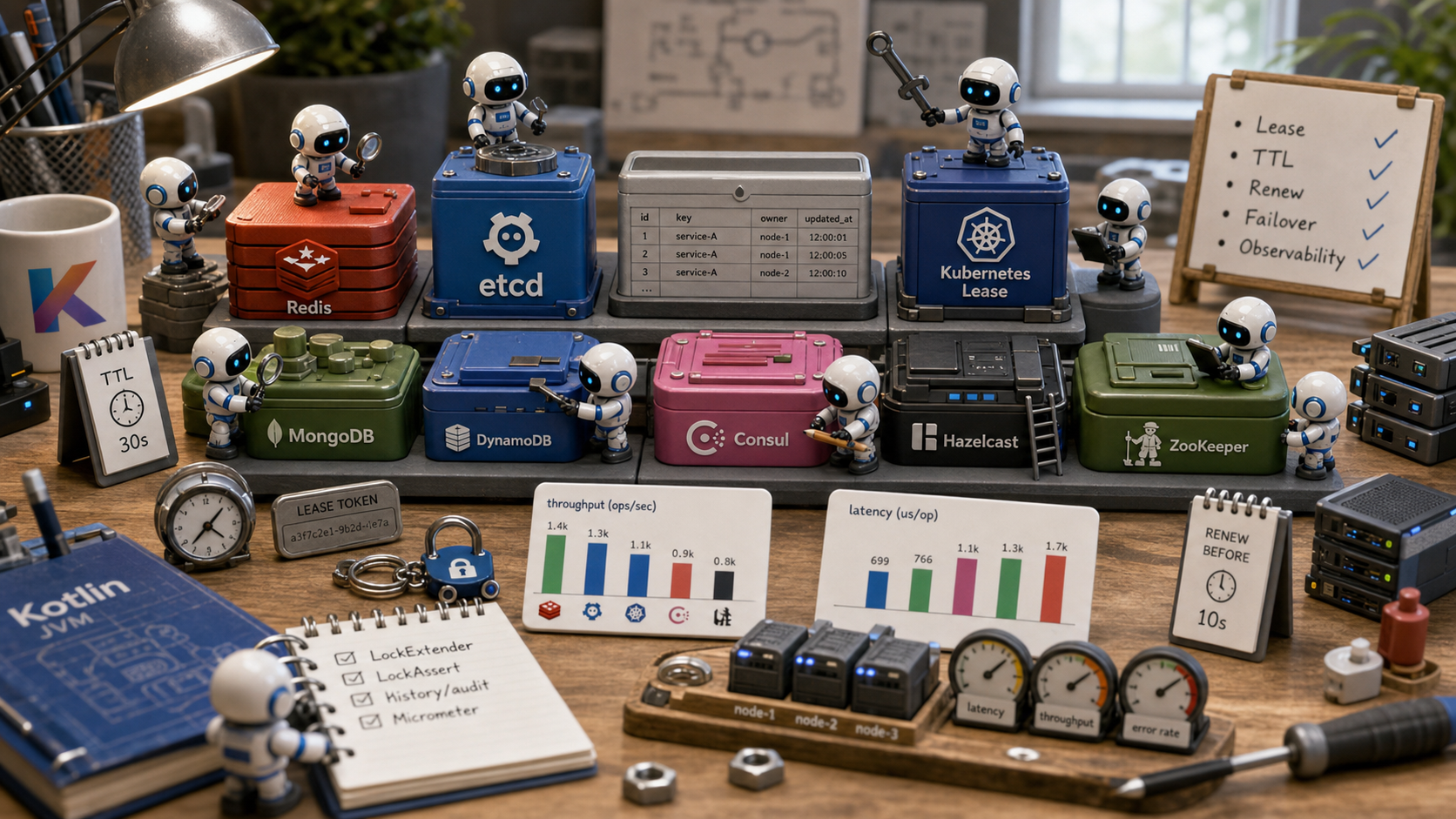
Part 4 covered Spring Boot annotation/AOP and Ktor application lifecycle boundaries.
Part 5 moves one level down. The same runIfLeader call behaves differently operationally depending on whether the lease lives in Redis, etcd, a SQL row, or a Kubernetes Lease object.
That makes backend choice less about API style and more about operations. Leader election should stay quiet during normal contention, but it must be explainable when something fails: who ran, who skipped, who extended the lease, and which backend failed.
Start with what you already run
Section titled “Start with what you already run”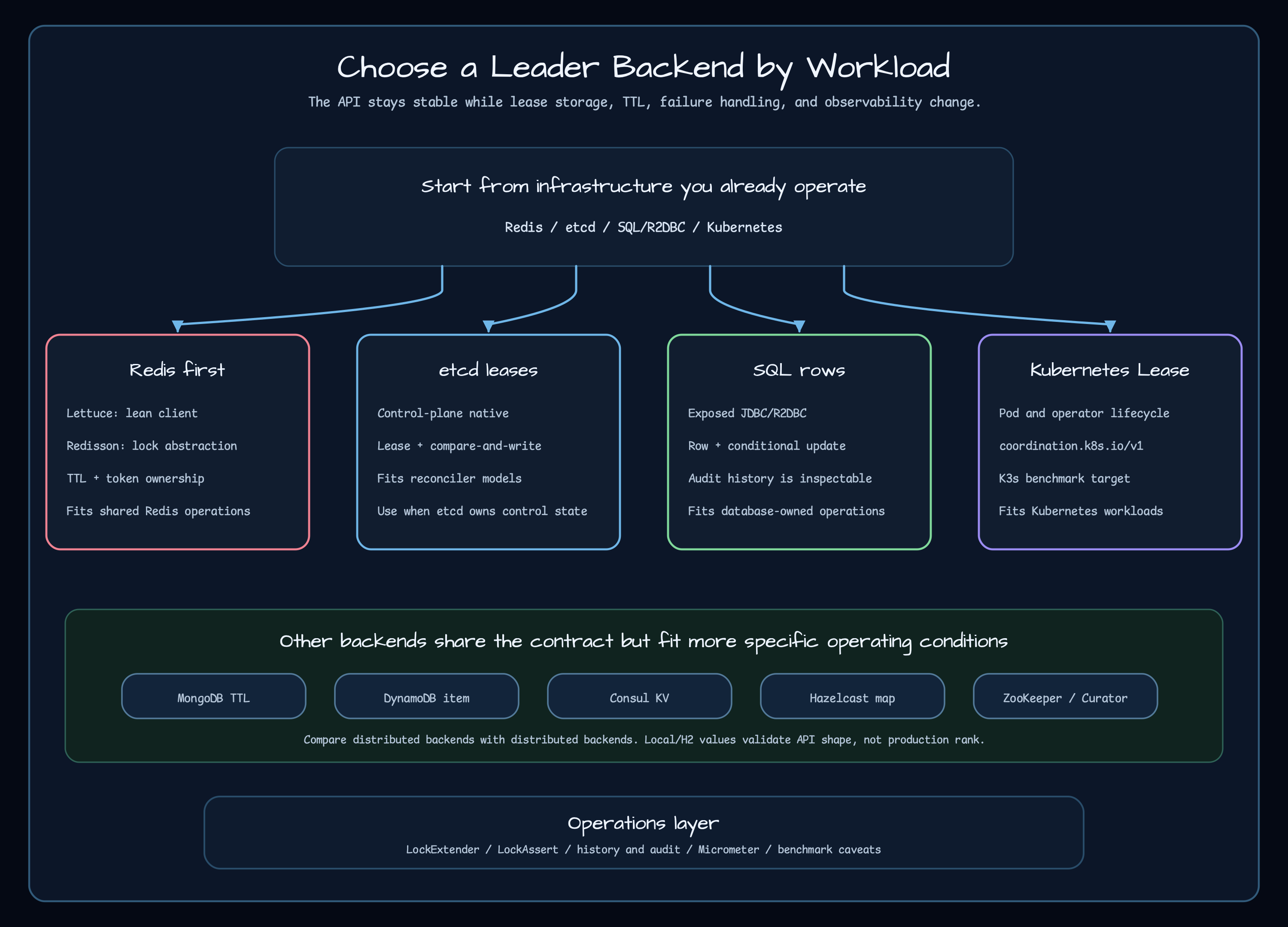
The first pass is usually this table.
| Existing substrate | Start with | Why |
|---|---|---|
| Redis is the shared cache/lock substrate | Lettuce or Redisson | Redis TTL plus token ownership makes single-leader locks straightforward. Lettuce is a lean client path; Redisson is familiar when lock-oriented Redis operations already exist. |
| etcd is control-plane truth | etcd v3 | Lease and conditional write semantics fit reconciler/control-plane work. |
| Database operations own the recovery path | Exposed JDBC/R2DBC | Lock rows, tokens, and expiry timestamps are easy to inspect, migrate, and audit. |
| The workload runs inside Kubernetes | Kubernetes Lease | coordination.k8s.io/v1 Lease objects match pod/operator lifecycle and API-server observability. |
| MongoDB, DynamoDB, Consul, Hazelcast, or ZooKeeper is already present | The matching backend | Avoiding a new infrastructure dependency can matter more than micro-benchmark rank. |
The reason is simple: backend choice brings lease storage rules with it. Who may extend the lease, how the owner token is checked, how expired ownership is cleaned up, and where operators inspect state all change with the backend.
Redis: start with Lettuce or Redisson
Section titled “Redis: start with Lettuce or Redisson”Redis is the most natural default. If Redis already carries cache, rate-limit, or short-lived coordination traffic, leader locks can stay in the same operational model.
bluetape4k-leader exposes two Redis families.
| Backend | Best fit | Watch |
|---|---|---|
leader-redis-lettuce | Teams already operating Lettuce and wanting a lean blocking/suspend path | Lease TTL, token validation, and auto-extension are application-level contracts. |
leader-redis-redisson | Teams already using Redisson and its lock-oriented operational model | Electors pass an explicit leaseTime, so the benchmarked autoExtend path is the shared bluetape4k extender, not Redisson native watchdog renewal. |
Long jobs can opt into lease renewal with autoExtend = true. Group election auto-extension is not supported yet because each slot has its own lease and completion boundary.
val options = LeaderElectionOptions(    leaseTime = 30.seconds,    autoExtend = true,)
val election = RedissonLeaderElector(client, options)
election.runIfLeader("nightly-maintenance") {    LockAssert.assertLocked("nightly-maintenance")    LockExtender.extendActiveLock("nightly-maintenance", 60.seconds)    runLongJob()}
LockAssert checks that the current code is actually running under a real lock. It does not pass outside a lock or inside a fail-open sentinel. LockExtender extends the active lock. Internally, detailed extension outcomes distinguish not-held, wrong-thread, and backend-failure cases so operators are not left with only a collapsed Boolean.
etcd: control-plane work
Section titled “etcd: control-plane work”etcd fits teams that already treat it as control-plane truth. If a reconciler must apply desired state from exactly one node, etcd leases are a natural model.
The selection question is different from Redis. It is not “does the service already connect to Redis?” but “is the authoritative state for this work already in etcd?” When the answer is yes, choosing etcd can make the operational story clearer than adding a separate Redis dependency.
The examples/etcd-reconciler project follows this shape: one node applies desired state while the rest observe or skip.
Other backend families are situational
Section titled “Other backend families are situational”Part 5 is not a ranking contest. It is a map.
| Family | Storage meaning | How to read it |
|---|---|---|
| Exposed JDBC/R2DBC | Lock row, token, expiry timestamp, optional history row | Good for migration gates, tenant aggregation, and audit-heavy batch work where SQL visibility matters. |
| MongoDB | findOneAndUpdate plus TTL-index style ownership | Useful when MongoDB is already the operational store for short-lived ownership documents. |
| DynamoDB | Conditional item write and TTL-shaped ownership | A candidate when AWS-native operations matter. The benchmark row is noisy enough to require repeat measurement before tuning. |
| Consul | Session + KV | Fits maintenance/drain workflows that already use the Consul service model. |
| Kubernetes Lease | coordination.k8s.io/v1 Lease object | Use when pod/operator lifecycle and Kubernetes API observability are the natural boundary. |
| Hazelcast | IMap-based backend | Meaningful when a Hazelcast cluster is already runtime substrate. README explicitly says this is IMap-based, not CP Subsystem based. |
| ZooKeeper | Curator lock/semaphore | A candidate when ZooKeeper/Curator remains the existing coordination substrate. |
Operations layer: extend, assert, record, measure
Section titled “Operations layer: extend, assert, record, measure”After the backend is chosen, the operational questions remain.
| Question | Tool |
|---|---|
| Can the task outlive the initial lease? | autoExtend, LeaderLeaseAutoExtender, LockExtender |
| Is this code really inside a lock scope? | LockAssert.assertLocked() / assertLockedSuspend() |
| Who led, completed, or failed? | Leader history recorder and backend-specific history sinks |
| How many AOP calls attempted, acquired, skipped, or failed? | leader-micrometer and MicrometerLeaderAopMetricsRecorder |
The history recorder is best-effort around sink failures: recording should not destroy the protected task. Cancellation is still rethrown. The same distinction showed up in Part 4’s lifecycle discussion: cancellation is cancellation; ordinary failure can be logged and recorded.
Micrometer records attempts, acquisition, not-acquired reasons, execution duration, task failures, and active gauges around the AOP boundary. The operational rule is to keep normal contention separate from backend failure. Contention is an expected skip. Backend failure is a reliability event.
Benchmarks: direction plus caveat
Section titled “Benchmarks: direction plus caveat”The benchmark README starts with a boundary: these are comparable kotlinx-benchmark suites for same-machine before/after comparison, not release-grade performance claims. The 2026-05-21 baseline used one fork, one thread, two warmup iterations, and three one-second measurement iterations. The cross-backend table below includes PostgreSQL/MySQL rows added on 2026-05-29, while the lease-renewal discussion uses the focused Redis rows from 2026-06-01.
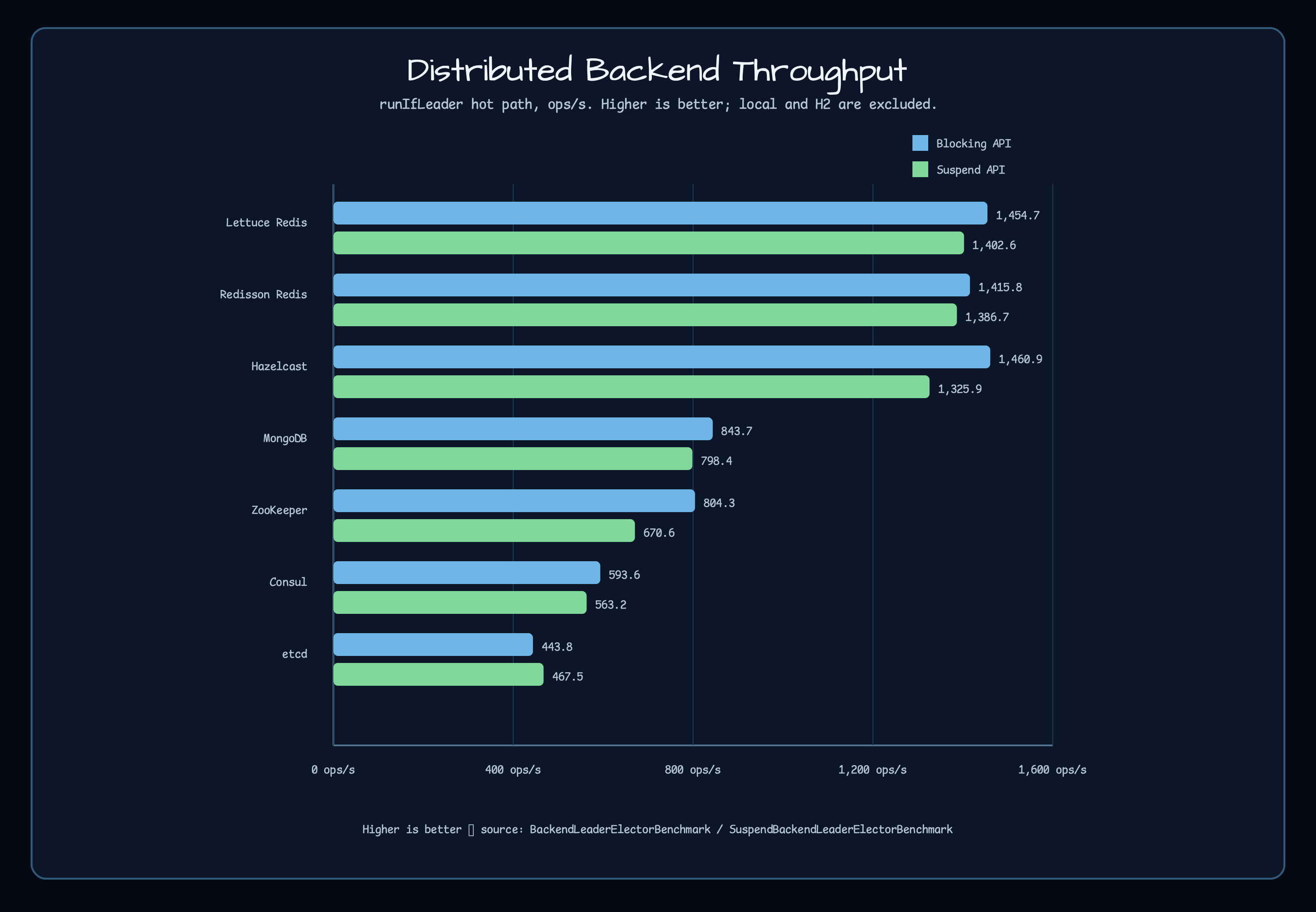
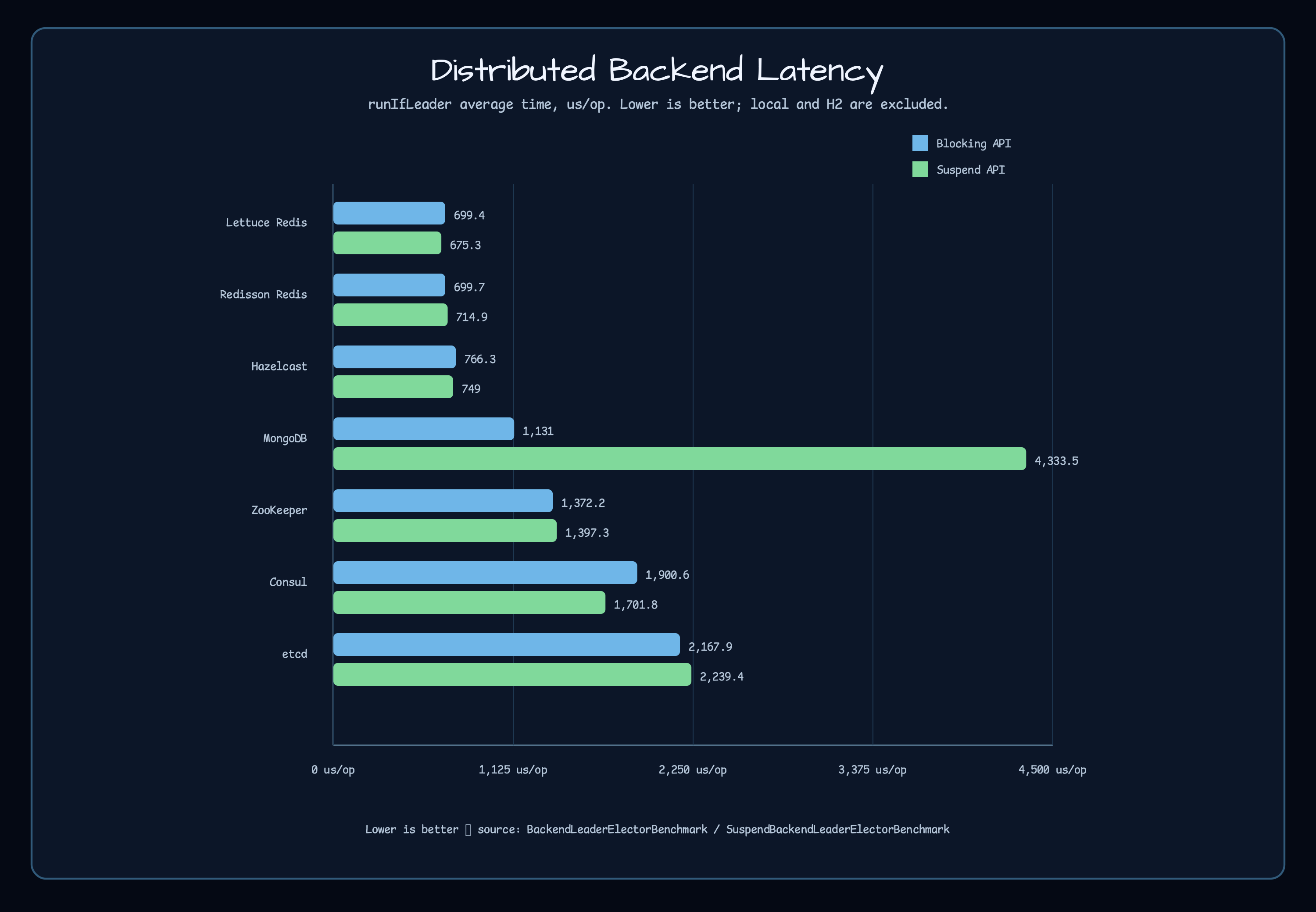
Representative rows from the 2026-05-29 cross-backend run:
| Row | Throughput ops/s | Average time us/op | Reading |
|---|---|---|---|
| Lettuce Redis blocking | 1,454.7 | 699.4 | Redis backends sit in the upper distributed-backend band. |
| Redisson Redis blocking | 1,415.8 | 699.7 | Similar band; operational client preference matters. |
| Hazelcast blocking | 1,460.9 | 766.3 | Same upper band in this benchmark. |
| MongoDB blocking | 843.7 | 1,131.0 | Competitive document-store row. |
| ZooKeeper blocking | 804.3 | 1,372.2 | Curator-backed coordination candidate. |
| Consul blocking | 593.6 | 1,900.6 | Read it in Consul session/KV operational context. |
| etcd suspend | 467.5 | 2,239.4 | Control-plane fit can matter more than raw rank. |
| PostgreSQL/MySQL exposed rows | 50-80 range | 13,000-17,000 range | Distributed SQL rows are slower here. Do not compare them with local/H2 structure checks. |
Kubernetes Lease runs in a separate source set because the Fabric8 client uses Vert.x 4 and Netty 4.1 while the default etcd target uses Vert.x 5. In the current README’s 2026-07-02 K3s scenario run, the public fresh-acquire-and-release path measured 82.297 ops/s for blocking and 90.055 ops/s for suspend. The active-holder skip path, which reads and returns without writing, measured 661.149 ops/s and 465.583 ops/s respectively. Those completion paths should not be ranked as if they measured the same operation.
The Redis lease-extension benchmark answers a narrower question. Normal runIfLeader and autoExtend rows are within the JMH error range. runIfLeaderWithRenewalWindow uses a 90 ms lease and 45 ms action dwell to force the extension path. If a row reads 50,000 us/op, treat it as 50 ms/op, not 50 microseconds, and do not read that row as the everyday cost of leader election.
Example map
Section titled “Example map”If you want to jump to code, start with examples.
| Example | Backend | What to inspect |
|---|---|---|
examples/batch-scheduler | Lettuce Redis/Spring | Cluster-wide scheduled batch |
examples/migration-gate | Exposed JDBC | Run schema/data migration on one node |
examples/webhook-poller | MongoDB | Avoid duplicate polling |
examples/cache-warmer | Hazelcast | Coordinate per-partition cache warming |
examples/tenant-aggregator | Exposed R2DBC | Independent leader per tenant |
examples/ktor-app | Ktor + Lettuce | LeaderElectionPlugin and leaderScheduled |
examples/prometheus-dashboard | Spring + Lettuce | AOP metrics, Prometheus, Grafana |
examples/etcd-reconciler | etcd | Desired-state reconciler |
examples/consul-maintenance | Consul | Maintenance/drain workflow |
examples/k8s-lease | Kubernetes Lease | Low-level Lease acquire/release/reacquire |
examples/k8s-operator | Kubernetes Lease + Spring | Three-replica operator pattern |
examples/rate-limiter | Lettuce + Bucket4j | Leader-dispatched external API probes |
examples/redisson-watchdog | Redisson | Long-running job and shared lease extender |
Sources
Section titled “Sources”- bluetape4k-leader README
- bluetape4k-leader benchmark README
- 2026-05-21 cross-backend baseline
- 2026-05-29 RDB backend throughput JSON
- 2026-06-01 Redis lease-extension benchmark
- 2026-07-02 Kubernetes Lease scenario benchmark
- LockExtender.kt
- LockAssert.kt
- LeaderLeaseAutoExtender.kt
- SafeLeaderHistoryRecorder.kt
- MicrometerLeaderAopMetricsRecorder.kt
- leader examples
Comments
Leave a note or reaction with your GitHub account.