
Bluetape4k Text Part 1: Starting Point and Quality Baseline

This is Part 1 of the bluetape4k-text series. We start with the map: where Korean tokenization, Japanese tokenization,
language detection, and Aho-Corasick search fit, and how the repository defines its release quality gate.
Text processing looks simple at first. trim(), lowercase(), split(" "), and contains() solve many small jobs. The
problem starts when that code moves to a real service boundary. Korean and Japanese can appear in the same text, emoji-only
input can arrive, keyword dictionaries can grow, and users can send very large payloads.
bluetape4k-text handles that boundary. It is not trying to become a large NLP platform. It provides reusable text-processing
primitives for Kotlin/JVM services, then backs them with examples and deterministic quality checks.
What It Solves
Section titled “What It Solves”Service text-processing work usually falls into these buckets.
| Situation | Processing needed | bluetape4k-text module |
|---|---|---|
| Korean search text | normalization, morphology, phrase extraction, stemming, sentence split | tokenizer-korean |
| Japanese search text | Kuromoji tokenization, noun filtering, blockword handling | tokenizer-japanese |
| Multilingual routing | language detection, mixed-language detection, detector reuse | lingua |
| Multi-keyword matching | dictionary-backed matching, masking, Flow matching | text-search |
| HTTP/API input boundary | blank/oversized rejection, no raw-text echo | tokenizer-core |
The important point is not to pull every module into every service. Choose the module that matches the boundary you are
solving. Korean tokenization starts with tokenizer-korean. Dictionary-backed keyword matching can start with text-search.
Language detection does not require bringing in the tokenizer modules.
The Pipeline View
Section titled “The Pipeline View”In real services, these pieces usually form one input pipeline.
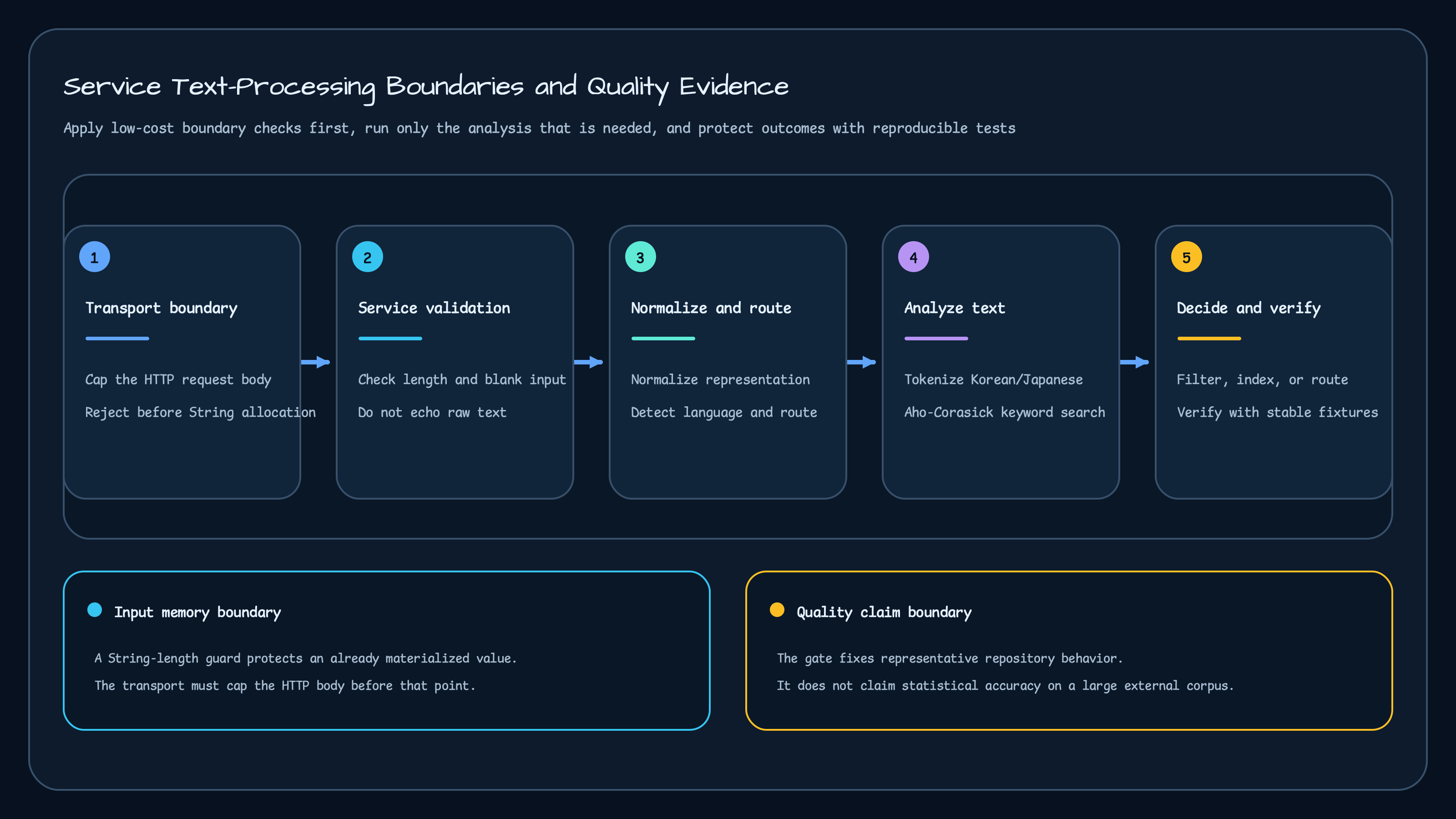
Suppose a service needs to accept user text, prepare search/index terms, or filter abuse words. First cap the HTTP request body
before it becomes a String. Once materialized, validate blank input and character count. Then normalize the text and detect its
language when routing depends on it. Use tokenizers for Korean or Japanese text when search-friendly terms matter. Use
text-search when a keyword dictionary needs to be matched in one pass.
If this is delayed, string handling spreads quickly. A controller calls String.contains, a service lowercases the text again,
and another layer repeats normalization before indexing. The same input can pass in one path and fail in another.
Module Map
Section titled “Module Map”The repository is split into these modules.
| Module | Role |
|---|---|
tokenizer-core | shared models such as TokenizeRequest, BlockwordRequest, Severity, dictionary utilities, and length guards |
tokenizer-korean | KoreanProcessor facade: normalization, tokenization, phrase extraction, stemming, sentence split, blockword masking |
tokenizer-japanese | JapaneseProcessor facade: Kuromoji IPAdic tokenization, noun filtering, blockword detection/masking |
lingua | Lingua-backed detector factories and Kotlin helpers such as detectAllLanguagesOf |
text-search | AhoCorasickAutomaton, DSL builder, replacement, word boundary, Kotlin Flow matching |
bluetape4k-text-bom | BOM for aligning multiple text artifacts to the same version |
Dependencies can be added module by module.
dependencies { implementation("io.github.bluetape4k.text:tokenizer-korean:<version>") implementation("io.github.bluetape4k.text:tokenizer-japanese:<version>") implementation("io.github.bluetape4k.text:lingua:<version>") implementation("io.github.bluetape4k.text:text-search:<version>")}Start small. Text behavior depends heavily on dictionaries and real input shape, so it is better to add the smallest module first and widen after checking representative data.
Small Starting Points
Section titled “Small Starting Points”Korean processing can start from the KoreanProcessor facade.
val normalized = KoreanProcessor.normalize("안됔ㅋㅋㅋㅋㅋ")// "안돼ㅋㅋㅋ"
val tokens = KoreanProcessor.tokenize("주말특가 쇼핑몰")val surfaces = KoreanProcessor.tokensToStrings(tokens)// ["주말", "특가", "쇼핑몰"]
Japanese processing uses Kuromoji-backed tokenization and noun filtering.
val tokens = JapaneseProcessor.tokenize("私は、日本語の勉強をしています。")val nouns = JapaneseProcessor.filterNoun(tokens).map { it.surface }// ["私", "日本語", "勉強"]Language detectors should normally be reused because model loading has a cost.
val detector = languageDetectorOf(    languages = setOf(Language.ENGLISH, Language.KOREAN, Language.JAPANESE),    minimumRelativeDistance = 0.0,    isEveryLanguageModelPreloaded = true,)
val languages = detector.detectAllLanguagesOf("Hello service. 안녕하세요. こんにちは。")// setOf(Language.ENGLISH, Language.KOREAN, Language.JAPANESE)
When the keyword dictionary grows, build an automaton once and scan the input once instead of repeating contains() per
keyword. Part 3 will go deeper into this.
val automaton = ahoCorasick<String> {    ignoreCase = true    wordBoundary = WordBoundary.WHITESPACE_SEPARATED    keyword("password reset", "ACCOUNT_TAKEOVER")    keyword("card declined", "PAYMENT_RISK")}
val matches = automaton.parseText("user requested password reset before card declined")
Input Boundary First
Section titled “Input Boundary First”One easy mistake is to attach a tokenizer or language detector before validating the input. Those processors can be expensive, so the service should validate an already materialized string before processor work starts.
tokenizer-safety-examples shows the boundary in a small form.
private fun validate(text: String, maxLength: Int): SafetyResponse? { if (text.length > maxLength) { return SafetyResponse(413, "text too long: ${text.length} chars (max $maxLength)") } if (text.isBlank()) { return SafetyResponse(400, "text is blank") } return null}This validation does not cap allocation while an HTTP body is being decoded into a String; that limit belongs at the transport
boundary. The request models and service handler then provide a second guard for character count and blank input.
The response also avoids echoing raw text. Search queries, reports, and chat messages can contain sensitive content. Error responses should carry metadata such as actual length and maximum length, not the submitted body.
Quality Gate, Not Benchmark Hype
Section titled “Quality Gate, Not Benchmark Hype”The bluetape4k-text 0.2.0 quality documents are intentionally modest. They do not claim leaderboard-style NLP accuracy.
They define deterministic repository fixtures that must stay stable before release.
| Area | What the gate checks |
|---|---|
| Korean tokenizer | expected Korean surface tokens remain present in mixed Korean/Japanese text |
| Japanese tokenizer | expected Japanese surface tokens remain present in mixed Korean/Japanese text |
| Language detection | English/Korean/Japanese mixed input and emoji-only unknown input are handled explicitly |
| Input safety | oversized request messages include length/max values without raw user text |
One Korean fixture uses this shape.
"서울에서 東京까지 주말 특가 티켓" to listOf("서울", "에서", "까지", "주말", "특가", "티켓")The Japanese fixture mirrors that kind of mixed input.
"서울から東京まで週末チケット" to listOf("東京", "週末", "チケット")Language detection checks that "Hello 안녕 こんにちは" resolves to English, Korean, and Japanese, while emoji-only input returns
an empty set.
This distinction matters. The quality gate says, “these repository behaviors are reproducible and protected.” It does not say, “this library beats every NLP system over a large external corpus.”
Dictionaries Are Operational State
Section titled “Dictionaries Are Operational State”Text processing does not end with code. Dictionaries change behavior. Adding a noun or blockword changes tokenization, masking, and user experience.
The dictionary update plan uses a small repeatable workflow.
| Step | Work |
|---|---|
| 1 | edit UTF-8 text files under the owning module resource root |
| 2 | trim whitespace and remove blank rows |
| 3 | sort deterministically when source order has no meaning |
| 4 | remove duplicates |
| 5 | run tests for the touched module |
| 6 | record the changed dictionary area and validation command in release notes |
That is more process than a quick data edit, but dictionary changes are user-visible. Treat them closer to code changes than incidental file edits.
Where To Start
Section titled “Where To Start”| Service problem | Start with |
|---|---|
| Korean search preprocessing | tokenizer-korean |
| Japanese search preprocessing | tokenizer-japanese |
| multilingual routing | lingua |
| abuse-word filtering | text-search or tokenizer blockword APIs |
| API input defense | transport body limits, tokenizer-core request models, and safety examples |
| multiple text artifacts on one version | bluetape4k-text-bom |
String.contains and split are not wrong by default. They are often enough for small internal tools. Once the same code
touches user input, multilingual text, dictionaries, search indexes, and logs, it needs a clearer boundary.
bluetape4k-text provides that boundary as modules and examples. Part 2 will focus on Korean/Japanese tokenizers and Lingua
language detection.
Source Links
Section titled “Source Links”- bluetape4k-text README
- Korean README
- Text Quality Gate And Fixture Corpus
- 0.2.0 Quality Report
- Dictionary And Blockword Update Pipeline Plan
- kotlin/text-processing workshop
- TokenizerSafetyExamples
- LinguaExamples
- TextSearchExamples
Comments
Leave a note or reaction with your GitHub account.