
Virtual Threads Part 3: Why JDBC Beat R2DBC More Often Than Expected

This is Part 3 of the Virtual Threads series. The full series continues with Part 1: introduction and cautions, Part 2: workshop rules, Part 3: JDBC + Virtual Threads benchmark, and Part 4: Java 21/25 SPI design.
Part 1 framed Virtual Threads as “threads that make waiting-heavy work easier to express,” not as “faster threads.” Now we can ask a more practical question.
If we already have R2DBC + Coroutines, can JDBC + Virtual Threads really win?
In the bluetape4k-exposed benchmarks, the answer leaned in one direction. I expected R2DBC to
look stronger: it is non-blocking, and Coroutines make the API pleasant. The measurements were
less kind to that assumption. General CRUD/JOIN benchmarks improved substantially when the JDBC path was
tuned around pool size and indexes, and batch benchmarks often favored JDBC + Virtual Threads
over R2DBC + Coroutines for the same workload.
First, the General Exposed JDBC Benchmark
Section titled “First, the General Exposed JDBC Benchmark”Looking only at batch results would make the conclusion too narrow. bluetape4k-exposed also
has a general CRUD/JOIN benchmark, ExposedJdbcBenchmark, under
exposed/exposed-jdbc/src/test/kotlin/.../ExposedJdbcBenchmark.kt.
It measures five methods on PostgreSQL Testcontainers through kotlinx-benchmark/JMH.
| Method | Meaning |
|---|---|
singleInsert | Single-row INSERT |
singleFindById | Primary-key SELECT |
singleUpdate | Single-row UPDATE |
joinQuery | users/orders JOIN query |
batchInsert | 100-row batch INSERT |
The initial total was 25,400.673 ops/sec. A self-improve loop adjusted HikariCP and benchmark
thread count, then added indexes for the JOIN target table.
| Step | Total throughput |
|---|---|
| Baseline | 25,400 ops/sec |
HikariCP max=24, minIdle=8, @Threads(14) | 43,487 ops/sec |
| Add orders-table index | 44,161 ops/sec |
| Highest point after stronger measurement settings | 45,431 ops/sec |
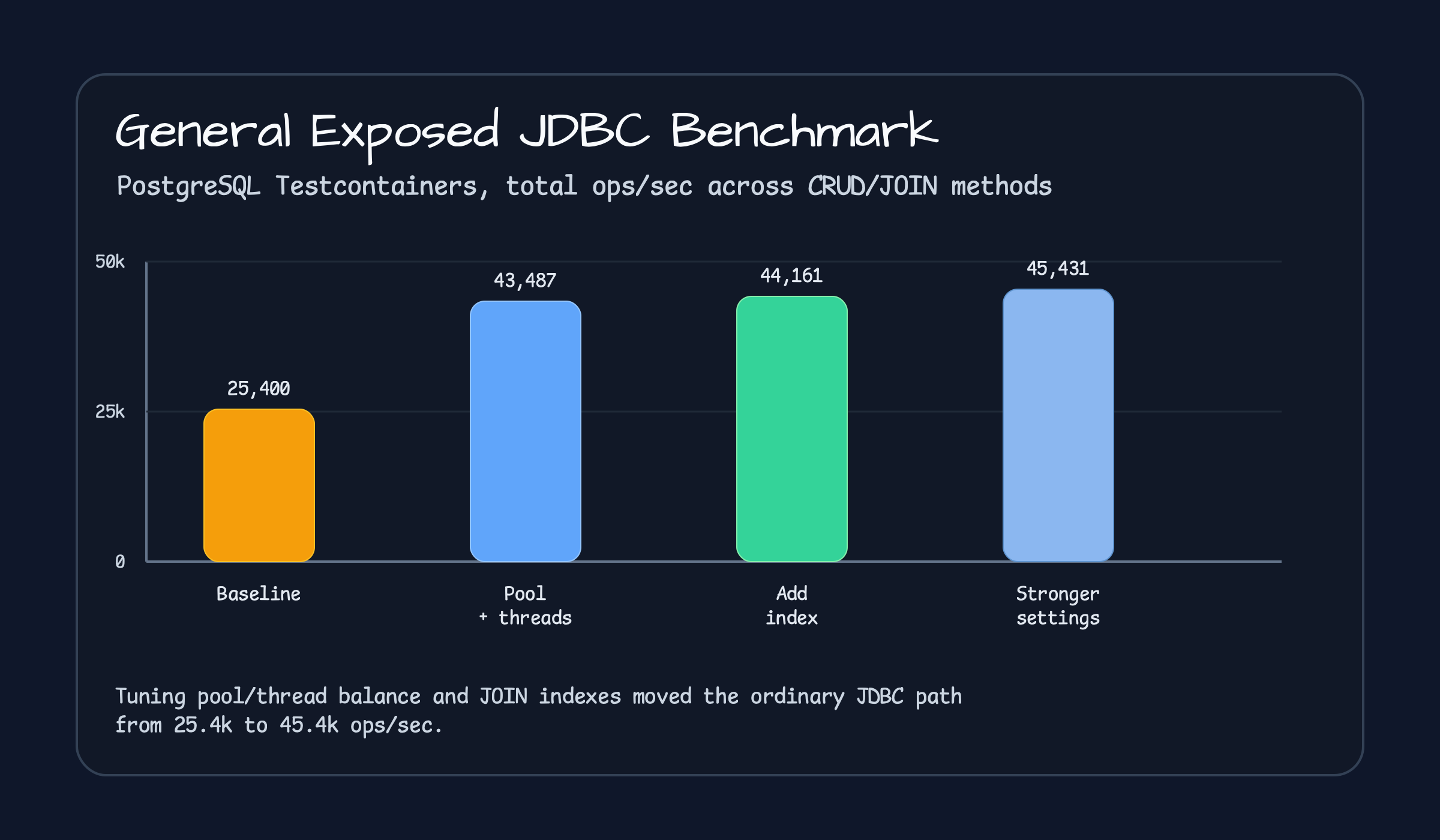
This is not a direct JDBC-vs-R2DBC comparison. It is evidence that the ordinary Exposed JDBC
path is sensitive to pool size, thread concurrency, and index design. In other words, measure
the basic path before assuming Virtual Threads will rescue anything. A more aggressive
synchronous_commit=off style tuning was rejected because it improved some inserts while
hurting SELECTs badly. A good benchmark cannot make one number pretty while damaging the whole
workload.
The benchmark method is intentionally ordinary.
@Benchmark@Threads(14)open fun singleFindById(): Int { val pk = (findIdSeq.getAndIncrement() % SEED_USERS) + 1 return transaction(database) { BenchmarkUsers .selectAll() .where { BenchmarkUsers.id eq pk } .count() .toInt() }}JDBC vs R2DBC Batch Comparison
Section titled “JDBC vs R2DBC Batch Comparison”The direct comparison lives in bluetape4k-exposed/utils/batch/benchmark.
| Axis | Value |
|---|---|
| Databases | H2, MySQL, PostgreSQL |
| JDBC path | JDBC + Virtual Threads |
| R2DBC path | R2DBC + Coroutines |
| Scenarios | seedBenchmark, endToEndBatchJobBenchmark |
| Parameters | dataSize = 1000/10000/100000, poolSize = 10/30/60, parallelism = 1/4/8 |
Entrypoints look like this.
./gradlew :exposed-batch:mysqlJdbcBenchmark./gradlew :exposed-batch:mysqlR2dbcBenchmark
./gradlew :exposed-batch:postgresJdbcBenchmark./gradlew :exposed-batch:postgresR2dbcBenchmark
The meaning is not “JDBC is always better.” It is narrower and more useful.
- The workload is batch insert and batch job oriented.
- The comparison includes actual Exposed/JDBC and Exposed/R2DBC implementation cost.
- It is not a coroutine microbenchmark.
- Driver maturity and DB-specific protocol paths are part of the result.
That makes it an end-to-end comparison from the application’s point of view.
Result Summary
Section titled “Result Summary”By ops/sec, JDBC won this many combinations.
| DB | Comparisons | JDBC wins | R2DBC wins | Large batch E2E parallelism=8 |
|---|---|---|---|---|
| MySQL | 36 | 36 | 0 | JDBC about 8.4-8.8x |
| PostgreSQL | 36 | 33 | 3 | JDBC about 4.9-5.2x |
| H2 | 36 | 36 | 0 | JDBC strongly ahead, but in-memory caveat applies |
The MySQL seed benchmark was especially wide. At dataSize=100000, JDBC reached about
1.455 ops/sec; R2DBC was about 0.050 ops/sec, roughly a 29x difference.
For the large end-to-end job, the result is easier to read.
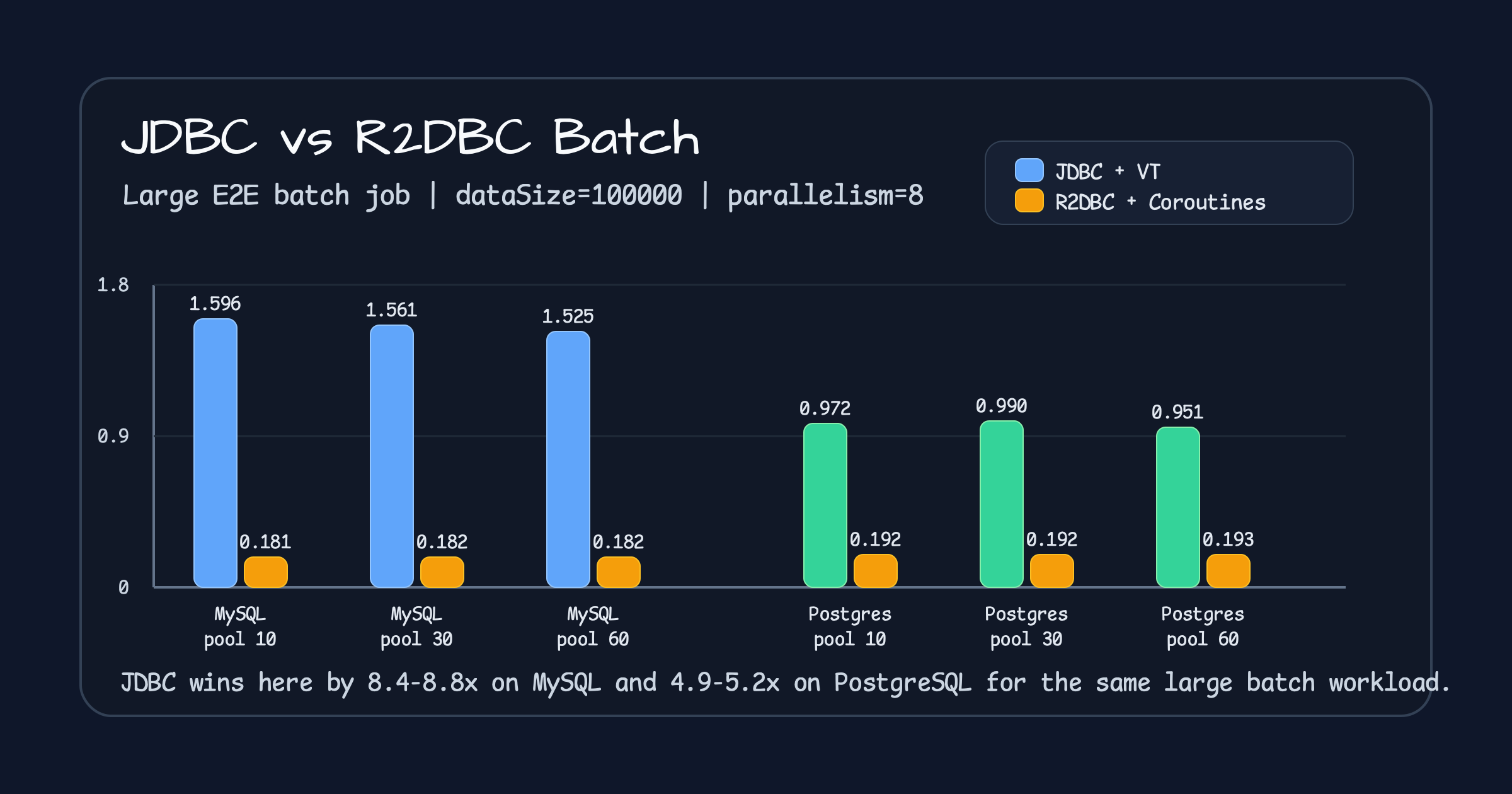
| DB | poolSize | JDBC ops/sec | R2DBC ops/sec | JDBC/R2DBC |
|---|---|---|---|---|
| MySQL | 10 | 1.596 | 0.181 | 8.8x |
| MySQL | 30 | 1.561 | 0.182 | 8.6x |
| MySQL | 60 | 1.525 | 0.182 | 8.4x |
| PostgreSQL | 10 | 0.972 | 0.192 | 5.1x |
| PostgreSQL | 30 | 0.990 | 0.192 | 5.2x |
| PostgreSQL | 60 | 0.951 | 0.193 | 4.9x |
PostgreSQL pointed the same way. JDBC won 33 of 36 combinations, and in the large end-to-end
job with parallelism=8 it was about 5x higher than R2DBC.
H2 was even more extreme, but H2 is in-memory and should not be treated as a direct network DB lesson. It is better read as a supporting signal: when JDBC overhead is low, Virtual Threads can drive a simple path effectively.
Why Did This Happen?
Section titled “Why Did This Happen?”R2DBC + Coroutines looks more modern on paper. It wraps callbacks in suspend APIs, uses fewer threads, and multiplexes more work through non-blocking I/O. That is real. It is also not the only cost in a batch workload.
| Cost | Explanation |
|---|---|
| driver maturity | JDBC batch paths have been tuned for a long time |
| protocol round-trip | non-blocking does not remove round-trips |
| mapping overhead | reactive stream/suspend bridge cost is part of end-to-end time |
| backpressure granularity | row-level backpressure can be excessive for batch jobs |
| connection pool behavior | DB concurrency is still bounded by connections and server capacity |
Virtual Threads help because the JDBC call may block, but it does not block an expensive platform thread. That lets us keep the fast JDBC batch path and still raise concurrency.
Executors.newVirtualThreadPerTaskExecutor().use { executor -> partitions.forEach { partition -> executor.submit { transaction { processPartition(partition) } } }}The code does not look special. That is a feature. Transaction boundaries, exceptions, stack traces, and profilers still look familiar.
Similar Direction to Coroutine Performance Gains
Section titled “Similar Direction to Coroutine Performance Gains”Virtual Threads and Coroutines solve a related problem: work that is waiting should not tie up expensive carrier resources for too long. That is why they can both improve I/O-heavy workloads.
The implementation tradeoffs differ.
| Aspect | Coroutines | Virtual Threads |
|---|---|---|
| API shape | suspend propagates through the API | Blocking APIs can stay |
| DB access | Fits async drivers such as R2DBC | Fits blocking drivers such as JDBC |
| tooling | Coroutine debugger/context matters | Thread dumps/JFR/thread stacks remain familiar |
| migration | API surface changes | Call stacks change less |
What the bluetape4k-exposed benchmark made clear is that “async is theoretically more
scalable” is not enough. Driver and workload matter. In this batch workload, JDBC + Virtual
Threads was both simpler and faster.
When R2DBC Still Fits
Section titled “When R2DBC Still Fits”This is not an argument to delete R2DBC. It is the better fit in plenty of cases.
- The whole stack is already reactive or suspend-first.
- Streaming responses and backpressure are core domain concerns.
- The database driver’s R2DBC path is fast for the actual workload.
- Reactive pipeline observability is more familiar than thread-per-request observability.
- Transactions are short and rows should be processed as a stream.
But “R2DBC must be faster” is no longer a safe assumption. For batch, insert-heavy, or transaction-heavy workloads, JDBC + Virtual Threads deserves a measurement.
Practical Rule
Section titled “Practical Rule”My rule from this result is:
| Situation | Try first |
|---|---|
| legacy JDBC code already exists | JDBC + Virtual Threads |
| many batch inserts/updates | JDBC + Virtual Threads benchmark |
| service API is suspend-first | R2DBC + Coroutines |
| streaming/backpressure is central | R2DBC + Coroutines |
| performance claim matters | Measure both on the same workload |
Virtual Threads put JDBC back into the “worth measuring” category. The JDBC retirement party can
wait a little longer. For Kotlin/JVM backend services, that is very practical: you can keep
existing blocking code and improve throughput without converting every API to suspend.
Part 4 shows how to expose that choice as a library API. Java 21 and Java 25 both belong to the
Virtual Threads era, but their available APIs differ, so bluetape4k-projects separates common
API from JDK-specific implementations.
Comments
Leave a note or reaction with your GitHub account.