
Bluetape4k Ecosystem at a Glance

Bluetape4k can look large at first. There are separate repositories for projects, exposed, aws,
image, text, leader, javers, graph, and dependencies, and each repository contains
multiple modules. This first introduction post is a map: where to start, which layer owns which
responsibility, and how the repositories fit together.
The core structure is simple. Spring Boot 4 or Ktor 3 owns the application boundary. Bluetape4k fills the domain capability, data, infrastructure, and foundation layers underneath. A service does not pull in everything. It picks the modules that match the boundary it actually touches.
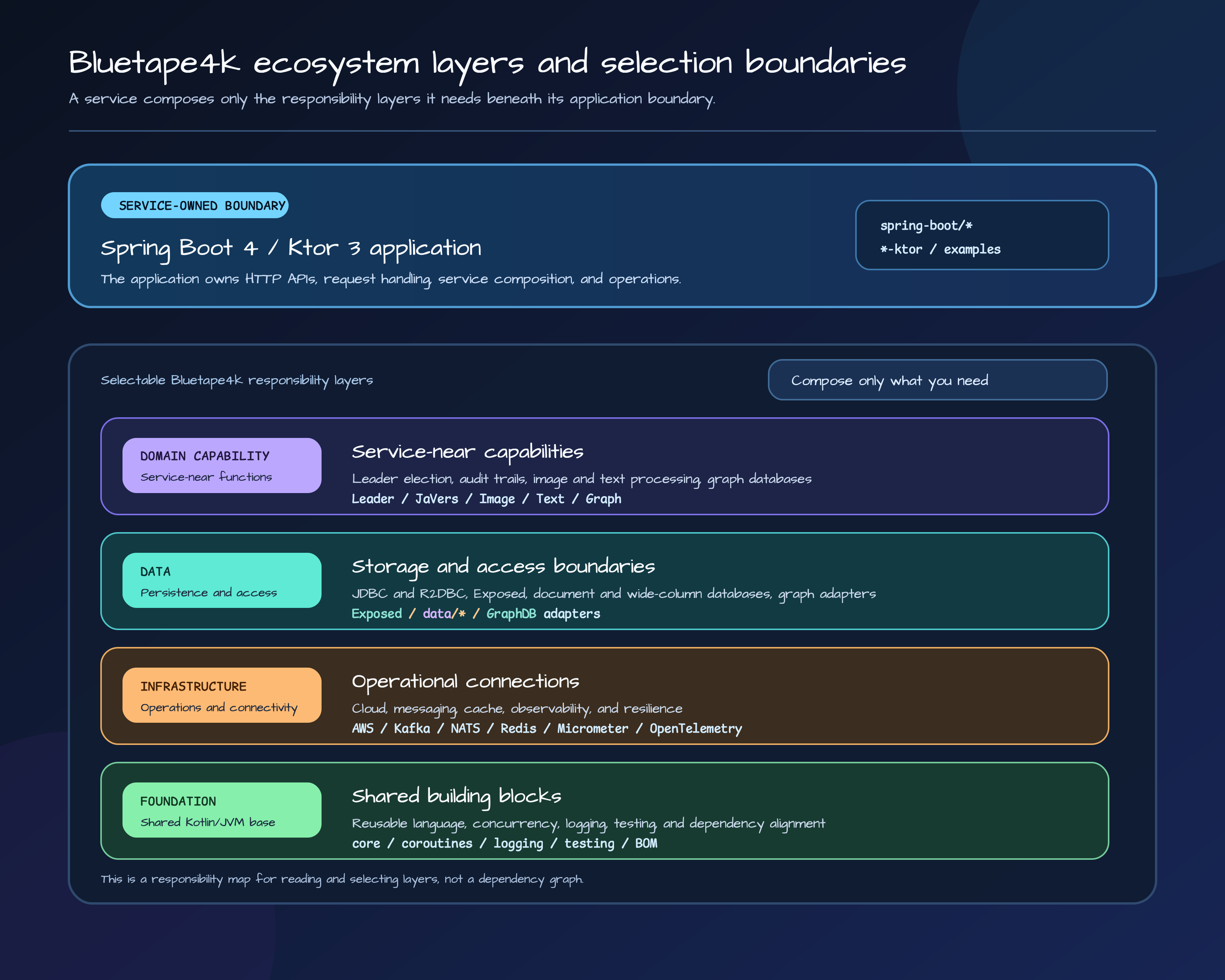
Overall Layer Map
Section titled “Overall Layer Map”| Layer | Role | Representative repositories and modules |
|---|---|---|
| Application | Spring Boot 4 and Ktor 3 application boundary | spring-boot/*, *-ktor, examples |
| Domain Capability | Feature groups close to service domains | Leader, JaVers, Image, Text, Graph |
| Data | JDBC, R2DBC, Exposed, and document/wide-column database helpers | Exposed, data/*, GraphDB adapters |
| Infrastructure | Cloud, messaging, cache, observability, and resilience | AWS, Kafka, NATS, Redis, Micrometer, OpenTelemetry, Resilience4j |
| Foundation | Shared Kotlin/JVM foundation | core, coroutines, logging, testing, BOM |
This table is more of a reading order than a dependency graph. Start with the foundation, then choose data, infrastructure, and domain-capability modules based on the boundary your service actually touches.
Application Layer
Section titled “Application Layer”The application layer belongs to Spring Boot 4 or Ktor 3. Bluetape4k does not try to replace those frameworks. It provides the repeated auto-configuration, coroutine data access, Redis/cache, cloud integration, and examples that sit inside them.
Spring Boot 4
Section titled “Spring Boot 4”The Spring Boot 4 modules connect Bluetape4k data, cache, infrastructure, and testing modules into a Spring application.
Key modules:
spring-boot/core: Spring Boot auto-configuration and common property bindingspring-boot/r2dbc: R2DBC coroutine data access integrationspring-boot/redis: Redis/Lettuce application cache and Redis integrationspring-boot/mongodb,spring-boot/cassandra: document and wide-column database integrationspring-boot/hibernate-lettuce: Hibernate second-level cache and Lettuce cache integration
These modules keep coroutine, R2DBC, Redis, MongoDB, and Cassandra boundaries wired consistently inside Spring Boot applications.
Ktor 3
Section titled “Ktor 3”Ktor modules focus on suspend APIs and coroutine clients. They are useful when a service wants a lighter runtime than Spring Boot but still needs AWS, leader election, or graph database integration.
Key modules:
aws-ktor: AWS SDK integration for Ktor servicesleader-ktor: leader election integration for Ktor applicationsgraph-ktor: graph database integration for Ktor boundariesexamples/aws-ktor-*: examples combining AWS, leader election, and graph database modules
Ktor 3 modules do not create a new framework. They provide an adoption path for using Bluetape4k modules inside Ktor services.
Domain Capability Layer
Section titled “Domain Capability Layer”The domain capability layer contains feature groups that are close to service-domain problems: leader election, audit trails, image processing, text processing, and graph databases.
Leader
Section titled “Leader”Leader modules let distributed services assign batch jobs, schedulers, polling workers, and migration gates to one node or a limited group of nodes.
Key modules:
leader-core: leader election APIs and execution modelleader-redis-lettuce,leader-redis-redisson: Redis-backed implementationsleader-hazelcast,leader-mongodb,leader-zookeeper: distributed backend variantsleader-exposed-jdbc,leader-exposed-r2dbc: database-backed implementationsleader-spring-boot,leader-ktor: application framework integration
The main features are runIfLeader(), blocking/CompletableFuture/coroutine/Virtual Threads
execution models, and LeaderGroupElector for multi-leader work.
JaVers
Section titled “JaVers”JaVers modules handle audit trails for aggregate and domain-object changes.
Key modules:
javers-core: JaVers helpers, codecs, and cache-backed repository supportjavers-persistence-redis: Redis Lettuce/Redisson snapshot storagejavers-persistence-kafka: Kafka event-stream persistencebom: JaVers dependency version alignment
The main features are aggregate/domain object history, Redis or Kafka-backed audit storage, and DDD-style diff, snapshot, and history lookup.
Image modules let a service choose between ordinary JVM image processing and libvips-backed high throughput processing.
Key modules:
images: Scrimage-based pure JVM image processingimages-vips-api: libvips abstraction and common APIimages-vips-java21: Java 21 JVips/JNI backendimages-vips-java25: Java 25 FFM/Panama backendimages-spring-boot,images-benchmark: Spring Boot integration and benchmarks
The main features are resize, crop, filter, encode, and batch processing. A service can start with pure JVM image work and move high-volume thumbnail or resize pipelines to libvips.
Text modules provide Korean/Japanese tokenization, language detection, and keyword search for Kotlin services.
Key modules:
tokenizer-core: common request/response models and dictionary utilitiestokenizer-korean: Korean normalization, POS tokenization, and phrase extractiontokenizer-japanese: Japanese tokenization with Kuromoji IPAdiclingua: language detection through Linguatext-search: Aho-Corasick search, replacement, and word filtering
The main features are Korean/Japanese text analysis, mixed-language detection, forbidden-word or keyword search, and replacement pipelines.
Data Layer
Section titled “Data Layer”The data layer covers persistence and database integration: Exposed DSL, JDBC/R2DBC repositories, document database helpers, and graph database adapters.
Exposed
Section titled “Exposed”Exposed modules provide a Kotlin DSL-oriented persistence model and let JDBC and R2DBC follow a similar repository pattern.
Key modules:
exposed-core: common repositories, query helpers, and DSL supportexposed-jdbc,exposed-r2dbc: JDBC and R2DBC adapters- cache, JSON, encryption, and dialect-extension modules
- Spring Boot JDBC/R2DBC integration
The main features are type-safe SQL, JDBC repositories, R2DBC coroutine repositories, CTE/recursive CTE/batch/measured-query helpers, JSON columns, encrypted columns, and database-specific extensions.
GraphDB
Section titled “GraphDB”GraphDB modules reduce API differences across graph databases and provide a common API for services where graph data is a major part of the model.
Key modules:
graph-core: graph models, repository abstraction, blocking API, and coroutine APIgraph-neo4j,graph-memgraph,graph-age,graph-tinkerpop,graph-falkordb: database adaptersgraph-io/core,graph-io/csv,graph-io/graphml,graph-io/jackson2,graph-io/jackson3,graph-io/okio: import/export and serializationgraph-spring-boot,graph-ktor: framework integrationexamples/*-graph-examples: code graph, knowledge graph, fraud detection, and recommendation examples
The main features are common access to Neo4j, Memgraph, AGE, TinkerGraph, and FalkorDB; node/edge batch insert; merge/upsert; schema and index management; transaction blocks; weighted paths; graph algorithm operations; and bulk I/O with CSV, NDJSON, GraphML, and OkIO streams.
General Data Modules
Section titled “General Data Modules”Some data helpers are not tied to Exposed or GraphDB.
data/hibernate: Hibernate persistence utilitiesdata/r2dbc: common R2DBC helpersdata/jdbc: JDBC data-access utilitiesdata/mongodb: MongoDB integration helpersdata/cassandra: Cassandra integration helpers
These modules reduce repeated repository, transaction, serialization, and Spring Boot data integration patterns for relational, document, and wide-column databases.
Infrastructure Layer
Section titled “Infrastructure Layer”The infrastructure layer is close to production operations: cloud, messaging, cache, observability, and resilience.
AWS modules wrap AWS Java SDK v2 and AWS Kotlin SDK patterns for service code.
Key modules:
aws: AWS Java SDK v2 helpersaws-kotlin: AWS Kotlin SDK coroutine-first helpersaws-spring-boot: Spring Boot 4 integrationaws-ktor: Ktor 3 integrationexamples/aws-*: S3, DynamoDB, SQS, and LocalStack/FLOCI examples
The main features are coroutine-friendly access to S3, DynamoDB, and SQS, plus local integration testing through LocalStack/FLOCI.
Messaging
Section titled “Messaging”Messaging modules reduce repeated setup for event pipelines and async integration.
infra/kafka,infra/kafka4: Kafka client integrationinfra/kafka-logback: application logging through Kafka event pipelinesinfra/nats: NATS messaging integrationinfra/pulsar: Pulsar messaging integration
The main features are Kafka/NATS/Pulsar client configuration and application logging or event pipeline integration.
Cache and Redis
Section titled “Cache and Redis”Cache and Redis modules cover local cache, distributed cache, and Redis client integration.
infra/redis,infra/lettuce,infra/redisson: Redis clients and distributed primitivescache/cache-core: common cache abstractioncache/cache-lettuce,cache/cache-redisson: Redis-backed cache backendscache/cache-hazelcast: Hazelcast distributed cache backendcache/hibernate-cache-lettuce: Hibernate second-level cache integration
The main features are local cache with Caffeine, distributed cache with Redis or Hazelcast, repository cache, Hibernate cache, application cache, near-cache, and 2-tier cache patterns.
Observability and Resilience
Section titled “Observability and Resilience”Production services need metrics, tracing, resilience, and rate limiting.
infra/micrometer: Micrometer metrics integrationinfra/opentelemetry: OpenTelemetry tracinginfra/resilience4j: retry, circuit breaker, and rate-limiter integrationinfra/bucket4j: rate-limiting supportutils/measured: measurement and logging helpers
These modules keep metric, tracing, and retry boilerplate out of application code and turn them into shared operational patterns.
Foundation Layer
Section titled “Foundation Layer”The foundation layer is the shared Kotlin/JVM base used across most Bluetape4k modules.
Core and Utilities
Section titled “Core and Utilities”bluetape4k/core: guards, validation, extensions, and common typesbluetape4k/annotations: API maturity opt-in annotationsbluetape4k/logging: Kotlin-friendly loggingutils/*: frequently used utility modules
These modules provide shared types and utilities so service code does not rebuild the same validation, logging, and extension patterns.
Coroutines and Virtual Threads
Section titled “Coroutines and Virtual Threads”Coroutine and Virtual Threads modules handle the execution model between Kotlin coroutines and Java Virtual Threads.
bluetape4k/coroutines: coroutine helpers and suspend-friendly utilitiesvirtualthread/api: common API for Virtual Threads abstractionvirtualthread/jdk21: Java 21 Virtual Threads supportvirtualthread/jdk25: Java 25 Virtual Threads support
The main features are suspend APIs, coroutine execution helpers, and a migration path for running blocking SDKs or JDBC work on Virtual Threads.
Testing
Section titled “Testing”Testing modules provide assertions, JUnit 5 helpers, Testcontainers launchers, and mock servers.
testing/assertions: bluetape4k assertion helperstesting/junit5: JUnit 5 test utilitiestesting/testcontainers: Testcontainers singleton launcherstesting/mock-web-server: HTTP client test supporttesting/mock-webflux-server: WebFlux/WebClient test support
The main features are assertion helpers, coroutine test support, Redis/database/messaging Testcontainers launchers, and HTTP/WebFlux mock servers.
BOM and Version Governance
Section titled “BOM and Version Governance”When the ecosystem is split across many repositories, dependency version drift becomes a real cost. BOMs and the dependency catalog reduce that drift.
bluetape4k-dependencies: ecosystem-wide dependency alignmentbluetape4k/bom: core repository alignment- repository-local BOMs: AWS, Exposed, Image, JaVers, Leader, Text, and Graph alignment
The main features are aligned dependency sets for Kotlin, Spring Boot, Exposed, AWS SDK, Testcontainers, and related libraries across different repository release cadences.
How to Read the Ecosystem
Section titled “How to Read the Ecosystem”For a new team, the easiest starting point is the application boundary: Spring Boot 4 or Ktor 3. Then read the foundation layer for core utilities, coroutines, testing, and BOM alignment. After that, add data and infrastructure modules based on the boundary your service actually touches. If the problem is leader election, audit trails, image processing, text processing, or graph data, move into the domain capability layer.
Bluetape4k is not one large framework. It is an ecosystem of small modules that can be added gradually to existing Spring Boot 4 or Ktor 3 services. The next posts will break the layers down further and look at representative repositories, architecture, and usage examples.
Comments
Leave a note or reaction with your GitHub account.