Turning AI Collaboration Into Infrastructure
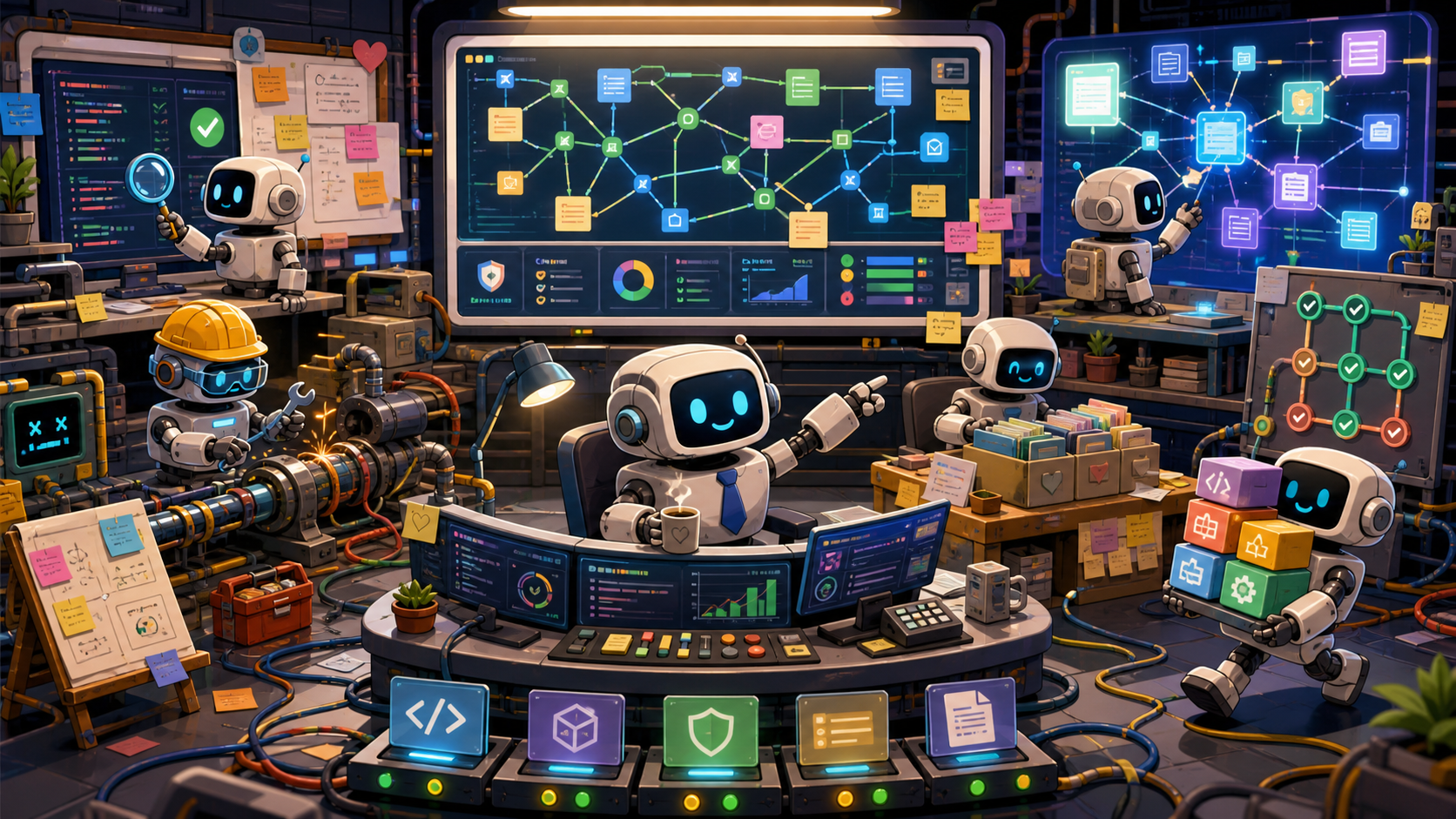
After reading Eugene Yan’s “How to Work and Compound with AI”, I wanted to write down how bluetape4k actually runs its AI working environment. The previous post was about what Claude Code and Codex helped build. This post is about what had to exist around them so that every session did not start from zero again.
At first, I thought a good prompt would be enough. It was not. Once the repositories grew and the rules around Kotlin, Spring, Exposed, Ktor, GitHub issues, PRs, lessons, CI, and releases started to interlock, prompts alone became too fragile. AI needed the same kind of onboarding docs, working procedures, searchable history, and verification gates that a human teammate would need.
In bluetape4k, that responsibility is shared by AGENTS.md, CLAUDE.md, skills, qmd, memory, and
hooks. Models keep changing. This working environment survives into the next session.
The Full Process
Section titled “The Full Process”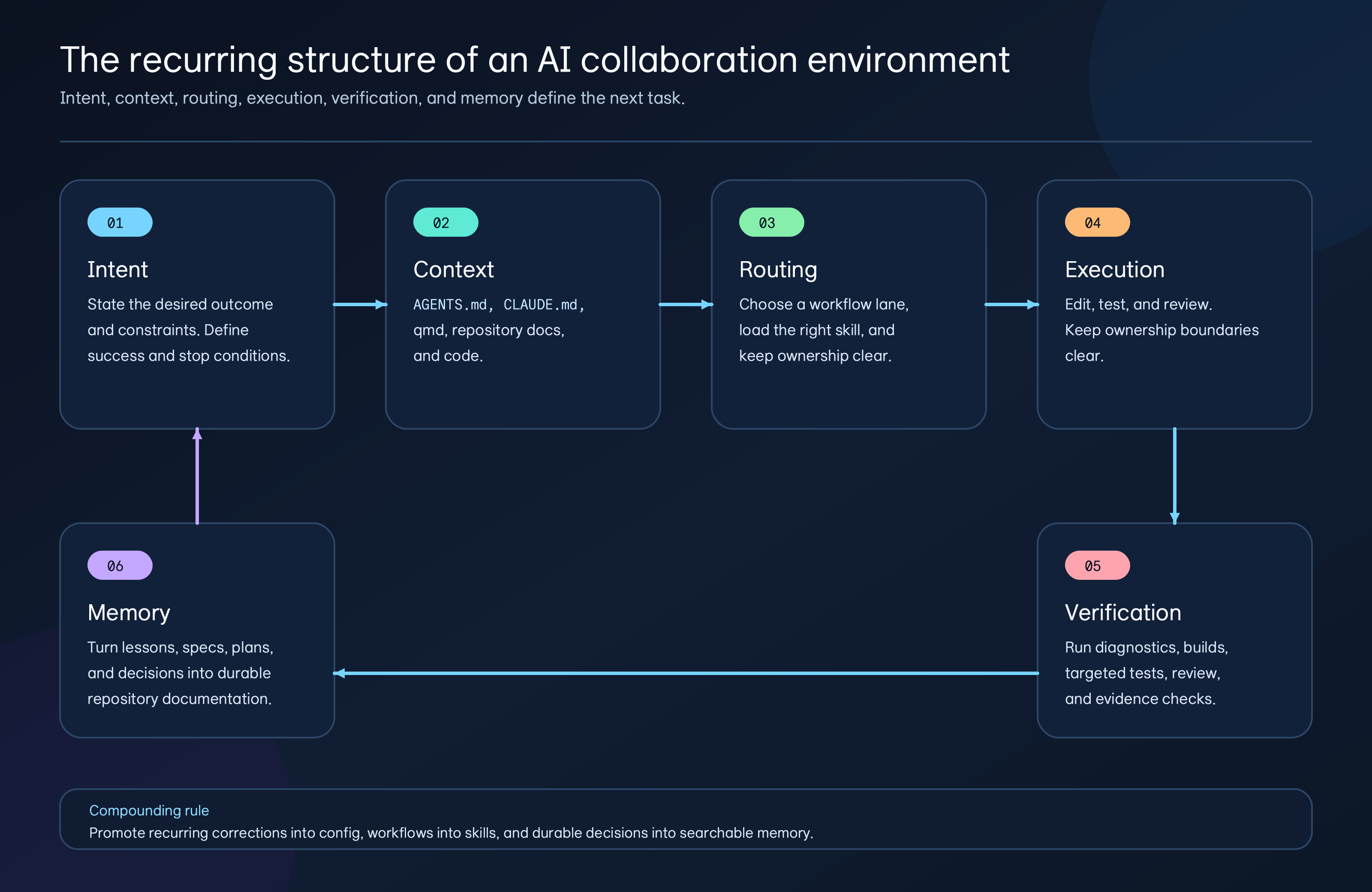
AGENTS.md and CLAUDE.md Are Onboarding Docs
Section titled “AGENTS.md and CLAUDE.md Are Onboarding Docs”When a human joins a project, you give them more than a README. You explain the code layout, branch policy, test style, documentation language, choices to avoid, and old decisions that still shape the project. AI needs the same information.
In the bluetape4k workspace, AGENTS.md is the primary onboarding document for Codex. It says that
conversation with the user stays in Korean, while public KDoc, PRs, and commit messages are written
in English. It records the Git policy: develop is the integration branch, and main is
release-only. It also records the Kotlin workflow: inspect references and impact before editing
Kotlin code; after touching .kt files, run IDE diagnostics, optimize imports, resolve deprecations,
then compile and test the affected modules.
Claude gets the same kind of guidance through ~/.claude/CLAUDE.md, commands, skills, and hooks.
Codex gets it through ~/.codex/config.toml, skills, MCP, native subagents, and repo-local
AGENTS.md files. The tooling is different, but the purpose is the same: onboard each new session
like a new teammate and promote repeated preferences into durable configuration.
These documents are layered. Global rules live under the home directory. Workspace-wide bluetape4k rules live at the workspace root. Each repository can add narrower rules. A Kotlin library repository and a blog repository cannot share every detail, so the closest document provides the most specific guidance.
Skills Are Procedures for Repeated Work
Section titled “Skills Are Procedures for Repeated Work”If a prompt says “think this way,” a skill says “work through this procedure.” Repeated work becomes fragile when it is left to a few prompt lines. A skill can say which context to read first, which gate to pass, and which verification evidence is required.
In bluetape4k, bluetape4k-workflow is the first router. It classifies work as Type A Full Feature,
B Fast Track, C Bug Fix, D Code Review, E Maintenance, P Publish, or F Self Improve, then selects the
verification level that fits the work.
More focused skills sit below it. bluetape4k-full-feature handles new modules, broad API changes,
and multi-layer work. bluetape4k-code-patterns handles Kotlin implementation and validation.
bluetape4k-bugfix owns reproducible fixes, while bluetape4k-publish and
bluetape4k-publish-go own release work. ecc-kotlin-exposed, ecc-springboot-kotlin,
ecc-kotlin-testing, and kotlin-coroutines-skill separate domain-specific judgment.
Instructions like “also update the README,” “watch for deprecated Exposed imports,” or “prove this
with affected module tests” are easy to forget when they have to be repeated every time. Loading the
right skill brings a blocking checklist into the task. Every executable row names its action,
evidence, and failure behavior. Unchecked rows block dependent work, SKIPPED is not accepted, and
N/A needs concrete scope evidence.
qmd Is the Search Layer for Old Decisions
Section titled “qmd Is the Search Layer for Old Decisions”AI sessions forget easily. Repositories accumulate docs, lessons, issues, PRs, plans, and experiments. qmd connects those two facts.
In bluetape4k, prior decisions, lessons, specs, plans, and historical context are searched through
qmd first. Workspace docs live in the bluetape4k-docs collection. Personal or cross-project
knowledge lives in the wiki collection.
Exact code symbols and filenames are still better handled with rg. But questions like “why did we
choose this?”, “where did we build something similar?”, or “did this fail before?” are better suited
to qmd. It narrows the relevant documents first, then the session can descend into code and PR
history.
That difference matters. Asking AI to read the whole repository is expensive and unstable. A search layer lets the session find the relevant context first and only read the range needed for the task.
Memory Must Escape the Session
Section titled “Memory Must Escape the Session”Claude and Codex both become unstable if session memory is the only source of truth. bluetape4k keeps memory in several layers.
Short-lived work state lives in runtime artifacts such as .omx/state, .omx/notepad.md, and
.omx/plans. Longer-lived design decisions live in docs/superpowers/specs and
docs/superpowers/plans. Lessons learned from completed work live in docs/lessons.
A lesson does not need to be long. It should record the context, decision, outcome, verification evidence, and what the next agent should do differently. That is enough to keep the next AI session from re-inferring the same decision.
The important part is not storage. The important part is whether the next task reads it. If a lesson
does not feed a skill, cannot be found through search, and is never read during the next task, it is
just an old note. Repeated lessons should become skills, AGENTS.md rules, hooks, or tests.
Hooks Catch Frequent Mistakes Early
Section titled “Hooks Catch Frequent Mistakes Early”Telling AI to “be careful” is not enough. Humans need CI, pre-commit checks, and linting. AI needs guardrails too. Rules that matter repeatedly should become hooks.
Claude has hooks for sensitive-file blocking, destructive-git guarding, Kotlin checks, Gradle test guards, README sync reminders, and keyword detection. Codex uses hooks, native subagents, skill routing, and MCP surfaces for similar purposes.
Hooks are not a sign that the model is untrusted. They are a way to catch common mistakes early. Destructive commands, branch-name mistakes, sensitive-file access, workflow drift, and missing tests are cheaper to stop during the task than after CI or review finds them.
Delegation Needs Verification
Section titled “Delegation Needs Verification”Codex native subagents and OMX team mode can run work in parallel. Parallelism does not guarantee quality. It changes the bottleneck from implementation speed to ownership and verification: which agent owns which files, how the result is checked, and where conflicts are reported.
That is why bluetape4k does not treat an explanation as proof of completion. For a small change, a targeted test or build check may be enough. If Kotlin code changed, IDE diagnostics, import cleanup, deprecation checks, and affected module tests are expected. If a public API changed, KDoc and README coverage matter. If GitHub workflow files changed, nightly workflow impact is checked too.
Those rules make delegation usable. Multiple agents can move at once only when the final judgment can still rely on verification evidence and a clear change boundary.
Codex and Claude Read the Same Environment Differently
Section titled “Codex and Claude Read the Same Environment Differently”In practice, Codex and Claude do not work exactly the same way. Codex is governed through
AGENTS.md, skills, MCP/context-mode, qmd, and native subagents. Claude is governed through
CLAUDE.md, commands, skills, hooks, and project histories.
That means durable guidance cannot stay on only one side. If Codex discovers a repeated rule that Claude also needs, it should move into repository docs or a shared skill. If Claude repeatedly catches a problem, the fix should become something Codex can read too.
The core instruction is simple:
Follow this repository workflow, inspect the impact, prove the change with tests, and leave a short lesson for the next agent.
The Environment Also Needs Refactoring
Section titled “The Environment Also Needs Refactoring”An AI working environment ages like a codebase. Skills can overlap. Hooks can warn about the wrong
thing. Long AGENTS.md and CLAUDE.md files can bury the rule that actually matters. The
environment itself needs maintenance.
My rule is simple. If I make the same correction twice, it should become a rule or skill. If I see the same failure three times, it should become a hook or test. If a procedure is no longer used, delete it. Do not preserve one-off notes forever; promote repeatable decisions into durable artifacts.
Conclusion
Section titled “Conclusion”The main lesson from working with AI over time is that the environment compounds more than the model.
Models change. A well-organized repository, clear AGENTS.md and CLAUDE.md, reusable skills,
qmd-searchable knowledge, verification hooks, and short lessons remain useful across sessions.
AI collaboration is less about a better prompt and more about a better working environment. If AI is used as a one-off generator, each session drifts. If AI is onboarded like a teammate, procedures are managed like code, and verification plus memory become infrastructure, the work becomes more stable across sessions.
Follow-Up: Turning the Working Environment Into Shareable Skills
Section titled “Follow-Up: Turning the Working Environment Into Shareable Skills”This article described AGENTS.md, skills, search, memory, and hooks as one AI collaboration
environment. Operating that environment exposed another set of problems: agents skipped parts of
long instructions, copied SKILL.md without its references, and lost live-only changes after the
next chezmoi apply. The bluetape4k-* namespace also looked too narrowly tied to Kotlin/JVM once Go,
Python, and Rust skills entered the same family.
The follow-up Bluetape Skills series records how we addressed those problems. Part 1 covers canonical
names, a distribution unit that includes references and validation scripts, mapping historical GNO
records across renamed skills, and source-first chezmoi synchronization. Part 2 explains how
$bluetape-workflow classifies requests and carries them through first-plan approval, blocking
checklists, and concrete completion evidence. Part 3 shows how the runtime records interrupted
workflow state so Codex can diagnose it and resume the work safely.
Comments
Leave a note or reaction with your GitHub account.