
Bluetape4k Text Part 2: Routing Input with Tokenizers and Language Detection
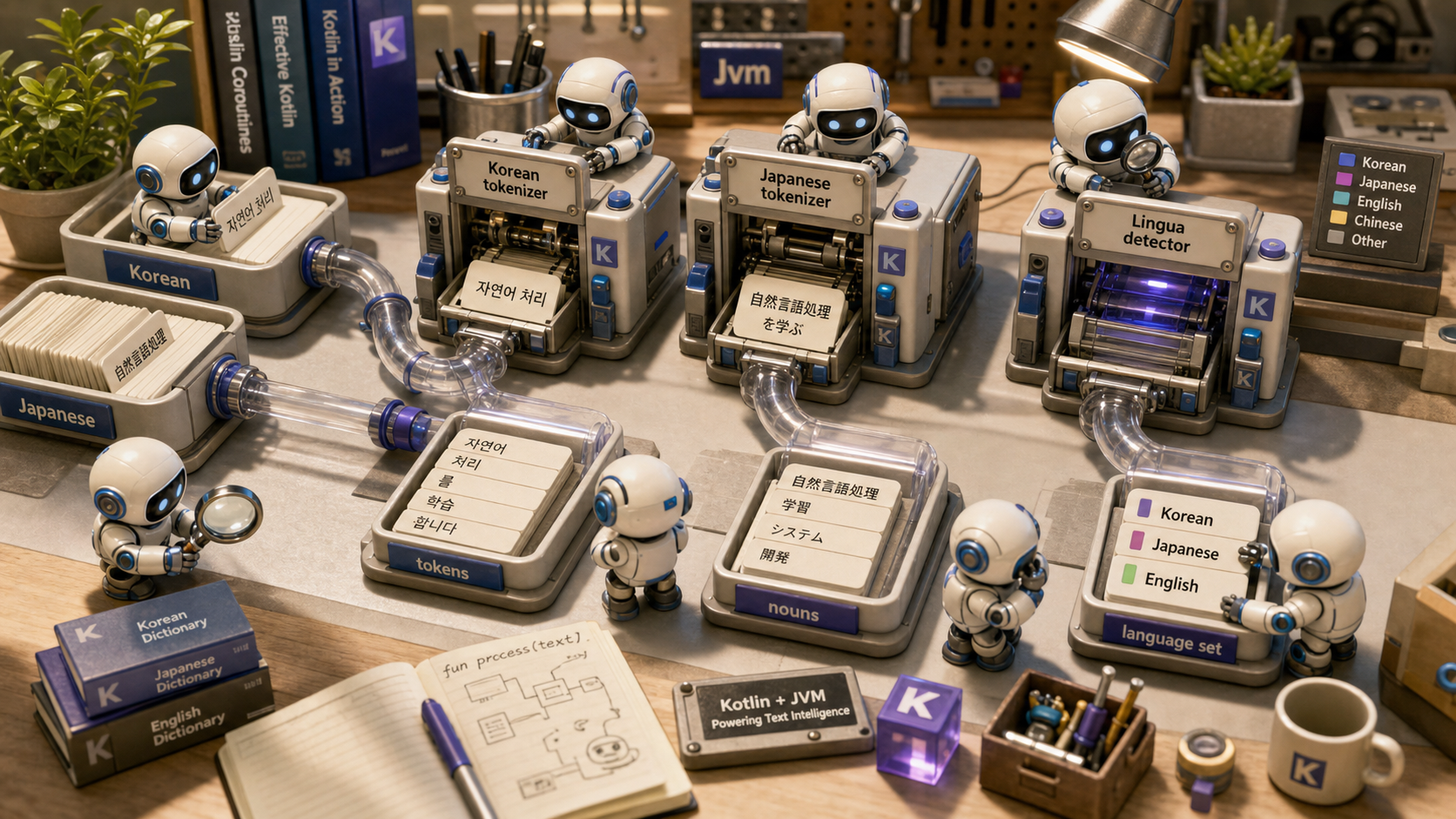
Part 1 mapped the whole bluetape4k-text repository. This post goes one level deeper from a service-input point of view. A user may submit a search query, report text, product name, or comment. The input may contain Korean, Japanese, English, or only emoji.
Pushing all of that through split(" ") is tempting at first. It stays simple until search quality drops, a blockword slips through, or a mixed-language input breaks an assumption. Then the code stops being “simple string handling” and becomes a debugging session around where the text was cut incorrectly.
The working rule for Part 2 is small:
- Validate the input boundary first.
- Detect the language.
- Send Korean text to
KoreanProcessor, Japanese text toJapaneseProcessor, and other input to a simpler fallback path. - Keep the result explicit: tokens, nouns, language sets, or fallback decisions.
Processing Path
Section titled “Processing Path”A service usually reads best when the path is drawn like this.
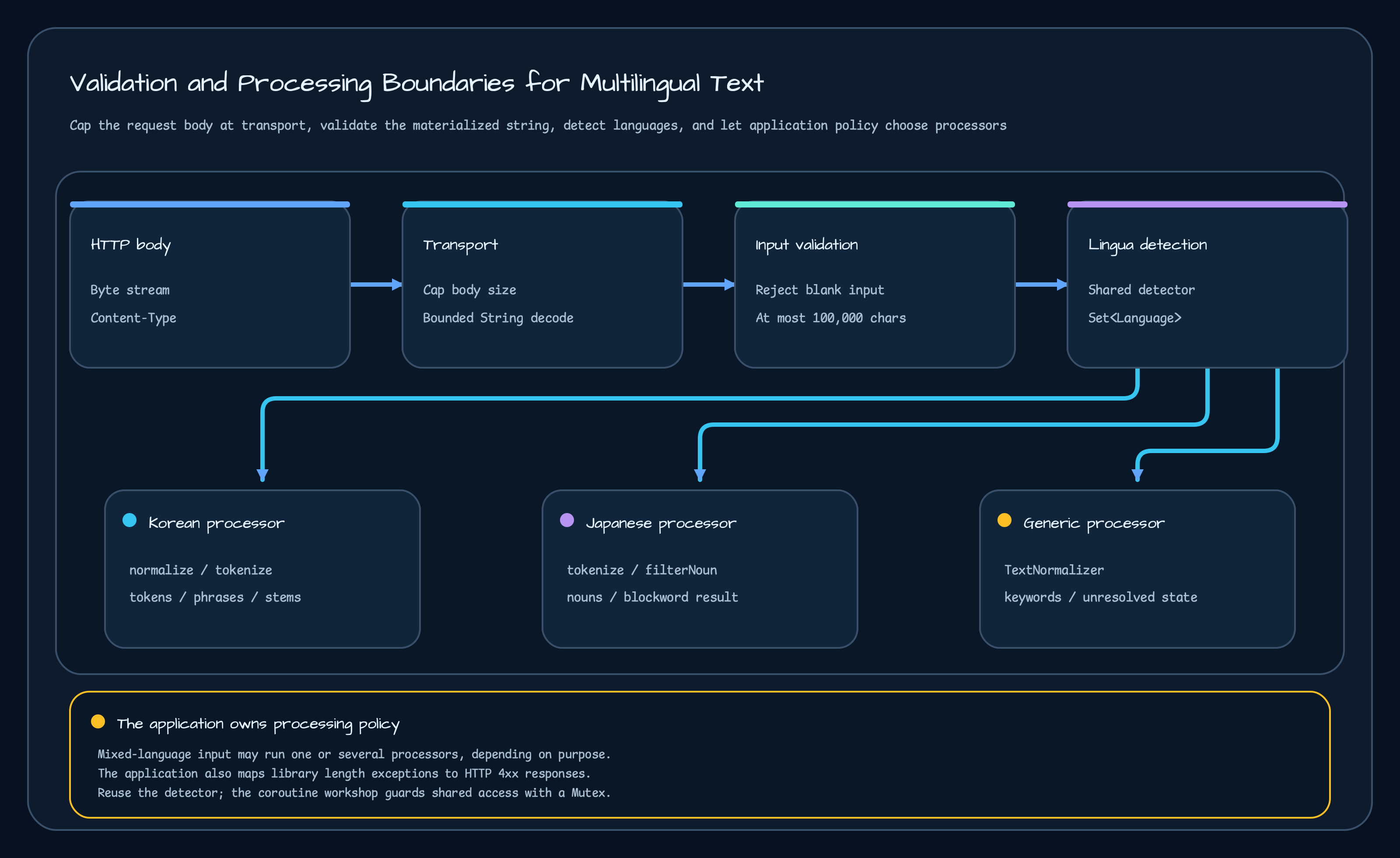
Lingua does not replace a tokenizer. It helps decide where the text should go. Korean and Japanese tokenization happen after that decision. If a service detects the language and then still sends every input through the same tokenizer path, the detector is mostly decorative. Decorative code is fun only until someone has to maintain it.
Korean Input: Normalize First, Then Freeze the Expected Output
Section titled “Korean Input: Normalize First, Then Freeze the Expected Output”Korean input often arrives in unstable forms. Repeated characters grow, informal typos appear, particles attach to nouns, and endings attach to verbs. Before indexing or filtering, keep normalization and tokenization as separate steps.
val normalized = KoreanProcessor.normalize("그랰ㅋㅋㅋㅋ 샤릉햌ㅋㅋ")// "그래ㅋㅋㅋ 사랑해ㅋㅋ"
val tokens = KoreanProcessor.tokenize(    KoreanProcessor.normalize("한국어를 처리하는 예시입니닼ㅋㅋㅋㅋ"))
val surfaces = KoreanProcessor.tokensToStrings(tokens)// ["한국어", "를", "처리", "하는", "예시", "입니다", "ㅋㅋㅋ"]
normalize reduces common colloquial noise, while tokenize returns tokens with part-of-speech and position metadata. If a service only needs surface strings, tokensToStrings removes space tokens and returns the text values.
Phrase extraction is another common Korean search path.
val phrases = KoreanProcessor.extractPhrases(    KoreanProcessor.tokenize(KoreanProcessor.normalize("한국어를 처리하는 예시입니닼ㅋㅋㅋㅋ")))
phrases.joinToString("/")// "한국어(Noun: 0, 3)/처리(Noun: 5, 2)/처리하는 예시(Noun: 5, 7)/예시(Noun: 10, 2)"
This is more than “cutting a string.” It creates units that downstream code can use for search candidates, index terms, recommendations, and tests. Freezing this output in tests makes dictionary updates and tokenizer changes easier to review.
Stemming is a separate decision as well.
val stemmed = KoreanProcessor.stem(KoreanProcessor.tokenize("가느다란"))stemmed.first().stem// "갈다"Services often need both the surface form and the normalized stem. The surface form is useful for display and highlighting. The stem is useful for grouping or search expansion. Mixing the two into a single string field usually becomes painful later.
Korean Dictionaries and Blockwords
Section titled “Korean Dictionaries and Blockwords”KoreanProcessor can extend noun and blockword dictionaries at runtime.
KoreanProcessor.addNounsToDictionary("블루테이프4K", "주말특가")
KoreanProcessor.addBlockwords(    listOf("은꼴사", "물쑈", "혼숙"),    severity = Severity.LOW,)
val response = KoreanProcessor.maskBlockwords(    BlockwordRequest("홈쇼핑 미니미는 무슨 은꼴사야 어쩌라구? 물쑈야? 혼숙이야?"))
response.maskedText// "홈쇼핑 미니미는 무슨 ***야 어쩌라구? **야? **이야?"
Runtime dictionary updates are useful because they do not require a service restart. They still change service behavior. A new dictionary word can change tokenization. A new blockword can hide normal text or stop a dangerous term from passing through. Both outcomes need tests.
Treat dictionary changes as behavior changes, not as harmless data edits. Keep representative input, expected tokens, and expected masking results near the change.
Japanese Input: Start with Noun Candidates
Section titled “Japanese Input: Start with Noun Candidates”JapaneseProcessor wraps Kuromoji IPAdic tokenization. The smallest useful check is the surface list.
val tokens = JapaneseProcessor.tokenize("お寿司が食べたい。")val surfaces = tokens.map { it.surface }// ["お", "寿司", "が", "食べ", "たい", "。"]For search and recommendation candidates, nouns are often the first useful result.
val nouns = JapaneseProcessor.filterNoun(    JapaneseProcessor.tokenize("私は、日本語の勉強をしています。")).map { it.surface }
// ["私", "日本語", "勉強"]
Making noun candidates explicit keeps downstream code simpler. The service can decide whether to index them, compare them against risk keywords, or use them as recommendation inputs. Starting with raw substring checks looks cheaper, but exception cases around particles, inflection, and compounds grow quickly.
Japanese blockword handling stays behind the same facade.
val found = JapaneseProcessor.findBlockwords("ホモの男性を理解できない").map { it.surface }// ["ホモ"]
val result = JapaneseProcessor.maskBlockwords(    blockwordRequestOf("ホモの男性を理解できない"))
result.maskedText// "**の男性を理解できない"
Japanese tokenization also validates oversized input before expensive work. If the boundary is missing, the tokenizer may get blamed for a problem that should have been rejected at the service edge.
Mixed Input: Both Sides Need to Survive
Section titled “Mixed Input: Both Sides Need to Survive”Real service input is not always single-language.
val ko = KoreanProcessor.tokensToStrings(    KoreanProcessor.tokenize(KoreanProcessor.normalize("서울에서 東京까지 주말 특가 티켓")))// contains ["서울", "에서", "까지", "주말", "특가", "티켓"]
val ja = JapaneseProcessor.tokenize("서울から東京まで週末チケット").map { it.surface }// contains ["東京", "週末", "チケット"]
These tests do not claim perfect translation. They check that the Korean tokenizer preserves Korean surfaces and that the Japanese tokenizer preserves Japanese surfaces in mixed input. That is the practical baseline a service often needs.
Lingua: Reuse the Detector
Section titled “Lingua: Reuse the Detector”Language detection starts with the lingua helpers.
val detector = allLanguageDetector {    withMinimumRelativeDistance(0.0)}
detector.detectAllLanguagesOf("Hello 안녕 こんにちは")// setOf(Language.ENGLISH, Language.KOREAN, Language.JAPANESE)
detectAllLanguagesOf returns an empty set for blank input and for input that has no usable language signal.
detector.detectAllLanguagesOf("   ")// emptySet()
detector.detectAllLanguagesOf("🔥🎉🧪")// emptySet()
Treat the empty set as an explicit fallback condition. A search query may go through generic normalization only. A report flow may store “language unresolved” for later review. The important part is not pretending that detection succeeded.
The detector should be reused because model construction is expensive. The workshop LanguageDetectionService keeps a detector field and shares it across calls.
class LanguageDetectionService {    private val detector: LanguageDetector = allLanguageDetector {        withMinimumRelativeDistance(0.0)        withLowAccuracyMode()    }
    fun detectLanguage(text: String): Language? {        if (text.isBlank()) return null        val detected = detector.detectLanguageOf(text)        return if (detected == Language.UNKNOWN) null else detected    }}
When the service needs confidence, keep the score map next to the decision.
val values = service.computeConfidenceValues(    "This is a well-formed English sentence with enough words for detection.")
val top = values.keys.firstOrNull()// Language.ENGLISH
Production code should not make every decision from detectLanguage alone. Short one-word input can be uncertain. Use confidence, input length, and service policy together, then route uncertain input to a visible fallback path.
Detector reuse does not automatically make concurrent access safe. The workshop
CoroutineLanguageDetectionService runs detection on a caller-provided dispatcher and uses a Mutex to serialize access to the shared detector. Construction cost and concurrency policy need to be designed together.
Compose the Boundaries with Application Policy
Section titled “Compose the Boundaries with Application Policy”The following code is application-owned pseudocode, not a library API. Check the HTTP body size and Content-Type at the transport boundary first. Only after bounded decoding has materialized a String can the application check blank input and the MAX_TOKENIZE_TEXT_LENGTH limit of 100,000 characters. The library throws IllegalArgumentException for oversized strings; mapping that failure to HTTP 413 belongs to the application.
fun analyzeText(text: String): TextAnalysis {    // Application policy: the transport caps the body before this String exists.    if (text.isBlank()) return TextAnalysis.rejected(400)    if (text.length > MAX_TOKENIZE_TEXT_LENGTH) return TextAnalysis.rejected(413)
    val languages = detector.detectAllLanguagesOf(text)
    return when {        Language.KOREAN in languages -> {            val normalized = KoreanProcessor.normalize(text)            val tokens = KoreanProcessor.tokensToStrings(KoreanProcessor.tokenize(normalized))            TextAnalysis.korean(tokens)        }
        Language.JAPANESE in languages -> {            val nouns = JapaneseProcessor                .filterNoun(JapaneseProcessor.tokenize(text))                .map { it.surface }            TextAnalysis.japanese(nouns)        }
        else -> {            TextAnalysis.generic(TextNormalizer.extractKeywords(text))        }    }}
This pseudocode chooses the Korean path first when both Korean and Japanese are detected. A language set does not choose the service policy. Abuse filtering may run both processors, while search query normalization may choose one primary language to control latency and cost. Keeping validation, detection, and processor selection explicit makes each policy independently testable.
Selection Table
Section titled “Selection Table”This post is not claiming that bluetape4k-text solves every NLP problem. It provides reusable boundaries for service code.
| Situation | Start with | Watch out for |
|---|---|---|
| Korean search or product names | KoreanProcessor.normalize + tokenize | Freeze expected tokens before and after dictionary changes |
| Korean phrase search | extractPhrases | Keep ranking/index policy separate from phrase extraction |
| Japanese search candidates | JapaneseProcessor.tokenize + filterNoun | Decide whether particles and verbs are needed |
| Japanese blockwords | findBlockwords + maskBlockwords | Validate length and never leak raw text in errors |
| Multilingual routing | Lingua detectAllLanguagesOf | Reuse detectors and keep blank/unknown fallback explicit |
| Simple English keywords | Workshop TextNormalizer | Keep simple inputs on a simple path |
One generic string function is fast to write. Once search quality, blockword filtering, logs, and user reports depend on the result, that early shortcut becomes debt. A few explicit tokenizer and detector branches give the service something much better: testable behavior.
Part 3 moves to text-search and the workshop abuse-word filtering example. That is where Aho-Corasick becomes useful: many keywords, one pass over the input.
Sources
Section titled “Sources”- bluetape4k-text README
- Korean README
- KoreanProcessor
- KoreanProcessorTest
- JapaneseProcessor
- JapaneseProcessorTest
- Lingua helpers
- LanguageDetectorExtensionsTest
- kotlin/text-processing workshop
- LanguageDetectionService
- CoroutineLanguageDetectionService
- TextNormalizer
Comments
Leave a note or reaction with your GitHub account.