
Transactional Outbox Part 2: Kafka-First Fallback to Keep the Hot Transaction Small

Part 1 stayed close to the classic transactional outbox model: write the domain row and the outbox row in the same database transaction, then let a relay publish the outbox row to Kafka. It is robust and easy to explain, but every hot write also pays for an extra event row.
Part 2 starts from a different question.
Do we always need to write the outbox table first when Kafka is healthy?
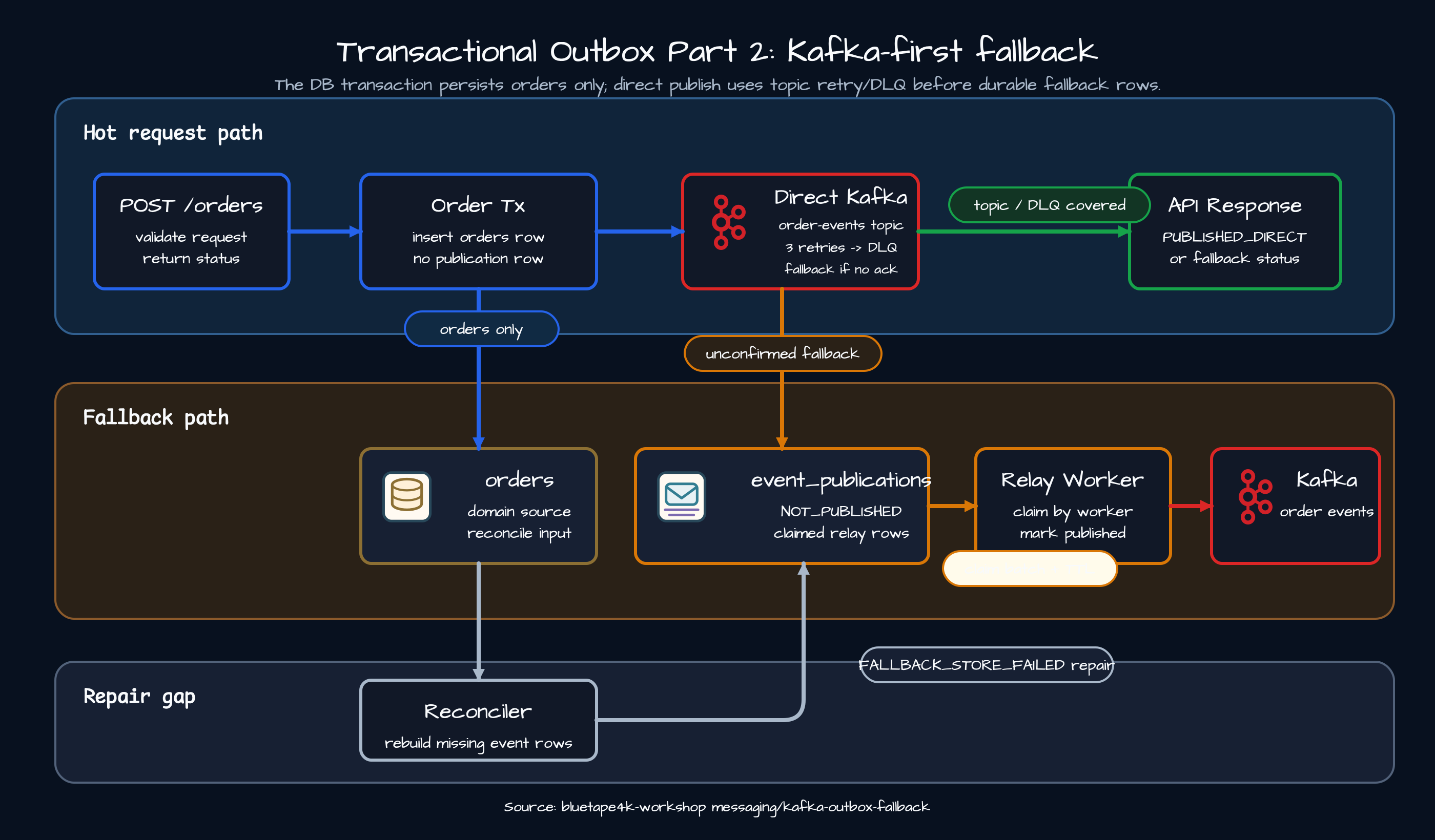
The workshop example answers “not always.” The order transaction owns only orders. After that transaction commits, the
application publishes the event directly to Kafka. If Kafka publish fails or times out, it stores a NOT_PUBLISHED row in
event_publications. During a Kafka outage or long broker timeout, the system degrades back to the familiar outbox relay
path.
What changes from classic outbox
Section titled “What changes from classic outbox”A classic outbox is usually described like this.
| Step | Classic transactional outbox |
|---|---|
| 1 | Insert orders and outbox in the same DB transaction |
| 2 | Relay claims an outbox row |
| 3 | Mark the row as PUBLISHED after Kafka publish succeeds |
The Kafka-first fallback path changes the success case.
| Step | Kafka-first fallback |
|---|---|
| 1 | Insert only orders inside the DB transaction |
| 2 | Publish directly to Kafka after the transaction |
| 3 | Do not create an event_publications row when direct publish succeeds |
| 4 | Store NOT_PUBLISHED only when direct publish fails or times out |
| 5 | Let the existing outbox relay publish the fallback row |
The trade-off is explicit: we reduce transaction write amplification, but we must acknowledge the small gap between direct
publish failure and fallback persistence. The example exposes that gap through FALLBACK_STORE_FAILED and a reconciler
instead of pretending it cannot happen.
The hot transaction writes orders only
Section titled “The hot transaction writes orders only”TransactionalOrderWriter is the transaction boundary. It intentionally does not write an outbox row.
@Transactionalfun saveOrder(customerId: String, product: String, quantity: Int): OrderRecord {    validate(customerId, product, quantity)
    val orderId = OrderTable.insertAndGetId {        it[OrderTable.customerId] = customerId        it[OrderTable.product] = product        it[OrderTable.quantity] = quantity        it[OrderTable.status] = OrderStatus.PENDING    }
    return getOrder(orderId.value)}
The first test locks this down: after saving one order, orders = 1 and event_publications = 0. Without that test,
someone could quietly move the outbox insert back into the transaction while trying to make the flow “safer.”
The public use case then builds an event and hands it to the publisher.
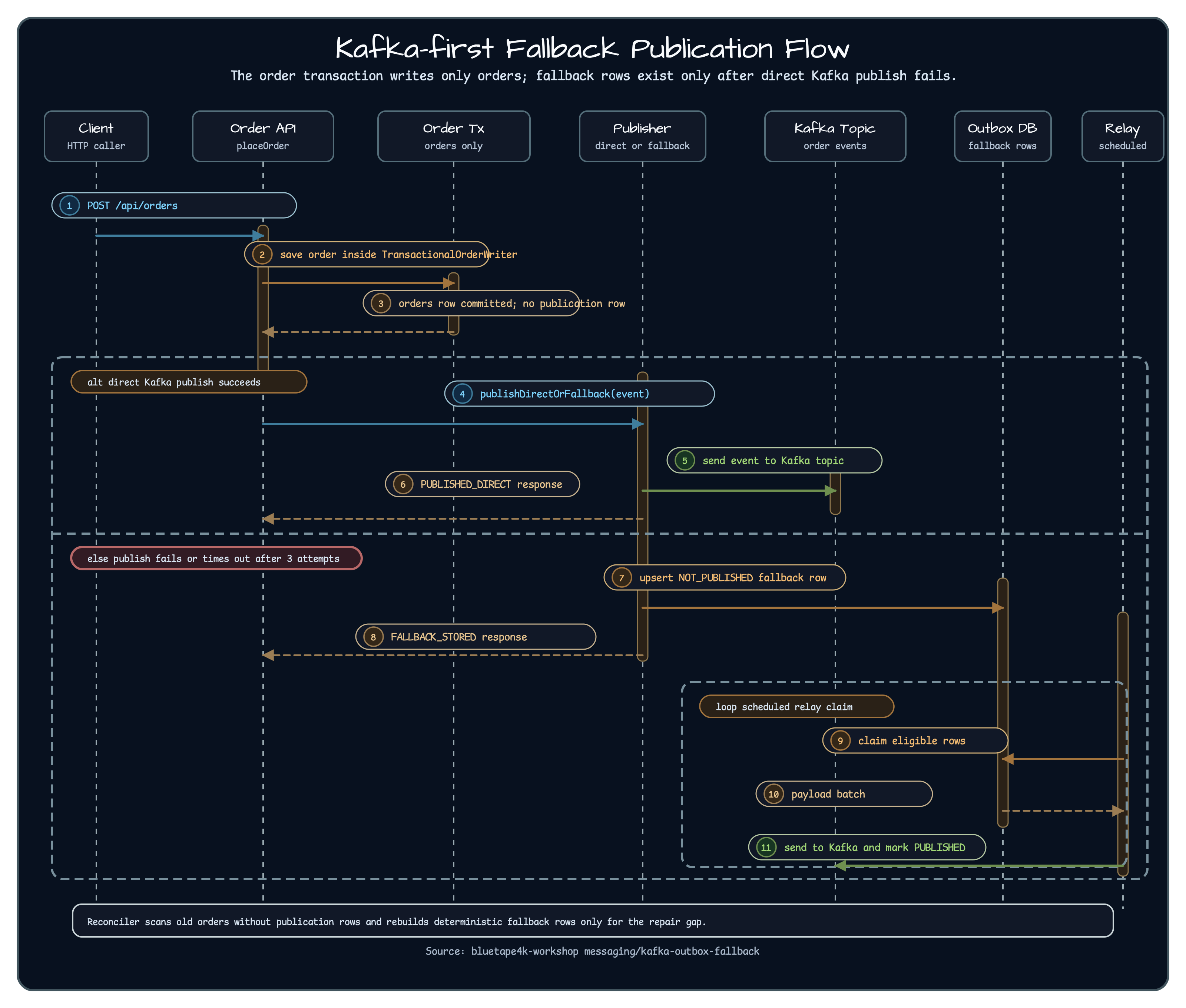
fun placeOrder(request: OrderRequest): OrderResponse { val order = transactionalOrderWriter.saveOrder( customerId = request.customerId, product = request.product, quantity = request.quantity, ) val event = OrderPlacedEvent.from(order) val publicationStatus = orderEventPublisher.publishDirectOrFallback(event) return OrderResponse.from(order, publicationStatus)}At this point, the order transaction is already over. That is why the API response carries a publication status such as
PUBLISHED_DIRECT, FALLBACK_STORED, or FALLBACK_STORE_FAILED.
Direct Kafka publish must fail small
Section titled “Direct Kafka publish must fail small”Kafka publish should not wait forever. The example bounds both direct attempts and total timeout.
for (attempt in 1..properties.directPublishAttempts) {    val remainingMillis = TimeUnit.NANOSECONDS.toMillis(deadline - System.nanoTime())    if (remainingMillis <= 0) break
    val timeoutMillis = minOf(properties.directPublishTimeout.toMillis(), remainingMillis)    var future: CompletableFuture<*>? = null    try {        future = kafkaTemplate.send(properties.topic, event.eventId, payload)        future.get(timeoutMillis, TimeUnit.MILLISECONDS)        outboxMetrics.recordDirectPublish("success")        return OrderPublicationStatus.PUBLISHED_DIRECT    } catch (e: TimeoutException) {        future?.cancel(true)        lastFailure = e        outboxMetrics.recordDirectPublish("timeout")    } catch (e: Exception) {        lastFailure = e        outboxMetrics.recordDirectPublish("failure")    }}
The tests verify the three-attempt failure path and assert that error summaries do not leak words such as secret/token/password. Operators often inspect outbox tables directly, so failure context must not become credential exposure.
Fallback persistence runs in a separate transaction.
@Transactional(propagation = Propagation.REQUIRES_NEW)fun upsertNotPublished( event: OrderPlacedEvent, payload: String, directAttemptCount: Int, errorCode: String, errorSummary: String,) { EventPublicationTable.insert { it[eventId] = event.eventId it[aggregateType] = "Order" it[aggregateId] = event.orderId.toString() it[eventType] = "OrderPlaced" it[EventPublicationTable.payload] = payload it[status] = EventPublicationStatus.NOT_PUBLISHED it[EventPublicationTable.directAttemptCount] = directAttemptCount it[relayRetryCount] = 0 it[lastErrorCode] = errorCode it[lastErrorSummary] = sanitize(errorSummary) it[nextAttemptAt] = now }}Once the row exists, the problem is back in familiar outbox territory.
Relay checks the claim owner
Section titled “Relay checks the claim owner”The relay claims NOT_PUBLISHED or FAILED rows. The important part is that claiming is a conditional update, not just a
select.
val updated = EventPublicationTable.update({ (EventPublicationTable.id eq rowId) and eligibleForClaim(now)}) { it[EventPublicationTable.claimedBy] = claimedBy it[EventPublicationTable.claimedUntil] = claimUntil it[updatedAt] = now}After publish succeeds, the relay marks the row as PUBLISHED only when the claim owner still matches. This is the minimum
guard against two relays processing the same row or a stale worker overwriting a newer claim. The tests cover concurrent
claim attempts and stale-claim TTL recovery.
Repeated failures move the row to FAILED, then to DEAD_LETTER after the retry cap. This part looks close to a classic
outbox relay. The difference is table semantics: this table contains failed or reconstructed events, not every event.
The dangerous gap is fallback persistence failure
Section titled “The dangerous gap is fallback persistence failure”The weak point is precise.
orderscommitted.- Direct Kafka publish failed.
- Fallback row persistence also failed.
At that point, an event can be lost. The example does not hide that risk. It returns and records FALLBACK_STORE_FAILED,
then relies on a reconciler that scans older orders rows without publication rows and reconstructs deterministic events.
fun reconcileOnce(): ReconcileResult {    val cutoff = LocalDateTime.now(clock).minus(properties.reconcilerGrace)    val candidates = eventPublicationRepository.findOrdersWithoutPublications()        .filter { event -> !event.createdAt.isAfter(cutoff) }
    val reconstructed = candidates.count { event ->        val payload = objectMapper.writeValueAsString(event)        eventPublicationRepository.upsertReconstructed(event, payload)    }
    return ReconcileResult(        scanned = candidates.size,        reconstructed = reconstructed,        duplicateRiskDocumented = true,    )}
duplicateRiskDocumented = true matters. Reconciliation reduces the chance of losing an event, but it does not create
free exactly-once delivery. Consumers still need idempotency by eventId. That is where the Part 1 idempotency topic
comes back.
When this variant is worth considering
Section titled “When this variant is worth considering”This is not “always better than classic outbox.” It fits only under the right constraints.
| Good fit | Avoid when |
|---|---|
| Kafka is usually healthy and you want to reduce success-path write amplification | You cannot tolerate any event-loss gap |
| Consumers already enforce idempotency by event id | The event row must share the exact atomic boundary with the domain row |
| You can operate fallback, reconciler, and metrics | The event payload cannot be reconstructed from domain state |
| You need graceful degradation into an outbox relay during Kafka trouble | The outbox row itself is the audit/source-of-truth record |
A real system might also use Redis as a buffer between direct publish failure and DB fallback persistence. That can work, but it moves the design burden to buffer durability, eviction policy, consumer group recovery, and duplicate handling. Do not trade one extra DB row for an unobservable recovery path.
Signals to watch in production
Section titled “Signals to watch in production”The example keeps metrics intentionally small.
| Metric | Meaning |
|---|---|
workshop.outbox.direct.publish.attempts | Direct Kafka publish success/failure/timeout |
workshop.outbox.fallback.stored | Fallback row persistence success/failure |
workshop.outbox.relay.events | Relay published/failed/dead-lettered/claim-lost outcomes |
workshop.outbox.reconciler.events | Reconstructed gaps |
I would alert aggressively on fallback.stored{result=failure} and reconciler.events{result=reconstructed}. Those are
not just Kafka outage signals; they mean the system was near an event-loss gap.
Admin endpoints are disabled by default. Manual relay/reconcile endpoints are useful during incidents, but if exposed carelessly they can repeat processing or leak payloads. The tests verify the disabled default and that publication lookup does not expose raw payloads or raw exception details.
Summary
Section titled “Summary”Kafka-first fallback does not discard transactional outbox. It skips the outbox cost on the success path and falls back to outbox relay on the failure path. The price is the publish/fallback gap, reconciler duplicate risk, and a hard requirement for consumer idempotency.
The main point is not “this is faster.” The point is making the cost boundary explicit: pay for an outbox row on every hot write, or pay fallback/reconcile cost only when Kafka publish fails. The workshop example keeps that choice visible in code, tests, metrics, and diagrams.
Source Links
Section titled “Source Links”- Workshop pull request: bluetape4k-workshop PR #349
- Example module:
messaging/kafka-outbox-fallback - Transaction boundary:
TransactionalOrderWriter.kt - Direct publisher:
OrderEventPublisher.kt - Fallback repository:
EventPublicationRepository.kt - Flow tests:
KafkaOutboxFallbackFlowTest.kt
Comments
Leave a note or reaction with your GitHub account.