
Bluetape4k Exposed Part 1: Why Exposed?

This is Part 1 of the bluetape4k-exposed series. Exposed was not the answer I started with. I looked at JPA, MyBatis,
R2DBC, Vert.x SQL Client, and Virtual Threads, then built examples to see which path could stay useful in production code.
The choice I kept coming back to was Exposed. bluetape4k-exposed adds the operational pieces I kept needing around it:
repositories, R2DBC, JSON and encryption columns, cache, and multi-tenancy boundaries.
The Part 1 question is simple:
JPA, MyBatis, R2DBC, and Vert.x SQL Client already exist. Why Exposed?
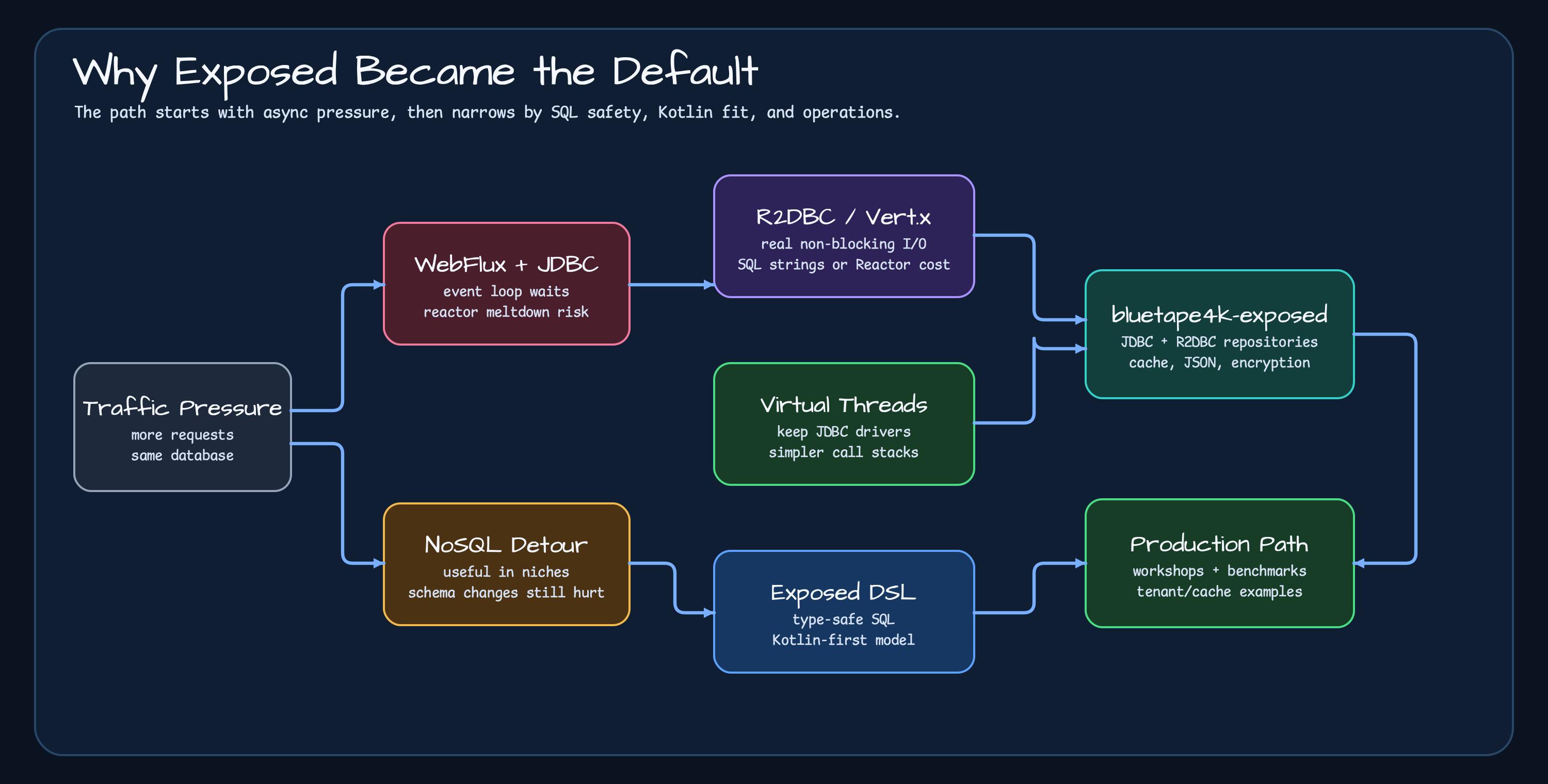
“The DSL looks nice” is not enough of an answer. The real starting point was the search for async and non-blocking data access. WebFlux does not help much if the database path blocks inside the request. R2DBC gives non-blocking I/O, but SQL DSL ergonomics and Kotlin usage become their own problem. Virtual Threads let us keep blocking JDBC with lower waiting cost, but they still need a safer way to write SQL.
Exposed sits in that middle ground. It keeps SQL visible, makes it safer through a Kotlin DSL, and lets the workload decide between JDBC and R2DBC.
The Starting Point: JDBC Blocks
Section titled “The Starting Point: JDBC Blocks”JDBC is synchronous. While a request waits for a database response, its thread is tied to that work. As traffic grows and database latency increases, many services survive by adding more application servers.
NoSQL was another common escape path for a while. MongoDB, Cassandra, and Elasticsearch are strong in their own domains. But moving every primary store to NoSQL brings different costs around schema changes, exception handling, operations, and back-office work. Many services eventually keep relational databases as the main store because they are strong and operationally familiar.
The harder question comes next. If a service uses an async/non-blocking web framework such as Spring WebFlux but keeps JDBC or JPA inside, only the entrance is asynchronous. The database path still queues. When the event loop spends time waiting for the database, the design that was supposed to improve responsiveness becomes risky.
I grouped the choices by what I had tried and where they became awkward in production.
| Choice | Strength | Friction |
|---|---|---|
| Hibernate Reactive | Brings ORM experience into a reactive stack | Vert.x based, with learning cost and ecosystem constraints |
| Vert.x SQL Client | Clean non-blocking access for I/O-bound database work | SQL strings and mapping code stay manual |
| Spring Data R2DBC | Natural in the Spring reactive stack | SQL DSL support is thinner, and Reactor types come first |
| JPA + Virtual Threads | Keeps existing blocking APIs mostly intact | JPA mapping weight and SQL-control issues remain |
| Exposed + Virtual Threads | Mature JDBC drivers plus Kotlin SQL DSL | The blocking JDBC boundary still has to be understood and measured |
| Exposed R2DBC + Coroutines | Exposed SQL DSL with suspend and Flow | Driver and workload behavior must be measured case by case |
The conclusion is not “R2DBC is wrong.” It is also not “Virtual Threads win everything.” Streaming and backpressure may make R2DBC the better fit. Mature JDBC drivers, batch behavior, familiar transaction boundaries, and simple call stacks may make JDBC plus Virtual Threads easier to operate.
What I Wanted from Exposed
Section titled “What I Wanted from Exposed”I was not looking for a large ORM world like JPA. For this codebase, it fit better to let developers who understand SQL write queries safely in Kotlin instead of hiding SQL behind a large domain graph and lazy-loading model.
val rows = Users .selectAll() .where { Users.email eq email } .orderBy(Users.id) .limit(1) .toList()Reducing string SQL is more than a style preference. When column names, types, joins, and where conditions live in code,
small production mistakes become less likely. Exposed is not an abstraction that makes SQL disappear. It is closer to a
Kotlin DSL that lets us write SQL more safely.
DAO is still available. Simple reads and relationships can be expressed neatly with EntityClass. In production code,
though, complex queries, transactions, cache, routing, and observability move together. That is why this series puts SQL
DSL and repository boundaries ahead of DAO.
What bluetape4k-exposed Adds
Section titled “What bluetape4k-exposed Adds”bluetape4k-exposed does not replace Exposed. JetBrains Exposed stays at the center. The extra layers are the pieces I
kept rebuilding in production services.
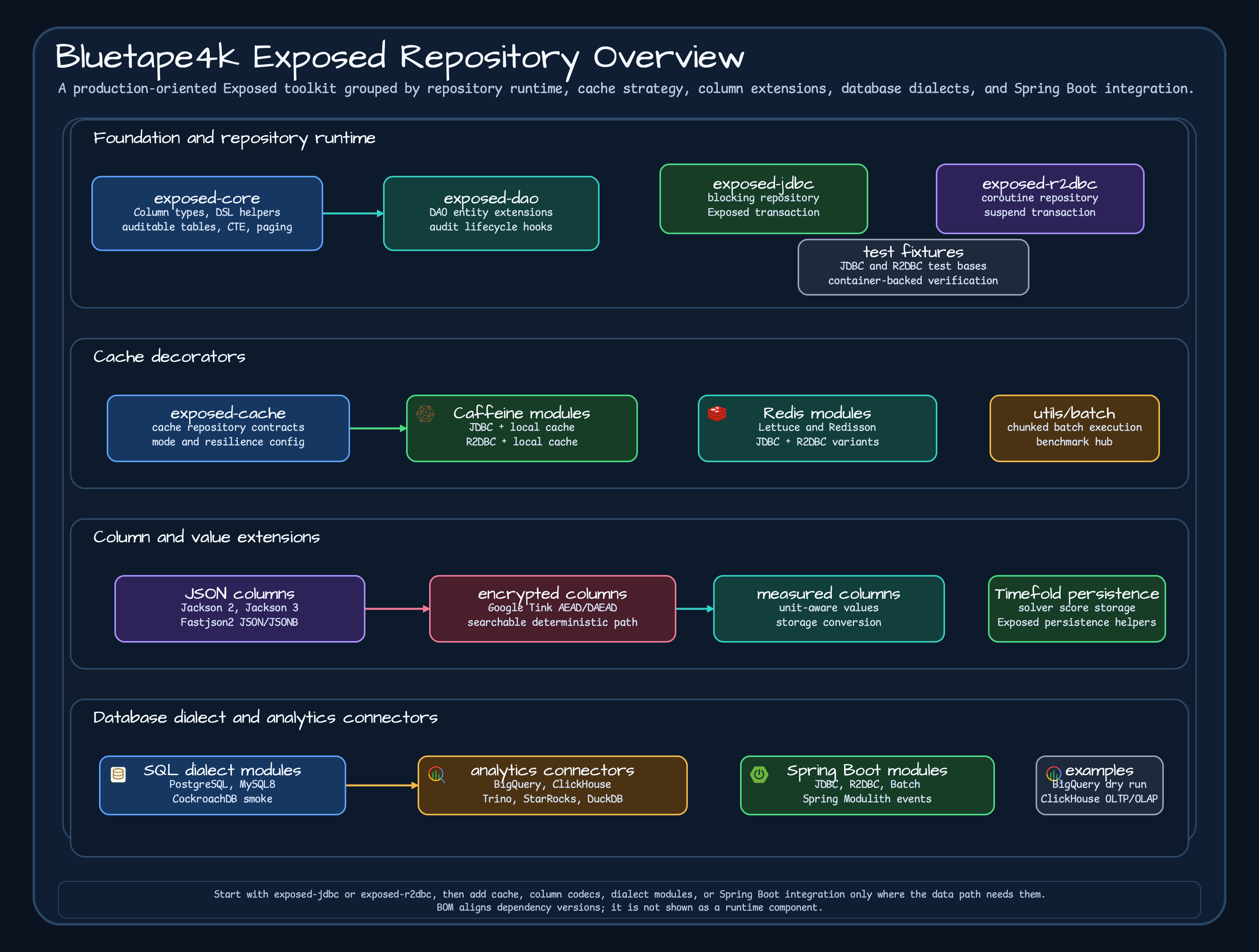
| Area | Representative extensions | Responsibility |
|---|---|---|
| Repository | exposed-jdbc, exposed-r2dbc | JDBC/R2DBC repository abstraction, audit and soft-delete patterns |
| Cache | exposed-cache, exposed-jdbc-caffeine, exposed-r2dbc-lettuce | Read paths with local or Redis cache |
| Column codecs | exposed-jackson2, exposed-jackson3, exposed-fastjson2, exposed-tink | JSON columns, encrypted columns, measured columns |
| Dialects | exposed-postgresql, exposed-mysql8, exposed-bigquery, exposed-clickhouse, exposed-trino, exposed-duckdb | Database-specific SQL and connector helpers |
| Spring Boot | exposed-spring-boot-jdbc, exposed-spring-boot-r2dbc, exposed-spring-boot-batch | Boot 4 auto-configuration and application wiring |
Adoption should stay selective.
dependencies { implementation("io.github.bluetape4k.exposed:bluetape4k-exposed-jdbc:1.9.2") implementation("io.github.bluetape4k.exposed:bluetape4k-exposed-r2dbc:1.9.2") implementation("io.github.bluetape4k.exposed:bluetape4k-exposed-jdbc-lettuce:1.9.2") implementation("io.github.bluetape4k.exposed:bluetape4k-exposed-jackson2:1.9.2") implementation("io.github.bluetape4k.exposed:bluetape4k-exposed-spring-boot-jdbc:1.9.2")}The intended use is not “pull in everything.” If you need only JDBC repositories, add only JDBC. If a cache-backed read path is needed, add the cache adapter. Add the Spring Boot module only when auto-configuration is useful. Keeping that distance matters; otherwise a library starts pretending to be a framework.
Choose with Numbers
Section titled “Choose with Numbers”The most dangerous sentence in data-access selection is “it should be faster in theory.” Theory gives direction. Production choices need measurements.
That is why the examples and benchmarks live close to the docs. The Virtual Threads/JDBC benchmark notes in
exposed-workshop show the representative ratios below. The ratio matters more than the absolute number here.
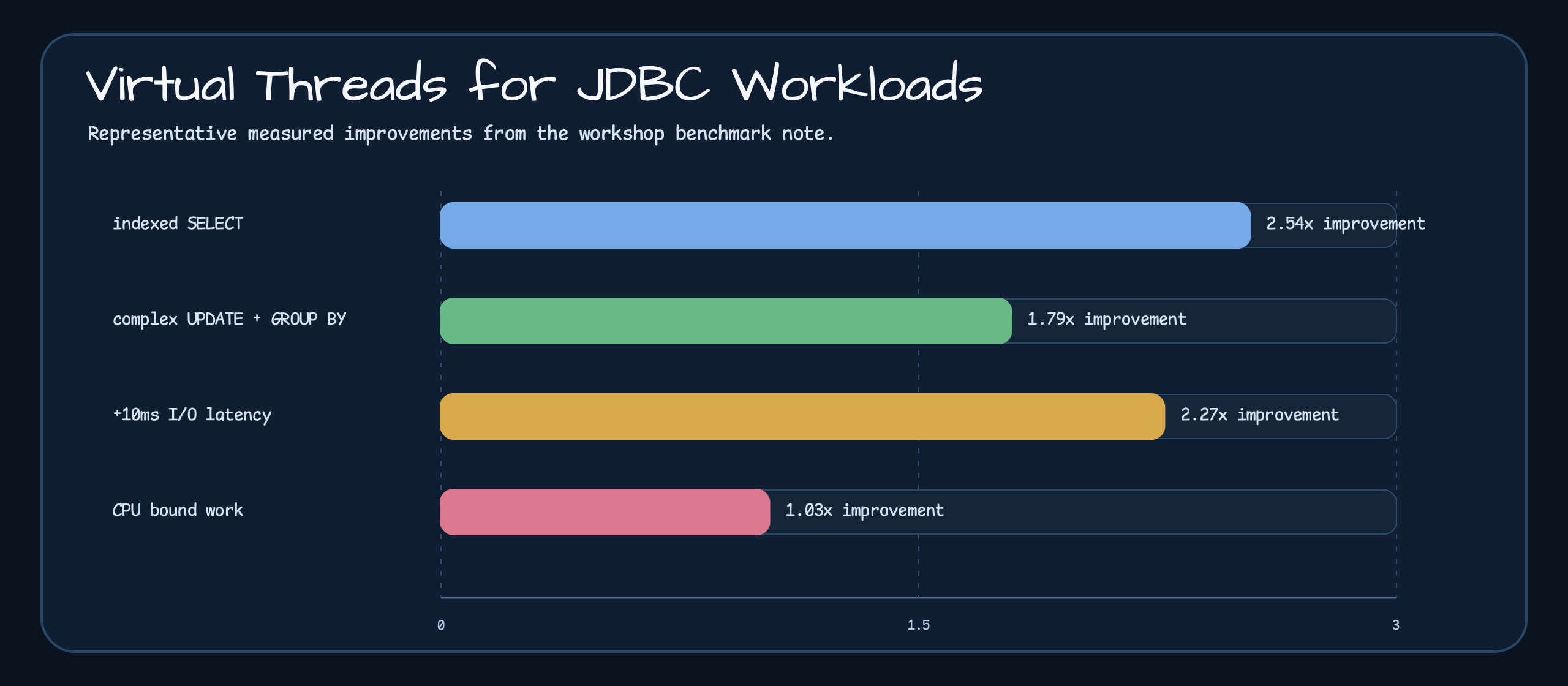
| Workload | Virtual Threads improvement |
|---|---|
| Simple indexed SELECT | 2.2-2.6x |
| Complex query, UPDATE + aggregation | 1.8x |
| 10ms I/O delay simulation | 2.3x |
| CPU-bound work | 1.02-1.03x |
These numbers do not mean “Virtual Threads make every code path faster.” The benefit is largest when a waiting JDBC path can release the carrier thread. CPU-bound work barely changes. JDBC plus Virtual Threads is a way to keep blocking APIs while lowering waiting cost, not a free CPU-performance button.
bluetape4k-exposed also includes ExposedJdbcBenchmark based on kotlinx-benchmark. It measures single-row CRUD,
JOINs, and batch inserts with PostgreSQL Testcontainers, HikariCP max 24, and JMH throughput mode.
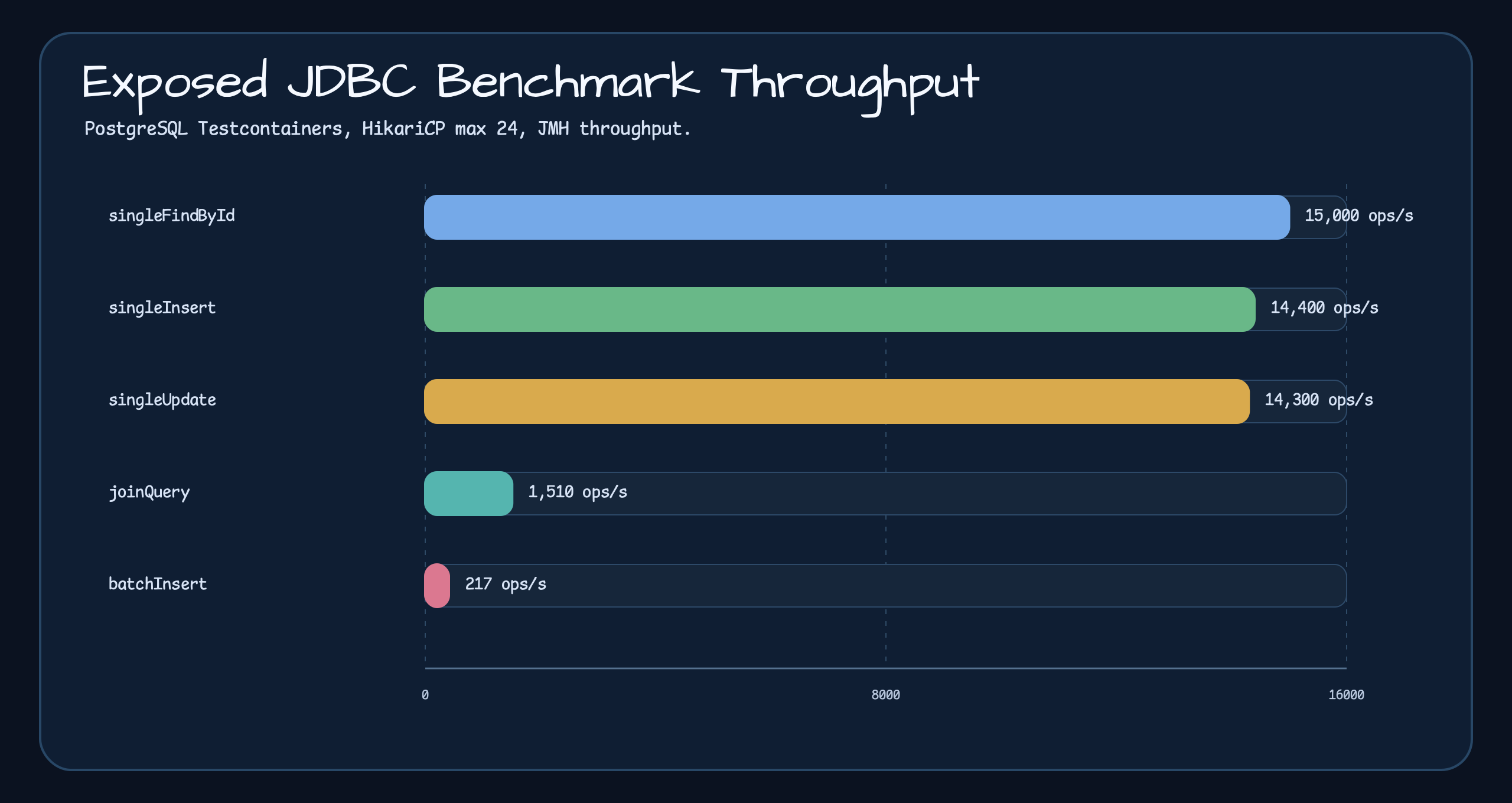
| Benchmark | Throughput |
|---|---|
singleFindById | 15,000 ops/s |
singleInsert | 14,400 ops/s |
singleUpdate | 14,300 ops/s |
joinQuery | 1,510 ops/s |
batchInsert | 217 ops/s |
This is not the final scoreboard for JDBC versus R2DBC. Part 3 covers that with batch benchmarks. The Part 1 lesson is smaller: when choosing Exposed, measure query shape, driver behavior, connection pool, and transaction boundaries together. Do not choose by abstraction name alone.
I also kept a JPA comparison. In exposed-workshop/11-high-performance/04-benchmark, the benchmark compares Person CRUD
operations with PostgreSQL Testcontainers and JMH average latency. Lower latency is better.
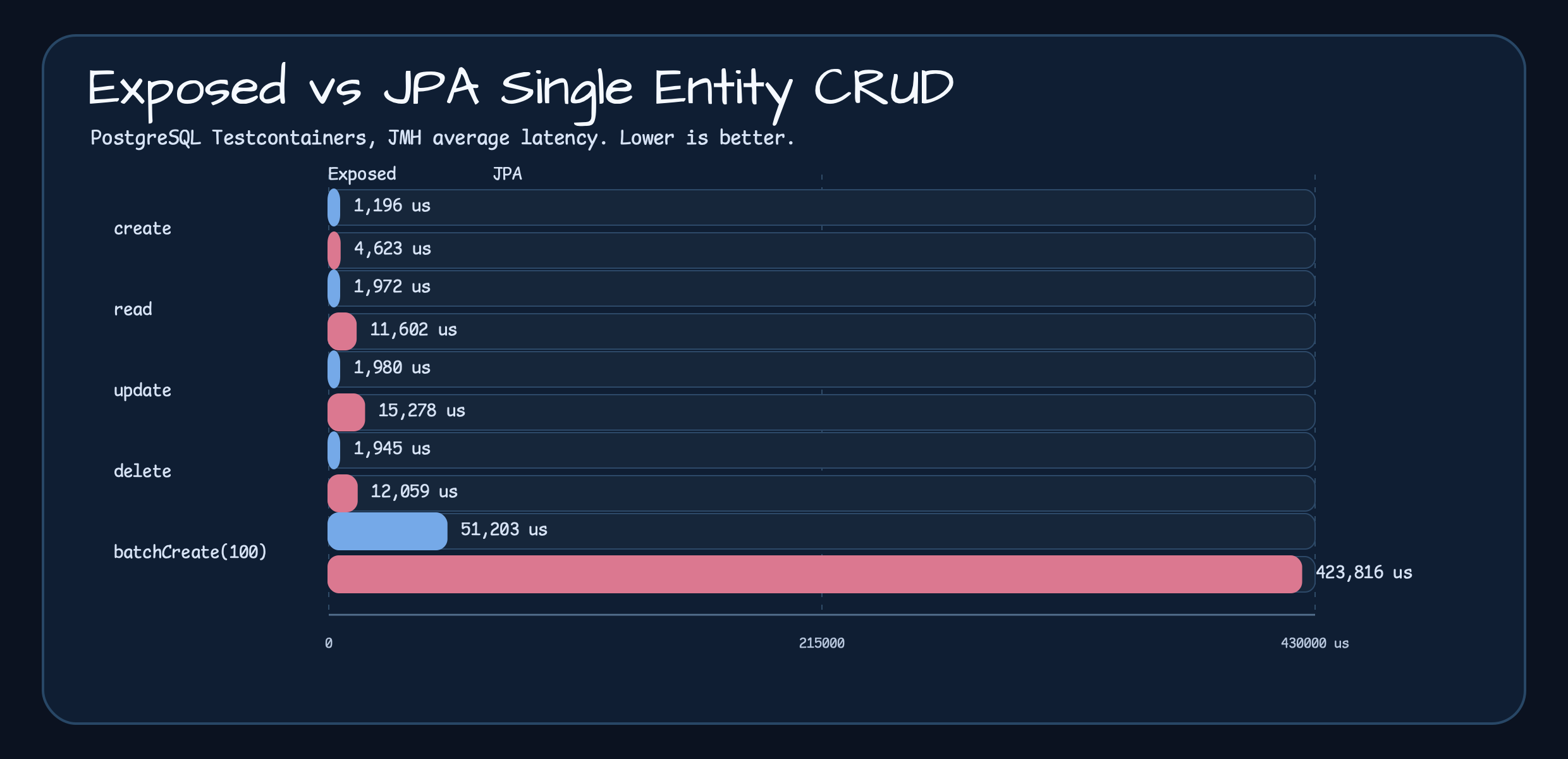
| Operation | Exposed | JPA | Interpretation |
|---|---|---|---|
| create | 1,196 us | 4,623 us | Exposed 3.9x faster |
| read | 1,972 us | 11,602 us | Exposed 5.9x faster |
| update | 1,980 us | 15,278 us | Exposed 7.7x faster |
| delete | 1,945 us | 12,059 us | Exposed 6.2x faster |
| batchCreate(100 rows) | 51,203 us | 423,816 us | Exposed 8.3x faster |
This does not mean “never use JPA.” JPA is still strong when complex domain graphs, second-level cache, and the Spring Data ecosystem matter. It does mean Exposed is a serious candidate when SQL control and lower ORM overhead matter.
Why the Workshops Stay Close
Section titled “Why the Workshops Stay Close”Changing a data-access layer based only on a blog post is risky. Small examples can hide the real problems. That is why
this series keeps linking exposed-workshop, exposed-r2dbc-workshop, and production examples.
| Repo / chapter | What to inspect in code |
|---|---|
exposed-workshop/02-alternatives-to-jpa | Why R2DBC, Vert.x, and Exposed were compared |
exposed-workshop/03-exposed-basic | Basic Exposed DSL and DAO usage |
exposed-workshop/08-coroutines | Coroutine and virtual-thread boundaries |
exposed-workshop/10-multi-tenant | Tenant isolation, routing datasource, cache isolation |
exposed-workshop/11-high-performance | Cache strategies and benchmark-centered examples |
exposed-workshop/12-production-integration | Outbox, idempotency, observability, readiness boundaries |
exposed-r2dbc-workshop | The same design revisited through R2DBC and coroutines |
The production examples focus especially on cache strategy and multi-tenancy. The point is not to stop at a design diagram, but to include running results and performance charts. Cache cannot be added because it “should be fast.” If tenant ID is missing from a cache key, the optimization becomes a data-leak candidate. That is worse than being slow.
Closing
Section titled “Closing”I built bluetape4k-exposed not because Exposed solves every problem, but because it does not try to. Exposed keeps SQL
visible and lets Kotlin’s type system and DSL make it safer. bluetape4k-exposed adds repositories, cache, JSON and
encryption columns, dialects, and Spring Boot wiring around that center.
The selection rule is:
- Use SQL through a Kotlin DSL instead of string SQL.
- Choose JDBC + Virtual Threads or R2DBC + Coroutines by workload.
- Avoid rebuilding cache, JSON, encryption, dialect, and Spring Boot wiring for every service.
- Check performance and production boundaries through benchmarks and workshop examples.
Next, Part 2 looks at JDBC repositories and SQL DSL patterns. The repository layer exists not to hide SQL DSL, but to avoid rebuilding mapping, paging, and soft-delete boundaries for every table.
Source Links
Section titled “Source Links”- Repository: bluetape4k-exposed
- README: README.md
- JDBC benchmark source: ExposedJdbcBenchmark.kt
- Exposed vs JPA benchmark: exposed-jpa-benchmark.md
- Batch benchmark hub: utils/batch/benchmark/README.md
- Virtual Threads/JDBC benchmark note: VirtualThread-Jdbc-Benchmark.md
- Workshop alternatives: exposed-workshop/02-alternatives-to-jpa
- R2DBC workshop: exposed-r2dbc-workshop
Comments
Leave a note or reaction with your GitHub account.