
Transactional Outbox and Idempotency in Spring and Ktor Examples

Suppose a service writes domain state and then calls another service, publishes an event, or returns a response that a client may retry. The code path looks simple: persist, call, respond.
The failure path is less polite. The process can die after the database write and before the HTTP call. The external API can succeed before the local status update. The client can see a timeout and send the same request again. Without an explicit boundary, duplicate requests, partial writes, and delivery gaps start to look the same.
This post is not a pattern encyclopedia. It uses the bluetape4k-workshop and exposed-workshop examples to show one
practical question: what belongs in the database transaction, and what should become retryable work after commit?
Start with the Failure Boundary
Section titled “Start with the Failure Boundary”Outbox and idempotency work together because they separate durable user intent from best-effort delivery. The request records the intent first. Delivery happens after commit and can be retried from stored state.
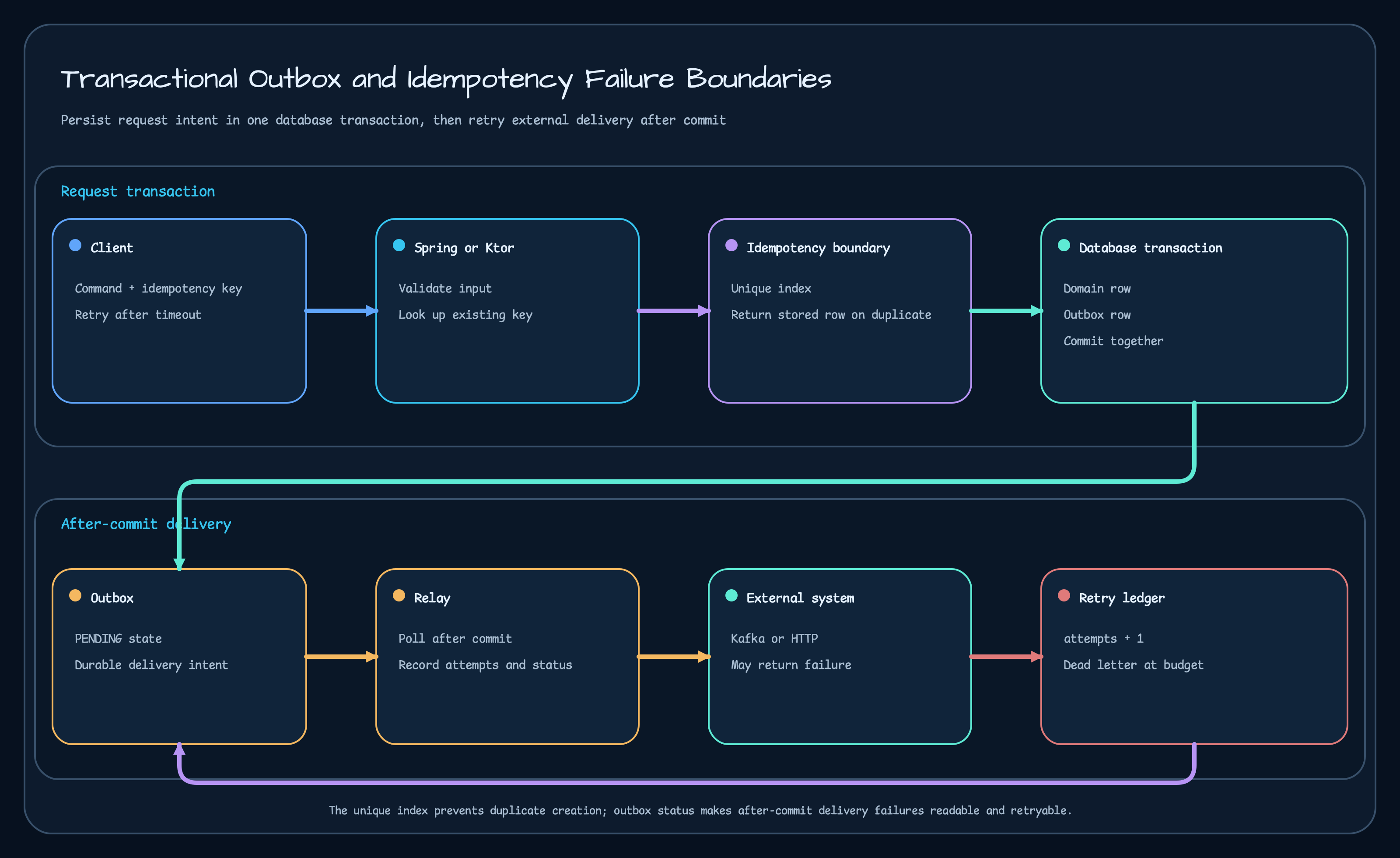
In messaging/transactional-outbox, OrderService writes the order row and outbox row inside the same Spring
transaction.
val orderId = OrderTable.insertAndGetId {    it[OrderTable.customerId] = customerId    it[OrderTable.product] = product    it[OrderTable.quantity] = quantity    it[OrderTable.status] = OrderStatus.PENDING}
OutboxEventTable.insert {    it[OutboxEventTable.aggregateType] = "Order"    it[OutboxEventTable.aggregateId] = orderId.value.toString()    it[OutboxEventTable.eventType] = "OrderPlaced"    it[OutboxEventTable.payload] = payload    it[OutboxEventTable.status] = OutboxStatus.PENDING}
That prevents a state where the order exists but no publishable intent exists. If the transaction rolls back, both rows are gone. The starting point is explicit.
The Idempotency Key Makes Retries Ordinary
Section titled “The Idempotency Key Makes Retries Ordinary”From the HTTP client side, retry after timeout is normal. The server still must avoid doing the external work twice.
The Spring and Ktor HTTP outbox examples put a unique index on idempotencyKey and return the existing record when the
key is already present.
fun submit(request: CreatePaymentRequest): PaymentResponse { val command = request.toCommand() val created = repository.createPending(command) if (!created.inserted) { return created.record.toResponse(duplicate = true) } return dispatch(created.record.id, command)}The repository repeats that rule at the database boundary. The initial lookup is only a fast path: two concurrent requests can both observe that the key is absent. The unique index closes that race. When one insert loses the race, the repository catches the constraint failure and rereads the committed row as a duplicate result.
try { transaction(database) { findByIdempotencyKey(command.idempotencyKey)?.asDuplicate() ?: insertPending(command) }} catch (e: ExposedSQLException) { rereadDuplicate(command.idempotencyKey) ?: throw e}The HTTP contract follows the same shape in Spring and Ktor: new records return 201 Created; duplicate keys return the
stored row with 200 OK. A duplicate request is not treated as an exceptional mystery. It is expected retry traffic with
a stable identity.
Spring and Ktor Differ in How the Boundary Is Expressed
Section titled “Spring and Ktor Differ in How the Boundary Is Expressed”Both examples teach the same business rule.
| Comparison point | Spring Boot example | Ktor example |
|---|---|---|
| HTTP entry | @RestController + ResponseEntity | explicit Route.paymentRoutes |
| repository call | blocking Exposed JDBC transaction | Exposed JDBC transaction inside withContext(Dispatchers.IO) |
| duplicate key | unique index + existing row reread | same unique index + existing row reread |
| gateway failure | retryable/permanent exception becomes status | suspend gateway uses the same status rule |
| validation/error mapping | MVC ErrorAdvice | Ktor StatusPages |
The Ktor version is worth reading because it keeps blocking JDBC work out of the main coroutine path.
private suspend fun <T> transactionIO(block: () -> T): T = withContext(Dispatchers.IO) { transaction(database) { block() } }The important comparison is not which framework wins. It is whether both frameworks express the same failure contract without hiding blocking work or duplicate-request behavior.
First Call, Same-Key Retry, Relay Retry
Section titled “First Call, Same-Key Retry, Relay Retry”The sequence below collects the three common cases: first submit, same-key retry, and retryable delivery failure.
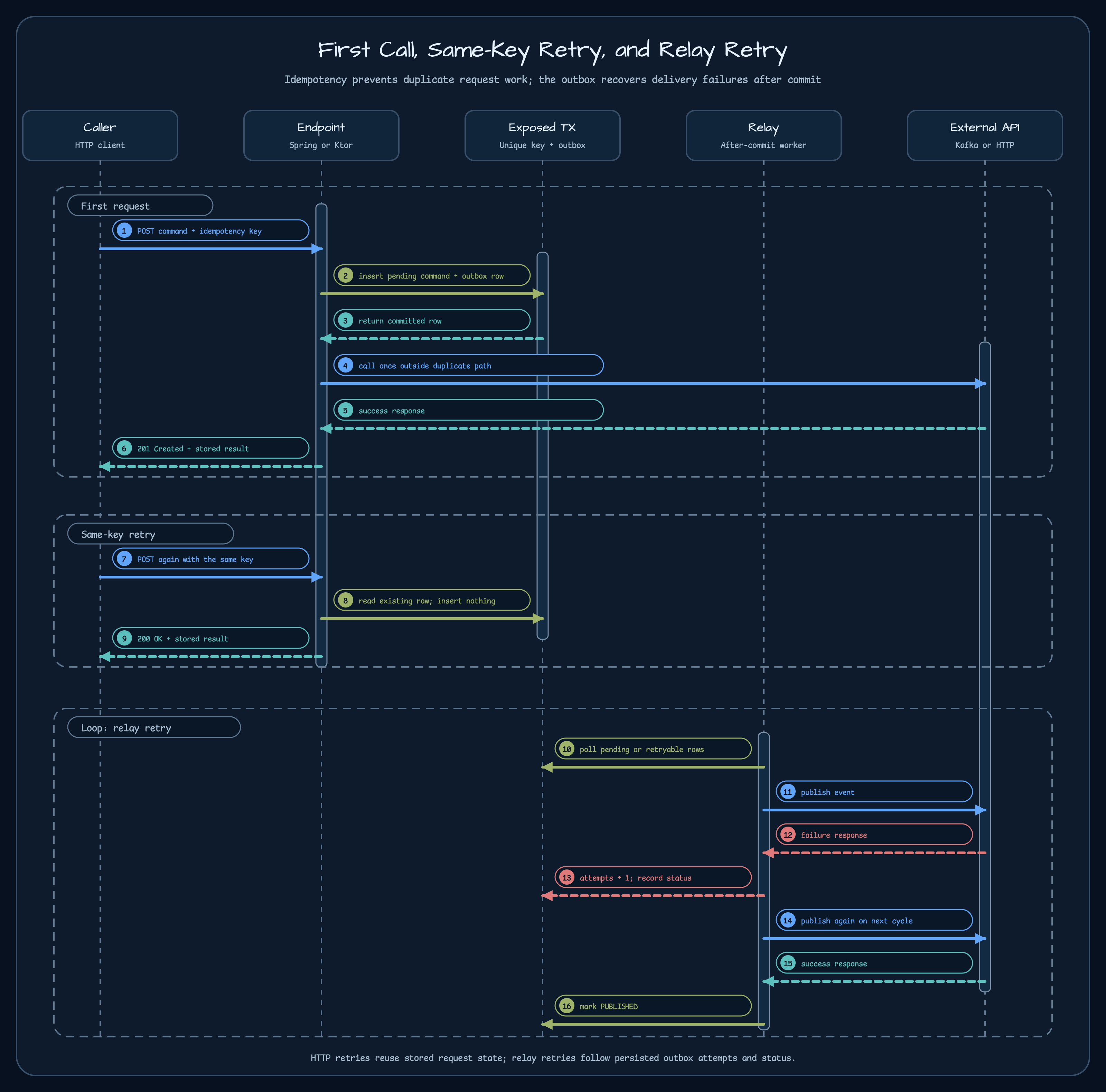
The tests lock that behavior down. The Spring and Ktor service tests submit the same key twice and verify that the second response points to the first row while the gateway was called only once.
val first = service.submit(CreatePaymentRequest("order-2", 2_500, "key-2"))val duplicate = service.submit(CreatePaymentRequest("order-2", 2_500, "key-2"))
duplicate.id shouldBeEqualTo first.idduplicate.duplicate shouldBeEqualTo truegateway.commands.size shouldBeEqualTo 1
Retryable failure follows the stored row as well. The first call records RETRYABLE_FAILED; the retry endpoint dispatches
from the same record.
val failed = service.submit(CreatePaymentRequest("order-retry", 1_000, "retry-key"))failed.status shouldBeEqualTo PaymentStatus.RETRYABLE_FAILED
val retried = service.retry(failed.id)retried.status shouldBeEqualTo PaymentStatus.SUCCEEDEDretried.attempts shouldBeEqualTo 2
Commit Does Not End All Failure
Section titled “Commit Does Not End All Failure”Transactional outbox does not remove failure. It moves failure to a place that can be inspected and retried.
| Failure point | Expected behavior | Source example |
|---|---|---|
| Before the database transaction | no durable record; retry behaves like a new request | payment createPending |
| After domain row but before outbox row | same transaction rolls back both rows | OrderService.placeOrder |
| After commit but before relay | outbox row remains available for polling | OutboxPublisher.publishPendingEvents |
| Retryable external failure | RETRYABLE_FAILED, eligible for /retry | Spring/Ktor PaymentService.retry |
| Permanent external failure | PERMANENT_FAILED, retry rejected | Spring/Ktor service tests |
| Kafka publish failure | retry count increases; budget exhaustion moves to DEAD_LETTER | OutboxTransactionTest |
| Same idempotency key retry | stored row returned; no second external call | Spring/Ktor service tests |
OutboxPublisher records Kafka send failure by incrementing retry state and eventually moving the row to DEAD_LETTER.
catch (e: Exception) { val newRetry = currentRetry + 1 incrementRetry(eventId, newRetry) false}The claim is not “nothing fails after commit.” Things still fail after commit. The difference is that the failure leaves a row behind. Operators can read status and retry count instead of reconstructing intent from scattered logs.
Realtime Outbox Uses the Same Rule for UI Delivery
Section titled “Realtime Outbox Uses the Same Rule for UI Delivery”07-spring-outbox-realtime and 08-ktor-outbox-realtime move from HTTP payment to notification delivery. The repository
creates a notification row and realtime outbox row in the same transaction. The service then reads pending rows and
tries delivery.
val notificationId = Notifications.insertAndGetId {    it[recipientId] = command.recipientId    it[message] = command.message}.value
val eventId = RealtimeOutbox.insertAndGetId {    it[aggregateId] = notificationId    it[eventType] = "notification.created"    it[status] = OutboxStatus.PENDING.name    it[attempts] = 0}.value
Successful delivery marks PUBLISHED; failed delivery marks FAILED. replayAfter(eventId) reads published rows after
a cursor. For WebSocket or SSE style delivery, that means recovery can be based on database state instead of whatever was
still in memory. This boundary replays published rows; proving that an individual client received them still requires a
separate acknowledgement or offset policy.
Rules to Take from the Examples
Section titled “Rules to Take from the Examples”The examples leave a compact set of rules.
- Put user intent and outbox intent in the same transaction.
- Assume external delivery can fail after commit and record status.
- Keep retryable and permanent failures distinct.
- Treat the idempotency key as a database unique boundary, not controller decoration.
- Spring and Ktor code shapes can differ; the failure contract should not.
Outbox and idempotency make the happy path longer. That extra length matters in production. A short path without stored state is pleasant until a timeout hides what happened. With an outbox row and idempotency key, the system can read where the failure landed and retry from there.
Source notes
Section titled “Source notes”- Transactional outbox workshop:
messaging/transactional-outbox - Atomic order write:
OrderService.kt - Kafka relay and retry status:
OutboxPublisher.kt - Spring HTTP outbox/idempotency:
03-spring-http-outbox-idempotency - Ktor HTTP outbox/idempotency:
04-ktor-http-outbox-idempotency - Spring realtime outbox:
07-spring-outbox-realtime - Ktor realtime outbox:
08-ktor-outbox-realtime
Comments
Leave a note or reaction with your GitHub account.