Bluetape4k Projects Part 3: the path bytes take
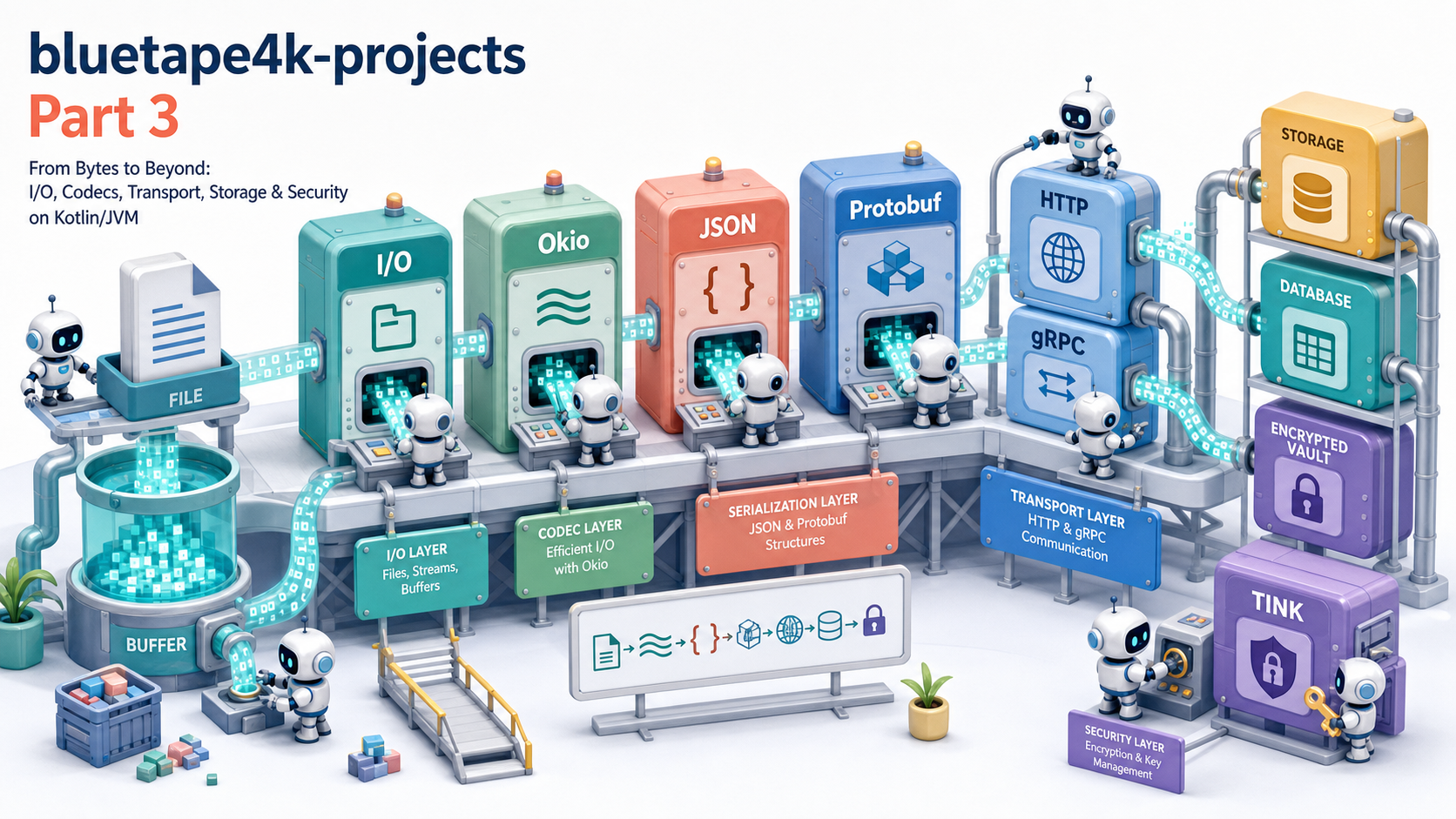
This is Part 3 of the bluetape4k-projects series. Part 1
introduced the shared foundation, and Part 2 covered
core, coroutines, logging, and testing. This post moves to service boundaries: reading files, compressing
bytes, turning objects into JSON or Protobuf, sending HTTP or gRPC calls, and encrypting the payloads that need it.
This area rarely looks dramatic when everything lines up. A string, a header, and a serializer option pass through without a story. When one of them is wrong, the failure shapes multiply quickly: broken text, streams that never end, incompatible serialized payloads, missing timeouts, or columns that cannot be decrypted. Small code review details can become very large production details.
I/O: the Basic Byte Toolbox
Section titled “I/O: the Basic Byte Toolbox”bluetape4k-io groups compression, ZIP, file helpers, and binary serializers. LZ4, Snappy, Zstd, GZip, Deflate,
BZip2, and Zip are exposed through a common Compressor layer. JDK, Kryo, and Apache Fory serializers are exposed
through the BinarySerializer contract.
The value is not the number of algorithms. It is keeping every service from inventing its
own try/catch, empty-byte handling, corrupted input policy, and serializer failure behavior. For example, compress()
returns emptyByteArray for null or empty input, while compressOrNull() variants let callers model damaged input as
null instead of an exception.
import io.bluetape4k.io.compressor.Compressorsimport io.bluetape4k.io.serializer.BinarySerializers
data class OrderSnapshot(val id: String): java.io.Serializable {    companion object {        private const val serialVersionUID: Long = 1L    }}
val payload = "invoice-payload".toByteArray()val compressed = Compressors.Zstd.compress(payload)val restored = Compressors.Zstd.decompress(compressed)
val bytes = BinarySerializers.Fory.serialize(OrderSnapshot("A-100"))val snapshot: OrderSnapshot? = BinarySerializers.Fory.deserialize(bytes)
There are fast paths such as ForyBinarySerializer.fast() and KryoBinarySerializer.fast(), but they are not magic
buttons. Fixed schemas, nullable behavior, and wire-format compatibility all matter. As the README warns, FastFory uses
a wire format that is not compatible with the default Fory codec, so it belongs at clear volatile boundaries such as
caches.
Okio: Streams as Composable Pipelines
Section titled “Okio: Streams as Composable Pipelines”bluetape4k-okio builds on Square Okio and adds compression, encryption, Base64, NIO channel integration, and
coroutine-friendly I/O. Okio’s model is intentionally small: read from Source, write to Sink, and work with
Buffer, BufferedSource, BufferedSink, and ByteString in between.
That small model lets files, sockets, HTTP bodies, and test fixtures look similar. You can add compression, then
decompression, then encryption, then a channel adapter without bouncing through several InputStream, Reader, and
byte-array shapes. Fewer shape changes also means fewer places for ownership and close rules to drift.
import io.bluetape4k.io.compressor.Compressorsimport io.bluetape4k.okio.compress.asCompressSinkimport okio.Buffer
val target = Buffer()
target.asCompressSink(Compressors.Streaming.Zstd).use { sink ->    val source = Buffer().writeUtf8("large payload")    sink.write(source, source.size)}
The README rules are practical: close owned sources and sinks with use {}, prefer streaming adapters for large
payloads, and use suspended sources/sinks in coroutine code instead of casually wrapping blocking streams. Compression
and encryption sinks often finalize footers or ciphertext on close(), so forgetting to close them can produce files
that are almost written and still unreadable.
JSON and Binary Formats: One Contract, Several Engines
Section titled “JSON and Binary Formats: One Contract, Several Engines”The JSON family is easiest to read through the JsonSerializer contract in bluetape4k-json. Implementations are
provided by Jackson 2, Jackson 3, and Fastjson2. The Jackson modules add Kotlin-ready mapper defaults, JsonNode
helpers, async JSON parsing, UUID Base62 support, field masking, and Tink-backed field encryption. Fastjson2 adds both
text JSON and JSONB.
Avro and Protobuf serve different boundaries. Avro focuses on generic/specific/reflect serializers, schema evolution,
and compression codec choices. Protobuf is a lightweight Protobuf helper module that does not depend on gRPC. It covers
Instant, Duration, LocalDateTime, and JavaMoney conversions, Any pack/unpack helpers, and an allowlist-based
ProtobufSerializer.
| Family | Backed by | bluetape4k value-add |
|---|---|---|
| Binary I/O | JDK, Kryo, Apache Fory, LZ4/Snappy/Zstd | Shared serializer contract, compression combinations, trust boundaries, safer defaults |
| Streaming I/O | Okio, Java NIO | Source/Sink adapters, streaming compression, cipher support, suspended I/O |
| JSON | Jackson 2/3, Fastjson2 | Kotlin-ready mappers, JsonSerializer, async parsing, JSONB, field masking/encryption |
| Schema format | Avro, Protobuf | Schema evolution helpers, well-known type conversions, allowlist serializers |
| HTTP/RPC | Apache HC5, OkHttp3, Feign, Retrofit2, gRPC | Coroutine integration, DSL builders, transport choices, in-process test boundaries |
| Security | Google Tink | AEAD/DAEAD wrappers, associated data, key rotation, links to JSON/Okio/data boundaries |
The first question should be less “which one is fastest?” and more “what does this boundary promise?” Human-readable public responses may favor JSON. Internal caches may prefer JSONB or binary serializers. Service contracts may fit Protobuf/gRPC. Long-lived records may care more about Avro schema evolution.
HTTP and RPC: Clients Need Foundations Too
Section titled “HTTP and RPC: Clients Need Foundations Too”HTTP client code starts simple: build a URL, add headers, call it. Then production options arrive: connection pools, keep-alive, timeouts, retries, caching, async execution, coroutine bridges, virtual threads, and transport choices.
bluetape4k-http covers Apache HttpComponents 5, OkHttp3, Vert.x HttpClient, and Ktor Client options. Its README
documents HC5 classic/async clients, caching clients, virtual-thread dispatchers, and coroutine async clients.
bluetape4k-feign adds Feign builder DSLs, suspend-function calls, transport choices, and Resilience4j integration.
bluetape4k-retrofit2 adds Retrofit builder DSLs, Result handling, coroutine support, and CallFactory choices.
gRPC, Netty, and Vert.x sit closer to the runtime boundary. bluetape4k-grpc provides server/client abstractions and
in-process test boundaries. bluetape4k-netty adds ByteBuf extensions, smart number encoding, and reference-counted
helpers. bluetape4k-vertx groups Vert.x core, coroutines, SQL client support, and Resilience4j integration.
The goal is not to force every service onto one client framework. It is to make the chosen client less abrasive in Kotlin, coroutine, and test code.
Tink: Do Not Invent Cryptography
Section titled “Tink: Do Not Invent Cryptography”Cryptography is the wrong place to say “we can build that ourselves.” bluetape4k-tink keeps this layer thin by
wrapping Google Tink for Kotlin usage. It provides AEAD, Deterministic AEAD, MAC, digest, the unified TinkEncryptor,
Base64 string and byte APIs, key rotation, and Redis-backed keyset storage.
The common decision is AEAD versus Deterministic AEAD. General data protection should use AEAD, where the same plaintext encrypts to different ciphertexts. Searchable database columns may require deterministic encryption such as AES-SIV, but that reveals equality patterns and should stay limited to controlled fields.
Associated data matters just as much. Binding tenant, user, table, or column context to ciphertext prevents ciphertext from being moved into a different context that happens to share the same key. That connects naturally to Exposed/data storage boundaries, Okio payload envelopes, and Jackson field encryption.
import io.bluetape4k.tink.aead.TinkAeads
val ad = "tenant-a:orders".toByteArray()val encrypted = TinkAeads.AES256_GCM.encrypt("secret payload", ad)val decrypted = TinkAeads.AES256_GCM.decrypt(encrypted, ad)
Where to Start
Section titled “Where to Start”Part 3 modules are not an all-or-nothing bundle. Start at the boundary your service actually touches.
| Problem you see | Start with | Why |
|---|---|---|
| Payloads need compression or binary cache storage | bluetape4k-io | Align compressor and binary serializer failure policies |
| Files, sockets, or large payloads need streaming | bluetape4k-okio | Compose compression, encryption, and coroutine I/O around Source/Sink |
| JSON mapper settings drift between services | bluetape4k-json, bluetape4k-jackson2/3 | Share Kotlin-ready mappers and serializer contracts |
| Internal storage or queue payloads need schema | bluetape4k-avro, bluetape4k-protobuf | Use schema evolution, well-known type conversions, and allowlist serializers |
| HTTP client configuration is scattered | bluetape4k-http, bluetape4k-feign, bluetape4k-retrofit2 | Keep timeouts, pools, coroutines, and transports in one place |
| gRPC or low-level byte buffers appear | bluetape4k-grpc, bluetape4k-netty, bluetape4k-vertx | Use RPC/test/in-process helpers and event-loop aware utilities |
| Stored data or JSON fields need protection | bluetape4k-tink | Use AEAD/DAEAD, associated data, and key rotation without hand-written crypto |
The rule is simple: first decide whether bytes become files, network traffic, cache entries, human-readable responses, or searchable fields. Then choose the module at that boundary.
Source Links
Section titled “Source Links”- Repository README: README.md
- I/O module root:
io/ - I/O README:
io/io/README.md - Okio README:
io/okio/README.md - JSON README:
io/json/README.md - HTTP README:
io/http/README.md - Tink README:
io/tink/README.md - Okio CSV parser post: Reducing CSV Parser Allocations with Okio
- Okio CSV writer post: Reducing CSV Writer Allocations with Okio BufferedSink
Closing
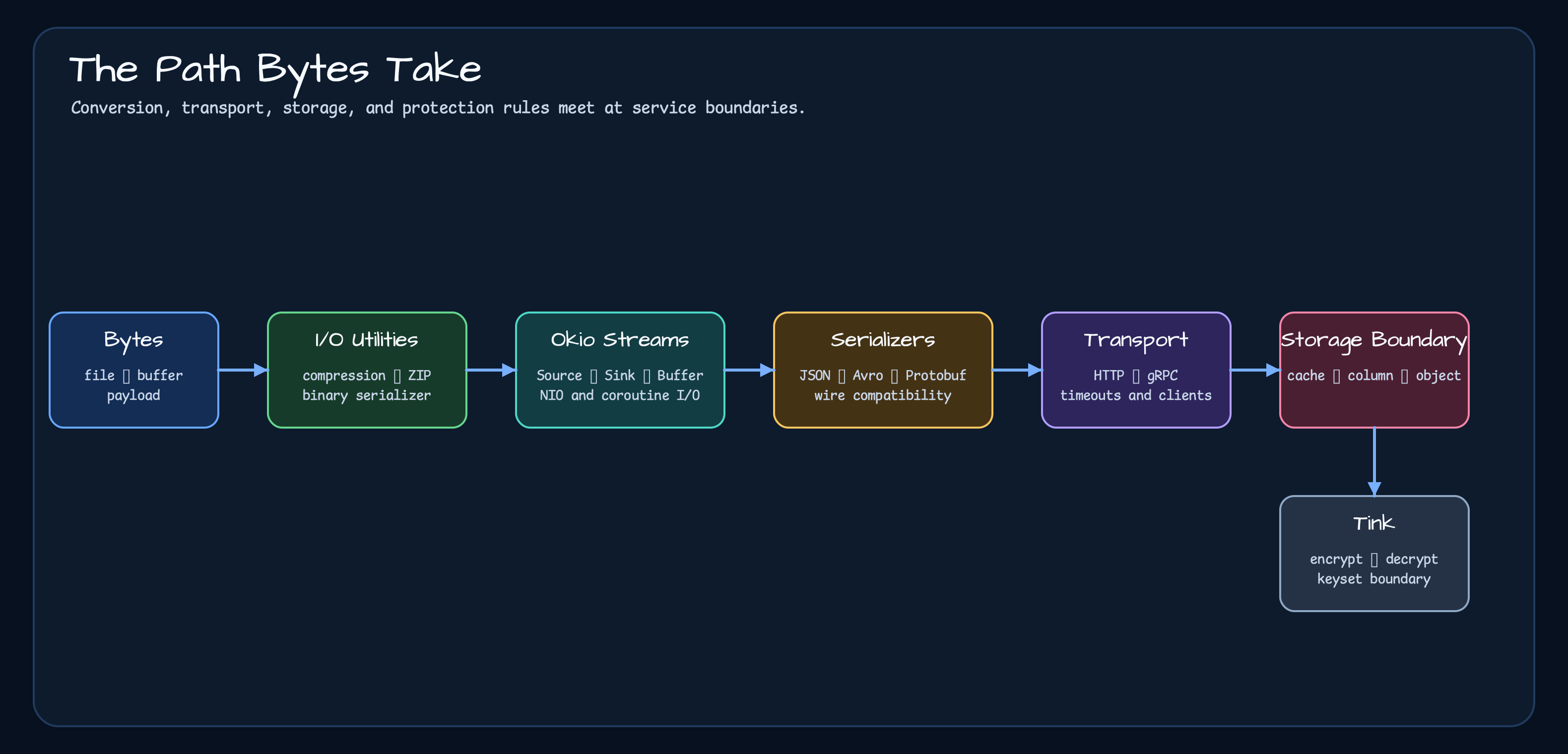
Section titled “Closing”Part 3 modules organize the path bytes take through service boundaries: compression, streaming, JSON, Protobuf, HTTP, RPC, and encryption.
When each service invents that path again, small differences accumulate. One service uses different timeouts. Another
swallows serializer failure as null. Another forgets encryption context. These differences can look like local
preference during development and become unregistered risk in production.
The shared I/O foundation does not make every problem disappear. It makes similar boundaries fail in similar ways. That matters. Similar failures are easier to find, fix, and teach to the next service. For engineering, that is a practical win: same boundary, same rule.
Next, we will look at data and infrastructure modules. Once bytes arrive safely, databases, Redis, and Kafka still have strong opinions of their own.
Comments
Leave a note or reaction with your GitHub account.