
Bluetape4k Leader Part 4: Spring Boot and Ktor Integration
Part 2 covered the call models: LeaderElector, SuspendLeaderElector, AsyncLeaderElector, and VirtualThreadLeaderElector.
Part 3 moved beyond one leader into group slots and strategic election.
Part 4 asks a different question: do callers need to wrap every job with runIfLeader manually?
In Spring Boot services, scheduled or service methods often want annotations.
In Ktor services, background jobs belong inside the application lifecycle.
bluetape4k-leader provides both integration surfaces.

Spring Boot: fixing the execution boundary with annotations
Section titled “Spring Boot: fixing the execution boundary with annotations”leader-spring-boot provides @LeaderElection and @LeaderGroupElection.
The method body becomes the election action.
Only the elected node runs the body; a contending node skips according to the return shape.
@Serviceclass ReportJob { @Scheduled(cron = "0 0 * * * *") @LeaderElection(name = "hourly-report", leaseTime = "PT10M") fun generateHourlyReport(): Report? { return reportService.generate() }}The direct API version looks like this:
val result = leaderElector.runIfLeader("hourly-report") { reportService.generate()}The annotation moves that boilerplate into the framework boundary. That also means the method return shape, proxy/AOP boundary, and lock-name expression become operational contracts. The code is shorter, but the execution boundary matters more.
Sources:
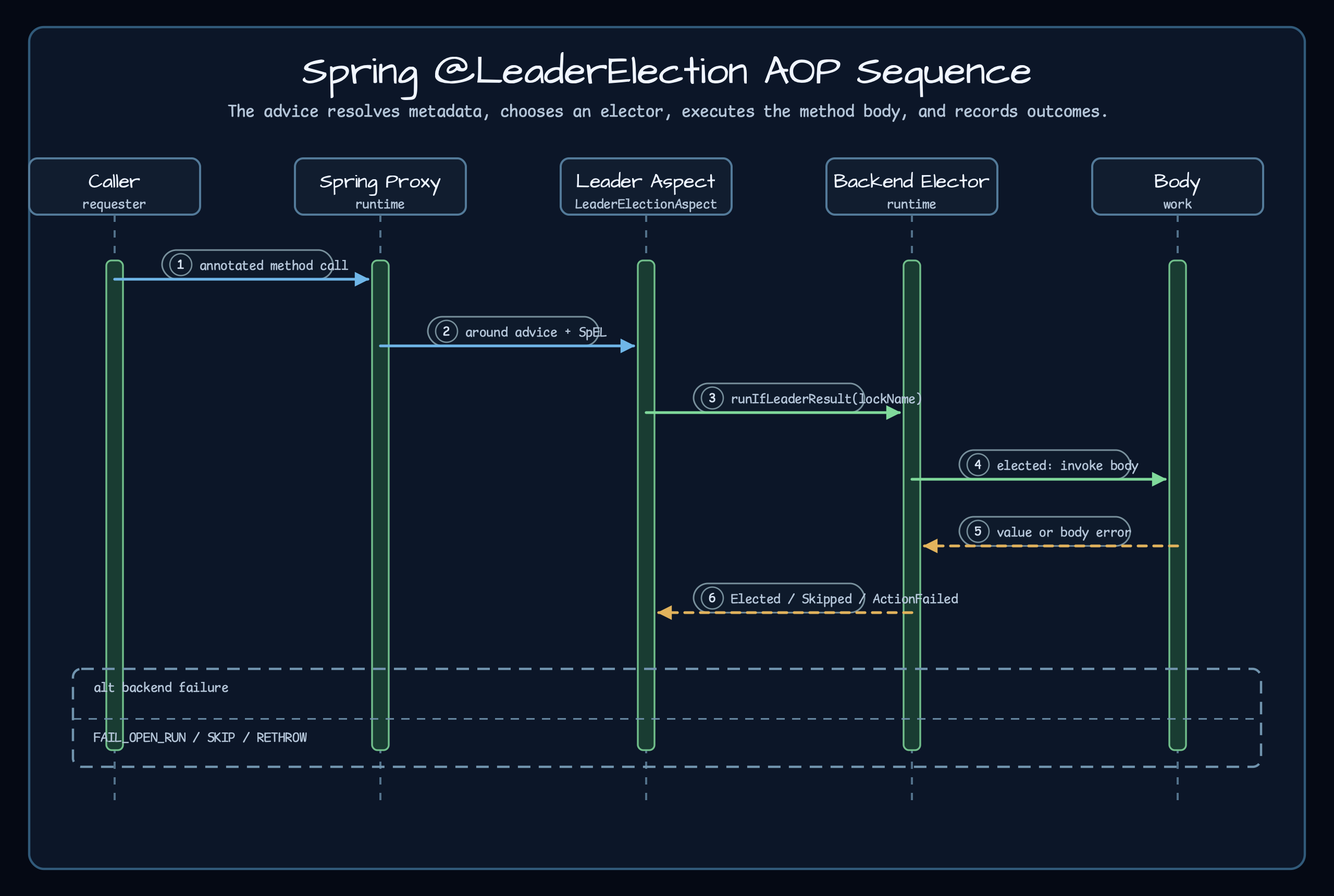
@LeaderElection is small, but its runtime path is not. The advice resolves the lock name, selects an elector by factory/options, separates backend results from body exceptions, and sends outcomes through metrics and failure-mode branches.That flow is why the annotation should not be treated as decoration.
The operational boundary lives inside the aspect, where contention skips, backend errors, and body exceptions follow different paths.
The LeaderRunResult distinction from Part 2 remains important at the AOP layer.
@LeaderGroupElection: N slots through an annotation
Section titled “@LeaderGroupElection: N slots through an annotation”Group election from Part 3 is available at the annotation boundary as well.
Use @LeaderGroupElection when one method may run on up to maxLeaders nodes at the same time.
@LeaderGroupElection( name = "tenant-rollup", maxLeaders = 3, leaseTime = "PT5M",)fun rollupNextTenant(): RollupResult? { return tenantRollupService.rollupNext()}maxLeaders <= 1 is rejected by startup validation because it is not meaningful group election.
Flux<T> and Flow<T> stream returns are not supported for group annotations yet.
Each slot needs its own lease extension and completion boundary.
Running a long stream inside a group slot postpones an expensive operational question.
Sources:
Lock names use SpEL, but syntax is strict
Section titled “Lock names use SpEL, but syntax is strict”Static names are straightforward.
@LeaderElection(name = "daily-settlement")fun settle()Dynamic names use plain SpEL.
@LeaderElection(name = "'process-' + #region")fun process(region: String)The important detail is "'process-' + #region", not "process-#region".
Without quotes, process- is parsed as an identifier, not a string prefix.
Spring property placeholders are also supported.
@LeaderElection(name = "\${spring.application.name}-warmup")fun warmup()AOP properties live under bluetape4k.leader.aop.*.
They control default wait and lease time, strict validation, failure mode, lock-name prefix, and whether SpEL method invocation is allowed.
The default lock-name prefix is ${spring.application.name:}:, which reduces collisions when multiple applications share the same backend.
bluetape4k: leader: aop: enabled: true strict: false failure-mode: RETHROW default-wait-time: PT5S default-lease-time: PT1M lock-name-prefix: "${spring.application.name:}:" spel: allow-method-invocation: falseSources:
failureMode: lock contention is not backend failure
Section titled “failureMode: lock contention is not backend failure”Lock contention is a normal skip.
Backend failure is different.
failureMode controls what happens when Redis, SQL, MongoDB, Kubernetes API, or another backend fails.
| Mode | Meaning |
|---|---|
RETHROW | Wrap and propagate the backend error as a leader-election exception |
SKIP | Treat backend failure like a skipped execution |
FAIL_OPEN_RUN | Run the method body even though the lock path failed |
FAIL_OPEN_RUN deserves caution.
Leader election exists to prevent duplicate execution, and fail-open deliberately lowers that protection during backend failure.
It can be practical for cache warmup or dashboard snapshots.
It is usually wrong for settlement, payment, or schema migration jobs.
@LeaderElection( name = "dashboard-job", failureMode = LeaderAspectFailureMode.FAIL_OPEN_RUN,)fun refreshDashboardSnapshot()Sources:
Metrics make the annotation boundary observable
Section titled “Metrics make the annotation boundary observable”When annotations hide the direct runIfLeader call, operations need smaller events than “method ran”.
Useful events include attempts, acquisitions, contention skips, backend-error skips, execution duration, failures, and active executions.
leader-micrometer provides MicrometerLeaderAopMetricsRecorder.
When a MeterRegistry is available, AOP callbacks become meters.
Prometheus exposes them as leader_aop_*.
| Meter | Meaning |
|---|---|
leader.aop.attempts | Lock acquisition attempts |
leader.aop.acquired | Successful elections |
leader.aop.lock.not.acquired | Skips, with a reason tag such as CONTENTION or BACKEND_ERROR |
leader.aop.execution.duration | Method-body execution duration |
leader.aop.task.failed | Method-body failures |
leader.aop.active | Currently active leader actions |
The prometheus-dashboard example registers an @LeaderElection job named dashboard-job and verifies leader_aop_* metrics through /actuator/prometheus.
In production, watch lock-name cardinality.
Putting tenant ids or request ids directly into lock-name tags can make the time-series backend hurt before the dashboard helps.
Sources:
Ktor: plugin plus application lifecycle
Section titled “Ktor: plugin plus application lifecycle”Ktor integration uses an explicit application boundary instead of Spring AOP.
Install LeaderElectionPlugin with a SuspendLeaderElector, then register periodic work with leaderScheduled.
fun Application.module() {    val elector = createLettuceSuspendLeaderElector()
    install(LeaderElectionPlugin) {        leaderElection = elector        managementRouteEnabled = true    }
    leaderScheduled("hourly-stats-aggregation", period = 1.hours) {        statsAggregator.aggregate()    }}
leaderScheduled runs a loop in an application coroutine.
Each cycle calls SuspendLeaderElector.runIfLeader(lockName) { ... }.
Because the job runs in the application coroutine scope, it is cancelled as the application shuts down.
CancellationException is rethrown; ordinary exceptions are logged and the next cycle continues.
That behavior is a good fit for batch-style background jobs.
A failed cycle does not tear down the whole application, but shutdown cancellation is not swallowed.
Sources:
Ktor management routes are for observation
Section titled “Ktor management routes are for observation”leader-ktor also provides a management route.
The default path is /management/leaderElection.
The route walks registered lock names, calls state(lockName), and returns a JSON snapshot.
install(LeaderElectionPlugin) { leaderElection = elector managementRouteEnabled = true managementRoutePath = "/management/leaderElection"}The key word is snapshot.
The management route shows who appears to hold a lock now.
It is not an execution-decision API.
Execution decisions must stay on the atomic runIfLeader path.
Checking state and then running the body manually writes a TOCTOU race by hand.
Those races are especially annoying because they often pass the first local test.
The route does not add authentication or authorization on its own, so expose it only behind a trusted management boundary such as an internal port, network policy, or authentication layer.
Source:
Selection guide
Section titled “Selection guide”| Situation | Spring Boot | Ktor |
|---|---|---|
Protect an existing @Scheduled method | @LeaderElection | Move the job to leaderScheduled |
| Allow N cluster-wide workers | @LeaderGroupElection(maxLeaders = N) | Configure the core group elector directly |
| Coroutine application job | Suspend method annotation or direct SuspendLeaderElector | LeaderElectionPlugin + leaderScheduled |
| Prometheus metrics | leader-micrometer + AOP recorder | Core/micrometer wrapper or route-level metrics |
| State inspection route | Mostly Actuator/health/metrics | /management/leaderElection |
Spring annotations fit services where method boundaries are already clear. Ktor helpers fit background jobs launched inside the application lifecycle. The shared rule is the same: contention is a normal skip, state lookup is observation, and execution decisions must happen through an API that combines lock acquisition with body execution.
Closing
Section titled “Closing”Part 4 is not about hiding leader election inside a framework. It is about moving the execution-authority boundary to the framework lifecycle where it is easier to review and operate. In Spring Boot, that boundary is annotation/AOP. In Ktor, it is the plugin plus application job.
Part 5 moves down into backends and operations: how Redis, SQL/R2DBC, MongoDB, Hazelcast, Kubernetes, etcd, and Consul differ in lease behavior, TTL, failure handling, and metrics.
Comments
Leave a note or reaction with your GitHub account.