Bluetape4k Exposed Part 6: BigQuery, Trino, CockroachDB, and DuckDB Integrations
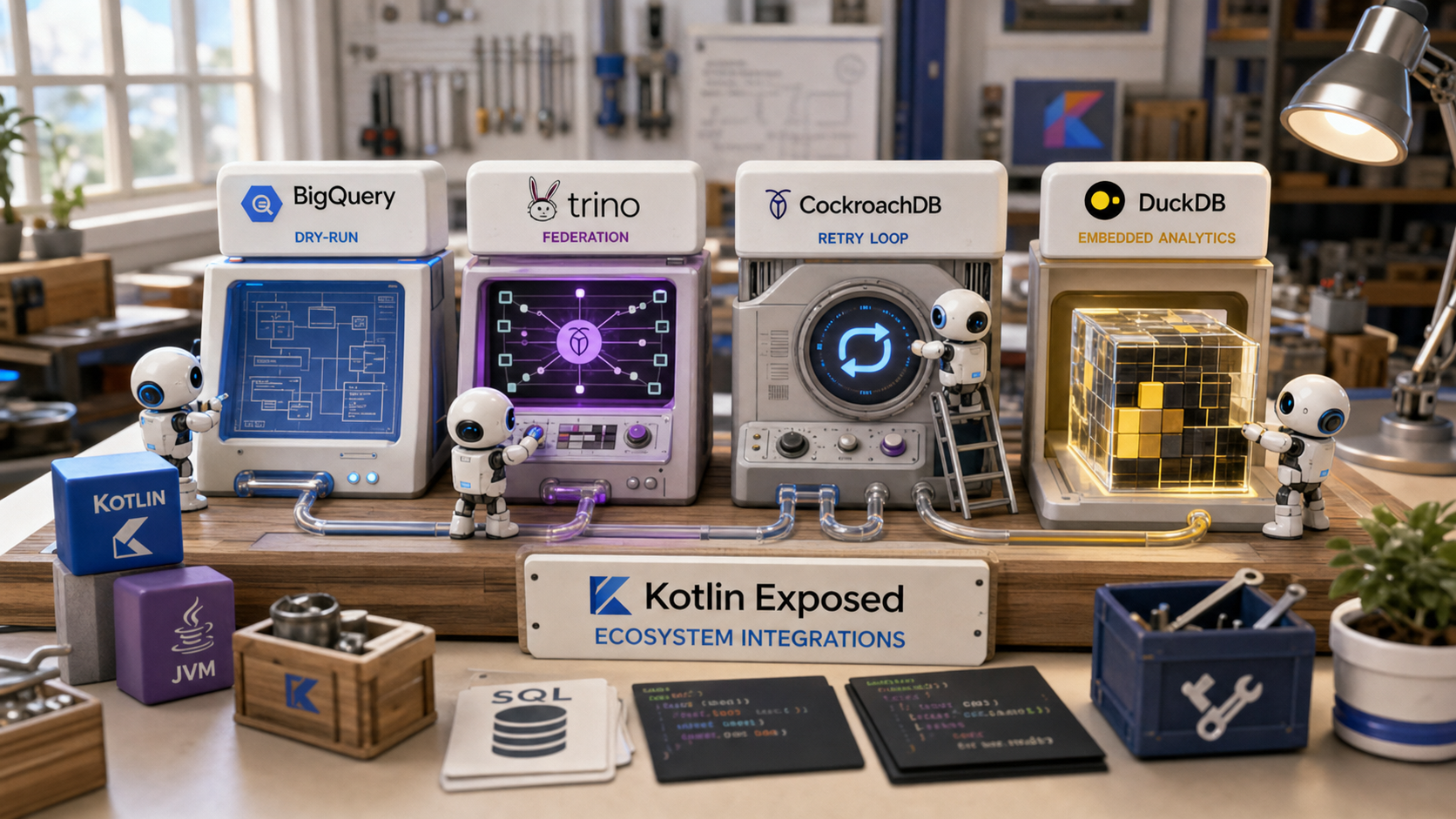
Part 4 covered JSON, encryption, and dialects. Part 5 moved into cache and production examples. This post looks at the next boundary: what to verify when Exposed SQL DSL meets BigQuery, Trino, CockroachDB, and DuckDB.
The point is not “use Exposed for every database in the same way.” These four integrations are not just another JDBC database with a different URL.
| Example | Contract to verify first | Default execution boundary |
|---|---|---|
| BigQuery | Dry-run request and option mapping before execution | Mocked REST client, no credential |
| Trino | Session options and SQL shape suitable for EXPLAIN | Local SQL generation, no coordinator |
| CockroachDB | Whole-transaction retry on SQLSTATE 40001 | Testcontainers CockroachDB |
| DuckDB | File-backed embedded analytics and transaction/Flow boundary | Local DuckDB file, no server |
That is why exposed-workshop/13-ecosystem-integrations does not start by calling real services. Most examples begin at
a local, fake, mocked, or Testcontainers boundary. Before enabling cost, credentials, and network access, the application
should test the contract it owns.
BigQuery: Dry-Run Before Execution
Section titled “BigQuery: Dry-Run Before Execution”The BigQuery example does not execute a warehouse query. It turns an Exposed query into a BigQuery jobs.query request
and checks that dryRun=true plus the query options are mapped correctly.
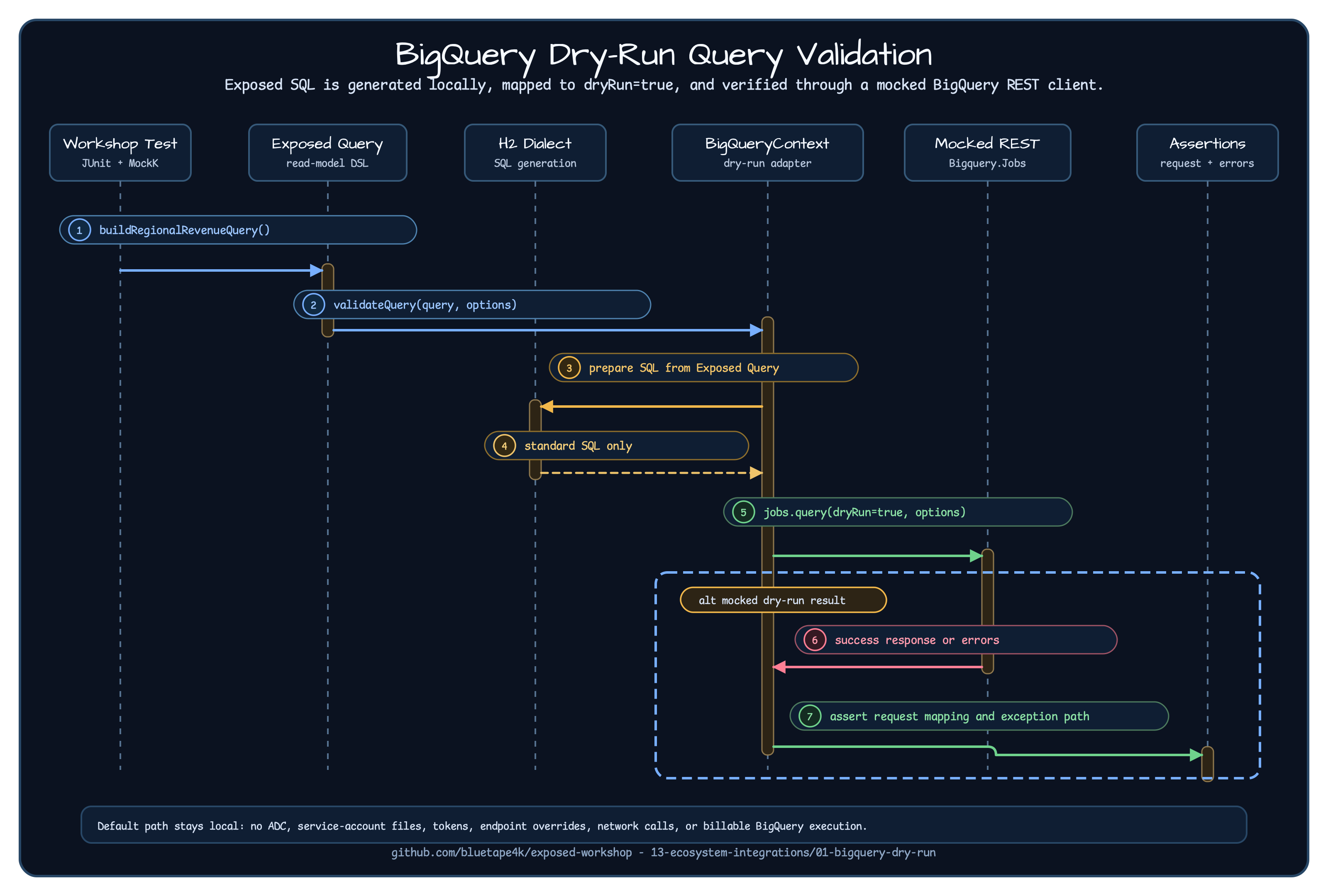
The main function is intentionally small.
fun validateRegionalRevenueDryRun( context: BigQueryContext, options: BigQueryQueryOptions = defaultDryRunOptions(), minimumRevenue: BigDecimal = BigDecimal("10.00"),): QueryResponse = context.validateQuery(buildRegionalRevenueQuery(minimumRevenue), options)defaultDryRunOptions() sets maximumBytesBilled, labels, priority, location, and timeoutMs. Tests capture the
outgoing request with a mocked BigQuery REST client. The important guarantee is credential freedom: the default command
must not read GOOGLE_APPLICATION_CREDENTIALS, ADC, service-account files, or API keys.
./gradlew :01-bigquery-dry-run:testThis is not a BigQuery performance example. It is a safety check for “can this query be sent with these options?” before real execution. Accidentally learning that lesson from a live warehouse bill is a poor feedback loop.
Trino: Connection Options Are Application Contracts
Section titled “Trino: Connection Options Are Application Contracts”The Trino example also avoids a live coordinator. Instead, it turns an application-facing profile into
TrinoConnectionOptions and wraps generated SQL in an EXPLAIN request shape.
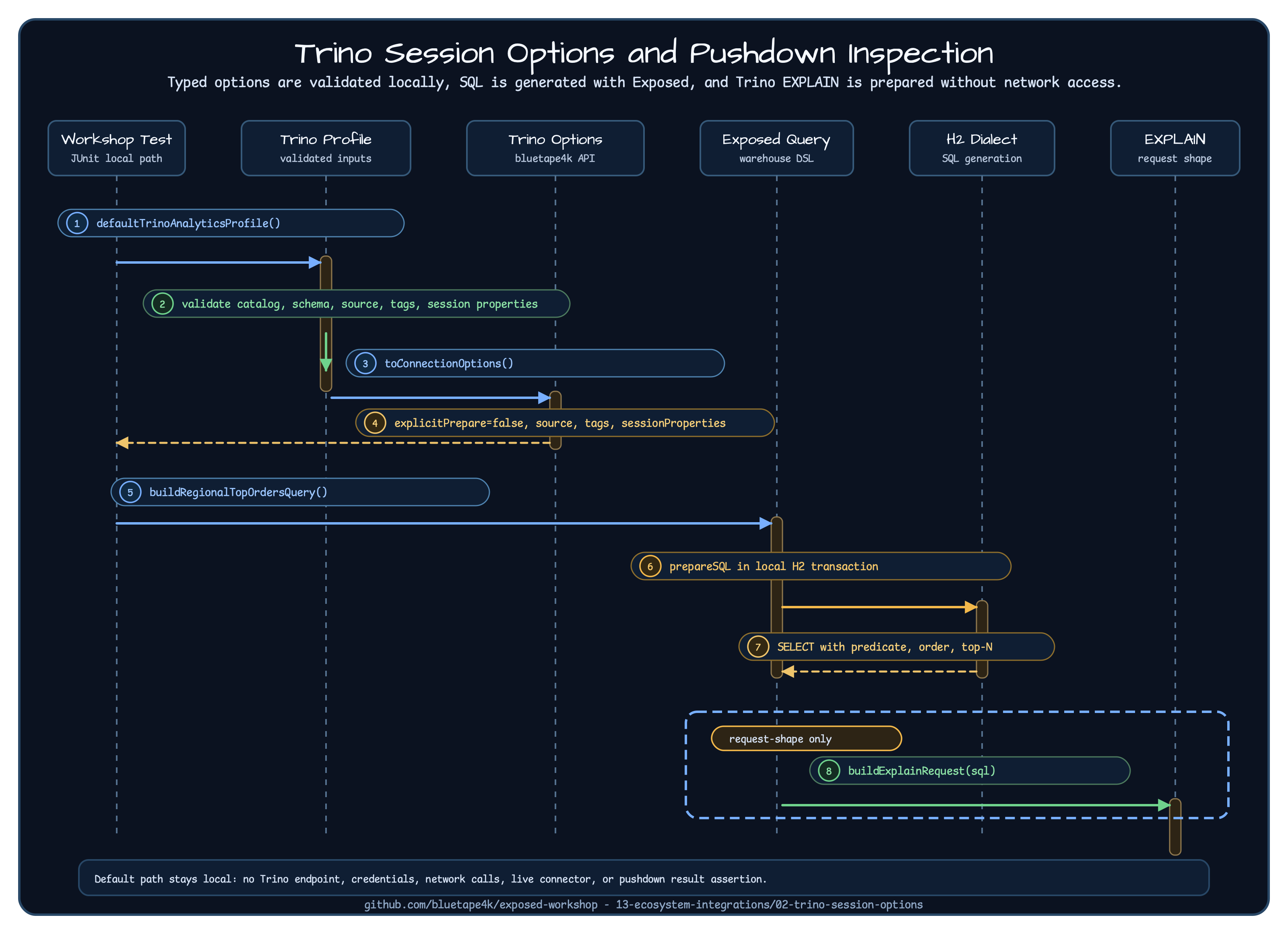
The profile validates application values before they become driver properties.
data class TrinoWorkshopConnectionProfile( val catalog: String = "hive", val schema: String = "analytics", val source: String = "exposed-workshop", val clientTags: List<String> = listOf("exposed", "analytics", "workshop"), val sessionProperties: Map<String, String> = mapOf( "join_distribution_type" to "AUTOMATIC", "query_max_execution_time" to "5m", ),): SerializableThen the example checks the query boundary.
fun buildExplainRequest(sql: String): String { sql.requireNotBlank("sql") return "EXPLAIN\n$sql"}The test does not prove connector-specific pushdown. Trino pushdown depends on the connector and catalog configuration. The workshop proves a smaller contract: generated SQL keeps projection, predicate, ordering, and top-N signals that a real Trino catalog can inspect later.
CockroachDB: Retry the Whole Transaction, Not the Last Statement
Section titled “CockroachDB: Retry the Whole Transaction, Not the Last Statement”CockroachDB speaks the PostgreSQL wire protocol, but application code still needs to understand its transaction failure
boundary. A serializable conflict can return SQLSTATE 40001 with a restart transaction style message. In that case,
rerunning only the last UPDATE is wrong. The read, validation, update, and ledger insert all need to be retried as one
transaction.
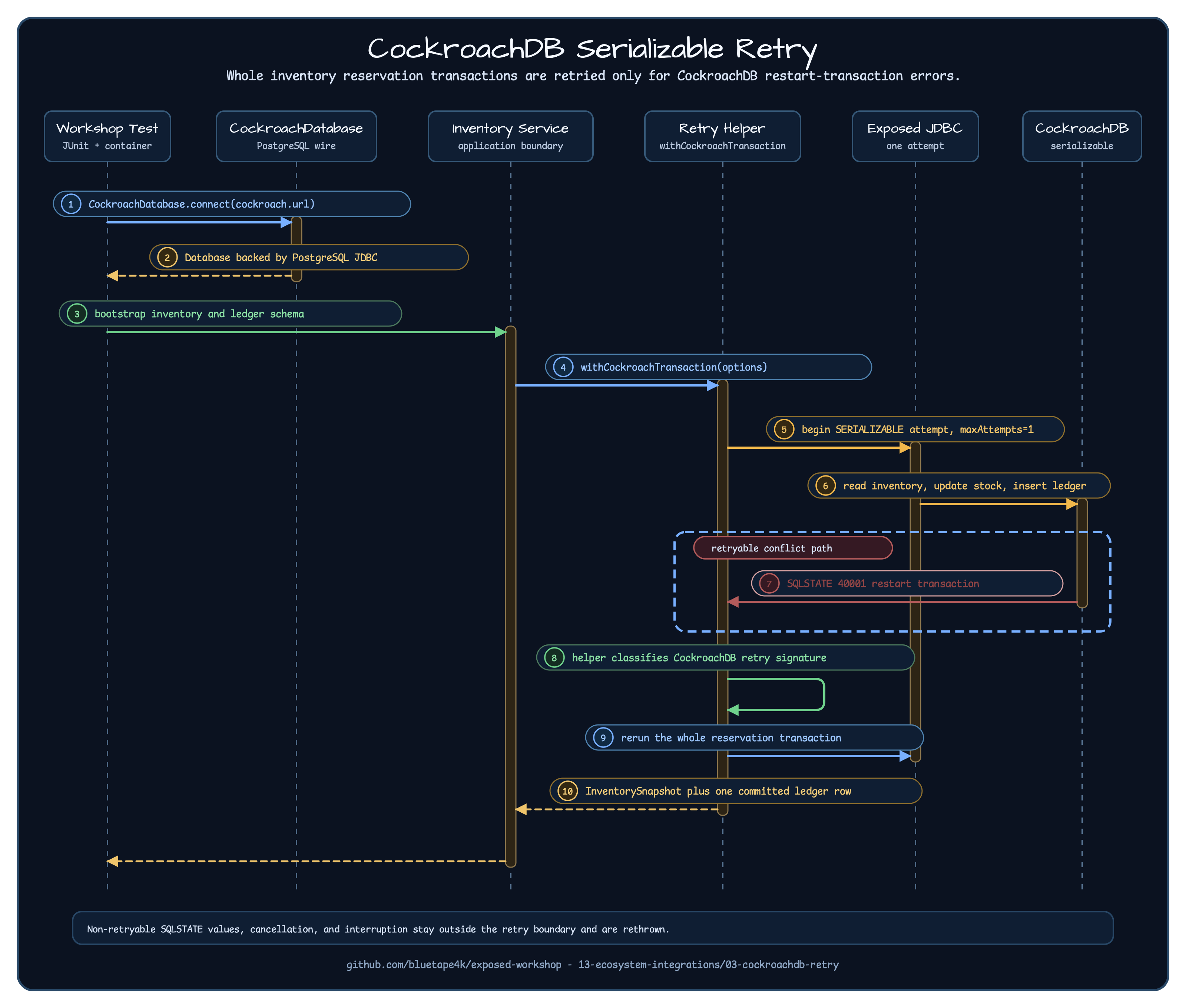
The service delegates retry ownership to withCockroachTransaction.
return withCockroachTransaction(db = db, options = retryOptions) {    val current = CockroachInventory        .selectAll()        .where { CockroachInventory.sku eq sku }        .single()        .toInventorySnapshot()
    CockroachInventory.update({ CockroachInventory.sku eq sku }) {        it[quantityOnHand] = current.quantityOnHand - quantity        it[version] = current.version + 1    }    CockroachLedger.insert {        it[CockroachLedger.sku] = sku        it[quantityDelta] = -quantity        it[CockroachLedger.reason] = reason    }}
The test starts CockroachDB through Testcontainers and checks normal reservation, one retryable conflict, and a non-retryable SQL error that must not be replayed.
./gradlew :03-cockroachdb-retry:testThe example is not about a custom CockroachDB dialect. It is about deciding which failures are retryable and where the retry unit belongs. Once every service starts making that judgment alone, the code gets messy fast.
DuckDB: Embedded Analytics, Not a Remote Warehouse
Section titled “DuckDB: Embedded Analytics, Not a Remote Warehouse”DuckDB is different from the other three. BigQuery and Trino show remote platform boundaries, and CockroachDB shows a distributed SQL transaction boundary. DuckDB opens a small analytics engine inside the application process.
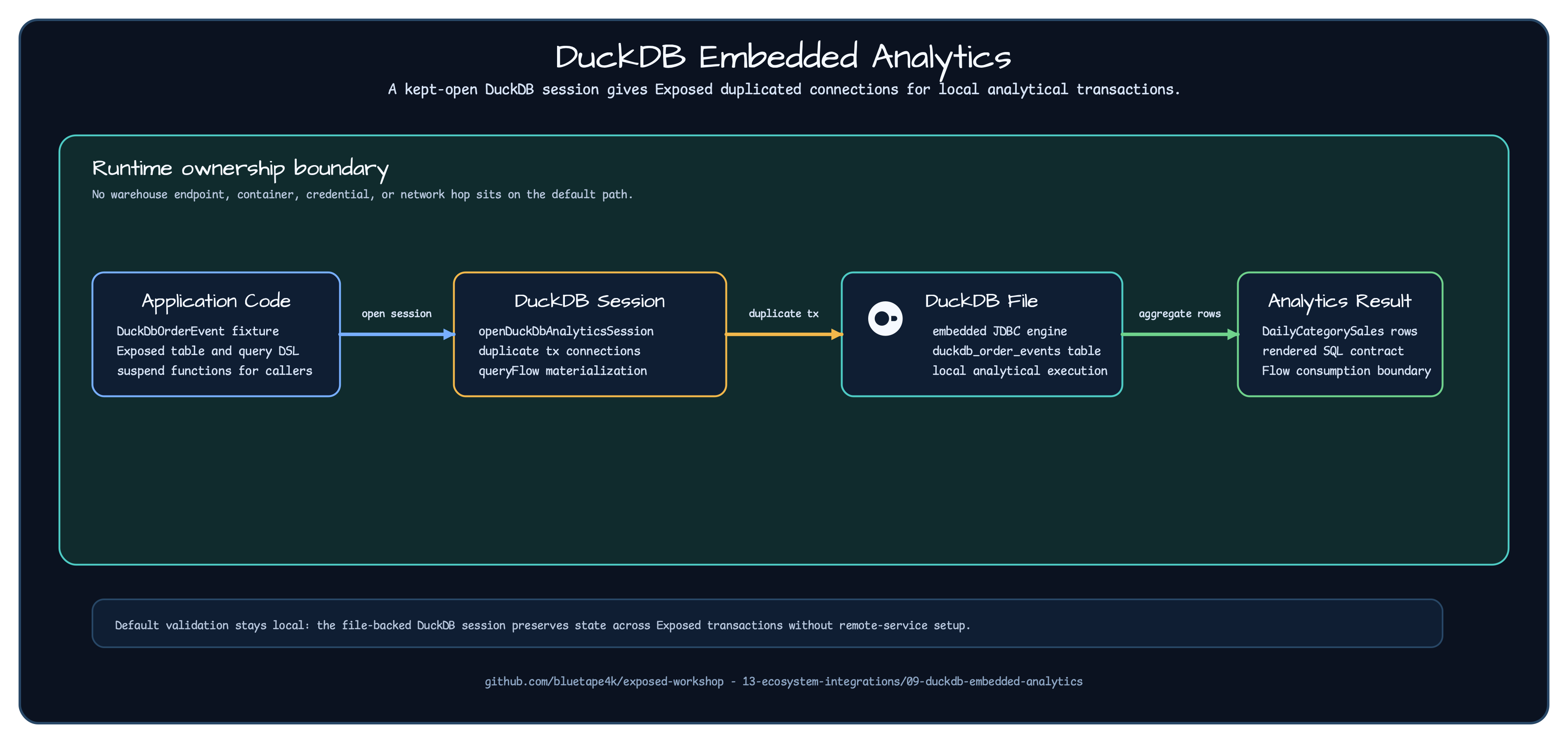
The workshop uses a file-backed database. That choice matters. A plain jdbc:duckdb: in-memory database can create an
independent catalog per connection. That is not a good default when separate Exposed transactions must observe the same
rows.
class DuckDbAnalyticsSession private constructor( val db: Database, private val rootConnection: DuckDBConnection,): AutoCloseable { companion object { fun file(path: Path): DuckDbAnalyticsSession { val rootConnection = DriverManager .getConnection("jdbc:duckdb:${path}") as DuckDBConnection val db = Database.connect( getNewConnection = { WorkshopDuckDbConnectionWrapper(rootConnection.duplicate()) }, ) return DuckDbAnalyticsSession(db, rootConnection) } }}The aggregate query is still written with Exposed DSL and executed locally by DuckDB.
fun buildDailyCategorySalesQuery(): Query = DuckDbOrderEvents .select( DuckDbOrderEvents.region, DuckDbOrderEvents.category, DuckDbOrderEvents.eventDate, DuckDbOrderEvents.orderId.count(), DuckDbOrderEvents.amount.sum(), ) .groupBy( DuckDbOrderEvents.region, DuckDbOrderEvents.category, DuckDbOrderEvents.eventDate, )The easy-to-misread part is queryFlow. streamDailyCategorySales returns a Flow, but it does not stream JDBC rows
outside the transaction one by one. The representative pattern is to materialize the query result as
List<DailyCategorySales> inside the transaction, then hand those materialized rows to the coroutine pipeline.
fun streamDailyCategorySales( db: Database, dispatcher: CoroutineDispatcher = Dispatchers.IO,): Flow<DailyCategorySales> = queryFlow(db, dispatcher) { buildDailyCategorySalesQuery().map(::toDailyCategorySales) }So the Flow boundary means “make already-read analytics rows pipeline-friendly”, not “keep a JDBC cursor open across
the coroutine pipeline.” The longer implementation and tests are linked below for readers who want the raw code. If a
Flow name tempts code to drag a JDBC cursor outside its transaction, debugging will be unpleasant.
Selection Rules
Section titled “Selection Rules”When the four examples are read together, the selection rule is clear.
| Situation | Example to inspect first | Rule to copy |
|---|---|---|
| Validate warehouse SQL before execution | BigQuery dry-run | Test request contract before cost and credentials |
| Control federation query settings from application code | Trino session options | Keep catalog/schema/source/session properties in a typed profile |
| Handle serializable conflicts in distributed SQL | CockroachDB retry | Retry the whole transaction, not the final statement |
| Run analytics SQL in local, CI, or offline jobs | DuckDB embedded analytics | Make file-backed session and materialized Flow boundaries explicit |
The conclusion is not “make every database look the same through Exposed.” It is the opposite. When the database or platform changes, expose the different contract first. BigQuery has a dry-run request, Trino has session options, CockroachDB has retry classification, and DuckDB has a file-backed embedded session.
Exposed DSL is a useful common language at that boundary: it builds SQL and expresses transaction blocks. It should not pretend that execution model, credentials, retry semantics, and cursor lifetime are all the same. The examples are small because small examples are where those boundaries are easiest to see.
Source Links
Section titled “Source Links”- Chapter 13: Ecosystem Integrations
- BigQuery dry-run: 01-bigquery-dry-run/README.md
- Trino session options: 02-trino-session-options/README.md
- CockroachDB retry: 03-cockroachdb-retry/README.md
- DuckDB embedded analytics: 09-duckdb-embedded-analytics/README.md
- DuckDB workshop source: DuckDbEmbeddedAnalyticsWorkshop.kt
- BigQuery support: exposed/bigquery
- Trino support: exposed/trino
- CockroachDB support: exposed/cockroachdb
- DuckDB support: exposed/duckdb
Comments
Leave a note or reaction with your GitHub account.