
Bucket4j Rate Limiting: Choose the Caller Identity Before the Bucket

When a public API needs rate limiting, it is natural to start with token buckets. In production, though, the first
mistake is often not the bucket data structure. It is caller identity. Using remoteAddress blindly can make every user
behind a proxy look like one caller. Trusting X-Forwarded-For blindly can let an attacker rotate quota by changing a
request header.
bluetape4k-workshop/ratelimit has four modules that make the problem easy to study in layers. The post works best when
each module has a clear role.
| Example | Role in this post | Main point |
|---|---|---|
bucket4j-caffeine-web | Single-JVM starter baseline | Stores buckets in Caffeine JCache and limits WebMVC endpoints |
bucket4j-redis | Distributed bucket baseline | Stores token state in Redis/Lettuce and limits WebFlux endpoints |
bucker4j-bluetape4k-webflux | bluetape4k limiter API example | Applies user-token buckets through DistributedRateLimiter |
bucket4j-advanced | Main article example | Separates IP, user, combined keys, proxy trust, and standard response headers |
The center of the article is therefore bucket4j-advanced. Caffeine and Redis explain storage choices. The bluetape4k
WebFlux module shows the library API. The operational problem, however, is usually not just “Redis or Caffeine?” It is
“did we put the right requests into the same bucket?”
Rate Limiting Architecture
Section titled “Rate Limiting Architecture”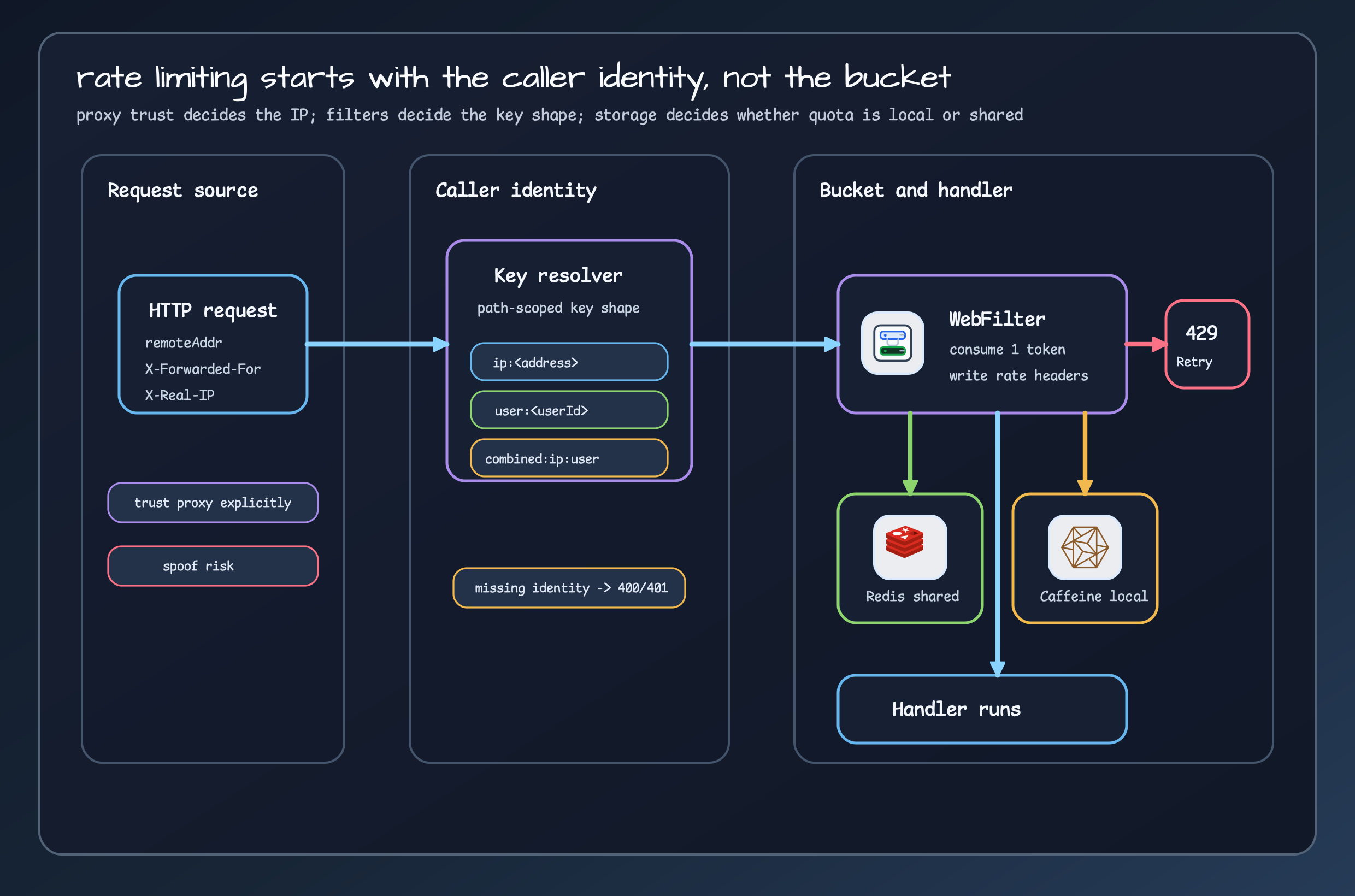
If rate limiting is treated as “count requests”, the design gets flat quickly. In practice, three questions have to be answered separately.
| Question | Failure mode |
|---|---|
| Which identity partitions the bucket? | A NATed user group can be blocked together, or an attacker can spoof a header to bypass the limit |
| Where is bucket state stored? | Multiple instances can each grant their own quota |
| How is the result exposed to clients? | Clients cannot tell when to retry and may amplify traffic |
In code, the diagram has two steps. First, the Bucket4j configuration decides which bucket policy is attached to which limiter bean. Then the WebFilter extracts an identity from the request, builds a bucket key, and asks whether one token can be consumed for that key.
Bucket4j Configuration Separates Policy from Limiter Beans
Section titled “Bucket4j Configuration Separates Policy from Limiter Beans”RateLimitConfig
creates one Redis proxy manager, then registers separate BucketConfiguration, AsyncBucketProxyProvider, and
DistributedSuspendRateLimiter beans for the IP, user, and combined strategies.
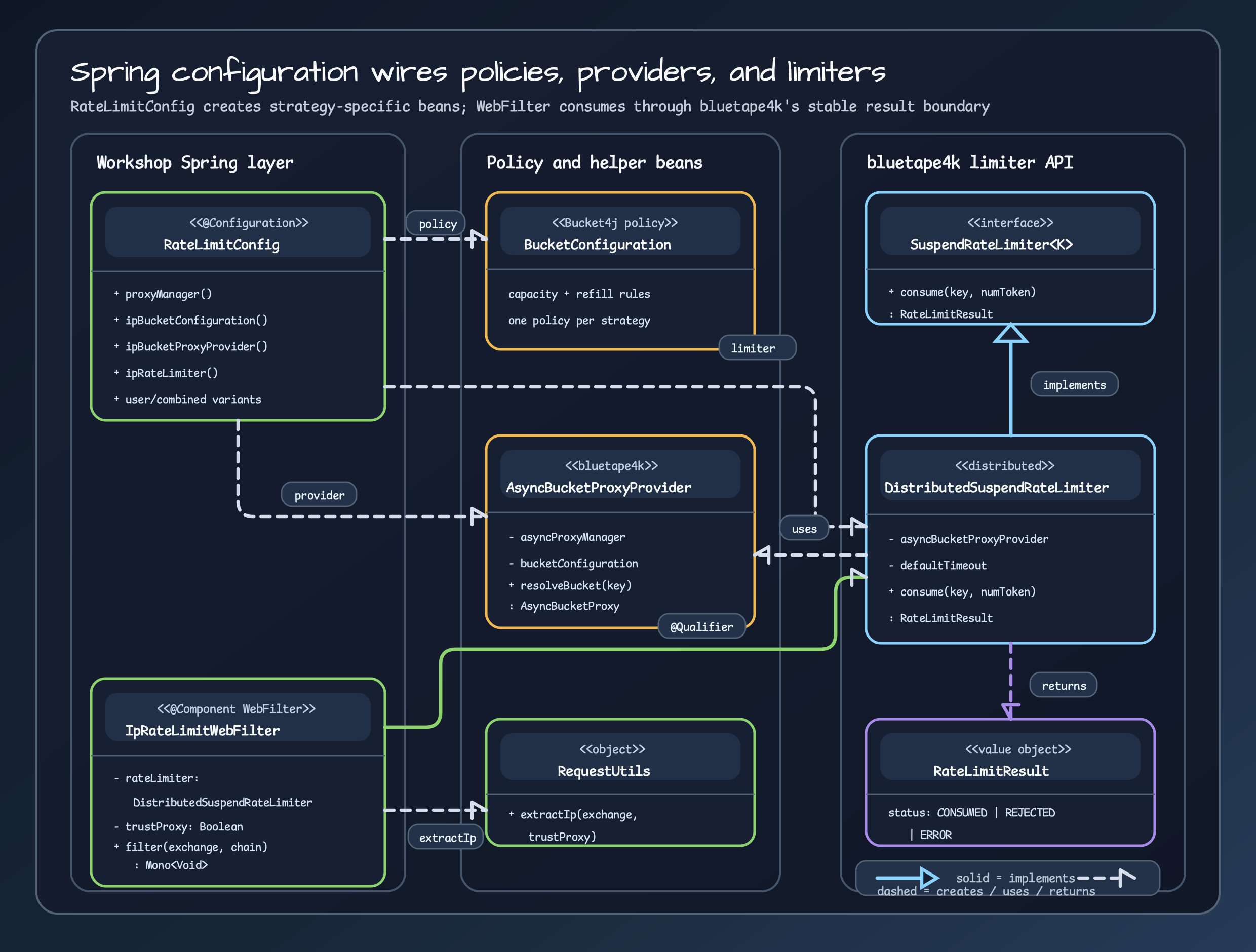
RateLimitResult. Solid lines mean interface implementation; dashed lines mean creates, uses, or returns.As a class diagram, RateLimitConfig is the wiring class that produces the same bean shape for each strategy.
BucketConfiguration owns the quota policy, AsyncBucketProxyProvider resolves the remote bucket for a key, and
DistributedSuspendRateLimiter implements SuspendRateLimiter. The HTTP filter only injects that limiter and interprets
RateLimitResult, so the boundary between Spring bean wiring and HTTP behavior is a single consume(key, 1) call.
@Beanfun proxyManager(lettuceClient: RedisClient): LettuceBasedProxyManager<ByteArray> {    return lettuceBasedProxyManagerOf(lettuceClient) {        ClientSideConfig.getDefault()            .withExpirationAfterWriteStrategy(                ExpirationAfterWriteStrategy                    .basedOnTimeForRefillingBucketUpToMax(Duration.ofSeconds(90))            )            .withExecutionStrategy(ExecutionStrategy.background(VirtualThreadExecutor))    }}
@Bean@Qualifier("ipBucketConfiguration")fun ipBucketConfiguration(): BucketConfiguration = bucketConfiguration {    addLimit { it.capacity(20).refillIntervally(20, Duration.ofSeconds(10)) }    addLimit { it.capacity(100).refillGreedy(10, Duration.ofMinutes(1)) }}
@Bean@Qualifier("ipBucketProxyProvider")fun ipBucketProxyProvider(    proxyManager: ProxyManager<ByteArray>,    @Qualifier("ipBucketConfiguration") ipBucketConfiguration: BucketConfiguration,): AsyncBucketProxyProvider =    AsyncBucketProxyProvider(proxyManager.asAsync(), ipBucketConfiguration)
@Bean@Qualifier("ipRateLimiter")fun ipRateLimiter(    @Qualifier("ipBucketProxyProvider") ipBucketProxyProvider: AsyncBucketProxyProvider,): DistributedSuspendRateLimiter =    DistributedSuspendRateLimiter(ipBucketProxyProvider)
The Redis proxy manager is the shared backend for token state. ipBucketConfiguration is the actual policy: 20 tokens
per 10 seconds plus 100 tokens per minute for anonymous IP traffic. ipRateLimiter is the entry point that consumes
that policy. The user and combined strategies use the same structure with different capacities.
bluetape4k RateLimiter Wraps Bucket4j Probes as Result Objects
Section titled “bluetape4k RateLimiter Wraps Bucket4j Probes as Result Objects”RateLimiter
and
SuspendRateLimiter
are small facades around Bucket4j. They do not expose Bucket4j internals to the HTTP filter. The filter calls
consume(key, numToken) and receives one stable result object.
interface SuspendRateLimiter<K> { suspend fun consume(key: K, numToken: Long = 1): RateLimitResult}consume does not wait for refill. It attempts immediate token consumption and returns a
RateLimitResult.
val result = rateLimiter.consume("ip:203.0.113.10", 1)
when {    result.isConsumed -> chain.filter(exchange).awaitSingleOrNull()    result.isRejected -> {        exchange.response.statusCode = HttpStatus.TOO_MANY_REQUESTS        Mono.empty<Void>().awaitSingleOrNull()    }    result.isError -> chain.filter(exchange).awaitSingleOrNull() // example policy: fail open}
RateLimitResult has three operational states.
| Status | Meaning | Use in an HTTP filter |
|---|---|---|
CONSUMED | The token was consumed | Continue to the handler |
REJECTED | The bucket had insufficient tokens | Return 429 with Retry-After |
ERROR | Provider or Redis processing failed | Supplies failure detail to the caller |
The distributed coroutine implementation,
DistributedSuspendRateLimiter,
resolves the key-specific async bucket proxy, awaits one tryConsumeAndReturnRemaining(numToken) ConsumptionProbe,
and maps that probe to RateLimitResult. It does not read availableTokens again after consuming.
val bucketProxy = asyncBucketProxyProvider.resolveBucket(key)val probe = bucketProxy.tryConsumeAndReturnRemaining(numToken).await()return toRateLimitResult(probe, numToken)That is the useful boundary for the workshop. The HTTP layer does not need to know Bucket4j probe internals. The current
bucket4j-advanced filters return 429 when a consumption result is not successful, while an exception thrown by
consume is caught by the outer filter and handled with an explicit fail-open path. Result states and thrown failures
therefore have distinct operational boundaries.
The Identity from extractIp Becomes the Permit Key
Section titled “The Identity from extractIp Becomes the Permit Key”For /api/anonymous, the
IpRateLimitWebFilter
extracts caller identity with RequestUtils.extractIp(exchange, trustProxy), builds an ip:<address> bucket key, and
calls rateLimiter.consume(key, 1L).
val ip = RequestUtils.extractIp(exchange, trustProxy)val effectiveIp = ip?.takeIf { it.isNotBlank() } ?: "unknown"
val key = "ip:$effectiveIp"val result = rateLimiter.consume(key, 1L)
exchange.response.headers.set(    HeaderConstants.X_RATELIMIT_REMAINING,    result.availableTokens.toString())
if (result.isConsumed) {    chain.filter(exchange).awaitSingleOrNull()} else {    val retryAfterSecs = result.retryAfter        ?.let { TimeUnit.NANOSECONDS.toSeconds(it.toNanos()).coerceAtLeast(1) }        ?: 1L    exchange.response.headers.set(HeaderConstants.RETRY_AFTER, retryAfterSecs.toString())    exchange.response.statusCode = HttpStatus.TOO_MANY_REQUESTS    Mono.empty<Void>().awaitSingleOrNull()}
The permit decision is result.isConsumed. If one token was consumed, the request reaches the handler. If consumption
does not succeed, the filter returns 429 Too Many Requests with Retry-After and never calls the handler. If the
consume call itself throws, the surrounding catch logs the failure and lets the request continue. That exception
path is the fail-open policy implemented by the current example.
The identity extraction in front of that decision changes with proxy trust:
fun extractIp(exchange: ServerWebExchange, trustProxy: Boolean = false): String? { val request = exchange.request if (trustProxy) { val forwardedFor = request.headers.getFirst(HeaderConstants.X_FORWARDED_FOR) if (!forwardedFor.isNullOrBlank()) { return forwardedFor.split(",").first().trim() } val realIp = request.headers.getFirst(HeaderConstants.X_REAL_IP) if (!realIp.isNullOrBlank()) { return realIp.trim() } } return request.remoteAddress?.address?.hostAddress}The difference between WebFlux and WebMVC is the request API, not the policy. WebFlux reads from
ServerWebExchange, using exchange.request.headers and exchange.request.remoteAddress. The same rule in a
Servlet/WebMVC filter or interceptor would use HttpServletRequest#getHeader() and request.remoteAddr.
fun extractIp(request: HttpServletRequest, trustProxy: Boolean = false): String? { if (trustProxy) { val forwardedFor = request.getHeader(HeaderConstants.X_FORWARDED_FOR) if (!forwardedFor.isNullOrBlank()) { return forwardedFor.split(",").first().trim() } val realIp = request.getHeader(HeaderConstants.X_REAL_IP) if (!realIp.isNullOrBlank()) { return realIp.trim() } } return request.remoteAddr}The two versions mean the same thing. With trustProxy=false, use the peer address observed by the framework. With
trustProxy=true, allow trusted proxy headers to become identity candidates. WebFlux uses a reactive server request
model; WebMVC uses the Servlet request model.
So “adding rate limiting” is not just enabling Bucket4j. In this example, extractIp decides the identity, that identity
becomes the bucket key, and consume decides whether the request is permitted or rejected. If proxy trust is wrong, even
a well-configured Bucket4j policy consumes tokens from the wrong caller.
Caffeine vs Redis Is a Storage Choice
Section titled “Caffeine vs Redis Is a Storage Choice”bucket4j-caffeine-web is the smallest starter-style example. Its test profile limits /hello to 5 requests per 10
seconds and /world to 10 requests per 10 seconds, then verifies 429 after the bucket is exhausted. For a local
servlet app or a single-instance service, this is the fastest way to see the starter behavior.
bucket4j-redis moves the same kind of token state into Redis/Lettuce for WebFlux. Multiple application instances share
the same bucket state, so quota is not accidentally multiplied by the number of pods.
| Choice | Fits | Watch out for |
|---|---|---|
| Caffeine local bucket | Single JVM, local development, starter behavior | Quota scales with instance count |
| Redis distributed bucket | Multi-instance services and gateway/service scale-out | Redis failure needs a fail-open or fail-closed policy |
That is the storage part. A Redis-backed limiter can still block the wrong caller if the key is wrong.
The Key Should Match the Endpoint
Section titled “The Key Should Match the Endpoint”bucket4j-advanced splits three filters by path prefix.
| Endpoint | Key shape | Bucket |
|---|---|---|
GET /api/anonymous/hello | ip:<address> | 20 tokens / 10s, 100 tokens / min |
GET /api/authenticated/hello | user:<userId> | 50 tokens / 10s, 200 tokens / min |
GET /api/sensitive/hello | combined:<ip>:<userId> | 10 tokens / 10s, 50 tokens / min |
Anonymous endpoints naturally start with IP buckets. Authenticated endpoints should normally use an authenticated
identity such as X-User-ID. Sensitive operations can combine IP and user ID to distinguish users behind the same NAT
from one user moving across network locations.
val key = "combined:$effectiveIp:$userId"val result = rateLimiter.consume(key, 1L)That line looks small, but a policy decision sits in front of it. The combined filter returns 400 when the user ID is
missing. The user-based filter returns 401 when X-User-ID is absent. Falling back from a missing authenticated
identity to remoteAddress is convenient, but it can silently treat the wrong identity as valid.
Proxy Trust Is a Security Setting
Section titled “Proxy Trust Is a Security Setting”Behind a proxy, remoteAddress often means “load balancer” rather than “real client.” Trusting X-Forwarded-For by
default is not a safe fix. If a client can send that header directly, it can pretend to be a different IP on every
request.
bucket4j-advanced defaults to ratelimit.trust-proxy=false. In that mode, X-Forwarded-For and X-Real-IP are
ignored and the TCP remote address is used. Only when trust-proxy=true does the utility take the leftmost
X-Forwarded-For value as the client address.
The WebFlux and WebMVC versions above share that same policy. This is closer to a security boundary than a convenience switch. Enable it only when the service sits behind a known, controlled reverse proxy and outside clients cannot inject proxy headers directly.
Response Headers Are a Client Contract
Section titled “Response Headers Are a Client Contract”A bare 429 tells the client it was rejected, but not how to behave next. bucket4j-advanced exposes remaining tokens
and retry timing through response headers.
| Header | Meaning |
|---|---|
X-RateLimit-Remaining | Tokens remaining after this request |
X-RateLimit-Reset | Seconds until reset; the example writes a calculated value while the README still treats it as reserved |
Retry-After | Seconds to wait before retrying; present on 429 Too Many Requests responses |
The basic bucker4j-bluetape4k-webflux module uses X-Bluetape4k-Remaining-Token. The advanced module is better for
this article because it demonstrates X-RateLimit-Remaining and Retry-After, which are easier to discuss as an HTTP
client contract.
Example Requests
Section titled “Example Requests”After starting bucket4j-advanced, these requests exercise the three policies.
# IP-based anonymous endpointcurl -i http://localhost:8080/api/anonymous/hello
# userId-based authenticated endpointcurl -i -H "X-User-ID: alice" \  http://localhost:8080/api/authenticated/hello
# combined IP + userId endpointcurl -i -H "X-User-ID: alice" \  http://localhost:8080/api/sensitive/hello
# ignored unless ratelimit.trust-proxy=truecurl -i -H "X-Forwarded-For: 203.0.113.10, 10.0.0.7" \  http://localhost:8080/api/anonymous/hello
The tests cover the same operational shape: the IP bucket returns 429 and Retry-After when exhausted, user buckets
for different user IDs remain independent, the combined endpoint returns 400 without a user ID, and exhausted combined
quota returns 429.
Wrap-Up
Section titled “Wrap-Up”WebFlux and coroutines do not change the operational contract of rate limiting. They do make it easier to hide token consumption, response headers, and fail-open/fail-closed behavior inside one async filter if the example is too compact.
The workshop modules are most useful when read as separate pieces:
bucket4j-caffeine-web: the smallest local-bucket starterbucket4j-redis: the distributed-bucket starterbucker4j-bluetape4k-webflux: bluetape4kDistributedRateLimiterusagebucket4j-advanced: operational identity, proxy trust, and response-header contracts
Before asking “should this bucket live in Redis?”, decide “whose request is this?” The bucket comes after that.
Comments
Leave a note or reaction with your GitHub account.