
Bluetape4k Exposed Part 3: R2DBC, Coroutines, and Virtual Threads
Part 2 covered JDBC repositories. That leads to the next question: if a service already runs on an async runtime such as WebFlux or Ktor, is JDBC with Virtual Threads enough, or should the data-access layer move to R2DBC?
I did not treat either side as the single answer. bluetape4k keeps both R2DBC with Coroutines and JDBC with Virtual Threads, then makes the workload choose.
exposed-r2dbc is the R2DBC extension for using Exposed’s R2DBC driver with a coroutine-first API. On the other side,
exposed-jdbc has Virtual Thread transaction helpers. Both address the same pressure: a request should not hold an
expensive resource while it waits. The difference is where each model solves that pressure.
The R2DBC Path
Section titled “The R2DBC Path”R2DBC exists here for a clear reason. If an event-loop runtime still performs database I/O through blocking calls, the
architecture is only half async. A service can adopt Spring WebFlux and still lose responsiveness if JDBC work holds the
event loop for too long. R2DBC is Reactive Streams based non-blocking database access, and exposed-r2dbc wraps that
path with Kotlin coroutine APIs.
suspend fun findById(id: Long): ResultRow? = suspendTransaction(database) { UserTable .selectAll() .where { UserTable.id eq id } .singleOrNull()}Repositories use suspend operations for single results and Flow for streaming reads.
interface UserRepository : ExposedR2dbcRepository<User, Long> {    suspend fun findByName(name: String): List<User>    suspend fun countByAge(age: Int): Long}
suspend fun processAllUsers() {    userRepository.findAll()        .collect { user ->            // streaming work        }}
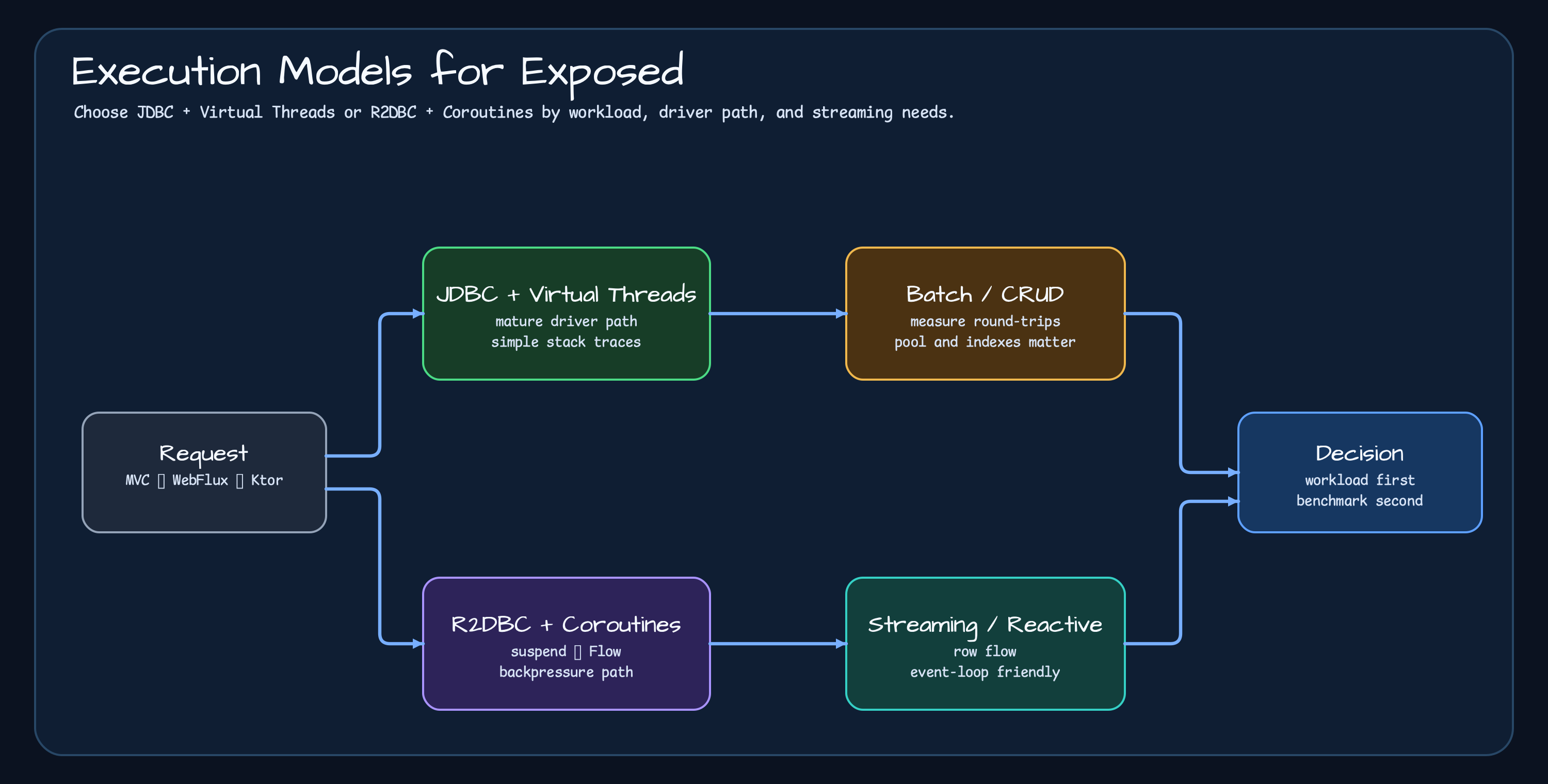
R2DBC is usually the better first choice when:
- The service already runs on an event-loop runtime such as WebFlux, Netty, or Ktor.
- Row streaming and backpressure are real domain requirements.
- Large results should be processed gradually instead of loaded into memory at once.
- The team is comfortable with Reactor or Coroutine context propagation and observability.
The JDBC with Virtual Threads Path
Section titled “The JDBC with Virtual Threads Path”That does not mean every service should be moved to R2DBC. JDBC is a blocking API, but Virtual Threads reduce the cost of waiting on that blocking call.
val count = newVirtualThreadJdbcTransaction { UserTable.selectAll().count()}I kept JDBC with Virtual Threads for practical reasons.
| Advantage | Why it matters |
|---|---|
| Driver maturity | JDBC drivers have long operational history around batching and pooling |
| Call stack | Stack traces and profilers keep a familiar shape |
| Migration cost | Existing JDBC and transaction code can stay mostly intact |
| SQL DSL | Exposed DSL remains the query surface |
There are tradeoffs. This is not non-blocking I/O, so database connections and server capacity are still hard limits. Virtual Threads lower thread waiting cost; they do not remove database round trips. If that distinction is missed, the threads become cheap while the database remains slow.
What the Batch Benchmarks Said
Section titled “What the Batch Benchmarks Said”That is why I measured both paths separately. bluetape4k-exposed/utils/batch/benchmark compares JDBC with Virtual
Threads and R2DBC with Coroutines across H2, MySQL, and PostgreSQL using the same batch workload.
| Axis | Value |
|---|---|
| Databases | H2, PostgreSQL, MySQL |
| JDBC path | JDBC + Virtual Threads |
| R2DBC path | R2DBC + Coroutines |
| Scenarios | seedBenchmark, endToEndBatchJobBenchmark |
| Parameters | dataSize=1000/10000/100000, poolSize=10/30/60, parallelism=1/4/8 |
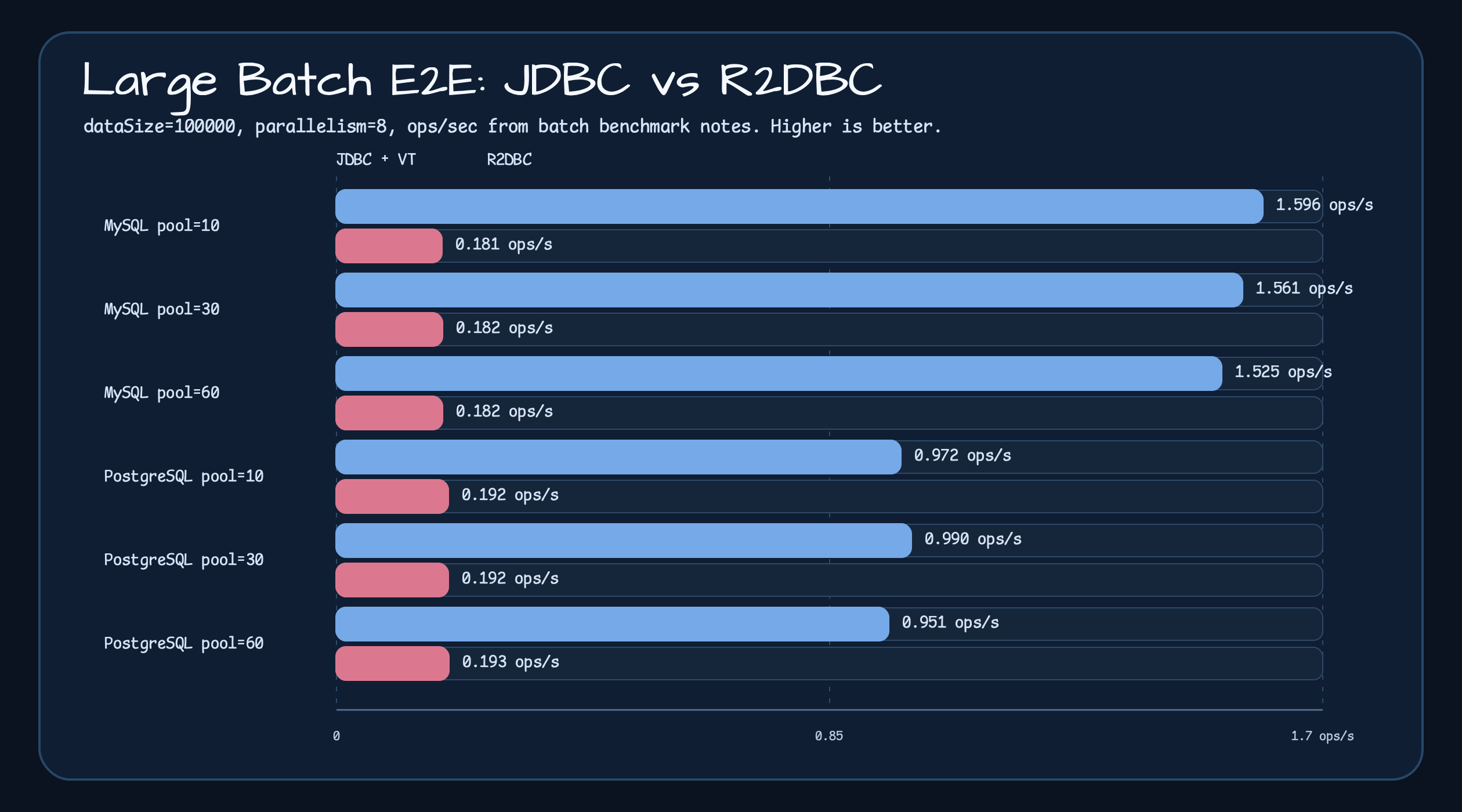
For the large end-to-end batch job with dataSize=100000 and parallelism=8, the result looked like this.
| DB | poolSize | JDBC ops/sec | R2DBC ops/sec | JDBC/R2DBC |
|---|---|---|---|---|
| MySQL | 10 | 1.596 | 0.181 | 8.8x |
| MySQL | 30 | 1.561 | 0.182 | 8.6x |
| MySQL | 60 | 1.525 | 0.182 | 8.4x |
| PostgreSQL | 10 | 0.972 | 0.192 | 5.1x |
| PostgreSQL | 30 | 0.990 | 0.192 | 5.2x |
| PostgreSQL | 60 | 0.951 | 0.193 | 4.9x |
The conclusion is not “JDBC always wins.” This benchmark measures batch insert and end-to-end batch jobs. If streaming responses or backpressure are central to the API, R2DBC can be the more useful model.
For this batch workload, though, JDBC driver maturity, a simple transaction boundary, and lower waiting cost from Virtual Threads worked well together. The API is blocking, but the result is practical.
The R2DBC Pool Still Matters
Section titled “The R2DBC Pool Still Matters”Choosing R2DBC does not remove pool design. Non-blocking I/O does not create unlimited database connections. The examples
therefore use bluetape4k-r2dbc’s R2dbcPoolConfig.highThroughput() as a baseline and inspect these points:
- Pure acquire/close throughput differs by driver.
- If each request holds a connection for
1-5 ms, throughput is dominated by that hold time. - In the 64-thread contention benchmark, where concurrent requests exceed pool size,
maxSizehas a visible effect. - If overload protection matters, start with bounded pending acquire, warmup, and finite timeout.
R2DBC is not “non-blocking, therefore no pool worries.” Database connections remain limited resources. Forgetting that turns the reactive pipeline into a neat-looking queue.
Selection Rules
Section titled “Selection Rules”| Situation | Start with |
|---|---|
| Ordinary CRUD, batch jobs, and mature JDBC driver behavior matter | JDBC + Virtual Threads |
| Streaming responses, backpressure, and event-loop consistency matter | R2DBC + Coroutines |
| Spring MVC service with many blocking libraries | JDBC + Virtual Threads |
| WebFlux or Ktor coroutine-first service | R2DBC, or carefully isolated suspend JDBC |
| Driver-specific batch performance is uncertain | Benchmark both paths |
I also include the team’s observability habits in the decision. If incidents are usually debugged with thread dumps, JFR, and JDBC pool metrics, JDBC with Virtual Threads may be easier to operate. If the team already understands Reactor or Coroutine context and backpressure metrics, R2DBC may be the more natural fit.
Closing
Section titled “Closing”R2DBC and Virtual Threads are not complete replacements for each other. They solve related waiting problems at different layers.
- R2DBC makes driver I/O itself non-blocking.
- Coroutines make that async path readable in Kotlin.
- Virtual Threads reduce the waiting cost of blocking JDBC calls.
- Exposed DSL keeps SQL in safe Kotlin code in both paths.
Part 4 moves down to JSON, encryption, measured columns, and dialect modules. Those modules exist less for speed and more for isolating messy database-specific details where they can be seen and controlled.
Source Links
Section titled “Source Links”- R2DBC README: exposed/exposed-r2dbc/README.md
- Batch benchmark hub: utils/batch/benchmark/README.md
- MySQL benchmark details: mysql.md
- PostgreSQL benchmark details: postgresql.md
- R2DBC workshop: exposed-r2dbc-workshop
Comments
Leave a note or reaction with your GitHub account.