
When the CSV Writer Took Off Its Ankle Weights

The previous CSV post was about reading. bluetape4k-csv stopped dragging every UTF-8 field
through a character-first lexer and let Okio scan source segments directly.
That left an obvious follow-up question: if reading got faster by respecting bytes and
segments, why was writing still politely handing every file export to OutputStreamWriter?
The writer optimization cleaned up that path. The public API already had the right shape:
suspend fun writeFile( path: Path, encoding: Charset = Charsets.UTF_8, append: Boolean = false, skipHeaders: Boolean = false, headers: List<String> = emptyList(), rows: Flow<Iterable<*>>,): LongYes, FlowCsvWriter is coroutine-based. That matters. The writer does not need to collect a
whole export into memory. It can collect one row from a Flow, write that row, check
cancellation, and move on.
The Suspicious Part Was Not Flow
Section titled “The Suspicious Part Was Not Flow”The streaming shape was already there. The expensive-looking part was below it:
OutputStreamWriter(FileOutputStream(path.toFile(), append), encoding).use { fw -> val fileWriter = DelimitedWriter(fw, delimiter, quote, settings.quoteEscape, lineSeparator) rows.collect { row -> currentCoroutineContext().ensureActive() writeRowToDelimited(fileWriter, fw, row) count++ }}This code is not bad. It is correct, portable, and keeps charset support simple. But for the common UTF-8 file export, it routes delimiter, quote, line separator, and payload text through a character writer even though the destination is ultimately bytes.
The new rule is simple:
| Output encoding | Writer path |
|---|---|
| UTF-8 | Okio BufferedSink fast path |
| Non-UTF-8 | Existing Writer fallback |
The API stays the same. The UTF-8 lane just takes the shorter road.
The Fast Path
Section titled “The Fast Path”The coroutine boundary still owns the file export. The difference is the sink inside it:
private suspend fun writeUtf8FileWithOkio( path: Path, append: Boolean, skipHeaders: Boolean, headers: List<String>, rows: Flow<Iterable<*>>,): Long { var count = 0L FileOutputStream(path.toFile(), append).sink().buffer().use { sink -> val fileWriter = OkioDelimitedWriter(sink, delimiter, quote, settings.quoteEscape, lineSeparator) if (!skipHeaders && headers.isNotEmpty()) { writeRowToOkio(fileWriter, headers) } rows.collect { row -> currentCoroutineContext().ensureActive() writeRowToOkio(fileWriter, row) count++ } } return count}The important line is not the Okio import. It is the structure around it: rows.collect, then
ensureActive(), then one row into a buffered sink. This keeps the export pipeline responsive
to cancellation while avoiding a detour through Writer.write(...) for UTF-8 files.
CSV Still Has Teeth
Section titled “CSV Still Has Teeth”CSV writing sounds boring until the first empty string, leading space, embedded quote, CRLF field, or TSV variant walks in. The fast path could not be a “join with commas” shortcut.
The internal writer keeps the existing DelimitedWriter semantics:
private fun writeQuoted(s: String) { sink.writeUtf8Char(quote) var start = 0 for (index in s.indices) { if (s[index] == quote) { if (start < index) { sink.writeUtf8(s, start, index) } sink.writeUtf8Char(quoteEscape) sink.writeUtf8Char(quote) start = index + 1 } } if (start < s.length) { sink.writeUtf8(s, start, s.length) } sink.writeUtf8Char(quote)}That chunked write is the small trick. Most field text goes to the sink in slices. Only quote characters become doubled quote bytes. The writer does not walk every normal character through a tiny call.
The behavior locks cover the cases that usually make CSV fast paths regret their confidence:
| Case | Expected behavior |
|---|---|
null | unquoted empty field |
"" | quoted empty string |
| leading or trailing space | quoted |
| delimiter inside field | quoted |
| embedded quote | doubled quote |
| CR/LF inside field | quoted |
quoteAll | every non-null field quoted |
| TSV mode | tab delimiter preserved |
Benchmark Result
Section titled “Benchmark Result”Benchmark command:
./gradlew :bluetape4k-csv:testBenchmarkMeasured writer workloads:
| Dataset | Existing Writer | Okio writer | Speedup |
|---|---|---|---|
writerBaseline_small vs okioWriter_small | 11,741.418 ops/s | 16,355.656 ops/s | 1.39x |
writerBaseline_medium vs okioWriter_medium | 676.110 ops/s | 2,068.696 ops/s | 3.06x |
writerBaseline_large vs okioWriter_large | 83.802 ops/s | 272.157 ops/s | 3.25x |
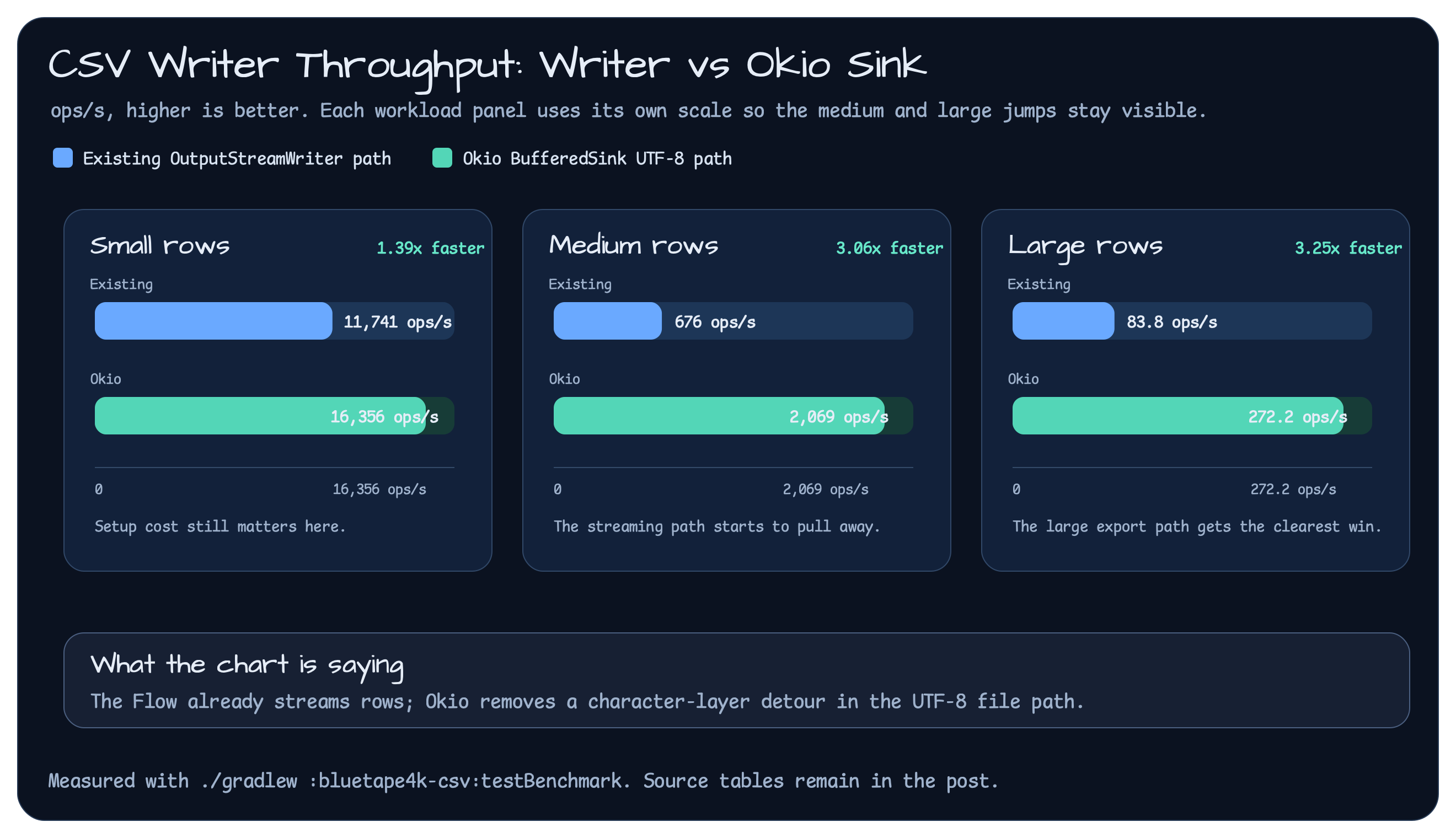
The small workload improves, but setup and coroutine collection overhead still show through. The medium and large workloads tell the real story. Once rows keep arriving, fewer character-layer writes and fewer tiny calls become visible.
The Reader Lesson Reused
Section titled “The Reader Lesson Reused”The reader optimization used BufferedSource and UnsafeCursor. The writer does not need
UnsafeCursor, because it is not searching through existing segments. It is producing bytes.
So the reusable lesson was not “always use the sharpest Okio API.” It was narrower:
| Direction | Useful Okio layer |
|---|---|
| Read | BufferedSource, Buffer, read-only UnsafeCursor for structural byte scanning |
| Write | BufferedSink for direct UTF-8 row output |
The same design rule applies in both directions: keep the public API stable, keep fallback paths for unsupported cases, and lock behavior with examples that include awkward CSV data.
Source Links
Section titled “Source Links”- Writer implementation:
OkioDelimitedWriter - Flow writer integration:
FlowCsvWriterImpl - Benchmarks:
CsvParserBenchmark - Tests:
FlowCsvWriterTest - Previous article: Reducing CSV Parser Allocations with Okio Segments
Closing
Section titled “Closing”This was the good kind of optimization: no new public concept, no new way to write CSV, and no
special API for users to remember. FlowCsvWriter already promised a streaming pipeline. The
patch just removed one layer of ankle weights from the UTF-8 file path.
Comments
Leave a note or reaction with your GitHub account.