
Bluetape4k Exposed Part 2: JDBC Repositories and SQL DSL

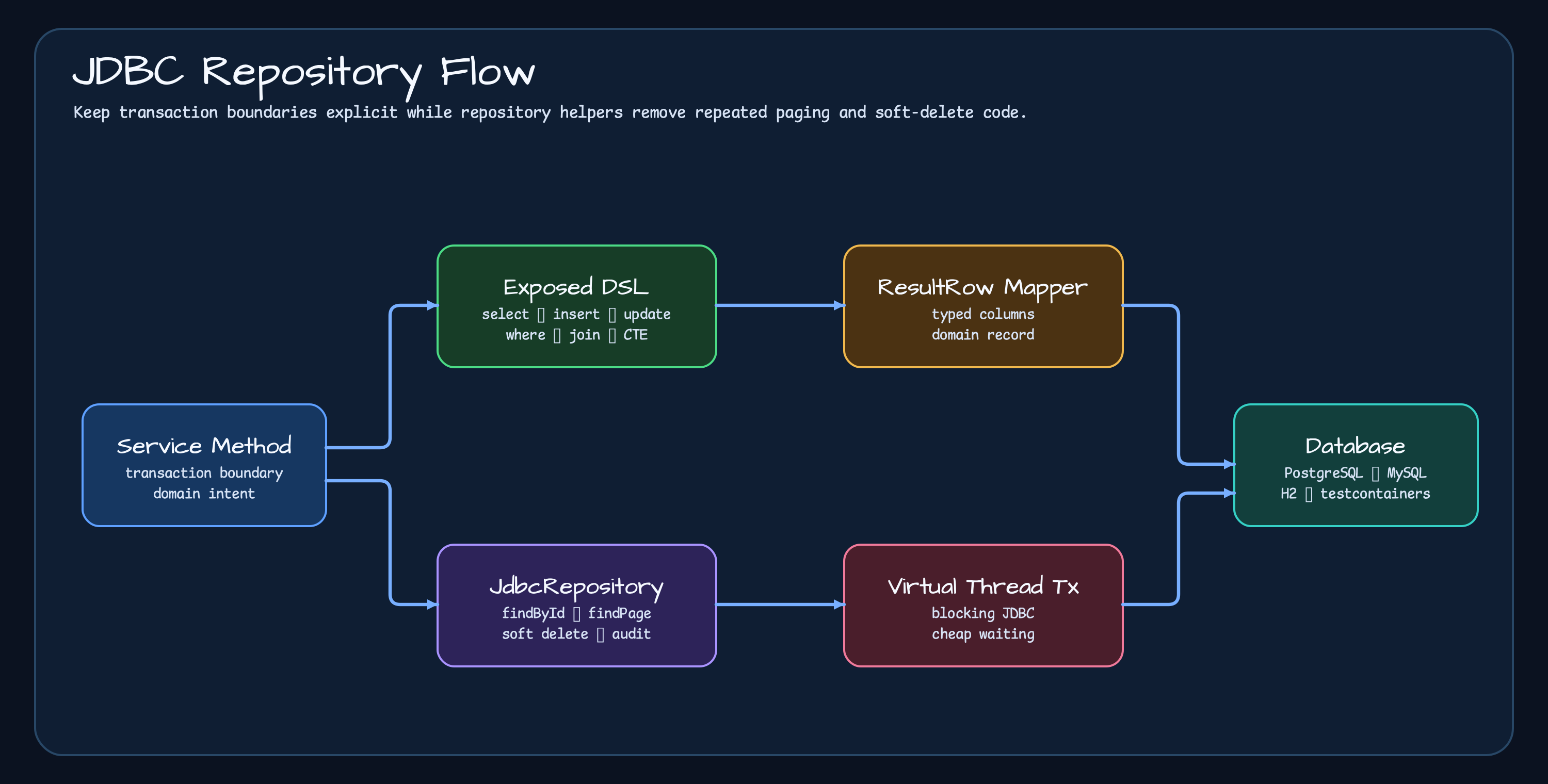
Part 1 covered why Exposed became the center of this data-access stack. Now we move to the JDBC side. Exposed DSL is already enough to write queries, but real services repeat the same smaller patterns around it: single-row lookup, paging, soft delete, audit updates, and mapping.
exposed-jdbc exists not to hide SQL DSL. Exposed is useful precisely because it lets SQL stay visible in Kotlin code.
JdbcRepository keeps that advantage and removes the code I kept rewriting around it: findById, findPage,
soft-delete filters, mappers, and virtual-thread transaction helpers.
Keep SQL DSL Visible
Section titled “Keep SQL DSL Visible”The most important part of Exposed JDBC is that the SQL shape remains in code. String SQL often reveals typos and parameter-order mistakes only at runtime. Exposed DSL builds the same SQL inside Kotlin’s type system.
val rows = Users .innerJoin(Orders) .select(Users.id, Users.name, Orders.amount) .where { (Users.id eq userId) and (Orders.status eq "PAID") } .orderBy(Orders.id) .toList()This code does not pretend SQL is gone. join, select, where, and orderBy are still there. The difference is that
columns and types stay in code, which reduces the typo, column drift, and parameter-order mistakes common in XML or raw
string SQL.
That is why I do not hide every query behind repository methods. Complex queries are often clearer when their SQL shape is visible. Repositories should handle repeated small queries and consistent paging or soft-delete rules. Once that line is crossed, the repository becomes another query language.
What JdbcRepository Removes
Section titled “What JdbcRepository Removes”The repository layer is not meant to be a large domain abstraction. The basic shape is small: implement
LongJdbcRepository<UserTable, UserRecord>, provide the table, and map ResultRow to an entity. That is enough to reuse
single-row and paging helpers.
data class UserRecord(    val id: Long = 0L,    val name: String,    val email: String,)
object UserTable : LongIdTable("users") {    val name = varchar("name", 100)    val email = varchar("email", 200)}
class UserRepository : LongJdbcRepository<UserTable, UserRecord> {    override val table = UserTable
    override fun ResultRow.toEntity() = UserRecord(        id = this[UserTable.id].value,        name = this[UserTable.name],        email = this[UserTable.email],    )}
That is thin enough. It does not block SQL DSL from view; it avoids rewriting the same mapping and paging code on every table.
| Feature | Why it belongs in a repository |
|---|---|
findById | Primary-key lookup repeats on almost every table |
findPage | Page number, page size, and total count calculation repeat |
| Soft delete | Missing an isDeleted=false predicate can become an operational incident |
| Audit update | Columns such as updatedAt and updatedBy are safer as rules |
| Batch insert/upsert | Database-specific differences should not be scattered across queries |
Do Not Hide Transaction Boundaries
Section titled “Do Not Hide Transaction Boundaries”With JDBC, the transaction boundary is the part I treat most carefully. Repositories are usually created at application
startup or injected by the DI container. They do not need to be recreated inside every transaction. Exposed executes the
query inside transaction { ... }.
val repo = UserRepository()
transaction {    val page = repo.findPage(pageNumber = 0, pageSize = 20) {        UserTable.name like "홍%"    }    page.content}
In a Spring @Transactional service, the Spring transaction boundary and Exposed Database binding must be clear. If it
is not obvious where the transaction starts, which connection it owns, and when schema or routing is decided,
multi-tenancy and read/write routing will be fragile.
Virtual-Thread Transactions
Section titled “Virtual-Thread Transactions”If we keep using blocking JDBC, we still need to pay attention to waiting cost. exposed-jdbc includes JDK 21+
Virtual Thread transaction helpers for that reason.
val count = newVirtualThreadJdbcTransaction {    UserTable.selectAll().count()}
val futures = List(10) { index ->    virtualThreadJdbcTransactionAsync {        UserTable.insert { it[name] = "user-$index" }        index    }}val results = futures.awaitAll()
This keeps the JDBC driver path. Blocking calls remain, but waiting work does not hold an expensive platform thread for as long. As Part 1 showed, this helps most on JDBC workloads with I/O wait.
Virtual Threads do not replace transaction design. Connection pool size, database capacity, indexes, and lock contention still matter. In practice, the bottleneck often appears there. Cheaper threads do not automatically increase database throughput.
A Closer Repository Example
Section titled “A Closer Repository Example”In production services, I needed single-row lookup, paging, batch save, soft-delete, and audit helpers more often than I needed CTE helpers. The repository is prepared outside the transaction and used inside it.
val repo = UserRepository()
transaction {    val user = repo.save(UserRecord(name = "홍길동", email = "hong@example.com"))    val found = repo.findByIdOrNull(user.id)
    val page = repo.findPage(        pageNumber = 0,        pageSize = 20,        sortOrder = SortOrder.ASC,    ) { UserTable.name like "홍%" }
    val inserted = repo.batchInsert(users) { item ->        this[UserTable.name] = item.name        this[UserTable.email] = item.email    }}
Soft-delete repositories turn deletion into a state transition instead of a physical DELETE.
val repo = PostRepository()
transaction {    repo.softDeleteById(postId)
    val activePosts = repo.findActive()    val deletedPosts = repo.findDeleted()
    repo.restoreById(postId)}
Audit repositories avoid repeating editor and update-time columns in every query.
val repo = ArticleRepository()
transaction {    UserContext.withUser("editor@example.com") {        repo.auditedUpdateById(articleId) {            it[ArticleTable.title] = "Updated Title"        }    }}
exposed-jdbc also includes withCte() for PostgreSQL/MySQL WITH and WITH RECURSIVE. Still, in ordinary service
code, I prefer showing the SQL DSL instead of hiding a CTE behind a long repository method name. When the query method
name starts reading like a sentence, the repository is reinventing SQL.
What to Look for in the Workshops
Section titled “What to Look for in the Workshops”A JDBC repository looks too simple in a tiny example. The workshops show where the boundary holds up when repositories meet Spring transactions, Virtual Threads, cache, and routing.
| Example | What to inspect |
|---|---|
exposed-workshop/03-exposed-basic | Basic DSL, DAO, and transaction shape |
exposed-workshop/08-coroutines/02-virtualthreads-basic | JDBC + Virtual Threads execution model |
exposed-workshop/09-spring | Spring transactions and repository wiring |
exposed-workshop/10-multi-tenant | Schema switching and transaction connection boundaries |
exposed-workshop/11-high-performance/03-routing-datasource | Read/write and tenant routing-key calculation |
Closing
Section titled “Closing”This is how I evaluate the JDBC path:
- I want to see the query shape explicitly.
- I want Kotlin DSL type-safety instead of string SQL.
- Transaction and query control matter more than a large ORM model.
- I want to keep blocking JDBC but reduce waiting cost with Virtual Threads.
- I want to remove repeated repository code without hiding SQL DSL.
Next, Part 3 looks at R2DBC, Coroutines, and Virtual Threads together. I split these paths not because one name sounds more modern, but because the better choice changes by workload.
Source Links
Section titled “Source Links”- JDBC README: exposed/exposed-jdbc/README.md
- JDBC benchmark source: ExposedJdbcBenchmark.kt
- Exposed workshop: exposed-workshop
Comments
Leave a note or reaction with your GitHub account.