
Coroutine Observability: The Boundaries Micrometer Tracing and Readiness Actually Prove

A coroutine-based WebFlux or Ktor service can work perfectly in local tests and still become confusing in production.
Traces appear to split across suspend boundaries. A readiness probe says UP while real requests stall on the database.
Adding another dashboard does not fix that. The first job is to decide which signal proves which part of the code path.
This post uses the observability examples in bluetape4k-workshop and the readiness examples in exposed-workshop.
The contract is small:
- parent spans must survive suspend boundaries;
- downstream
WebClientcalls must carrytraceparent; - readiness must prove database reachability, not just endpoint availability.
Separate the work path from the observe path
Section titled “Separate the work path from the observe path”Prometheus, Grafana, Zipkin, Actuator, and registries do not trigger business work. They read the meters and spans left behind by the request path. If that boundary is unclear, both diagrams and operational decisions drift.
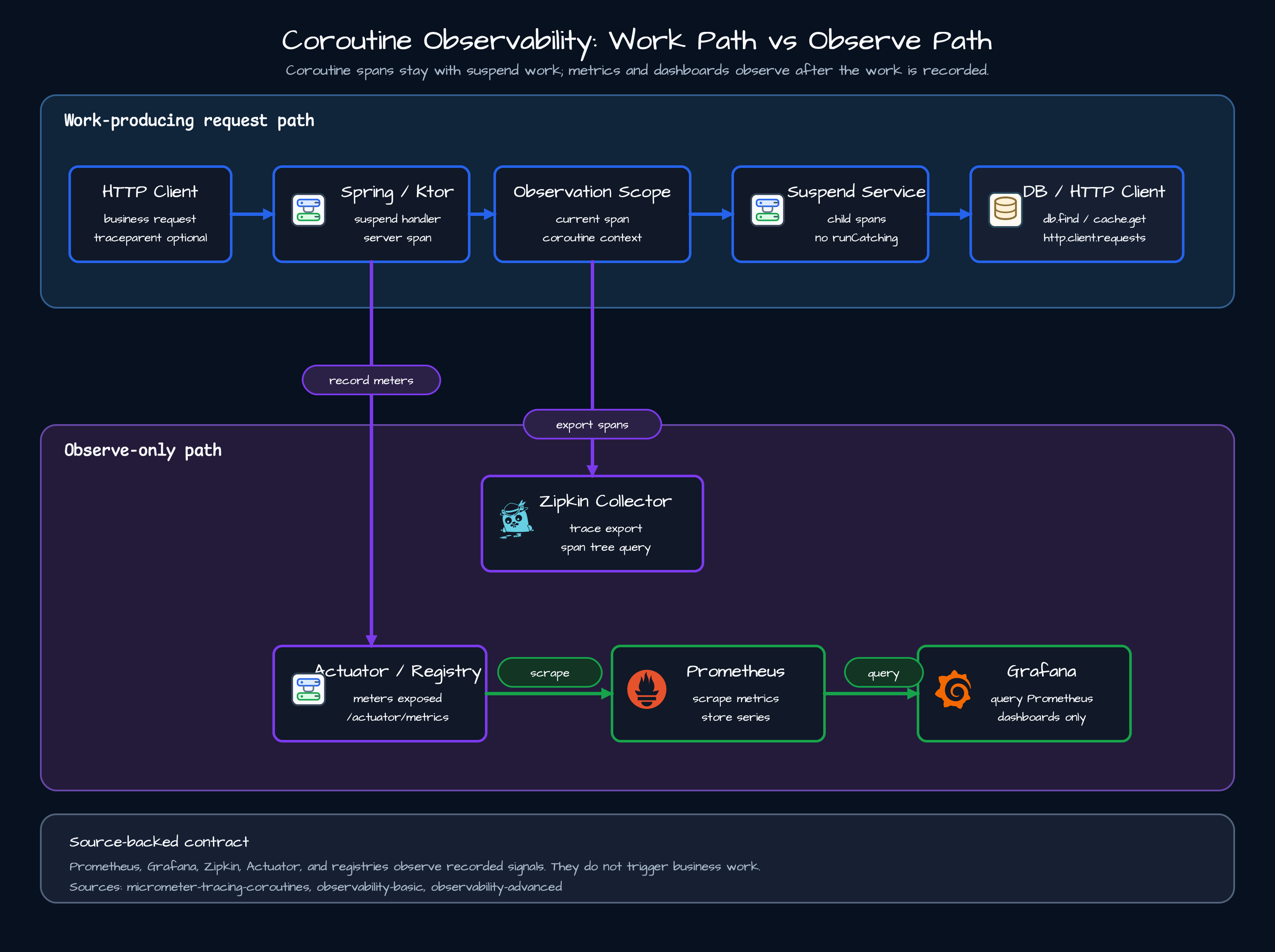
In micrometer-tracing-coroutines, CoroutineService wraps suspend blocks with withObservationSuspending. The scope
must stay alive across delay(...) and WebClient.awaitBodyOrNull() suspension points.
private suspend fun getTodoById(id: Int): Todo? { return withObservationSuspending("get-todo-by-id", observationRegistry) { client.get() .uri("/todos/${id}") .retrieve() .awaitBodyOrNull<Todo>() }}withObservationSuspending itself is only a thin wrapper. The important shape is the coroutine context created by
withObservationContextSuspending: the current observation is stored in Reactor context, and a ThreadContextElement
reopens the Micrometer scope whenever the coroutine resumes on a carrier thread.
suspend fun <T: Any> withObservationContextSuspending(    name: String,    observationRegistry: ObservationRegistry,    block: suspend CoroutineScope.() -> T?,): T? {    name.requireNotBlank("name")    val observation = observationRegistry.start(name)
    return try {        withContext(observation.asCoroutineObservationContext()) {            block()        }    } catch (e: CancellationException) {        throw e    } catch (e: Throwable) {        observation.error(e)        throw e    } finally {        observation.stop()    }}
The bridge is asCoroutineObservationContext().
private class ObservationScopeContextElement(    private val observation: Observation,): ThreadContextElement<Observation.Scope>, AbstractCoroutineContextElement(Key) {    companion object Key: CoroutineContext.Key<ObservationScopeContextElement>
    override fun updateThreadContext(context: CoroutineContext): Observation.Scope =        observation.openScope()
    override fun restoreThreadContext(context: CoroutineContext, oldState: Observation.Scope) {        oldState.close()    }}
private suspend fun Observation.asCoroutineObservationContext(): CoroutineContext {    val reactorContext = (currentReactiveContext() ?: Context.empty())        .put(ObservationThreadLocalAccessor.KEY, this)
    return reactorContext.asCoroutineContext() + ObservationScopeContextElement(this)}
The important part is not the helper name. It is how the current span is opened, restored, and stopped inside suspend code. Coroutines may resume on another carrier thread. If the trace scope is only thread-local, a span tree can suddenly look flat.
Tests pin down trace propagation
Section titled “Tests pin down trace propagation”observability-basic keeps the path intentionally small. A WebFlux suspend endpoint creates the HTTP server span,
OrderService creates order.service.fetch, and the Spring-managed WebClient.Builder injects W3C traceparent into
the downstream inventory call.
@AutoConfigureTracingclass TracePropagationTest : AbstractBasicTest() {    @Test    fun `GET orders id - traceparent header propagated to downstream`() = runSuspendIO {        webTestClient.get()            .uri("/orders/1")            .exchange()            .expectStatus().isOk
        val request = mockServer.takeRequest(2, TimeUnit.SECONDS)        request.headers["traceparent"].shouldNotBeNull()    }}
observability-advanced adds cache-aside behavior. On a cache miss, user.cache.get, user.db.find, and
user.cache.put must be child spans under user.service.get. On a cache hit, the DB span must not exist.
http.server.requests └─ user.service.get ├─ user.cache.get ├─ user.db.find └─ user.cache.putUserServiceTest verifies the parent-child relationship with hasParentObservationContextSatisfying. It does not only
check that span names exist; it checks that the cache-miss spans attach to the same service span.
CancellationException is not a failed span
Section titled “CancellationException is not a failed span”A common coroutine observability mistake is wrapping suspend calls in a broad helper such as runCatching {}. The
examples rethrow CancellationException first and record only non-cancellation failures as observation errors.
return try { withContext(ObservationScopeContextElement(observation)) { block() }} catch (e: CancellationException) { throw e} catch (e: Throwable) { observation.error(e) throw e} finally { observation.stop()}That keeps observability code from breaking structured concurrency. A cancellation should not pollute error dashboards. Real failures such as 5xx responses or Redis errors should still become span errors or explicit fallback signals.
Readiness means “ready to receive”, not merely “alive”
Section titled “Readiness means “ready to receive”, not merely “alive””Liveness and readiness differ first in the action a platform should take when they fail. Liveness asks whether the process is still worth keeping alive. If it fails, an orchestrator such as Kubernetes normally restarts the container. Readiness asks whether this instance should receive traffic right now. If it fails, the instance should be removed from the load balancer or Service endpoints without necessarily killing the process.
That distinction matters not only when the database is down, but also when a saturated connection pool causes database timeouts while the HTTP server and coroutine dispatcher are still healthy. The process can be alive, so liveness can still pass. The service cannot safely process orders without usable database access, so readiness must fail. That is the gap between “alive” and “ready to receive”.
This distinction also shows up in incident language. Backend developers often describe connection-pool exhaustion and database timeouts as “the DB is down” rather than “the service cannot use the DB.” Infrastructure engineers can fairly answer, “the database process is healthy.” Both statements can be true within their own observation boundary. The problem is that without separate liveness and readiness semantics, “the process is alive,” “the database process is alive,” and “this service can use the database” collapse into one overloaded sentence.
The Spring Boot and Ktor examples express this operational contract with different framework shapes.
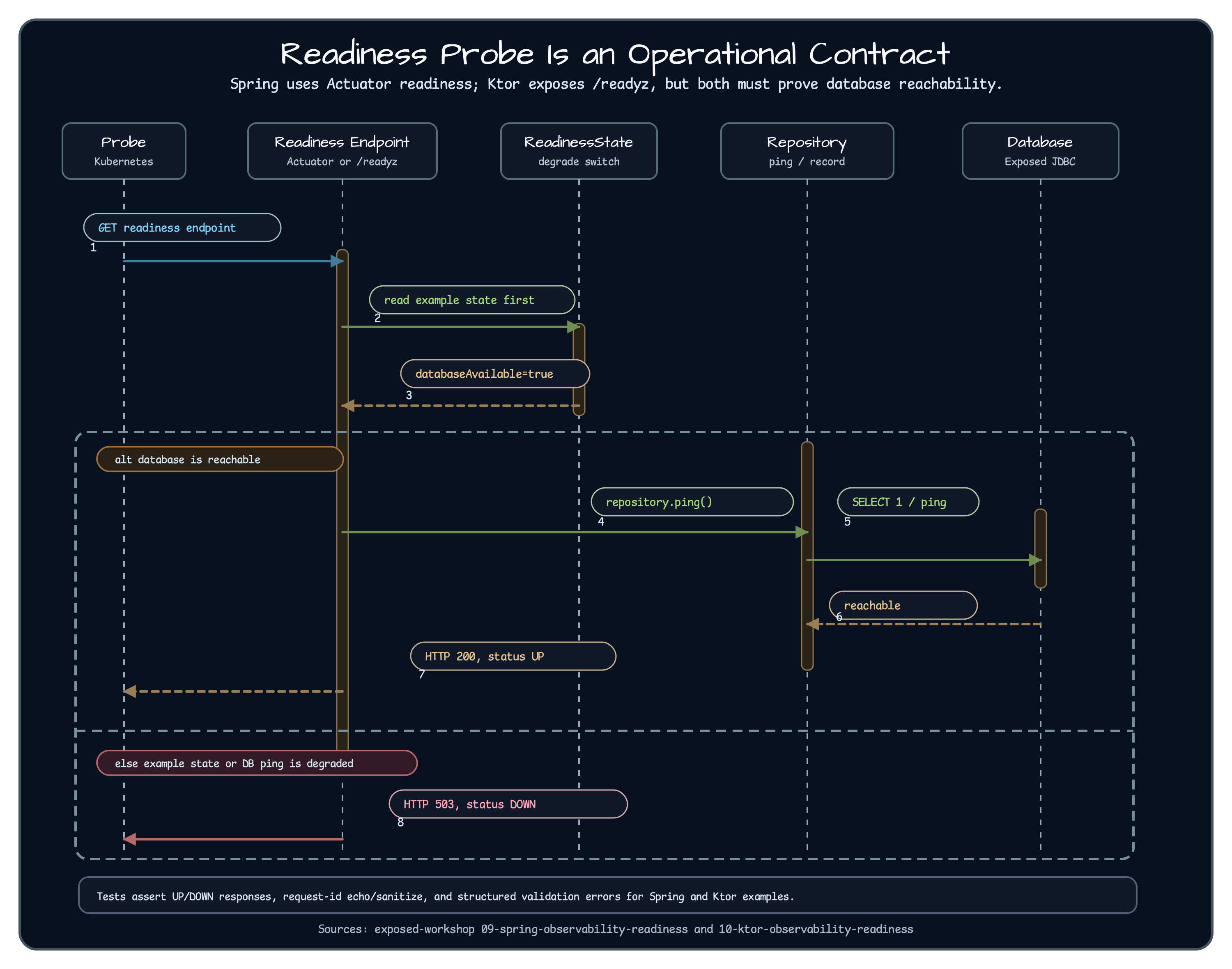
The Spring example plugs a custom health contributor into Actuator readiness.
override fun health(): Health = when { !state.isDatabaseAvailable() -> Health.down() .withDetail("database", "degraded by example state") .build() else -> databaseHealth() }The Ktor example implements /readyz directly.
get("/readyz") { val databaseReady = readinessState.isDatabaseAvailable() && repository.ping() call.respond( status = if (databaseReady) HttpStatusCode.OK else HttpStatusCode.ServiceUnavailable, message = ReadinessResponse( status = if (databaseReady) "UP" else "DOWN", database = if (databaseReady) "reachable" else "degraded", requestId = call.callId.orEmpty(), ), )}Spring gives you Actuator conventions and health groups. Ktor makes the response shape and route behavior explicit in application code. Neither is universally better. The choice depends on the operational contract your platform expects.
Missing signals usually mean missing wiring
Section titled “Missing signals usually mean missing wiring”| Missing signal | Likely wiring issue | Example evidence |
|---|---|---|
No traceparent on downstream calls | Tracing bridge is missing, or code bypasses the managed WebClient.Builder | TracePropagationTest |
| DB span is not a child of the service span on cache miss | Current observation scope is not restored after coroutine resume | ObservationScopeContextElement |
| Cancellation appears as a failed span | CancellationException is swallowed by a broad catch | local observed() helper |
| Readiness returns 200 during DB degradation | Readiness state and repository ping are not connected to the endpoint | Spring DatabaseReadinessHealthIndicator, Ktor /readyz |
| Request id differs between logs and responses | Missing sanitize/echo boundary | Spring RequestCorrelationFilter, Ktor CallId |
Observability is less about what you installed and more about which failure is fixed to which signal. When traces stay connected, readiness does not lie, and request ids line up between responses and logs, incident analysis moves from guessing to checking.
Coroutines do not change the operational contract
Section titled “Coroutines do not change the operational contract”Coroutine-based services do not need a completely different observability model. The broad shape is the same as a thread-per-request service: create the HTTP server span, attach service and downstream spans as children, record real errors, and make readiness report whether the instance can safely receive traffic.
Virtual Threads fit the same rule. When Spring MVC or blocking clients run on virtual threads, the code shape is closer
to classic thread-per-request, and ThreadLocal-based observation scope is easier to reason about than in coroutine
suspend/resume code. The operational contract still does not change. More virtual threads do not create more database
connections. Connection-pool exhaustion, downstream timeouts, and readiness returning 503 remain the same decisions.
The difference is that coroutine code must be more explicit about what still belongs to the same request. Execution can
suspend and resume on another carrier thread. If the current observation lives only in a thread-local scope, it can
disappear at exactly that boundary. That is why the example restores scope through ThreadContextElement and also keeps
the observation in Reactor context.
The practical cautions are narrow:
- Pin context propagation with tests. Verify both downstream
traceparentand parent-child span relationships. - Do not turn cancellation into a failed span. Rethrow
CancellationExceptionfirst, and record only real failures withobservation.error(e). - Readiness must describe whether requests can be handled, not whether coroutines are still running. If a required dependency such as the database is degraded, the process can be alive while readiness returns 503.
In short, coroutine observability is not about memorizing a separate model. It is about preserving the existing observability contract across suspend boundaries without leaking context or misclassifying cancellation.
Comments
Leave a note or reaction with your GitHub account.