
Bluetape4k Projects Part 1: The Shared Kotlin/JVM Foundation

This is Part 1 of the bluetape4k-projects series. The full series continues with
Part 1: shared foundation, then Part 2:
core, coroutines, logging, tests, Part 3: I/O, serialization, HTTP, encryption, Part 4: data and
infrastructure, Part 5: utilities and adoption path, and Part 6: Spring Boot 4 and Ktor.
bluetape4k-projects is the broadest foundation in the bluetape4k ecosystem. It keeps the
Kotlin/JVM utilities, coroutine helpers, I/O wrappers, data and infrastructure adapters, testing
support, and BOM that backend services keep reaching for.
It is not a place where every feature stays forever. AWS, Exposed, Image, Text, Leader, and
JaVers have moved into standalone repositories because they carry their own domain depth and
release rhythm. projects keeps the shared foundation and runtime building blocks that many
repositories and services depend on first. It is shared infrastructure: quiet when it works,
suddenly interesting when it stops.
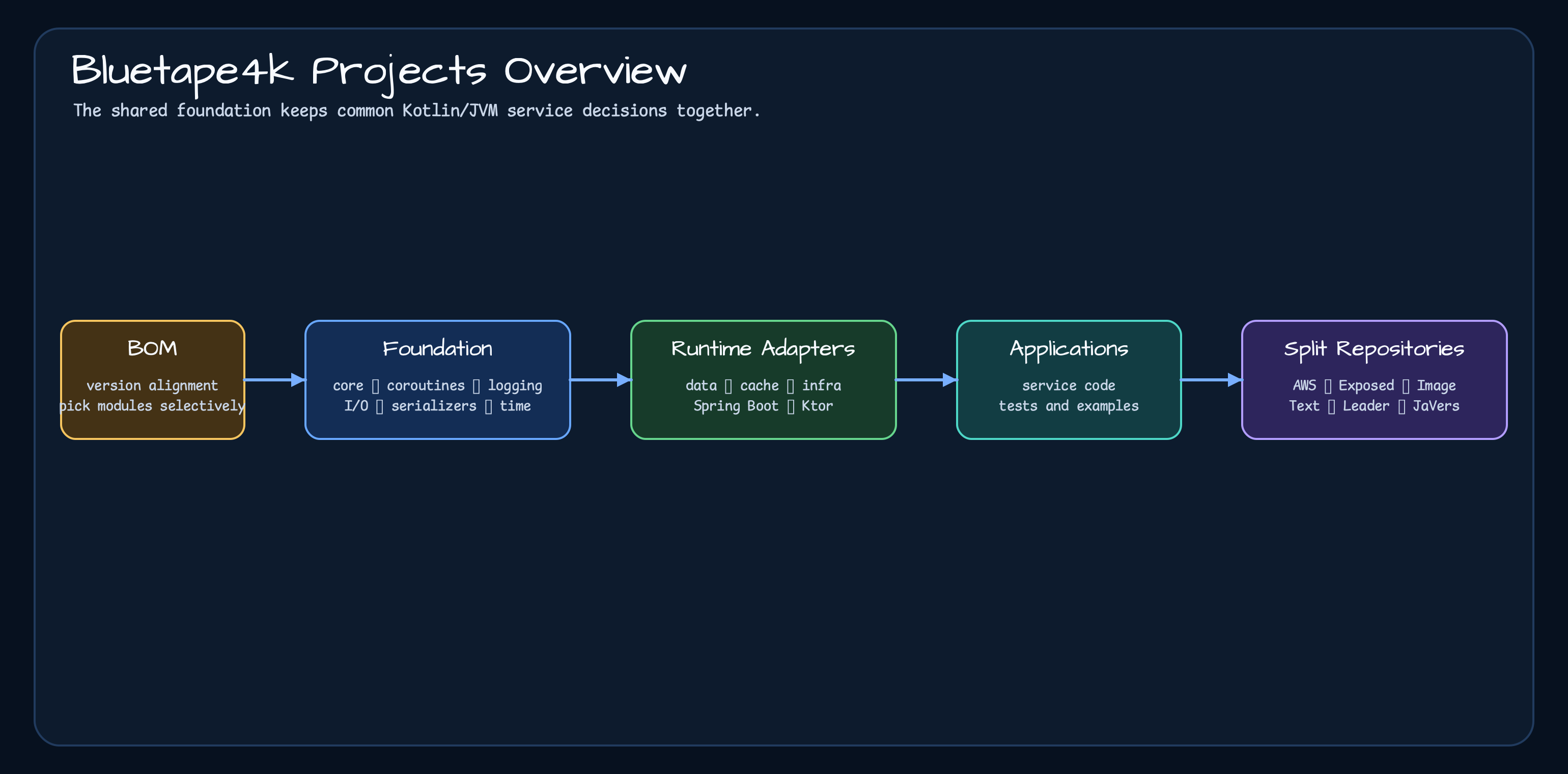
projects starts from the BOM and foundation, then supports runtime adapters and application code.Why This Repository Exists
Section titled “Why This Repository Exists”Kotlin/JVM backend work usually starts on proven Java libraries. The rough edges appear when those libraries meet Kotlin service code.
- Java APIs often do not fit Kotlin null-safety or DSL style.
- Callbacks,
Future, and blocking APIs do not always compose cleanly with coroutines. - Tests repeatedly need Redis, Kafka, databases, clocks, concurrency, and integration fixtures.
- Services re-create similar codec, serializer, timeout, retry, and logging conventions.
bluetape4k-projects reduces that repetition. The point is not to invent a new all-encompassing
framework. It is a thin Kotlin-friendly layer over production libraries, smoothing the edges that
services keep hitting.
implementation(platform("io.github.bluetape4k:bluetape4k-bom:<version>"))implementation("io.github.bluetape4k:bluetape4k-core")implementation("io.github.bluetape4k:bluetape4k-coroutines")implementation("io.github.bluetape4k:bluetape4k-junit5")The root README describes the same direction: idiomatic Kotlin helpers, Java library wrappers, coroutine integration, testing infrastructure, Redis/cache/infra support, and split repositories for domain areas large enough to need their own release rhythm.
Module Map
Section titled “Module Map”The current root README shows the boundary clearly.
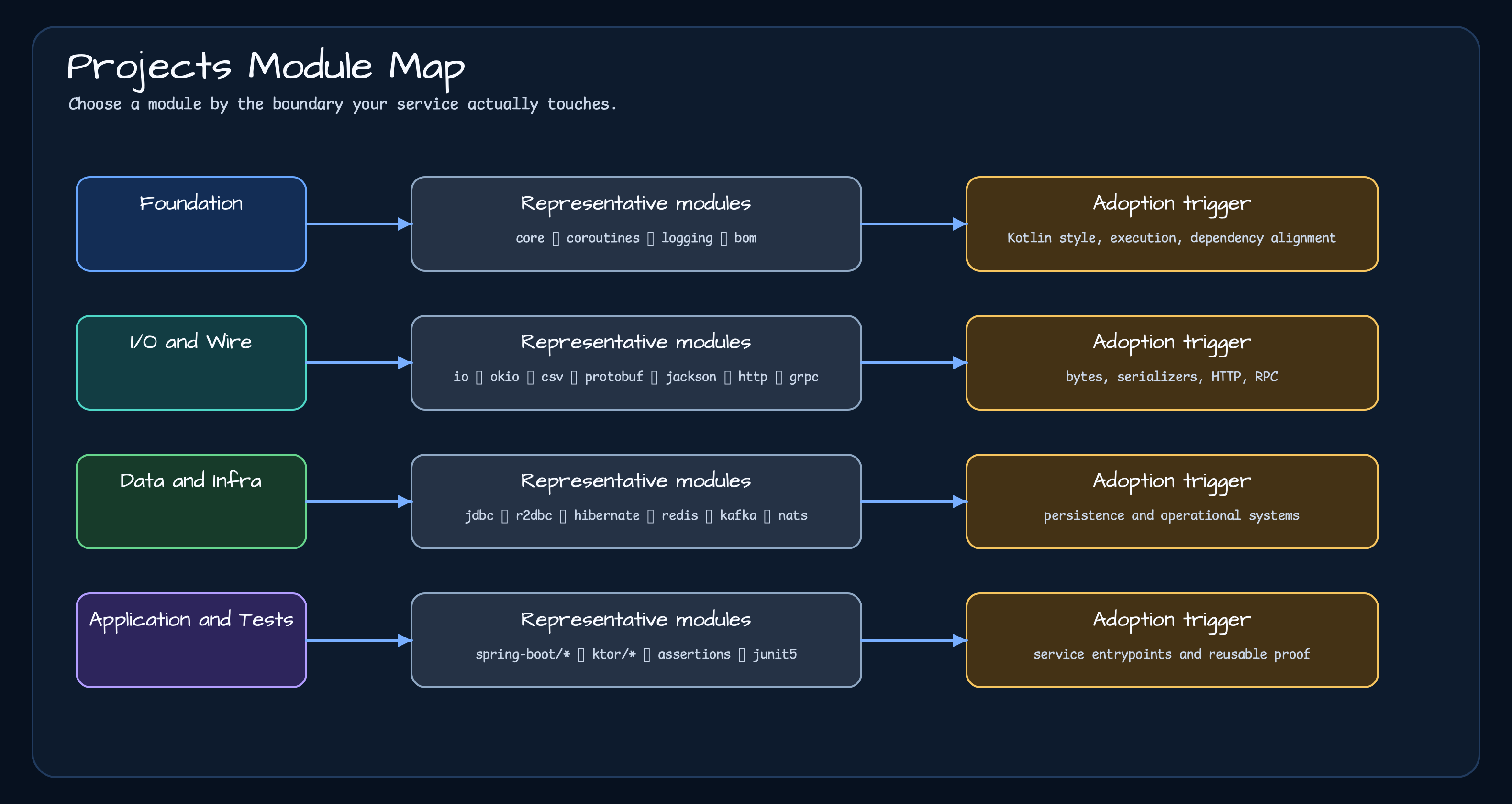
projects as both foundation and runtime adapter layer.| Area | Representative modules | Adoption trigger |
|---|---|---|
| Foundation | core, coroutines, logging, bom | Kotlin style, execution model, and dependency alignment |
| I/O | io, okio, csv, protobuf, jackson2/3, http, grpc | Bytes, files, serializers, HTTP, and RPC boundaries |
| Data | jdbc, r2dbc, hibernate, mongodb, cassandra | Persistence helpers and coroutine data access |
| Infrastructure | lettuce, redisson, kafka, nats, opentelemetry, resilience4j | Adapters around operational systems |
| Application | spring-boot/*, ktor/*, examples/* | Service entrypoints and working examples |
| Testing | assertions, junit5, testcontainers | Reusable integration-test fixtures |
The model is selective adoption, not “pull in the whole ecosystem.” The BOM aligns versions, and each module can be picked up only when the service actually touches that boundary.
What Moves Out
Section titled “What Moves Out”As a feature area grows, keeping it inside projects can slow it down. One toolbox can hold a lot,
but at some point it becomes moving day. bluetape4k splits those areas into standalone repositories.
| Standalone repository | Why it moved out |
|---|---|
bluetape4k-aws | AWS SDK v2 and Kotlin SDK service coverage has its own release cadence |
bluetape4k-exposed | Exposed 1.2.x repositories, cache, and SQL DSL form their own ecosystem |
bluetape4k-image | Pure JVM image processing and libvips/JNI/FFM need separate validation |
bluetape4k-text | Korean/Japanese tokenizers and text search need their own dictionaries and quality bars |
bluetape4k-leader | Leader election API and backend parity evolve as a focused subsystem |
bluetape4k-javers | Audit/diff persistence spans Redis, Kafka, and Exposed on a separate release axis |
The rough rule is simple: thin shared Kotlin/JVM foundation stays in projects; a domain with its
own learning curve, release rhythm, and verification surface moves out. That keeps the foundation
light and lets larger domains evolve at their own pace.
What the BOM Does
Section titled “What the BOM Does”The BOM looks small, but it matters in a shared foundation repository. Kotlin, Spring Boot, Exposed, Jackson, Redis clients, and testing libraries all move at different speeds. Once versions start dancing independently, CI is usually the first one to get tired.
bluetape4k-bom aligns the module versions published from projects. Applications import the
BOM first, then declare only the modules they need.
dependencies { implementation(platform("io.github.bluetape4k:bluetape4k-bom:<version>")) implementation("io.github.bluetape4k:bluetape4k-okio") implementation("io.github.bluetape4k:bluetape4k-r2dbc") testImplementation("io.github.bluetape4k:bluetape4k-testcontainers")}For Gradle Kotlin DSL, the root README recommends implementation(platform(...)) over
dependencyManagement { imports } to avoid conflicts with KGP 2.3.x. The BOM is not a signal to
use every module. It is a signal to keep the versions aligned for the modules you do use.
Where to Start
Section titled “Where to Start”For a first pass through the repository, this order is usually the least noisy. Start with the map, then follow the problem your service is actually hitting.
- Read the root
README.mdfor the module map. - Skim
core,coroutines,logging,junit5, andtestcontainers. - Pick I/O, data, or infrastructure modules based on the boundary your service actually touches.
- Use Spring Boot or Ktor examples to see application-level wiring.
- Follow topic posts for cache, virtual threads, CSV/Okio, and benchmark-heavy areas when needed.
The blog is the narrative entrance, while the repository-owned manual is the executable reference. Start at the
bluetape4k-projects manual for the three-level repository → group → module map, then
drill into a module for decision tables, failure contracts, representative tests, and immutable source links. The
manual is synchronized from docs/manual; this article intentionally stays shorter and explanatory.
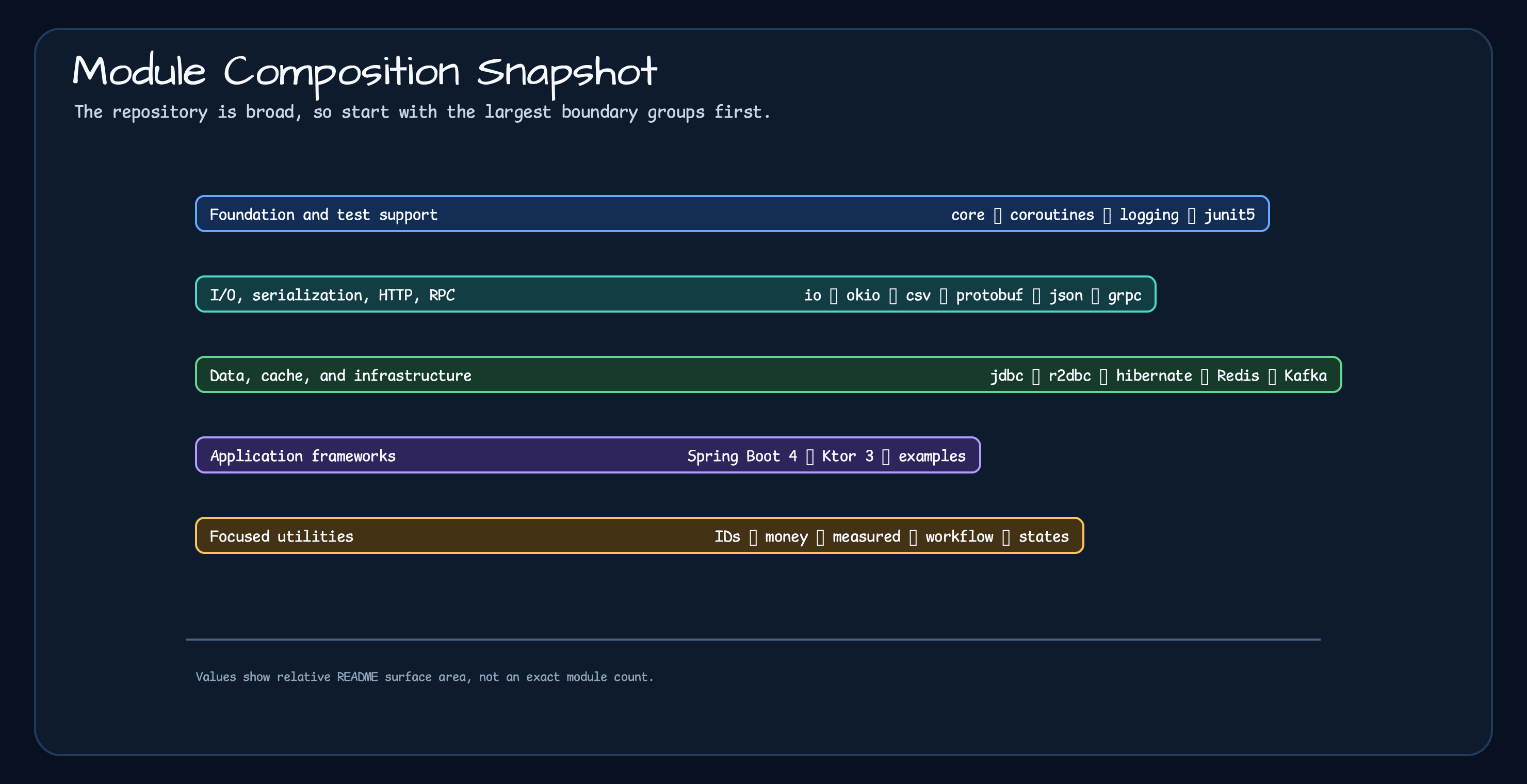
Source Links
Section titled “Source Links”- Repository: bluetape4k-projects
- README: README.md
- Korean README: README.ko.md
- BOM README: bluetape4k/bom/README.md
- Projects manual: repository map and module manuals
- Cache deep dive: Bluetape4k Cache Part 1
Closing
Section titled “Closing”In one sentence, bluetape4k-projects is the shared foundation Kotlin/JVM backend services
should not have to rebuild each time. Large domain capabilities move into focused repositories, while this repo
keeps core utilities, coroutines, I/O, data, infrastructure, application support, testing, and
the BOM aligned.
Next, we will open the innermost layer: core, coroutines, logging, and testing modules. The
small foundations are not exciting until they are missing. Then they become the whole incident
review.
Comments
Leave a note or reaction with your GitHub account.