Bluetape4k AWS Part 2: Core Modules and Service Coverage
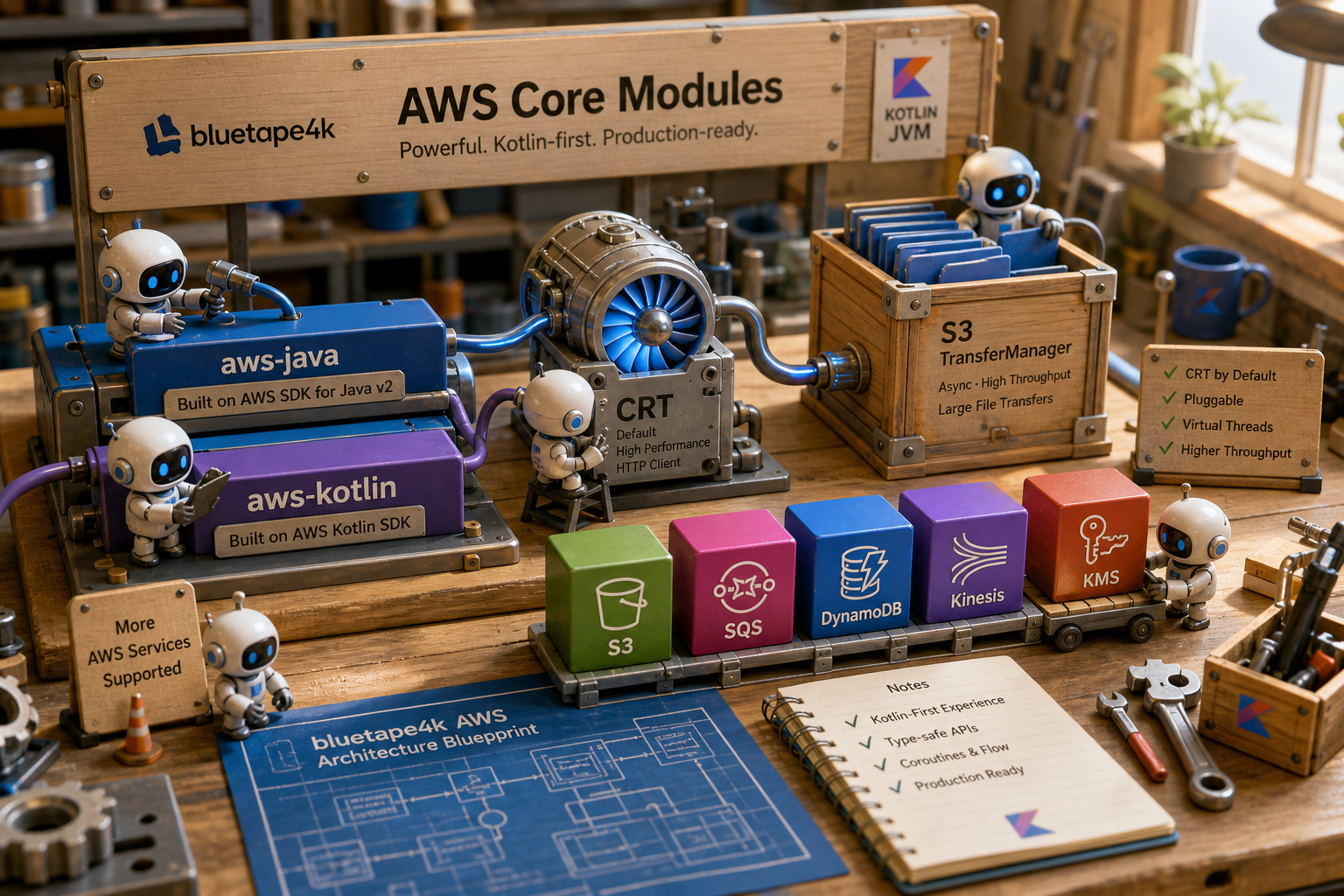
This is Part 2 of the bluetape4k-aws series. Part 1 covered the
repository overview and mental model. This post focuses on
the core modules: what bluetape4k-aws-java and bluetape4k-aws-kotlin actually remove from
application code.
The goal is not to reimplement the AWS SDKs. The official AWS Java SDK v2 and AWS Kotlin SDK remain
the foundation. bluetape4k-aws-java connects Java SDK v2 async clients to Kotlin coroutine code
and makes the S3 CRT/TransferManager path easier to use for large files. bluetape4k-aws-kotlin
keeps the native suspend model of the Kotlin SDK while adding explicit shared HTTP-engine options,
lifecycle helpers, and service-specific DSL builders.
Java SDK v2 Approach
Section titled “Java SDK v2 Approach”When a service uses AWS Java SDK v2 directly, there are several early decisions. Sync and async
clients have different shapes. Async clients bring HTTP client selection and CompletableFuture
composition. S3 transfer workloads add another layer because the best path for large files is often
the CRT-backed S3 async client plus S3TransferManager.
bluetape4k-aws-java does not hide those choices. It prepares the repetitive wiring. The general
async client factory currently defaults to Netty, while SdkAsyncHttpClientProvider.AwsCrt and
awsCrtAsyncHttpClientOf provide a first-class CRT async HTTP client option. The S3 large-transfer
path goes further: S3ClientFactory.CrtAsync.create uses S3AsyncClient.crtBuilder(), and
S3ClientFactory.TransferManager.create builds a S3TransferManager on that CRT-backed async
client.
The TransferManager factory also defaults its executor to
Executors.newVirtualThreadPerTaskExecutor(). That makes the Java module a practical fit for
high-throughput S3 transfer code where async completion, file I/O, and blocking edges meet.
import io.bluetape4k.aws.s3.S3ClientFactoryimport io.bluetape4k.aws.s3.transfer.downloadFileimport io.bluetape4k.aws.s3.transfer.uploadFileimport software.amazon.awssdk.regions.Regionimport java.nio.file.Path
suspend fun mirrorObject(bucket: String, key: String, source: Path, target: Path) {    val transferManager = S3ClientFactory.TransferManager.create(        region = Region.AP_NORTHEAST_2,    )
    transferManager.uploadFile(bucket, key, source)    transferManager.downloadFile(bucket, key, target)}
This does not replace TransferManager. AWS SDK provides that capability. bluetape4k-aws-java
reduces the repeated assembly around it: CRT S3 async client creation, Virtual Thread executor
selection, and async/coroutine extensions.
For smaller S3 objects, the coroutine helpers make the Java SDK v2 async client feel natural in
Kotlin code. The SDK returns CompletableFuture; the extension functions await it behind a
suspend API.
import io.bluetape4k.aws.s3.S3ClientFactoryimport io.bluetape4k.aws.s3.getAsStringimport io.bluetape4k.aws.s3.putAsString
suspend fun writeAndRead(bucket: String, key: String): String {    val client = S3ClientFactory.Async.create()
    client.putAsString(bucket, key, "hello from bluetape4k-aws")    return client.getAsString(bucket, key)}
The same idea appears across services. DynamoDB Enhanced Async Table scan/query can be consumed as
Flow; SQS, SNS, SES, KMS, CloudWatch, CloudWatch Logs, Kinesis, and STS get async/coroutine
helpers around the Java SDK v2 clients. The point is to keep Java SDK v2’s broad service coverage
while making it less awkward in coroutine-heavy Kotlin services.
Kotlin SDK Approach
Section titled “Kotlin SDK Approach”bluetape4k-aws-kotlin starts from a different place. AWS Kotlin SDK operations are already
suspend functions. The useful work is not converting CompletableFuture; it is making client
creation, HTTP engine selection, request builders, and lifecycle handling easier to repeat
correctly.
HttpClientEngineProvider.defaultHttpEngine returns a shared CRT engine, while
HttpClientEngineProvider.OkHttp.httpEngine provides a shared OkHttp engine. These engines are
externally managed singletons for clients that intentionally share a transport. For a single client,
omit httpClient and let the AWS Kotlin SDK own the engine lifecycle, or use a withXxxClient helper.
import aws.smithy.kotlin.runtime.net.url.Urlimport io.bluetape4k.aws.kotlin.s3.putFromPathimport io.bluetape4k.aws.kotlin.s3.withS3Clientimport java.nio.file.Path
suspend fun uploadReport(path: Path) {    withS3Client(        endpointUrl = Url.parse("http://localhost:4566"),        region = "ap-northeast-2",    ) { client ->        client.putFromPath("reports", "daily/report.csv", path)    }}
Helpers such as withS3Client, withSqsClient, and withDynamoDbClient create a client, run the
block, and close it. Long-lived clients can use s3ClientOf, sqsClientOf, and similar factories
directly. The module keeps one-shot and application-scoped client lifecycles separate.
The service helpers go beyond thin wrappers. S3 has file, byte-array, string, and stream helpers.
SQS has queue-URL-oriented send, batch send, and receive helpers. DynamoDB has item-map helpers,
batch execution, and request builders. Kinesis has recordFlow, a cold Flow<Record> that polls a
single shard and handles iterator expiry plus retryable throttling behavior.
import io.bluetape4k.aws.kotlin.kinesis.KinesisStartingPositionimport io.bluetape4k.aws.kotlin.kinesis.recordFlow
suspend fun consumeShard(client: aws.sdk.kotlin.services.kinesis.KinesisClient) {    client.recordFlow(        streamName = "orders",        shardId = "shardId-000000000000",        position = KinesisStartingPosition.TrimHorizon,    ).collect { record ->        println(record.data.decodeToString())    }}
AWS Service Coverage
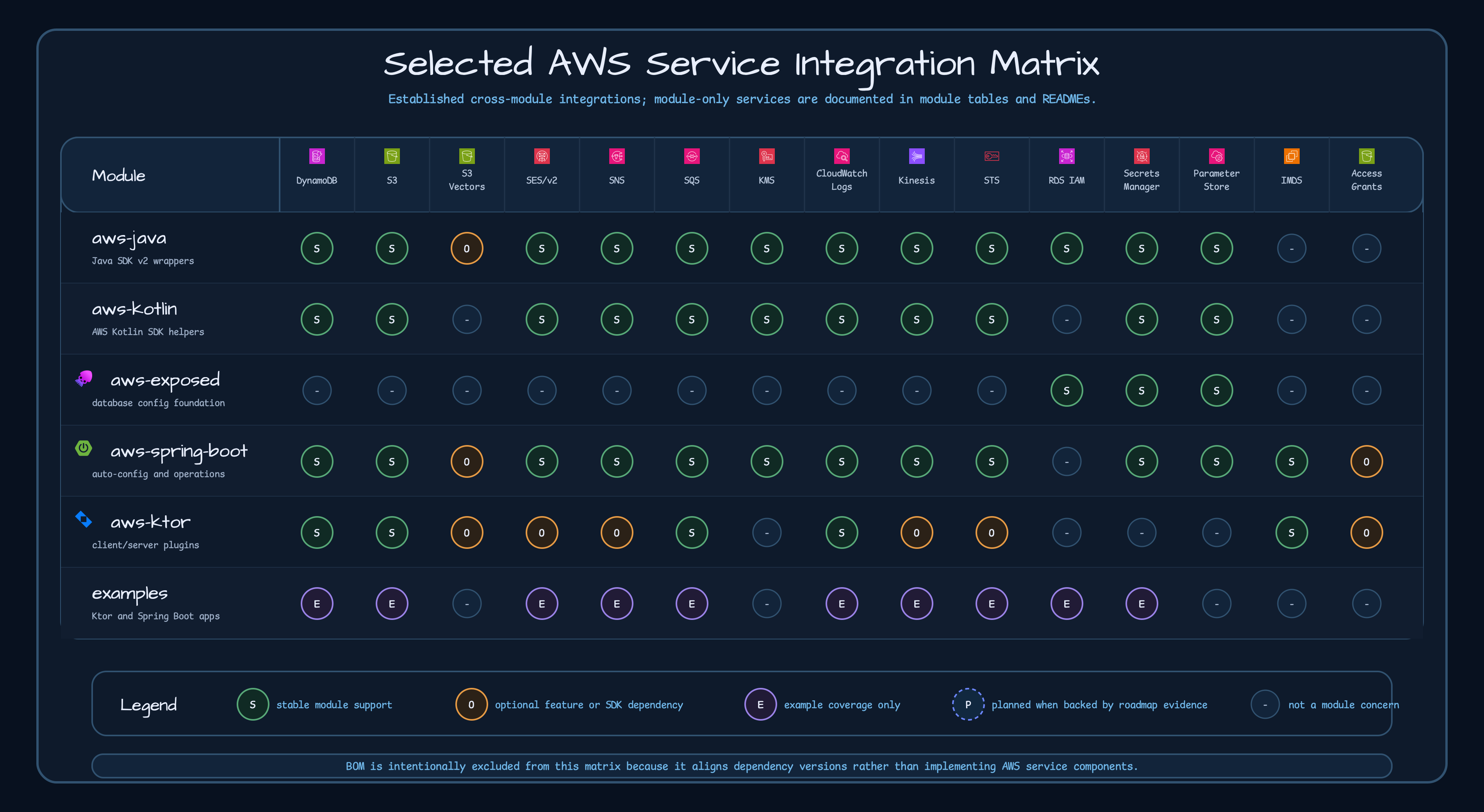
Section titled “AWS Service Coverage”The core modules are useful because the pattern is repeated across many AWS services, not because there is one nice S3 helper. Alongside S3, SQS, SNS, DynamoDB, KMS, SES/SESv2, CloudWatch, CloudWatch Logs, Kinesis, and STS, the current core modules cover EventBridge, EventBridge Scheduler, Bedrock Runtime, Secrets Manager, and Parameter Store. The Java module also provides S3 Vectors and RDS IAM token helpers. Spring Boot and Ktor modules add framework entry points on top of that foundation.
| Service | Java SDK v2 | Kotlin SDK | Convenience features |
|---|---|---|---|
| S3 | sync/async/coroutine, CRT async, TransferManager | suspend client, file/string/byte helpers | large transfers, file upload/download, object listing |
| S3 Vectors | optional coroutine facade | not supported | vector bucket/index discovery and vector put/get/list/query |
| DynamoDB | Enhanced Client, async table, coroutine/Flow | table/item/batch helpers, model DSL | item conversion, batch write, scan/query |
| SQS | async/coroutine queue operations | suspend send/receive/batch helpers | queue-URL-oriented send/receive/delete |
| SNS | topic publish, SMS, push | suspend publish/subscription helpers | topic creation, publish, subscription |
| SES/SESv2 | email send helpers | send/raw/templated/bulk helpers | email request builders and send APIs |
| KMS | sync/async client builders, request DSL | encrypt/decrypt/data key helpers | key operation DSL |
| CloudWatch/Logs | metric/log coroutine extensions | metricDatum/inputLogEvent DSL | metric publish, log event publish |
| Kinesis | put/get record coroutine extensions | recordFlow, putRecord helpers | shard polling, retry/backoff |
| EventBridge/Scheduler | event publishing and schedule helpers | event publishing and schedule helpers | request and schedule model DSLs |
| Bedrock Runtime | sync/async/coroutine helpers | native suspend helpers | model invocation requests and responses |
| Secrets Manager/Parameter Store | async/coroutine lookup helpers | native suspend lookup helpers | secret/parameter lookup and request DSLs |
| STS | assumeRole, caller identity, session token | suspend STS helpers | identity checks, temporary credentials |
| RDS IAM | authentication token helper | not supported | Java SDK-backed RDS IAM authentication tokens |
This table does not mean every application should carry every AWS service artifact. The library offers helpers for many services; the application chooses the service dependencies it actually runs.
Dependency Model
Section titled “Dependency Model”The aws-java and aws-kotlin Gradle files keep most service SDK dependencies as compileOnly.
For Java SDK v2 that includes Bedrock Runtime, DynamoDB Enhanced, S3, S3 Vectors, S3 Transfer
Manager, SES/SESv2, Secrets Manager, SNS, SQS, Parameter Store, KMS, CloudWatch, CloudWatch Logs,
Kinesis, EventBridge, Scheduler, RDS, and STS. The Kotlin module follows the same idea for the
corresponding Kotlin SDK service artifacts except S3 Vectors and RDS.
That lets the core modules compile helper code for broad service coverage while the runtime
classpath stays application-owned. A service that only uses S3 and SQS should not carry Kinesis and
SES by accident. The BOM aligns versions; the application adds the AWS SDK artifacts it really
uses as implementation dependencies.
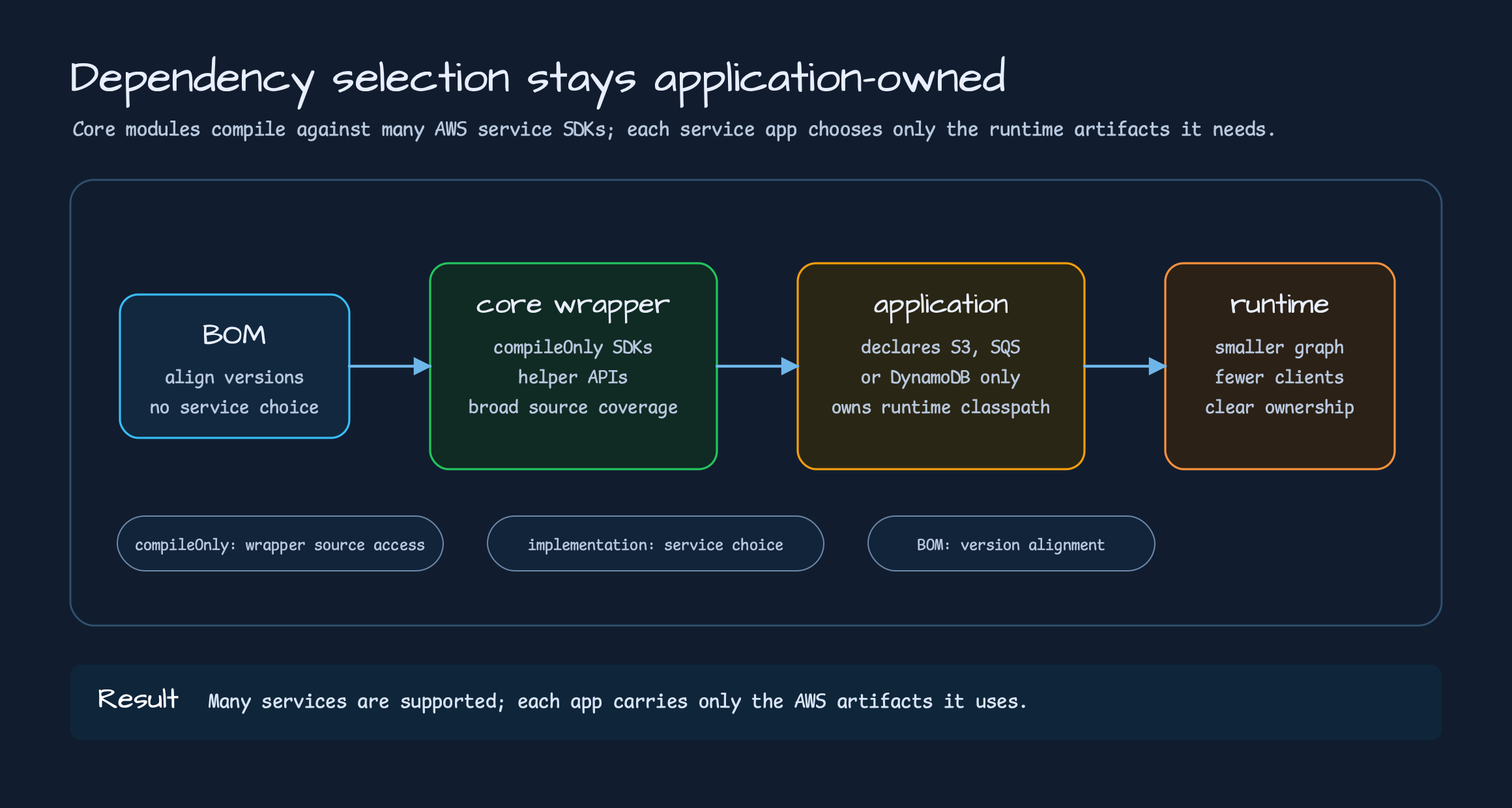
compileOnly lets wrappers compile; runtime service selection remains with the application.Which Module Should You Choose?
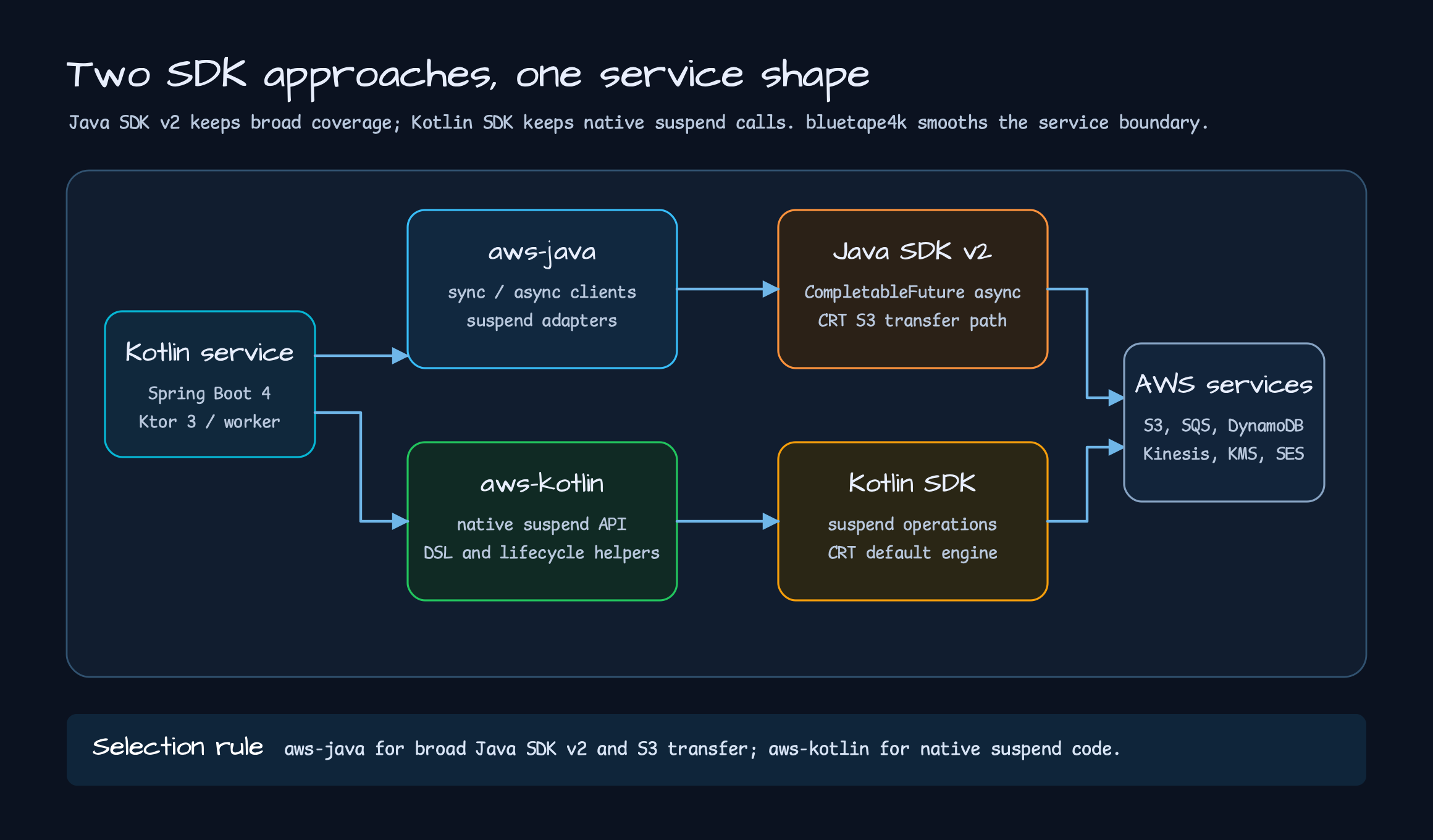
Section titled “Which Module Should You Choose?”Use bluetape4k-aws-java when the service needs broad AWS Java SDK v2 coverage or wants the S3
large-transfer route with TransferManager, CRT-backed async clients, coroutine helpers, and Virtual
Threads. This is especially useful where direct SDK use would otherwise require choosing the HTTP
client, async client, executor, and coroutine bridge in every service.
Use bluetape4k-aws-kotlin when new code wants to use the AWS Kotlin SDK and keep native
suspend operations. It separates SDK-owned engines from explicitly shared CRT or OkHttp engines
and adds withXxxClient lifecycle helpers plus service-specific request DSLs.
If the problem is Spring Boot 4 or Ktor 3 wiring, that belongs to Part 3. The core modules sit below those framework adapters. They reduce repeated SDK boundary code while keeping runtime dependency selection explicit.
Source Links
Section titled “Source Links”- Repository: bluetape4k-aws
- README: README.md
- Java module README: aws-java/README.md
- Kotlin module README: aws-kotlin/README.md
- Java S3 factory: S3ClientFactory.kt
- Java async HTTP provider: SdkAsyncHttpClientProvider.kt
- Java S3 TransferManager coroutine extensions: S3TransferManagerCoroutinesExtensions.kt
- Kotlin HTTP engine provider: HttpClientEngineProvider.kt
- Kotlin Kinesis Flow helper: KinesisRecordFlow.kt
- Dependency declarations: aws-java/build.gradle.kts, aws-kotlin/build.gradle.kts
Closing
Section titled “Closing”bluetape4k-aws-java and bluetape4k-aws-kotlin solve the same integration problem from different
SDK choices. The Java approach keeps AWS Java SDK v2 coverage, adds coroutine bridges, and makes the S3
CRT/TransferManager/Virtual Threads route easier to adopt. The Kotlin approach keeps the AWS Kotlin
SDK’s native suspend model and adds explicit shared-engine choices, lifecycle helpers, and request DSLs.
Next, we will move up to the framework layer: Spring Boot 4 auto-configuration, SQS listeners, Ktor SigV4 plugins, and working examples.
Comments
Leave a note or reaction with your GitHub account.