
Bluetape4k Text Part 3: Aho-Corasick Search and Workshop Scenarios

Part 2 covered routing input through tokenizers and language detection. This post moves to the next step: finding risk keywords or abuse words after the input path has been chosen.
For a small list, keywords.any { text.contains(it) } is fine. Ten keywords and short inputs do not need a more complicated
structure. The problem starts when the dictionary grows into hundreds or thousands of entries: abuse words, brand names,
security events, URL schemes, and code keywords.
The text-search module places an Aho-Corasick automaton at that boundary. Build the automaton once from the keyword
dictionary. Then scan each input once and emit matches with positions, keywords, and associated values.
Why Replace Repeated contains()
Section titled “Why Replace Repeated contains()”The simplest implementation looks like this.
fun hasRisk(text: String, keywords: List<String>): Boolean = keywords.any { keyword -> text.contains(keyword, ignoreCase = true) }For a small internal tool, this may be the better implementation. It is readable and has fewer moving parts. Once the dictionary grows, the cost shape changes because the input is scanned again for each keyword.
| Approach | Dictionary work | Input work | Good fit |
|---|---|---|---|
Repeated contains() | none | scan the input per keyword | small keyword lists and low call volume |
| Aho-Corasick | prebuild keyword trie and failure transitions | scan the input once and emit matches | large reused dictionaries in services |
Repeated contains() lines keywords up for every request. Aho-Corasick assembles the dictionary first and then passes text
through that machine. The first approach is cheap to write. The second approach is better when the same dictionary is reused
many times.
Processing Path
Section titled “Processing Path”In service code, text-search usually fits like this.
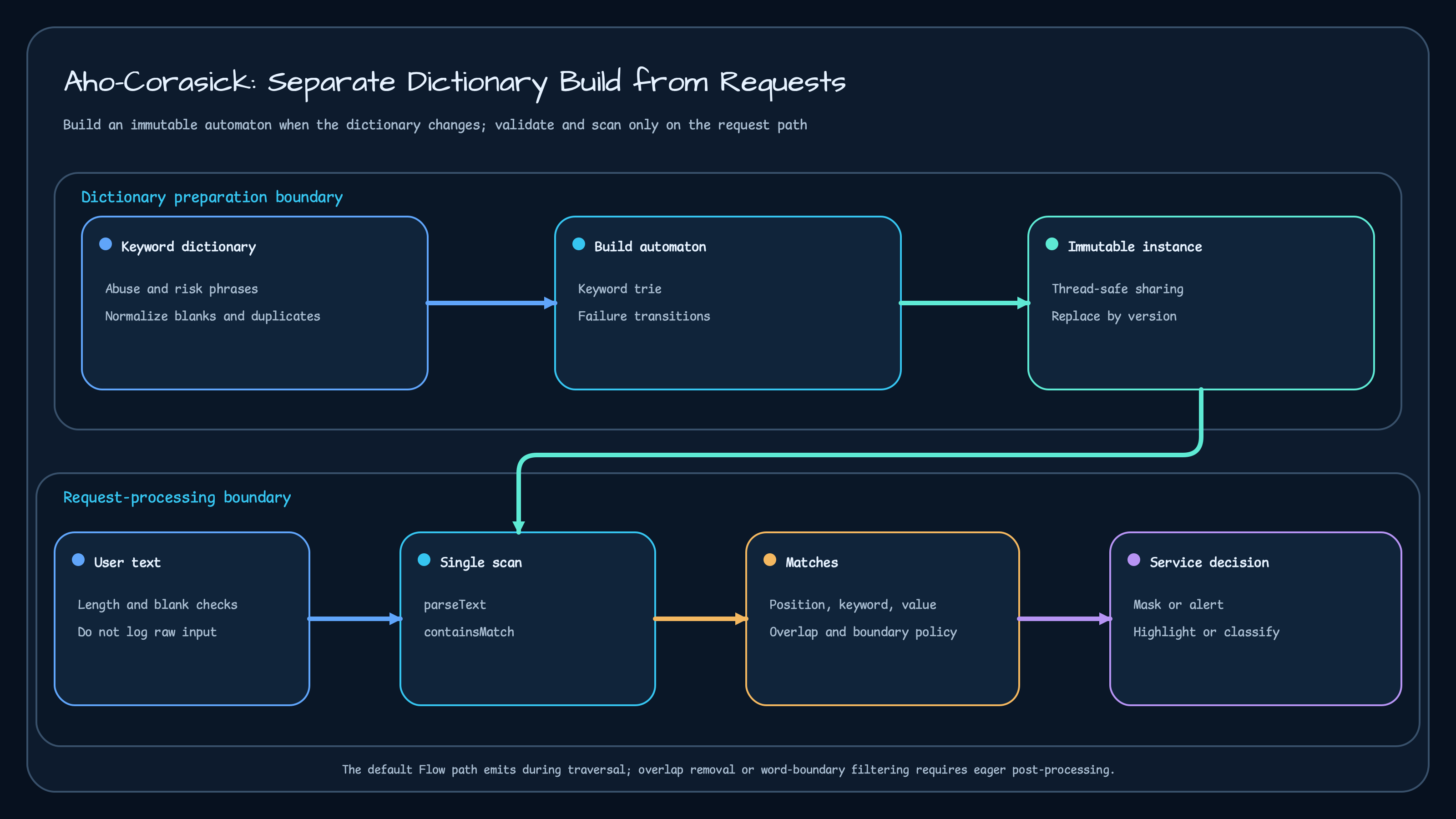
The most common mistake is rebuilding the automaton per request. Building creates the keyword trie and failure transitions. Do that at service startup, configuration reload, or dictionary-version change, not inside each request handler.
After build, AhoCorasickAutomaton is immutable and thread-safe. Multiple requests can share the same instance. The service
method can then choose between parseText, containsMatch, replaceAll, and matchesAsFlow.
Builder and DSL
Section titled “Builder and DSL”The builder API is the most explicit starting point.
val automaton = AhoCorasickAutomaton.builder<String>()    .add("password reset", "ACCOUNT_TAKEOVER")    .add("card declined", "PAYMENT_RISK")    .options(        SearchOptions(            ignoreCase = true,            allowOverlaps = false,            wordBoundary = WordBoundary.WHITESPACE_SEPARATED,        )    )    .build()
val matches = automaton.parseText(    "user requested password reset before card declined")
matches.map { it.value }// ["ACCOUNT_TAKEOVER", "PAYMENT_RISK"]
The DSL gives the same shape with less boilerplate.
val automaton = ahoCorasick<String> { ignoreCase = true allowOverlaps = false wordBoundary = WordBoundary.WHITESPACE_SEPARATED keyword("password reset", "ACCOUNT_TAKEOVER") keyword("card declined", "PAYMENT_RISK")}Values do not need to be strings. Production code often reads better with enums or small data classes.
enum class RiskType {    ACCOUNT_TAKEOVER,    PAYMENT_RISK,}
val automaton = ahoCorasick<RiskType> {    ignoreCase = true    wordBoundary = WordBoundary.WHITESPACE_SEPARATED    keyword("password reset", RiskType.ACCOUNT_TAKEOVER)    keyword("card declined", RiskType.PAYMENT_RISK)}
That lets downstream code branch on typed values instead of comparing string constants.
Workshop Abuse-Word Filter
Section titled “Workshop Abuse-Word Filter”The kotlin/text-processing workshop module contains AbuseWordFilter. It shows the service-helper shape around text-search.
class AbuseWordFilter(abuseWords: Collection<String>) {    private val automaton: AhoCorasickAutomaton<String> = ahoCorasick {        ignoreCase = true        allowOverlaps = true        normalization = NormalizationForm.NFC        abuseWords.filter { it.isNotBlank() }            .forEach { word -> keyword(word, word) }    }
    fun containsAbuse(text: String): Boolean =        automaton.containsMatch(text)
    fun filterText(text: String): String =        automaton.replaceAll(text) { match ->            "*".repeat(match.length)        }
    fun findMatches(text: String): List<AhoCorasickMatch<String>> =        automaton.parseText(text)}
The helper exposes three different service decisions.
| Method | Internal API | Service meaning |
|---|---|---|
containsAbuse | containsMatch | stop when existence is enough |
filterText | replaceAll | mask the matched span with * |
findMatches | parseText | inspect position, keyword, and value |
The tests pin that contract directly.
val filter = AbuseWordFilter(listOf("badword", "spam", "abuse", "hate"))
filter.containsAbuse("This message contains badword!")// true
filter.filterText("badword and spam together")// "******* and **** together"
filter.findMatches("spam and abuse are badword").size// 3
Abuse filtering rarely ends at true or false. The service may mask display text, raise a report score, or send the item to a moderation queue. That is why the automaton value is useful: it can carry category, severity, or policy metadata.
Pick Boundary Options First
Section titled “Pick Boundary Options First”SearchOptions collects small choices that have large behavioral effects.
| Option | Use when | Watch out for |
|---|---|---|
ignoreCase | English keywords should ignore case | keywords are normalized through the same pipeline |
allowOverlaps | choose whether to surface overlapping matches | replacement still uses non-overlapping spans |
wordBoundary | substring matches would be false positives | prefer WHITESPACE_SEPARATED over LATIN_ALPHA for Korean/CJK |
normalization | jamo, fullwidth text, or compatibility chars are possible | NFKC is expensive, so use it only where needed |
stopOnFirstMatch | blocking APIs only need existence | Flow should use take(1) |
Korean word boundaries deserve care. LATIN_ALPHA uses Character.isAlphabetic, and Hangul/CJK characters are alphabetic as
well. For Korean token-like matching, WHITESPACE_SEPARATED is usually safer.
val automaton = ahoCorasick<String> {    normalization = NormalizationForm.NFC    wordBoundary = WordBoundary.WHITESPACE_SEPARATED    keyword("사과", "APPLE")    keyword("바나나", "BANANA")}
automaton.parseText("오늘 사과 와 바나나 를 먹었다").map { it.value }// ["APPLE", "BANANA"]
Normalization is another deliberate choice. It is useful when inputs can contain decomposed Hangul or compatibility characters
such as ㈜, but it is not free.
val automaton = ahoCorasick<String> {    normalization = NormalizationForm.NFKC    keyword("(주)", "CORP")}
automaton.parseText("회사명: ㈜블루테이프").first().value// "CORP"
Flow for Streaming Boundaries
Section titled “Flow for Streaming Boundaries”matchesAsFlow emits matches as a Flow. The example uses it to collect the first alert-like match.
val automaton = ahoCorasick {    ignoreCase = true    keyword("critical login", "ACCOUNT_TAKEOVER")    keyword("card declined", "PAYMENT_RISK")}
val firstAlert = automaton.matchesAsFlow(    "critical login failed before card declined").take(1).toList().firstOrNull()
firstAlert?.value// "ACCOUNT_TAKEOVER"
Do not rely on stopOnFirstMatch for Flow. Use take(1) at the collector. With default options, traversal can emit matches
as it finds them and cooperative cancellation can stop the producer.
There is one caveat: allowOverlaps = false or a non-NONE wordBoundary requires whole-result post-processing. In that
case, the Flow still checks cancellation between sends, but it cannot behave like a purely streaming scan.
Benchmark Direction
Section titled “Benchmark Direction”The repository includes a JMH benchmark. Treat the numbers as a local comparison snapshot, not a production ranking.
Run command:
./gradlew :text-search:benchmarkThe baseline file is docs/benchmark/2026-06-04-issue-97-ahocorasick-baselines.json, and ops/s is higher-is-better.
| Benchmark | Ops/s | What it means |
|---|---|---|
parseTextNoMatch | 12,209.23 | 5,000-keyword automaton with no matches |
parseTextDenseMatches | 3,566.90 | dense overlapping matches |
parseTextLargeDictionary | 3,116.99 | 5,000 keywords and 2,000 match tokens |
matchesAsFlowLargeDictionaryCollect | 712.62 | collect all Flow results for a large dictionary |
naiveContainsSmallDictionary | 248.39 | 1,000 sequential String.contains checks |
parseTextNfkcNormalization | 3.68 | NFKC plus ignore-case path |
The point is not “Aho-Corasick is always N times faster.” The benchmark scenarios are different, and normalization has its own
cost. The useful conclusion is narrower: if a service repeatedly uses a large dictionary, rebuilding repeated contains
scans into a reusable automaton is the right structure.
The parseTextNfkcNormalization result is also a warning. NFKC can be very expensive. Enable it only where the input data
needs it.
Service Shape
Section titled “Service Shape”Application code usually wants a boundary like this.
class RiskKeywordService(    keywords: Collection<RiskKeyword>,) {    private val automaton = ahoCorasick<RiskKeyword> {        ignoreCase = true        allowOverlaps = true        normalization = NormalizationForm.NFC        keywords.forEach { keyword(it.phrase, it) }    }
    fun inspect(text: String): RiskInspection {        if (text.isBlank()) return RiskInspection.clean()        if (text.length > MAX_TEXT_LENGTH) return RiskInspection.rejected()
        val matches = automaton.parseText(text)        if (matches.isEmpty()) return RiskInspection.clean()
        return RiskInspection.flagged(            categories = matches.mapTo(linkedSetOf()) { it.value.category },            masked = automaton.replaceAll(text) { "*".repeat(it.length) },        )    }}
When dictionary reload is needed, build a new automaton and swap the reference. Avoid mutating an existing matcher while requests are using it. Immutable matchers are much easier to test and reason about.
The same input boundary from Part 1 still applies. Reject oversized input before matching, and do not echo raw submitted text into error messages or logs.
When Not to Use It
Section titled “When Not to Use It”Aho-Corasick is not always the right answer.
| Situation | Simpler choice |
|---|---|
| 3-5 keywords and low call volume | repeated contains() |
| regex syntax is the actual requirement | regex or parser |
| context or semantic classification is required | tokenizer, rule engine, or ML classifier |
| every request has a different dictionary | measure with automaton build cost included |
| very short input and a tiny dictionary | simpler code may be easier to maintain |
It fits best when a dictionary is reused and match positions matter: abuse words, security events, brand/product names, URL
schemes, and code keywords. replaceAll and tokenize then let the same match result feed masking or highlighting.
The practical rule is short. Small keyword lists can stay simple. Large reused dictionaries should become immutable automatons. Choose options from input evidence and test fixtures, not from a desire to enable every feature at once.
Sources
Section titled “Sources”- text-search README
- AhoCorasickAutomaton
- SearchOptions
- matchesAsFlow
- AhoCorasickScenarioTest
- AhoCorasickKoreanTest
- AhoCorasickFlowTest
- AhoCorasickBenchmark
- Aho-Corasick benchmark baseline
- TextSearchExamples
- AbuseWordFilter
- AbuseWordFilterTest
Comments
Leave a note or reaction with your GitHub account.