
Bluetape Skills Part 3: Recovering and Resuming Interrupted Workflows

Part 2 explained how $bluetape-workflow classifies a task
and validates the approved plan with Action–Evidence–Failure checklists. That structure catches
missed gates well. Once work spans a long session and several native subagents, however, a checklist
alone cannot answer every operational question.
When an agent stops responding, is it still computing or has it stalled? How much of an earlier agent’s result should a new session trust? Can the whole run finish because several lanes reported completion? If a receipt is damaged, can recovery continue from the last line that still looks valid?
Bluetape Skills 1.1.0, released on July 14, 2026, adds the Phase 2 native workflow runtime to
address these questions. It does not introduce another orchestrator. Instead, it records native
coordination performed by the Codex main session as verifiable state. After an interruption, that
state supports a concrete decision: resume the run, replace a lane, or create a separate recovery
run.
Why Workflows Need to Be Recoverable
Section titled “Why Workflows Need to Be Recoverable”When work finishes in one session, the conversation usually gives a rough picture of progress. As the run grows longer and splits into multiple lanes, reported progress and actual state can drift. An agent may say it is done without running a required check. It may change files without verifying that they fall inside the approved write scope.
Treating silence as immediate failure is also unsafe. A large build or an external response can leave an agent quiet while it is still working normally. The reverse is true as well: a continuing heartbeat does not prove progress. A signal that an agent is alive and evidence that the task is closer to completion are different facts.
Replacement introduces a harder problem. If the old agent sends a late result after a new agent has taken over, that result must not overwrite the current state. The same applies across sessions: the previous owner and the new owner cannot modify the same run at once. The runtime needs an explicit record of who currently holds write authority.
A recoverable workflow therefore needs more than a task list. It records the current run and lane states, owner generation, liveness observations, replacement lineage, per-component checks and evidence, and receipt validation. A later session can then continue from the recorded state rather than reconstructing it from old conversation history.
From Document Checklists to a Native Runtime
Section titled “From Document Checklists to a Native Runtime”The 1.0.0 checklist contract defined the Action each task must perform, the Evidence it must
produce, and the Failure condition that stops dependent work. 1.1.0 keeps that contract and adds a
state-recording layer so the same rules remain enforceable while multiple lanes are active.
The public bundle includes manifest version 1.1.0,
the liveness contract,
the topology contract,
receipt validation rules, and a guarded CLI. The manifest pins run and lane states, observation
intervals, replacement limits, and completion rules. The contracts define which commands may
change each state and what evidence those transitions require.
The runtime is not a scheduler that performs the work. It records and validates workflow state
under .bluetape. Creating native subagents, sending messages, waiting, listing agents, and
interrupting them remain responsibilities of the Codex main session. The runtime records the main
session’s intent before an action and its bounded observed evidence afterward, using defined state
transitions.
That separation prevents a recorded command from being mistaken for an executed native action. A
CLI lane-start does not mean an agent was created. The main session must perform the native spawn,
inspect its result, and only then record startup-ack. Silence is not an ACK.
How Runs and Lanes Move
Section titled “How Runs and Lanes Move”A run represents the complete approved task. A lane is a bounded unit of that task assigned to one agent or to the main session. The left side of the diagram shows one run dividing work across lanes and collecting their proof. The right side follows one lane through normal execution, recovery, and replacement.
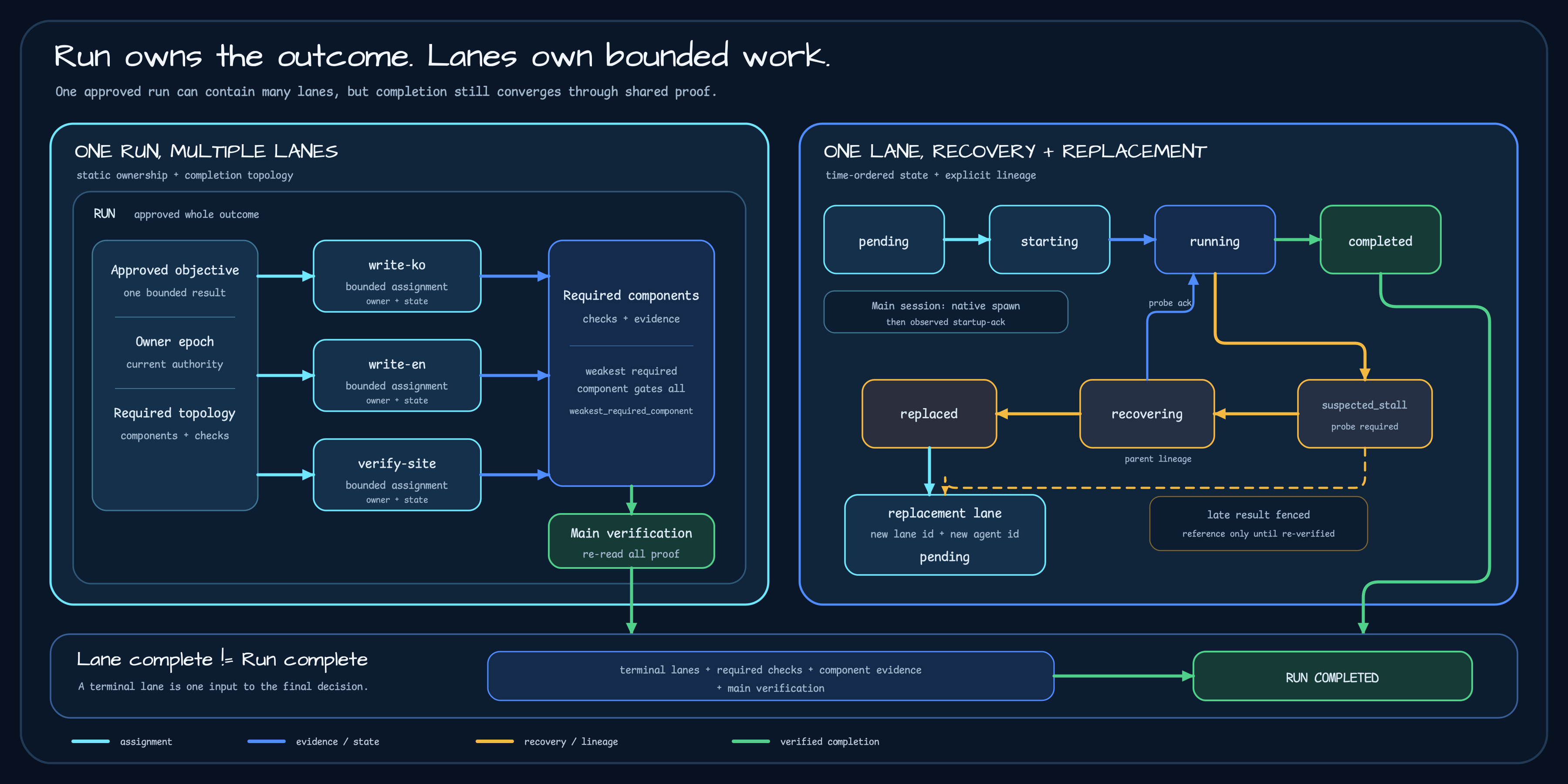
The basic startup path is:
bluetape-flow.py: run-approve -> run-start -> lane-create -> lane-startCodex main session: native spawnbluetape-flow.py: startup-ackThese arrows do not all belong to the same executor. From run-approve through lane-start,
bluetape-flow.py records approval and execution intent. The main session then creates the agent
with a native agent tool. Only after observing the native result does it record that bounded
evidence with startup-ack.
A lane moves through states such as pending, starting, running, suspected_stall, and
recovering before reaching a terminal state. The terminal states are completed, failed,
blocked, and cancelled. A replaced lane records replaced; its successor uses a distinct lane
and agent id. Reusing only the old lane id would falsely present the replacement as the same
execution.
The new lane receives a scope no broader than the original assignment and exactly one checkpoint. It also records parent lineage to the old lane. This fences late results from the previous agent after replacement. Those results may still be useful as reference material, but they cannot become completion evidence without verification by the current owner.
Before completing a lane, the main session rereads its evidence and collects actual changed paths
from Git status and the branch diff. It verifies that every path remains under the pinned repository
root and inside the write scope. An empty write scope means “write no files,” not “write anywhere.”
After lane-complete, required checks and component evidence must still be present before the whole
run can be considered complete.
Liveness Is Not Progress
Section titled “Liveness Is Not Progress”The liveness values in the manifest establish time boundaries for recovery decisions.
| Item | v1.1.0 value | Meaning |
|---|---|---|
| Observation interval | 30 seconds | Default interval for checking active native subagent state again |
| Suspected stall | 120 seconds | Silence threshold for considering a stall when no valid silence lease exists |
| Maximum silence lease | 600 seconds | Longest silence a single lease may cover |
| Probe grace | 60 seconds | Time to wait for a probe response after a suspected stall |
The 600-second value is not a limit for the entire task. It is the maximum interval one lease can cover when silence is justified by a build or an external wait. Renewing a lease requires new bounded evidence and a reason for the expected silence. Repeating “still working” cannot extend the lease indefinitely.
The runtime also does not interrupt an agent as soon as 120 seconds pass. liveness-check is a
read-only decision that evaluates the current record and recommends the next action. For a
suspected stall, the workflow records stall-record and probe-sent; the main session then uses
native send_message or checks the agent list. It performs a native interrupt only when the agent
does not answer within the 60-second probe grace period and policy returns interrupt authority.
Reduced to command names, the recovery path looks like this:
bluetape-flow.py: liveness-check -> stall-record -> probe-sentCodex main session: native probe -> native interrupt (when authority is present)bluetape-flow.py: interrupt-result -> lane-reassignThe Python/native-tool boundary applies here too. probe-sent first records intent to send the
probe. The main session performs the actual message and interruption. The CLI records the observed
result with interrupt-result before lane-reassign reserves a new lane. A lane may be replaced at
most once.
A heartbeat proves only that the agent is alive. It is not a changed path, a check result, component coverage, main verification, or completion evidence. Reusing a heartbeat for completion would collapse “an agent that can respond” and “work that has passed verification” into the same state.
The Weakest Required Component Determines Completion
Section titled “The Weakest Required Component Determines Completion”Completion reports from several lanes do not establish whether the whole run is complete. One lane can own multiple components, and work from separate lanes can converge in one required check. The runtime therefore records the approved topology by component.
Each component carries these fields:
required: marks whether this component blocks overall completion.owner_lane: identifies the lane responsible for its evidence.required_checks: lists the checks that must pass.dependencies: lists component ids that must complete first.evidence_refs: points to bounded evidence available in the receipt.coverage_state: states whether current evidence covers the component.
The completion rule is weakest_required_component. A run cannot advance beyond its least-complete
required component. For example, both the writing lane and site-verification lane may report
completed, but the run cannot finish if the Korean route build failed or Hero evidence is empty.
| Required component | Owner lane | Required check | Evidence | Decision |
|---|---|---|---|---|
| Korean article | write-ko | source-link check | Present | May complete |
| English article | write-en | locale parity | Present | May complete |
| Rendered routes | verify-site | production build | Missing | Cannot complete |
In this example, Rendered routes remains the weakest component even though the first two are
ready. completion-check looks for missing terminal lanes, required components, checks,
replacement lineage, evidence, and main verification. If any required item is absent, complete
does not run.
Removing a component from the topology is also an explicit operation. A difficult required
component cannot be silently dropped from the list. topology-remove requires a reason and
prevents implicit removal of a dependency or a required component that the run still needs.
Recovering Interrupted Work from Receipts
Section titled “Recovering Interrupted Work from Receipts”Recovery begins by determining whether the receipt is healthy. A new session resuming a run with a valid receipt follows a different path from a run whose receipt chain is damaged.
Resume a Healthy Receipt with a New Owner Epoch
Section titled “Resume a Healthy Receipt with a New Owner Epoch”First, replay the run with the read-only resume-check command. If it finds an unfinished
replacement reservation, ownership does not transfer immediately. The workflow must finish the new
lane with replacement-repair or explicitly stop it with replacement-block.
After the check passes, resume creates a new owner handle, appends a run_resumed event, and
increments the owner epoch by 1. The previous handle is fenced and removed. The new session does
not reuse the former owner’s credential, and the previous owner and agents cannot modify state at
the latest epoch.
The owner credential does not belong in command arguments or JSON. It exists only in an owner file
with mode 0600 under an allowed state root. resume issues a new file as an ownership transfer;
it does not copy a token through the conversation as a handoff.
Move a Damaged Receipt into a Separate Recovery Run
Section titled “Move a Damaged Receipt into a Separate Recovery Run”When a receipt is damaged, continuing from the last readable event may look convenient. Doing so would make it impossible to prove where the original record ends and a manually appended record begins.
receipt-diagnose is a read-only diagnosis, not a repair command. It reports the first damaged
sequence, the head of the trusted prefix, manifest identity, lock state, and the damaged receipt
hash. Use that result to identify the damage, but do not truncate, edit, or continue the original
chain.
After recovery is approved, recovery-run-create verifies the diagnosis checksum and approval
evidence. It keeps an immutable copy of the damaged original under quarantine/ with permission
0600, then creates a separate run whose first event carries the provenance. The new run is an
independent planned run, not the next sequence in the old chain. In-place migration is not
supported.
This division makes recovery slightly more deliberate. In return, it keeps ownership transfer for a healthy run separate from restarting work after record corruption. Increment the epoch when the receipt is healthy; preserve the diagnosis and original receipt and move to a new run when it is damaged.
The Runtime Records; Codex Executes
Section titled “The Runtime Records; Codex Executes”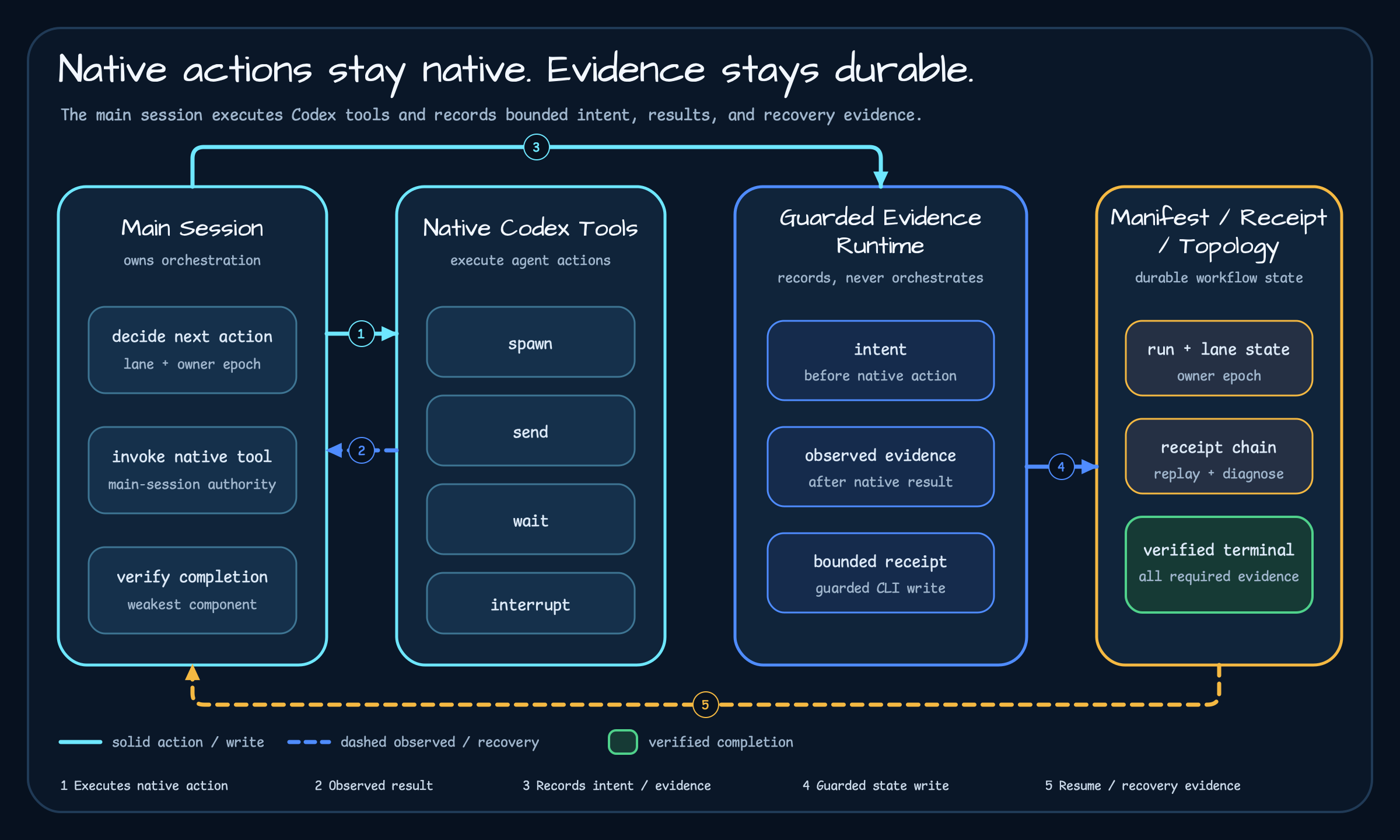
Although bluetape-flow.py is written in Python, it does not call native coordination tools. Agent
spawn, messaging, waiting, listing, and interruption belong to the Codex main session. Claiming that
the CLI performed them would blur the boundary between the executor and the receipt writer.
The boundary can be summarized as: record intent, perform the native action, then record observed
evidence. A native spawn must follow lane-start, and a native probe must follow probe-sent.
interrupt-result contains only the bounded interruption result observed by the main session. CLI
output alone is not evidence that a native action occurred.
The guarded bluetape-flow.py CLI is the only supported write path for .bluetape state. Editing a
receipt or manifest state directly when something goes wrong is unsupported. Read-only commands do
not silently change caches or receipts either.
Evidence has its own boundary. Owner credentials, secrets, raw prompts, unbounded tool output, and fencing information are not accepted as ordinary JSON fields in receipts or reports. The runtime does not need a copy of every native-tool conversation. It needs only the bounded observation that can validate the next state transition. This keeps the receipt a workflow state ledger rather than a duplicate session transcript.
Reproducing 1.1.0 and Installing the Current Release
Section titled “Reproducing 1.1.0 and Installing the Current Release”The runtime described in this article first shipped in 1.1.0. To reproduce that historical release,
validate a shallow clone of its tag in a separate directory instead of overwriting the current checkout.
git clone --branch v1.1.0 --depth 1 https://github.com/bluetape4k/bluetape-skills.git bluetape-skills-v1.1.0cd bluetape-skills-v1.1.0./scripts/validate.sh./scripts/install.sh --forcevalidate.sh checks the public bundle boundary, manifest inventory, workflow contracts, and the
shipped regression tests. It requires Bash, rg, Python 3, and uv. install.sh --force moves each
existing canonical skill directory to a timestamped backup before installing the new version. If
you have edited skills locally, inspect those changes with git log and git diff before forcing a
replacement.
For a current installation, use the latest stable tag. As of July 28, 2026, that release is v1.2.2:
git clone --branch v1.2.2 --depth 1 https://github.com/bluetape4k/bluetape-skills.git bluetape-skills-v1.2.2cd bluetape-skills-v1.2.2./scripts/validate.sh./scripts/install.sh --forceDo not close the current Codex task first. Launch a separate Codex process in the same workspace,
verify that it loads the new skills and passes self-audit, and only then retire the previous process.
code-review and self-audit are external companion skills outside the public canonical bundle.
Install them separately if you use the Code Review path or the harness self-audit gate.
At publication, the v1.1.0 release candidate recorded passing validation for 14 canonical skills,
133 tests and 151 subtests, and source/bundle parity across 83 files. These historical results must
not be read as current v1.2.2 validation counts.
When to Use the Runtime
Section titled “When to Use the Runtime”Not every task needs the Phase 2 runtime. For a small wording change that one agent can finish quickly, with obvious changed files and checks, the ordinary checklist and Git diff may be enough. Creating a run, lanes, and topology can cost more than the recovery risk warrants.
The recorded state becomes useful when any of these conditions apply:
- Work may outlive one session or need a handoff to a new session.
- Several native subagents work in parallel lanes.
- The workflow must distinguish agent silence from a legitimate long-running operation.
- A stalled lane may need replacement, with late results from the old agent fenced out.
- Completion depends on required checks and evidence from several components.
- A damaged receipt requires a recovery run that preserves provenance.
The decision is not about the number of commands. Ask whether a later session can read the current owner, lane states, component evidence, and receipt and choose a safe next action without guessing from conversation history. If that is difficult, the runtime has a job to do. For short work with clear boundaries, finish with the checklist alone.
Series
Section titled “Series”- Start here: Turning AI Collaboration Into Infrastructure
- Bluetape Skills Part 1: Sharing and Installing the Toolkit
- Bluetape Skills Part 2: Starting Work with bluetape-workflow
- Bluetape Skills Part 3: Recovering and Resuming Interrupted Workflows
Comments
Leave a note or reaction with your GitHub account.