
[Design 3] Why an N-Visit Product Is Not One Appointment

An N-visit product sounds like a repeated appointment: buy five visits, then put five rows on the calendar. That shortcut loses the business facts that matter after the first visit. A patient can reschedule, miss a visit, receive only part of the care, or have a future benefit changed by a separate commerce decision. A confirmed slot is only one operational promise; it is not the same thing as a purchased right or completed care.
Suppose Patient A buys a five-visit product. The reservation service must answer three different questions:
- How many visits did the commerce service sell?
- How many obligations has the authoritative clinical evidence completed?
- How many obligations are still executable, and which one is ready for a new proposal?
Purchased rights ≠ confirmed appointments ≠ completed care
This article follows one cycle for Patient A and then shows how the next cycle is calculated. The goal is not to invent a single counter for every service. The goal is to keep the purchase contract, the reservation plan, the visit commitment, and the completion fact explainable when the patient’s calendar changes.
Patient A buys five visits, not five confirmed slots
Section titled “Patient A buys five visits, not five confirmed slots”We generalize the product name, price, clinic, and personal information. The number five is an example that makes the
three counts visible; the model works for any positive repeatCount.
| Time | Patient A action or event | Business meaning | What the reservation service preserves |
|---|---|---|---|
| T1 | Buys a five-visit product | Commerce grants five uses under a product version | Purchase source, purchase ID, and purchase-time catalog snapshot |
| T2 | Purchase completion is received | One commercial fact must become one executable plan | One AppointmentPlan for the authority-qualified purchase |
| T3 | The plan is expanded | Five future obligations are created, not five calendar slots | PlannedTreatment 1..5, intervals, dependencies, and source history |
| T4 | Patient A requests a first date | A preference or proposal input, not consent | Immutable BookingPreferenceSnapshot |
| T5 | One candidate is proposed and accepted | One visit becomes a commitment | One Appointment with the agreed AppointmentItem |
| T6 | Patient A attends and the treatment completes | One obligation is fulfilled | Completion evidence, used = 1, and remaining = 4 |
The first purchase does not create five Appointment aggregates. It creates one plan with five obligations. Only the
first obligation that is ready, eligible, and consented becomes an appointment. The other four remain traceable
future work even while Patient A’s first visit is held or confirmed.
The word right here means a commercial benefit that Patient A acquired. It is not an authentication or authorization grant. The reservation service does not decide the price or refund eligibility; it preserves the purchase interpretation needed to schedule the benefit.
Total, used, remaining, and reserved answer different questions
Section titled “Total, used, remaining, and reserved answer different questions”The user-facing screen may display “4 visits remaining,” but the underlying facts should not be collapsed into one mutable integer. After Patient A completes the first visit while the second visit is only proposed, the facts can look like this:
| Measure | Example after visit 1 | Question it answers | What changes it |
|---|---|---|---|
| Total purchased rights | 5 | How many uses did commerce sell under this product snapshot? | A new purchase creates a new plan; a product edit does not rewrite this snapshot |
| Used / fulfilled | 1 | How many obligations has authoritative completion evidence fulfilled? | A clinical completion or fulfillment event, not a proposal or hold |
| Remaining executable obligations | 4 | How many plan items are still available for future fulfillment? | Completion, an explicit future-item cancellation, or another source-qualified business event |
| Reserved slots | 0 or 1 | How many calendar commitments currently occupy capacity? | PROPOSED, HELD, CONFIRMED, reschedule, expiry, or cancellation |
A future HELD or CONFIRMED appointment can reduce available capacity without reducing used. Conversely, a
commerce-approved cancellation of a future benefit can reduce executable obligations without pretending that Patient A
received care. A no-show is an attendance fact and a policy input; it is not automatically a consumed visit.
The practical rule is simple: show “remaining rights” from plan and source-qualified business facts, and show “reserved slots” from appointment commitment facts. Never subtract a visit merely because a calendar row was created.
One purchase becomes one plan, then multiple PlannedTreatment items
Section titled “One purchase becomes one plan, then multiple PlannedTreatment items”The selected model keeps the purchase boundary and the physical visit boundary separate:
Purchase 1 ──> AppointmentPlan 1 ──> PlannedTreatment 1..N ▲ │ fulfills / attemptsAppointment 1 ──> AppointmentItem 1..N ──────┘ │ └── ResourceAllocation 1..NOne AppointmentPlan belongs to one authority-qualified purchase:
sourcePurchaseAuthorityandsourcePurchaseIdidentify the purchase source and original fact.catalogSourceAuthority,productId, andcatalogVersionpreserve the product interpretation used at purchase time.- Each
PlannedTreatmentkeeps its sequence, expected duration, required capabilities, and interval constraints. - A later purchase creates a new
AppointmentPlan; it is not silently merged into the first plan.
sequenceNo is useful metadata for “visit 1” or “visit 5.” It is not a child aggregate that owns a calendar. A
physical visit is represented by Appointment; the treatment obligations attempted in that visit are represented by
AppointmentItem. A single visit may include compatible items from more than one plan, but each item remains linked
to its own purchase and planned treatment.
This distinction matters when Patient A buys another five-visit product later. The second purchase may share a visit with the first plan if the items are clinically and operationally compatible and the patient consents. It must still retain a second plan, a second purchase source, and separate remaining obligations.
Why we do not confirm all five appointments at purchase time
Section titled “Why we do not confirm all five appointments at purchase time”The product snapshot can tell us that five obligations exist. It cannot know every future commitment at the moment of purchase:
- The preferred interval may be measured from the actual completion of the previous treatment, not from the purchase timestamp.
- Clinic hours, practitioners, rooms, and equipment can change before the next visit.
- Patient A may want a different date, and a confirmed change requires a new proposal and consent.
- A first-booking rule such as
WithinDaysAfterPurchaseis a limited fallback for the first proposal. It is not benefit expiry and it is not automatic confirmation. - Confirming all five slots would overstate capacity and would create promises Patient A has not yet reviewed.
The commitment states make that distinction explicit:
| State | What Patient A sees | Capacity meaning | Is the product right used? |
|---|---|---|---|
PROPOSED | A candidate time, item, and resource to review | No durable commitment; policy may still recalculate | No |
HELD | A short provisional hold | Capacity is occupied until the hold expires | No |
CONFIRMED | One consented visit promise | The agreed visit occupies capacity | No, not until completion |
COMPLETED | The visit/item was actually fulfilled | Historical fact, no future slot occupancy | Yes, for that planned treatment |
The first three states concern a visit commitment. The last fact concerns care completion. They must not be inferred from one another by a UI counter or a retry handler.
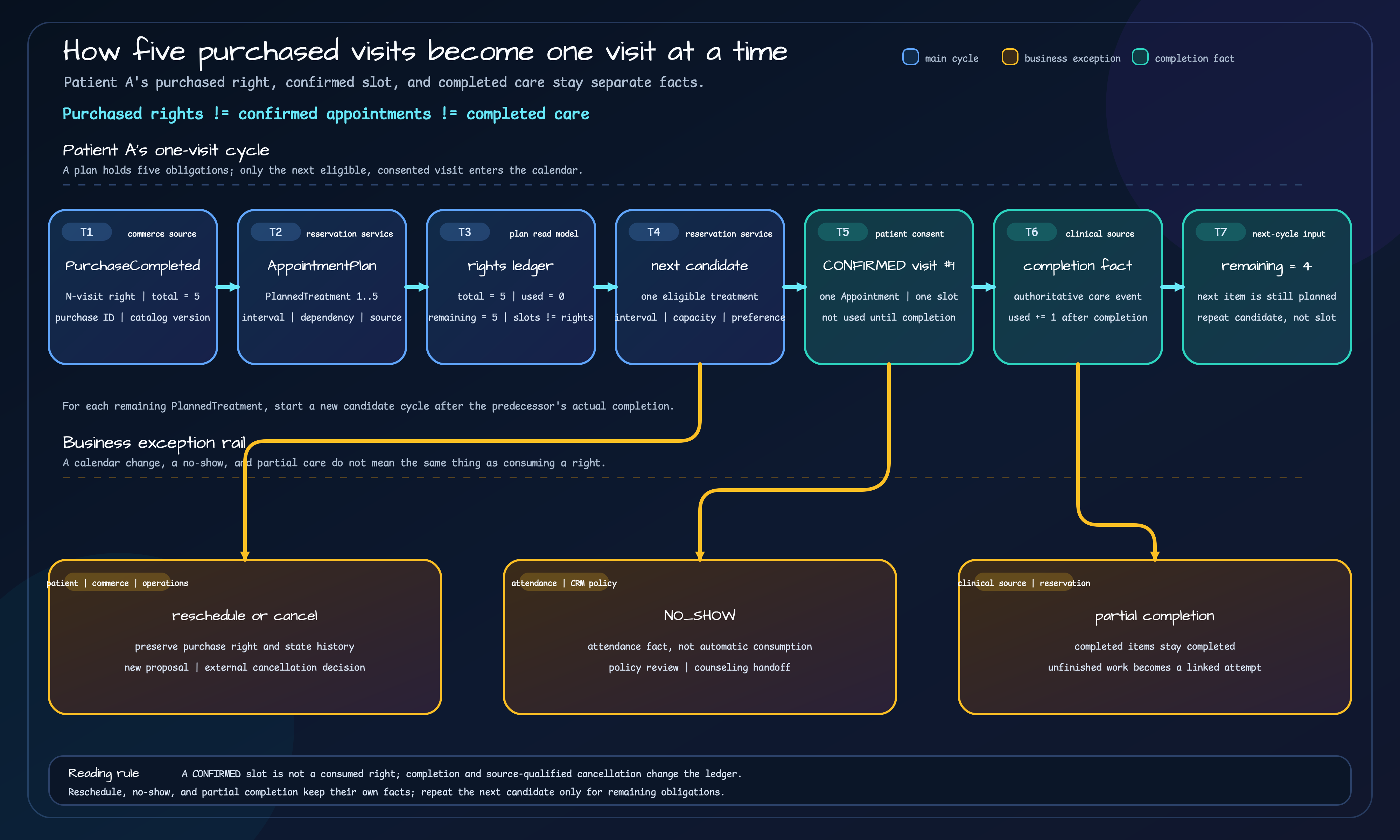
The next visit is a new proposal, not a rewrite
Section titled “The next visit is a new proposal, not a rewrite”After visit 1 completes, the reservation service uses the completion fact as the anchor for the next eligible obligation. It does not move a pre-created appointment row from “visit 2” to a new date because no such confirmed row should have existed.
| Cycle | Fact for Patient A | Reservation interpretation | Next action |
|---|---|---|---|
| First cycle | PlannedTreatment 1 completes at the clinic | used = 1; item 2 is still PLANNED | Calculate a candidate using the actual completion time and policy |
| Next proposal | A date satisfies interval, resource, and clinic rules | A new PROPOSED or HELD offer | Ask for consent; do not reuse an old confirmation |
| Reschedule | Patient A requests another time before the visit | The offer or commitment changes, not the purchase total | Expire or replace the proposal and retain the reason |
| Second completion | Item 2 completes | used = 2; remaining obligations become 3 | Repeat the cycle for the next eligible item |
The predecessor’s actual completion is especially important when care is interrupted. If a treatment started on Monday but its clinical completion arrives on Wednesday, the next interval is calculated from Wednesday. A purchase date or an abandoned proposal is not a clinical milestone.
Rescheduling, cancellation, and no-show change different facts
Section titled “Rescheduling, cancellation, and no-show change different facts”“The patient did not keep this calendar entry” is not enough information for the next service. The reservation service preserves an objective appointment fact and hands the decision to the owner of the next business rule.
| Situation | Reservation fact | Effect on the five-visit right | Next owner or action |
|---|---|---|---|
| Proposal expires or is declined | The offer never became a confirmed commitment | No use is consumed; the planned treatment remains available | Calculate a new proposal or contact Patient A |
| Confirmed visit is rescheduled | The original commitment and the new proposal are both auditable | The purchase total and used count stay unchanged | New time/resource offer and customer consent |
Patient is a NO_SHOW | Attendance did not occur for the confirmed visit | Do not decrement used automatically | Apply an explicitly approved policy and provide an objective CRM handoff |
| Visit is partially completed | Completed items and unfinished items are separated | Consume only the authoritative completed item(s) | Defer unfinished work and create a linked attempt |
| Clinic disruption affects a confirmation | The affected resource, time, and commitment history are preserved | No silent consumption or deletion of the purchased right | New proposal, explanation, and customer consent |
A hospital may decide that repeated no-shows require a reconfirmation step, a deposit, or a counseling call. It may also define a transparent priority policy for VIP customers. Those are operating or commerce/CRM policies with their own source data and approval. They are not a hidden decrement in the reservation service, and they are not presented here as a current product feature.
Reservation does not own consumption
Section titled “Reservation does not own consumption”The data flow becomes easier to review when each service can answer a different question about Patient A:
| Business area | Source of record | Fact exchanged | Reservation service responsibility |
|---|---|---|---|
| Product management | Versioned product, BOM, repeat count, intervals, and resource requirements | Catalog projection or synchronization event | Validate and preserve the purchase-time scheduling snapshot |
| Commerce / purchase | Purchase contract, entitlement, refund, and original purchase ID | PurchaseCompleted, refund, or plan-cancel event | Create one plan per purchase and apply external entitlement decisions to future obligations |
| Reservation | Plan, planned treatments, proposals, holds, confirmations, and appointment history | Objective appointment event and durable outbox | Own time, capacity, commitment state, and audit history |
| Clinical care | Actual start, completion, and partial completion | Completion or fulfillment fact | Reflect completion in the plan and calculate downstream eligibility |
| Counseling / CRM | Customer profile, no-show conversation, complaint, compensation, and service tier decision | Delay, no-show, cancellation, and reschedule facts | Provide an objective handoff; do not decide the counseling outcome |
| Notification and analytics | Contact consent, delivery history, projections, and metrics | Reservation event and schema contract | Keep channel delivery and read models outside the reservation transaction |
sourceAuthority in these contracts means the source-of-record service that owns a fact. It is not a user role,
permission, or claim that the reservation service can mutate another service’s data. The same boundary protects the
meaning of “used”: a calendar commitment can be reported by reservation, while treatment completion comes from the
clinical source and entitlement/refund decisions come from commerce.
Current implementation, approved design, awaiting operations, and roadmap
Section titled “Current implementation, approved design, awaiting operations, and roadmap”| Evidence label | Scope in this article | Question for the reader |
|---|---|---|
| Current implementation | Versioned catalog projection, one purchase-to-plan identity, repeated PlannedTreatment expansion, preference snapshot, and plan/item states | Can the contract be found in the observed source and tests? |
| Approved design | One-at-a-time candidate, PROPOSED · HELD · CONFIRMED, completion anchored follow-up, and explicit exception paths | Is a design document being described as an already deployed API? |
| Awaiting operations | Broker delivery, clinical/commerce event integration, notification outbox canary, and production backfill/readiness | Has delivery, replay, and recovery been proven in operation? |
| Roadmap | Patient-facing consent for later proposals, concrete no-show penalties, and an explainable VIP priority policy | Have undecided policies been mistaken for current behavior? |
The current foundation creates a plan and its planned treatments; it does not mean that every clinic already offers a complete five-visit commitment workflow. The approved design describes the boundary that later candidate, capacity, consent, and disruption work must honor. Keeping those labels visible is part of the technical contract.
What comes next
Section titled “What comes next”An N-visit product repeats the same kind of care. The next article turns to a package product: how a product BOM becomes a graph of treatments with different durations, dependencies, and possible visits, without flattening it into one appointment or one remaining counter.
Revisit the visual companions
Section titled “Revisit the visual companions”These companions supplement the source design; they do not replace the article or the clinic-appointment source repository.
- Classifying product scheduling behavior
- Expanding a product BOM into scheduling
- Appointment plans and capacity
- Clinic appointment visual companion index
Evidence links
Section titled “Evidence links”- clinic-appointment repository
- Product catalog definition
- AppointmentPlan model
- AppointmentPlan revision model
- Booking preference snapshot
- Purchase completion handler
- Product, purchase, and reservation data flow
- Appointment plan and capacity design
- Visit commitment design
Comments
Leave a note or reaction with your GitHub account.