
bluetape4k-dependencies 2.0.0 in Practice Part 4: Operational Diagnostics and Fail-Closed Boundaries
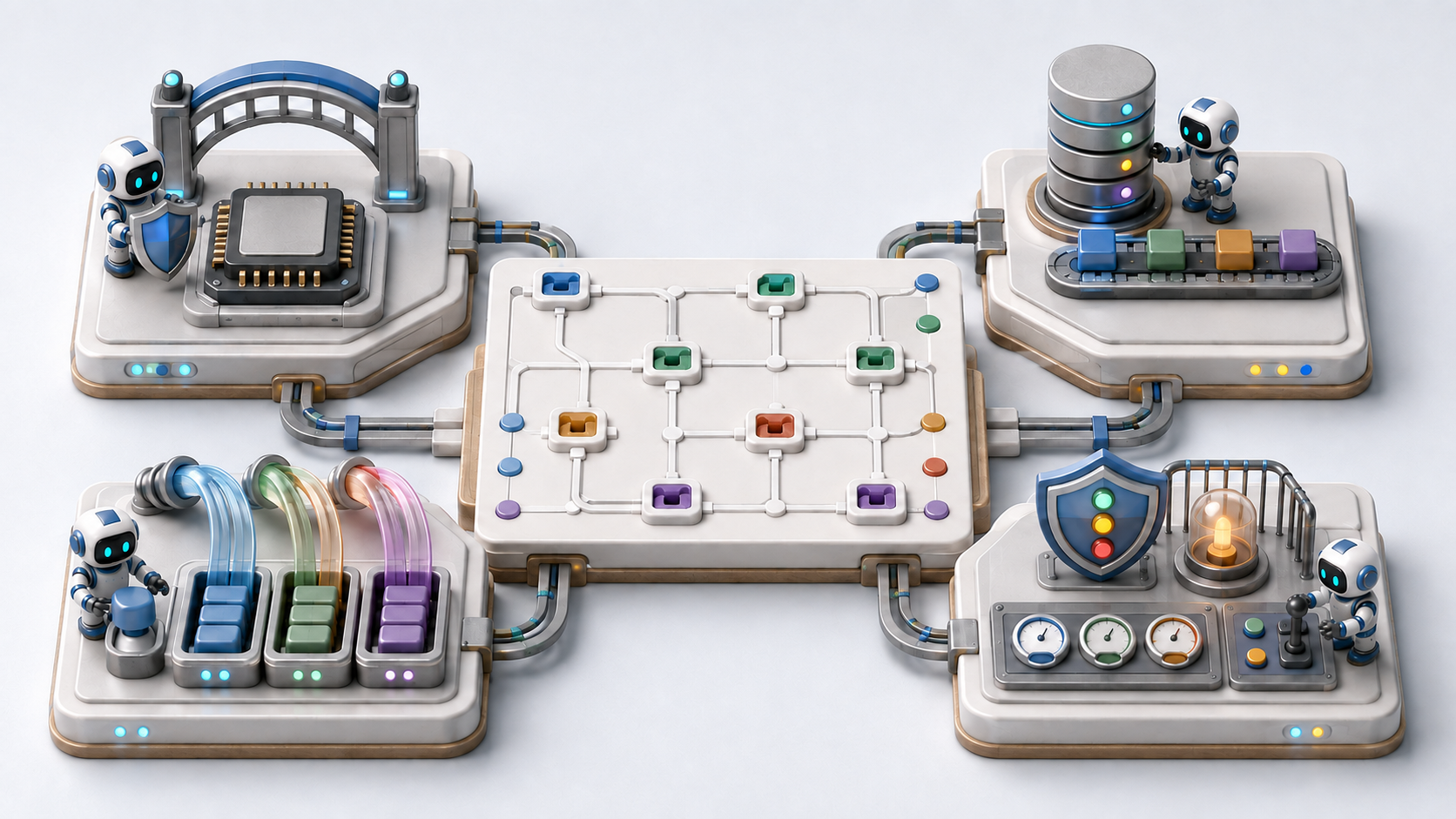
A production system cannot always give a definitive answer. A backend may not support active diagnostics, durable history may be corrupted, or input may be too large to decode safely. Replacing those conditions with a convenient default—or returning a partial result—makes failure look healthy.
bluetape4k-dependencies 2.0.0
selects bluetape4k-leader 1.0.0,
bluetape4k-javers 1.0.0,
bluetape4k-image 1.0.0, and
bluetape4k-text 1.0.0.
Each release makes a different failure boundary explicit.
Do not present unknown state as healthy
Section titled “Do not present unknown state as healthy”An operational API needs more than success and failure.
| State | Meaning | Operational action |
|---|---|---|
| Healthy | The current condition was actively confirmed | Interpret the metric or health result as healthy |
| Unhealthy | A failure condition was actively confirmed | Alert and run the recovery procedure |
| Unknown | The condition could not be confirmed | Keep a bounded reason; never promote it to healthy |
| Corrupted | A durable-data invariant was violated | Stop instead of returning a partial result |
| Unsupported | The provider or runtime lacks the capability | Select a fallback explicitly or disable the feature |
UNKNOWN and corruption are not equivalent. The first describes a limit of observation; the second is a confirmed invariant
violation. Alerting, retry, and traffic-routing policy should reflect that distinction.
Leader exposes bounded UNKNOWN reasons
Section titled “Leader exposes bounded UNKNOWN reasons”Leader 1.0.0 introduces LeaderBackendDiagnosticsProbe as a common active-connectivity contract. When a probe cannot confirm the
state, it reports a bounded reason rather than placing an arbitrary exception message in a metric label.
CLIENT_STATE_UNCONFIRMED: client state alone cannot confirm connectivity.PROVIDER_UNSUPPORTED: the selected provider does not support the active probe.PROVIDER_EXCEPTION: the diagnostic call itself failed.
The same meanings flow through Spring health, Ktor management routes, Micrometer counters, Prometheus alerts, and the runbook. This
preserves the cause without letting tag cardinality grow with exception text. Most importantly, UNKNOWN does not become UP.
Operators can distinguish an unconfirmed backend from a verified healthy one.
A Javers audit chain stops when corrupted
Section titled “A Javers audit chain stops when corrupted”Javers 1.0.0 validates schema ownership and conflicting flags while Spring Boot auto-configuration starts. If multiple components claim responsibility for the same schema, the application fails before they can race at runtime.
The Redis repository head follows the same rule. If the audit head is corrupted or rewound, returning only the readable prefix would hide that history became shorter. Version 1.0.0 stops fail-closed rather than silently truncating the audit history. Recovery remains a separate operator-owned procedure based on the original store and the reported error.
expected head: 418observed head: 271decision: stop and report corruptionnot: return revisions 1..271 as complete historyFor audit data, visible incompleteness is safer than partial success. The release applies the same idea to reproducible JSON receipts for benchmark teardown and first-attempt CI failures.
Image separates runtime objects from durable data
Section titled “Image separates runtime objects from durable data”Image 1.0.0 removes false Serializable contracts from privacy-pipeline runtime objects and Spring storage/CDN collaborators. A
client or service object is not safely restorable merely because its class claims Java serialization support; credentials, native
handles, and process-local state still have different lifecycles.
Values that truly need persistence use a Jackson 3 codec with schemaVersion=1. Decode size is bounded, and byte arrays and
collections are defensively copied. Existing Java-serialization consumers should persist PrivacyDerivativePayload, report, or batch
snapshots rather than a runtime object.
The distinction gives each category a specific rule.
- Runtime collaborator: keep it inside the process and manage its lifecycle explicitly.
- Versioned data: persist it with a codec that defines schema version, size limits, and copy behavior.
- External input: validate encoded size and decoded dimensions before processing.
PaddleOCR model downloads and an ONNX production backend also remain inactive. Until license, immutable artifact, producer
provenance, and offline receipt evidence exist, the decision is DEFER. A documented hold is safer than advertising an unsupported
production capability.
Text makes model initialization cost a choice
Section titled “Text makes model initialization cost a choice”The Lingua mixed-language example in Text 1.0.0 creates a detector once outside the pipeline and reuses it across inputs. This separates model preparation cost and object lifetime from the per-input processing boundary.
Choose the loading policy for the deployment environment.
| Policy | Benefit | Cost and suitable environment |
|---|---|---|
preload | Predictable first-request latency | Startup time and initial memory are acceptable for a long-running service |
lazy | Fast startup and no unused model load | First-use latency is acceptable for an intermittent workload |
Example tests confirm equivalent results for both paths. Detector reuse remains the baseline either way. Rebuilding a heavy model for every request unnecessarily destabilizes throughput and tail latency.
Operational decision table
Section titled “Operational decision table”| Question | Safe default | Interpretation to avoid |
|---|---|---|
| Could the backend state not be confirmed? | Expose a bounded UNKNOWN reason | Treat it as healthy |
| Is the audit head corrupted or rewound? | Stop reads and require recovery | Return a remaining prefix as complete history |
| Must a runtime object survive restart? | Persist only the required values as versioned data | Java-serialize the entire collaborator |
| Are you decoding an external image payload? | Bound encoded size and decoded dimensions | Read as much as memory permits |
| Does a new ML backend lack provenance? | Record the gate and DEFER | Enable production from experimental results alone |
| Is a language detector used repeatedly? | Reuse one and choose preload or lazy | Rebuild the model per request |
Failing safely is not a technique for catching every exception. It is a contract that preserves healthy, unknown, corrupted, and unsupported states—and leaves the next action visible to callers and operators.
Comments
Leave a note or reaction with your GitHub account.