Bluetape Skills Part 2: Starting Work with bluetape-workflow
This article connects the skill layer from “Turning AI Collaboration Into Infrastructure” and the sharing and installation structure from Part 1 to an actual execution procedure. The focus is what happens to one request as it moves through classification, approval, execution, and verification.
Installing the skills does not mean memorizing every name. Bluetape ecosystem work starts with
$bluetape-workflow. It is not a universal prompt that writes all the code. It is a router that
first identifies the shape of the request and then selects the right leaf skill and validation
level.
The router has this structure because earlier procedures failed in both directions. Agents skipped gates, treated a later success as proof of an earlier step, or reduced checks because a change looked small. At other times, safe local work stopped repeatedly to ask for permission even after the scope had been approved.
The current boundary is different: approve the scope and deliverables once in the first concrete plan, then continue safe and reversible work without repeated handoffs. Every open gate still needs fresh evidence before it passes.
$bluetape-workflow
Add a new cache usage example to the bluetape4k-exposed README.
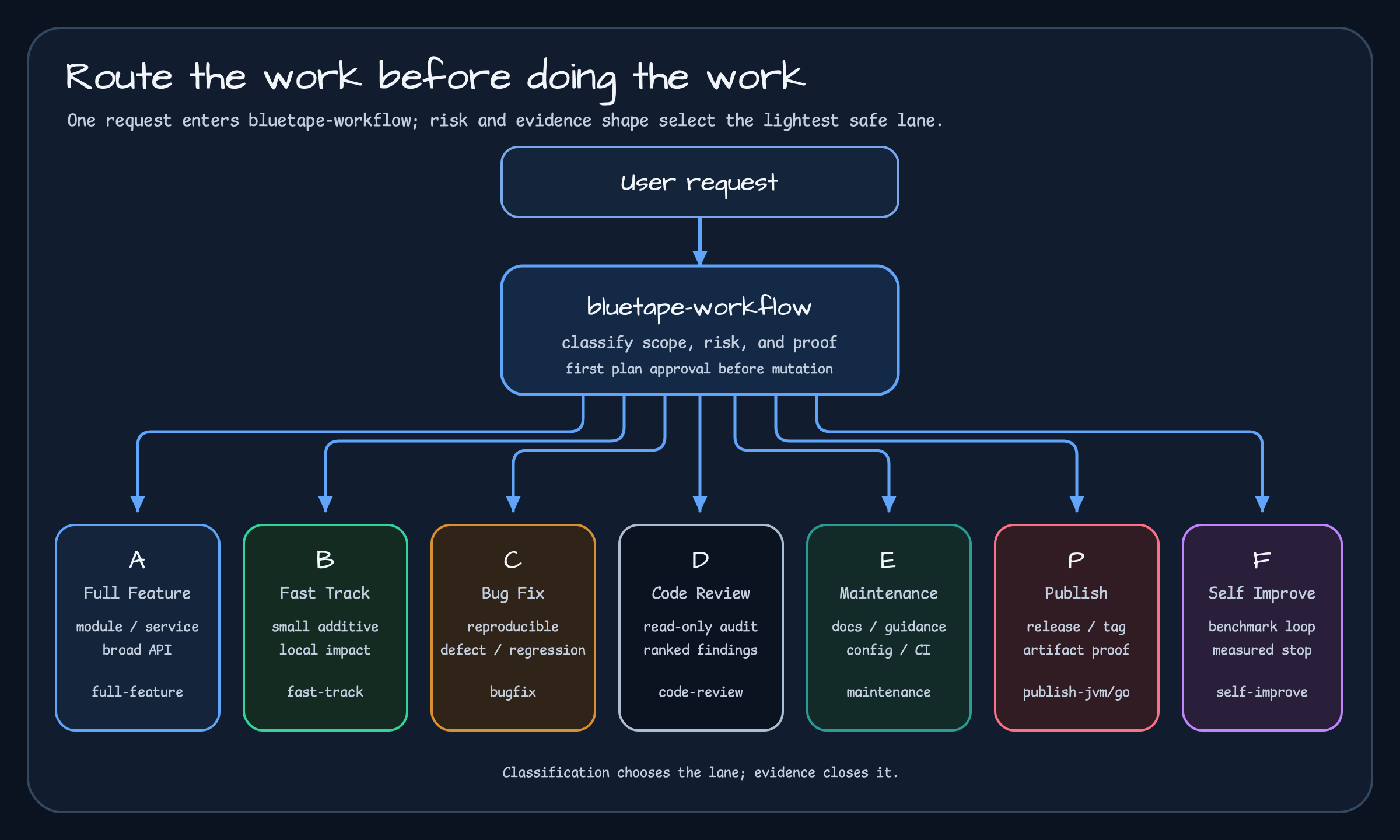
That request changes documentation rather than production behavior, so it routes to Type E Maintenance. A reproducible failure routes to Type C Bug Fix. A new module or broad API design routes to Type A Full Feature. Classification changes the plan, evidence, test scope, and the gates that must pass before a PR can open.
The First Step Is Classification, Not Implementation
Section titled “The First Step Is Classification, Not Implementation”An explicit user classification wins. Otherwise, bluetape-workflow chooses the lightest safe type.
| Type | Use it for | Execution skill |
|---|---|---|
| A · Full Feature | New modules, services, dependencies, broad public APIs, multi-layer changes | $bluetape-full-feature |
| B · Fast Track | Small features or extensions with bounded impact | $bluetape-fast-track |
| C · Bug Fix | Reproducible defects, regressions, wrong output, failing tests | $bluetape-bugfix |
| D · Code Review | Review, audit, or investigation without an implementation request | Code review plus a language pattern skill |
| E · Maintenance | README, KDoc, docs, AGENTS, skills, config, CI hygiene | $bluetape-maintenance |
| P · Publish | Snapshots, releases, BOM/catalog trains, tags, Maven Central | $bluetape-publish-jvm or $bluetape-publish-go |
| F · Self Improve | Benchmark loops with a baseline and stop condition | $bluetape-self-improve |
Calling a task small does not automatically make it Type B. A new dependency or module is Type A even when the diff is short. A review stays Type D unless the user also requests implementation. A bug fix mixed with an unrelated feature becomes two workflows. Risk and required evidence matter more than the label attached to the request.
Stay Read-Only Until the First Plan Is Approved
Section titled “Stay Read-Only Until the First Plan Is Approved”After classification, the agent does not edit files immediately. It presents a concrete plan first.
Work type: Type E - MaintenanceBasis: Only README examples and wording change; production behavior stays unchanged.
1. Action: Inspect the current README locales and actual API usage.   Expected DoD: Source and documentation identifiers match.2. Action: Update README.md and README.ko.md over the same scope.   Expected DoD: Both locales contain corresponding examples and links.3. Action: Run the diff check and documentation build.   Expected DoD: Changed routes and links render correctly.
Discovery remains read-only until this point. The agent may inspect AGENTS.md, skills, source,
status, issue and PR metadata, and prior lessons. It may not edit files, create durable plans,
commit, open a PR, dispatch a workflow, or merge before the first plan is approved.
This gate is not meant to reduce autonomy. Fast implementation under the wrong classification only increases the amount of work that must be undone. The user confirms scope and outputs once; the agent then owns the approved local edits and checks without asking again at every step.
Repeated Failures Clarified the Approval Boundary
Section titled “Repeated Failures Clarified the Approval Boundary”Earlier guidance scattered “work autonomously” and “get plan approval first” across different documents. Some tasks began editing without a plan. Others requested approval for every local change after the plan was already accepted.
The boundary is now explicit.
| Situation | Current behavior |
|---|---|
| Inspect status, source, skills, issue/PR metadata | Read-only discovery is allowed before approval |
| First concrete plan | Show Action and Expected DoD, then obtain approval |
| Approved local edits, tests, and verification | Continue without repeated permission handoffs |
| A new task that materially changes the scope | Present and approve the changed plan |
| Merge, tag, publish, release, destructive cleanup | Confirm that the approved external-action scope covers it |
The approval gate separates decisions the user must make from execution the agent should finish. It is not a checkpoint inserted after every command.
Every Checklist Row Has Three Parts
Section titled “Every Checklist Row Has Three Parts”After approval, the router instantiates its own checklist, the common gates, and the selected leaf skill checklist. Every executable row has the same shape.
- [ ] **CG-07 — Lock behavior and run targeted proof** - **Action:** Run the smallest tests and build checks that prove the changed contract. - **Evidence:** Record the command, result, and affected module or route. - **Failure:** Return to implementation instead of entering the next stage.Action names the work, Evidence names the proof, and Failure defines the recovery path. Together
they turn a checkbox into a gate rather than a reminder.
The status rules are strict.
[ ]means unproved and blocks dependent work.UNKNOWN, stale output, and an agent’s unsupported completion claim are failures.SKIPPEDdoes not exist.N/Aneeds concrete evidence of why the row does not apply.- A later success never proves an earlier missing gate.
A passing site build does not prove plan approval or locale parity. For a README-only change, Kotlin
compiler diagnostics may be N/A, but the task should still show evidence such as “zero .kt files
changed.”
These rules also came from real misses: checking optional rows without proof, closing rows as N/A
without examining scope, and marking checkboxes before reading command output. The contract therefore
adds several constraints.
- Create the checklist before editing files.
- Classify each row as required, conditional, or
N/Abefore execution. - Record evidence immediately after reading it.
- Leave failed rows unchecked and block dependent work.
- If order was violated, repair the missing row and rerun affected downstream validation.
- Before completion, reconcile
Required checks: X/Y; N/A: N; Blocked: Nwith the actual rows.
Evidence reconstructed later is recorded as a repair, not normal execution. Every downstream check that depended on the missing gate must be refreshed.
The Router Opens Six Gates in Order
Section titled “The Router Opens Six Gates in Order”The core flow is concise.
WF-01 Classify -> WF-02 Write the first concrete plan -> WF-03 Obtain first-plan approval -> WF-04 Load execution contracts -> WF-05 Execute gates in dependency order -> WF-06 Repair skipped or weak gatesWF-04 does not load every skill. Type E loads $bluetape-maintenance, the common gates, and only
the references the current task triggers. Kotlin work adds $bluetape-kotlin-patterns, Go adds
$bluetape-go-patterns, and article work adds $bluetape-writer. Context stays small, but every
selected instruction file is read completely.
WF-05 preserves dependency order. Editing code before a test is not automatically a workflow
failure. Skipping reproduction and regression coverage in a bug fix is. In that case, WF-06
repairs the missing gate and refreshes every affected check.
WF-06 exists to stop the inertia of “we have already come this far.” When a miss is found,
downstream work pauses. The missing Action and DoD are reconstructed, fresh PASS evidence is
collected, and only then does execution resume.
Common Gates Protect the Work Before and After the Leaf Skill
Section titled “Common Gates Protect the Work Before and After the Leaf Skill”Leaf skills own type-specific execution. The 18 common gates own repository-wide safety.
| Range | What it checks |
|---|---|
| CG-01–03 | Applicable authority, historical and current evidence, user work, and worktree boundaries |
| CG-04–06 | Policy, audience, and language boundaries; ecosystem reuse; public-contract documentation |
| CG-07–10 | Targeted proof, serialized heavyweight tests, lesson evaluation, and pre-PR convergence |
| CG-11–14 | PR authority, exact branch publication, live PR verification, CI, and review feedback |
| CG-15–18 | Merge-ready reporting, fresh merge approval, verified merge, local synchronization, and cleanup |
Not every task runs every operation. Blog work makes public API KDoc and Testcontainers N/A, while
locale parity, site build, PR body, and post-merge sync remain required. User-scope skill changes
also activate the separate chezmoi persistence gate: editing a live file alone cannot pass. The
workflow must update the chezmoi source, apply it, prove parity, self-audit, commit, and push.
The common gates absorbed recurring closeout failures too: creating issues and PRs without checking
assignee, milestone, or labels; merging after green CI without rereading new review comments; and
leaving local develop behind after a remote merge. Each is now a separate proof. A PR body is read
from GitHub directly, and its final ## heading must be ## DoD Status.
The Decisions Before Coding Matter More Than Coding
Section titled “The Decisions Before Coding Matter More Than Coding”In my experience, the Superpowers brainstorming, spec, and plan stages matter much more than writing the code. Coding transfers a chosen direction into files and tests. If the goal, boundary, API contract, or failure mode is wrong, fast clean code merely completes the wrong implementation sooner. When the earlier stages are precise, implementation becomes a series of small verifiable steps.
Type A therefore does not begin with the editor.
| Stage | What it fixes before coding | What goes wrong without it |
|---|---|---|
| Brainstorming | User problem, scope and exclusions, 2–3 approaches, selection rationale, architecture, failure handling | The first idea is mistaken for the requirement, producing unnecessary features or wrong boundaries |
| Design Spec | Approved behavior and API contract, alternatives and rejection reasons, compatibility, failure modes, acceptance criteria, DoD | Implementers interpret the request differently and tests have no stable contract to prove |
| Implementation Plan | Spec-to-task mapping, dependency order, exact files, TDD steps, validation commands, docs, rollback, hazards | Design restarts during implementation and tests, README, CI, Nightly, or BOM registration is missed |
| Coding | Failing tests and minimal implementation following the approved spec and plan | Weak earlier decisions turn the code itself into an implicit design document |
Brainstorming is not a meeting for producing the largest number of ideas. It compares viable approaches, removes scope with YAGNI, and obtains a design decision. The design spec turns that decision into a contract that implementation and tests can read consistently.
The plan is not a short task list either. It maps every acceptance criterion to files, tests, and commands. It corrects dependencies between tasks and makes follow-up surfaces explicit: README locales and KDoc for public behavior, or CI, Nightly, coverage, and BOM registration for a new module.
This preparation does not necessarily reduce the amount of code. It reduces code written in the wrong direction, architecture debates discovered during review, and missing operational contracts found only after the PR opens. Speed is the time from an approved requirement to a verified result, not raw code-generation throughput.
Artifacts do not become safe merely by existing. Brainstorming, specs, and plans need independent perspectives. Authors already know their intended context and unconsciously fill in missing assumptions. Multi-perspective review removes that invisible help and tests performance, stability, security, operations, API, and caller concerns explicitly.
2-R, 3-R, and 6-R Run 7-Tier Review Until P0/P1=0
Section titled “2-R, 3-R, and 6-R Run 7-Tier Review Until P0/P1=0”The most important Full Feature review gates are 2-R, 3-R, and 6-R. They review different
artifacts, but they use the same 7-Tier engine and convergence rule. Running a review once is not
enough. Revision and re-review continue until the latest integrated result reaches P0=0 and
P1=0.
| Gate | Artifact | Condition that opens the next stage |
|---|---|---|
2-R · Spec Review | Approved design spec, research evidence, boundaries, failure modes, compatibility, acceptance criteria | Latest integrated design review has P0=0, P1=0 |
3-R · Plan Review | Spec-to-task mapping, dependency order, tests, docs, rollback, repository hazards | Latest integrated plan review has P0=0, P1=0 |
6-R · Pre-PR Review | Current branch diff, tests and diagnostics, docs, module changes, PR evidence | Latest integrated diff review has P0=0, P1=0 |
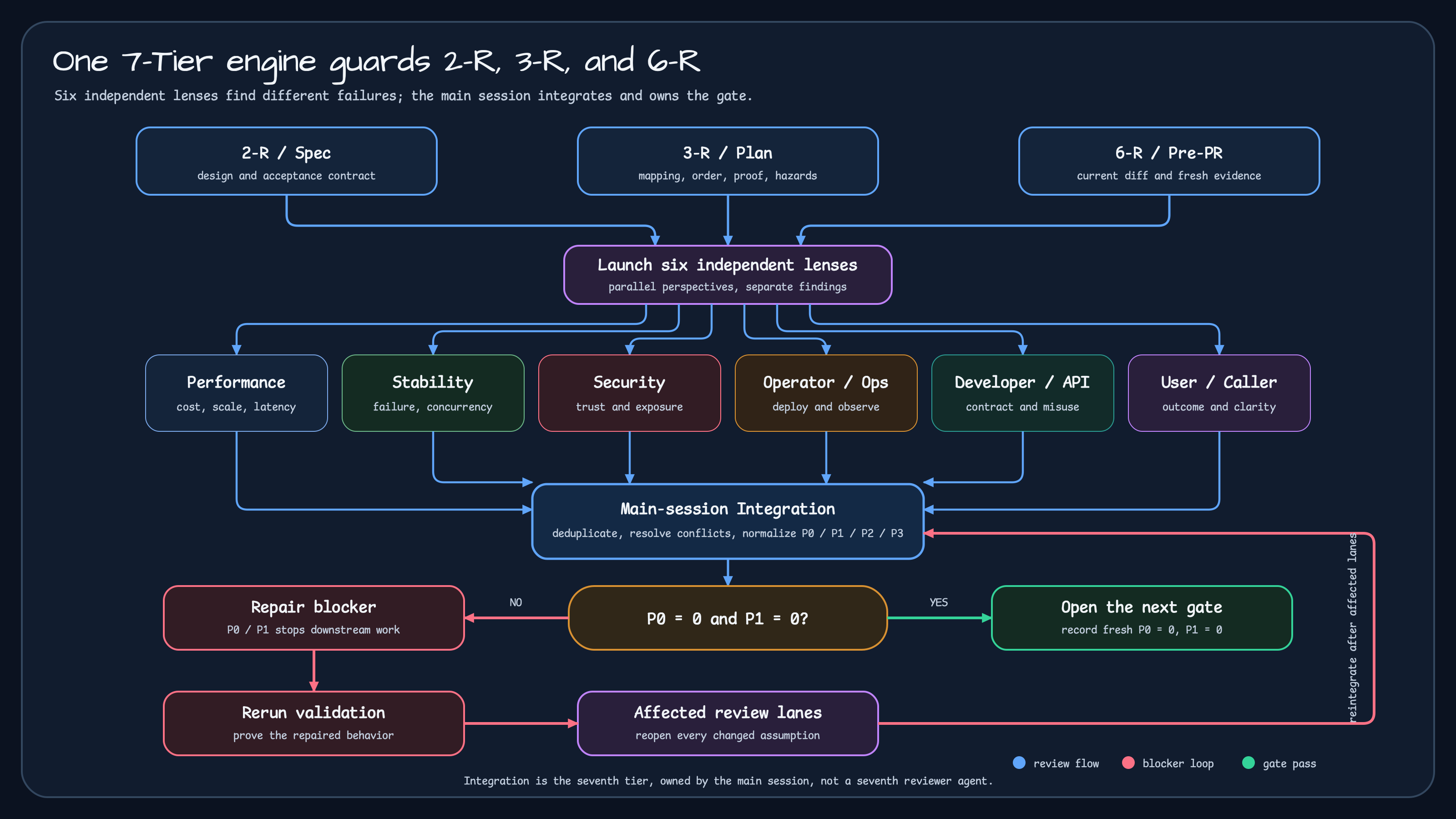
Seven tiers do not mean seven copies of the same code review. Six independent perspectives cover
Performance, Stability, Security, Operator/Ops, Developer/API, and User/Caller. The main session is
the seventh tier: it integrates the findings, removes duplicates, resolves conflicts, normalizes
severity to P0/P1/P2/P3, and makes the gate decision.
The red loop in the diagram is the convergence rule. Fix blockers, rerun affected validation, reopen every review perspective whose assumptions changed, and integrate again. The gate asks whether the latest artifact is blocker-free, not whether a review once ran.
P0/P1 findings are immediate blockers, not TODOs. A blocker at 2-R stops the plan, one at 3-R
stops implementation, and one at 6-R stops the PR. After a fix, rerun the affected perspectives
rather than mechanically repeating every review. If a fix changes several assumptions, reopen all
related perspectives.
P2/P3 findings are not silently discarded. Fix them in scope, record why they are deferred, or
create a follow-up issue. The absolute gate condition remains P0=0, P1=0 in the latest review.
An older zero-blocker result or later green CI does not prove the current artifact is clean.
Each Execution Lane Handles Failure Differently
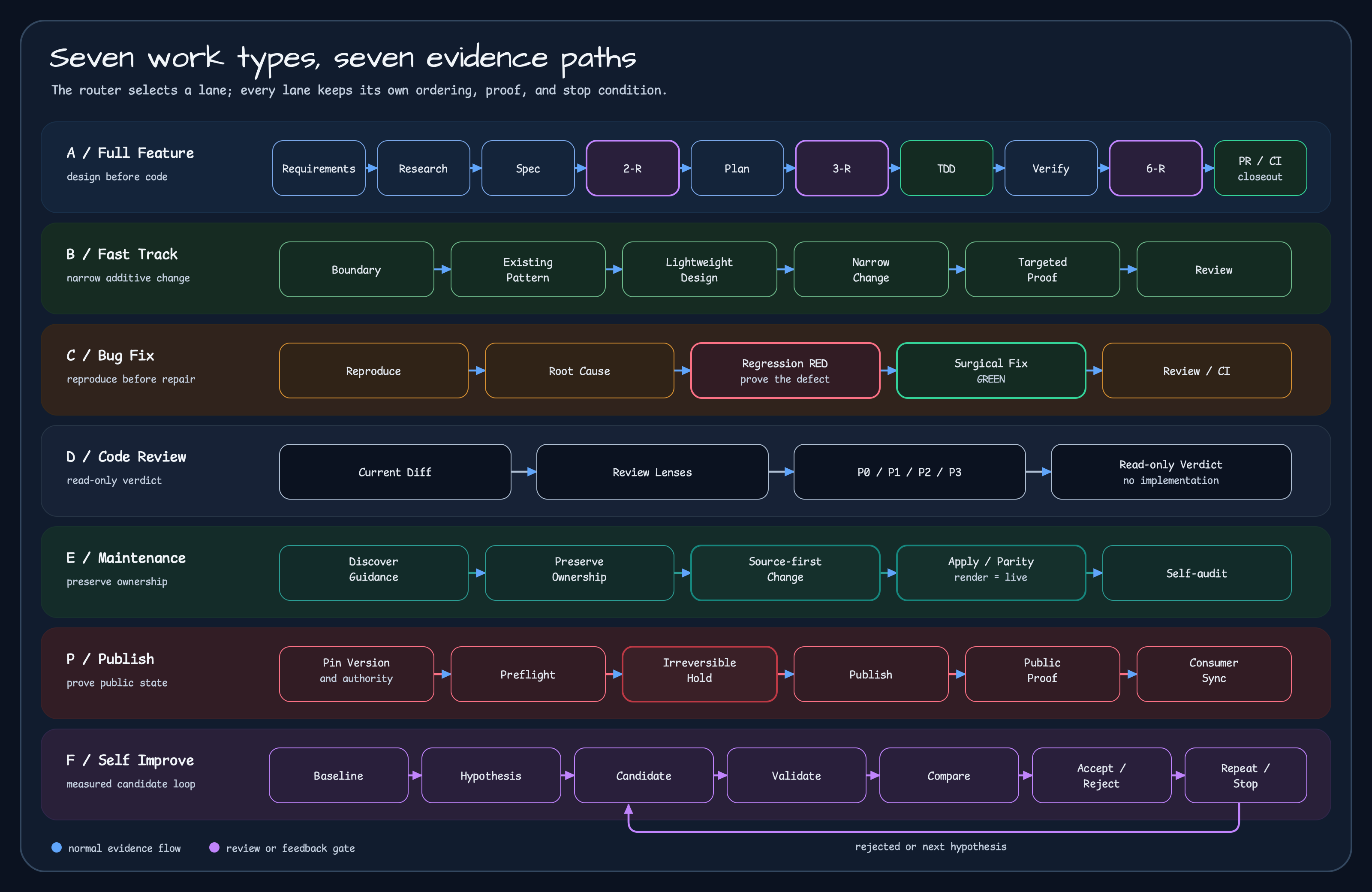
Section titled “Each Execution Lane Handles Failure Differently”Classification selects more than a name. Each lane has its own sequence, evidence, and return point.
Bug Fix
Section titled “Bug Fix”Type C begins by reproducing the defect. It identifies root cause, creates a regression test that fails when the bug returns, and applies the smallest fix. If reproduction fails, it does not edit files based on speculation.
Fast Track
Section titled “Fast Track”Type B proves that impact is bounded and relies on targeted tests. A small feature does not exempt documentation or public API checks, and any remaining P0/P1 finding blocks progression.
Full Feature
Section titled “Full Feature”Type A runs through spec, plan, advisor review, implementation, verification, and code review. A new
module also checks settings.gradle.kts, README locales, repository module lists, CI, Nightly,
coverage, and BOM/catalog registration. In particular, 2-R, 3-R, and 6-R independently review
the spec, plan, and current diff until each reaches P0/P1=0.
Maintenance
Section titled “Maintenance”Type E preserves production behavior while changing README, articles, AGENTS, skills, or config. User-scope Codex guidance starts from managed source, not the live target that the next chezmoi apply could overwrite.
Publish and Self Improve
Section titled “Publish and Self Improve”Type P pins the target version, latest external version, authority, consumer scope, and dispatch hold. Even with plan approval, irreversible actions such as tags, stable publication, and release creation need explicit authority.
Type F requires an objective, primary metric, benchmark command, fresh baseline, threshold, and stop condition. It tests one hypothesis at a time and integrates only a candidate that passes tests, sealed-file validation, and the benchmark acceptance rule.
Progress Reports Should Be DoD-Centered
Section titled “Progress Reports Should Be DoD-Centered”During execution, a concise gate report is more useful than “still working.”
Type E · BLOG-04 PASSAction: Completed the Korean primary route.Evidence: Verified the /ko/blog/... route and source links.Next: Naturalness review and site build.The final report reconciles every applicable row.
Required checks: 18/18N/A: 4Blocked: 0P0/P1: 0For a PR, the workflow rereads assignee, milestone, labels, CI, and review threads from GitHub. The
body’s final ## heading must be ## DoD Status. If merge was approved, the work ends only after
the real local checkout matches its upstream branch.
How Much Did This Improve the Actual Work?
Section titled “How Much Did This Improve the Actual Work?”There was a long period of friction. Agents skipped parts of longer guidance, marked checklist rows without evidence, and lost improvements when live configuration drifted from managed source. As those failures became workflow gates, the practical result changed noticeably.
My subjective satisfaction reached about 90% with gpt-5.5 at high reasoning and about 98% with
the current gpt-5.6-sol at high. These are not benchmark-suite success rates. They summarize my
experience reviewing real Bluetape work, and they do not isolate model improvement from skill
improvement.
The largest gain was not the prose quality of the first answer. It was continuity: approved work
continued without unnecessary stops, every stage produced evidence, and a failed gate was less
often hidden by later success. In Full Feature work, the 7-Tier loops at 2-R, 3-R, and 6-R
substantially reduced drift between design, plan, and implementation. A better model follows a skill
more reliably; a better skill helps that model produce consistent repository-specific results.
What to Remember When Using It
Section titled “What to Remember When Using It”Start the request with $bluetape-workflow. Review the router’s classification and first plan. After
approval, look beyond descriptions and confirm that Evidence contains real commands, files, URLs,
tests, and results.
$bluetape-workflow
Reproduce this failure, fix the root cause, and prove it with a regression test.
$bluetape-workflow
Add this module and include README locales, CI, Nightly, and BOM registration.$bluetape-workflow
Review this PR without editing it, prioritizing P0/P1 findings.Using the workflow does not mean running the longest process every time. It means classifying the work accurately, opening only the required procedure, and never crossing an open gate without evidence. Small documentation work stays light. Releases and new modules receive the rigor their risk demands.
Series
Section titled “Series”- Start here: Turning AI Collaboration Into Infrastructure
- Bluetape Skills Part 1: Sharing and Installing the Toolkit
- Bluetape Skills Part 2: Starting Work with bluetape-workflow
- Bluetape Skills Part 3: Recovering and Resuming Interrupted Workflows
Comments
Leave a note or reaction with your GitHub account.