
[Operations 6] Why Notifications and Reminders Are Separate Services
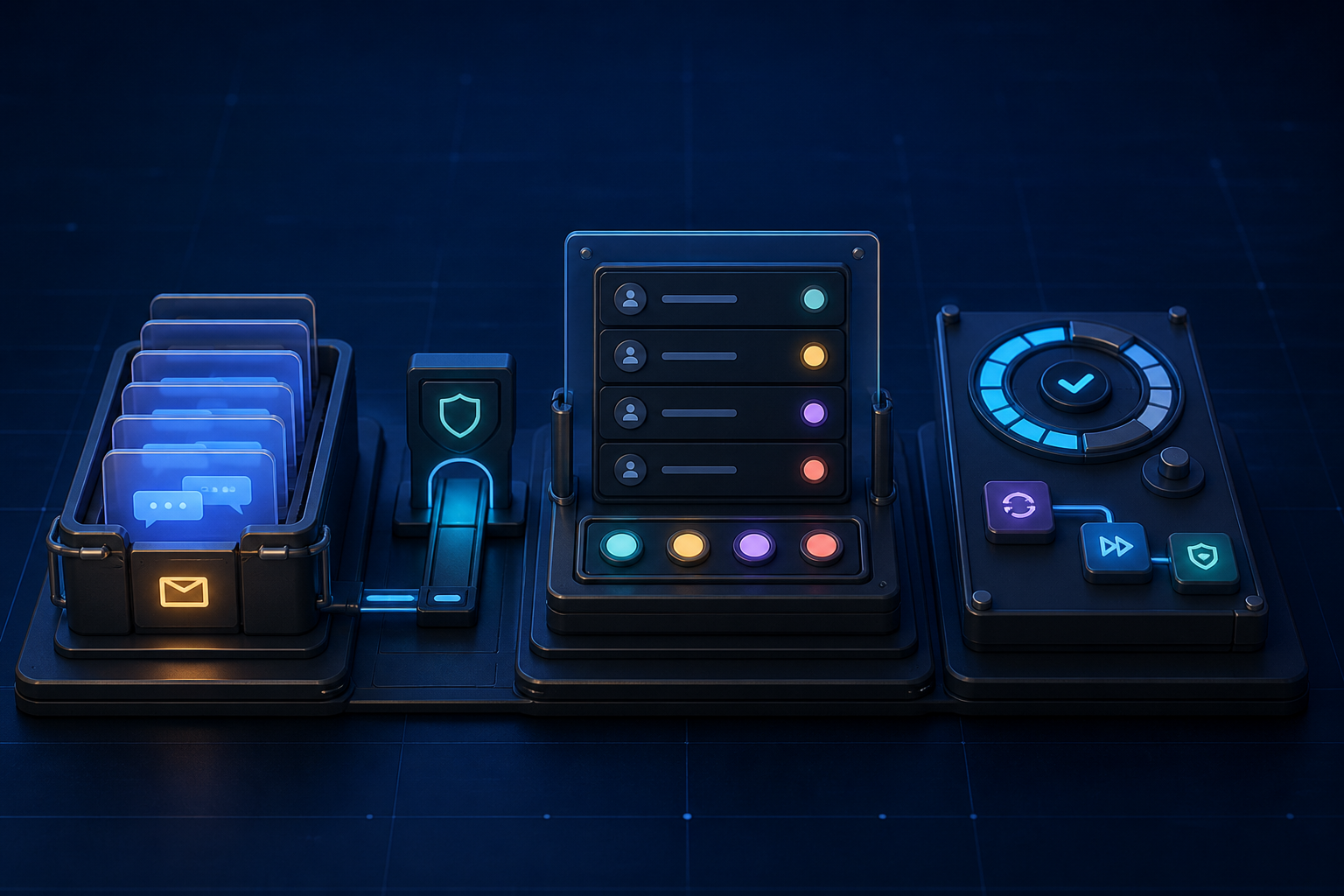
An appointment becoming CONFIRMED does not mean that a patient received a notification. Likewise, a temporary provider
failure must not cancel the appointment or make the appointment service save it again. Appointment confirmation is a fact owned
by the appointment service; notification delivery is an execution result owned by the notification service.
The conclusion is simple:
The appointment transaction durably records only the intent to send. The notification service reads the member profile at send time and decides between
SENT,SUPPRESSED,RETRY_WAIT, andEXHAUSTED. If a reminder is missing, recovery materializes the outbox with the same idempotency key instead of rewriting the appointment confirmation.
The screen and diagram in this article are synthetic design mockups, not captures containing real patients or production metrics. The article keeps the current implementation, approved design, and operations mockup separate.
Appointment confirmation and notification delivery are different successes
Section titled “Appointment confirmation and notification delivery are different successes”Calling the provider inside the appointment confirmation request creates an obvious latency problem. The more serious problem is that it makes a provider result look like part of the appointment transaction.
| Fact | Owning boundary | What does not change when it fails | What to check next |
|---|---|---|---|
| Appointment confirmed | Appointment service | Appointment state and history | Whether the notification intent was committed to the outbox |
| Notification intent recorded | Outbox in the appointment transaction | The appointment confirmation | Whether a worker can process it |
| Notification sent | Notification service and provider channel | Appointment state and product contract | Provider result and stable reason code |
| Reminder missing | Reminder recovery scanner | Existing appointment and notification idempotency key | Whether it is early, recoverable, or already present |
For example, the provider can fail immediately after a successful appointment confirmation. Reverting the appointment makes the patient believe that the booking disappeared; recording only a success leaves STAFF unable to tell whether delivery happened. By storing the two results separately, the appointment remains confirmed while the notification moves to retry or an operational action queue.
The appointment transaction records a minimal notification intent
Section titled “The appointment transaction records a minimal notification intent”The appointment command commits the appointment change and a minimal notification outbox row in one transaction. The row contains only what is needed to re-evaluate delivery: member and appointment references, notification type, template key and version, reminder slot, and a deterministic idempotency key. It does not contain rendered text or a provider payload.
The boundary works as follows:
- The appointment service validates the
CONFIRMEDtransition. - The same transaction records the notification intent and idempotency key in the outbox.
- After commit, a separate worker finds deliverable outbox rows.
- The worker conditionally claims one row with a database lease and fencing token.
- Only the claiming worker resolves the member profile, renders the template, and calls the provider.
If the application restarts immediately after commit, the appointment is already confirmed and the notification intent can still be processed. A provider call inside the appointment transaction would instead put network latency, timeouts, and retries inside the command’s atomicity boundary.
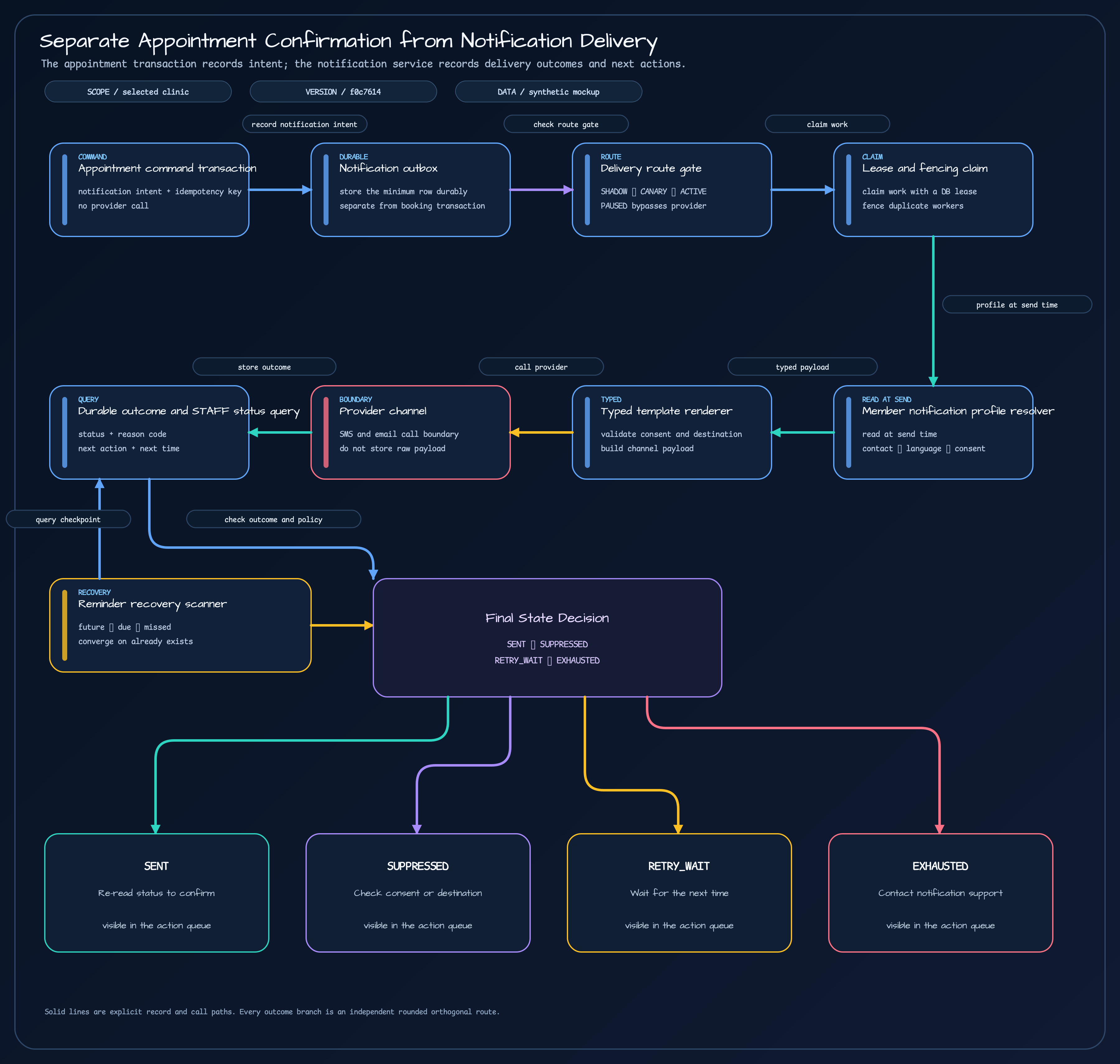
The diagram’s DURABLE card is the outbox boundary left by the appointment transaction. CLAIM is the database claim that keeps
multiple workers from processing the same row concurrently. READ AT SEND means that contact details, language, and consent are
read immediately before delivery instead of being copied and reused from an older snapshot. The RECOVERY card is a separate
materialization repair flow; it does not call the provider itself.
Contact details and consent are read at send time
Section titled “Contact details and consent are read at send time”The member management system (CRM) is the system of record for phone numbers, email addresses, language, and notification consent. Persisting those values in the notification outbox would allow a stale destination to be used or a withdrawn consent to be ignored.
The notification service stores a member reference and typed template parameters, then calls MemberNotificationProfileResolver
immediately before delivery.
| Send-time check | Result | Safe value shown to STAFF |
|---|---|---|
| Consent has been withdrawn | SUPPRESSED(CONSENT_DENIED) | CONSENT_DENIED, check member settings |
| No destination exists | SUPPRESSED(DESTINATION_UNAVAILABLE) | DESTINATION_UNAVAILABLE, check member contact |
| Member scope does not match | Suppressed or held for review | Stable scope error code |
| Profile lookup temporarily fails | Bounded retry | Retry state and next time |
The store and operations response do not contain names, phone numbers, email addresses, rendered subject or body, provider error text, or stack traces. STAFF needs a reason and an action, not a copy of the sensitive payload. A patient-facing response exposes an even smaller closed set of statuses and does not leak internal suppression or exhaustion reasons.
Lease and fencing are a contract that reduces duplicate delivery
Section titled “Lease and fencing are a contract that reduces duplicate delivery”A worker does not call the provider merely because it found an outbox row. It first conditionally acquires a lease and receives a fencing token. That token is required when recording success, suppression, or retry. Once a lease has expired, the old worker must no longer be able to update the row.
The system cannot promise that a provider network call happened exactly once. If a response is lost and the worker retries, the provider may already have processed the first request. The practical contract is instead:
- use a deterministic provider idempotency key for the same logical notification;
- bound provider calls per lease, total attempts, and total elapsed time; and
- validate the fencing token before storing a result so a stale worker cannot win.
Retryable failures become RETRY_WAIT. When the attempt or elapsed-time budget is exhausted, the row becomes
EXHAUSTED. Coroutine cancellation is propagated rather than converted into a provider retry. Raw provider failures stay
out of storage and logs; only stable low-cardinality failure codes and safe fingerprints remain.
The STAFF screen should show the next action, not only a status
Section titled “The STAFF screen should show the next action, not only a status”The first question on a notification operations screen is not “How many notifications are there today?” It is:
- How many can STAFF act on now?
- How many are waiting until their next retry time?
- How many were suppressed because of consent or destination data?
- How many have exhausted automatic retries and need an owner?
- Which reminder candidates are early, enqueued, late and suppressed, or already present?
The following mockup answers those questions with separate metric cards, an action queue, a safe detail panel for the selected item, and reminder recovery outcomes.
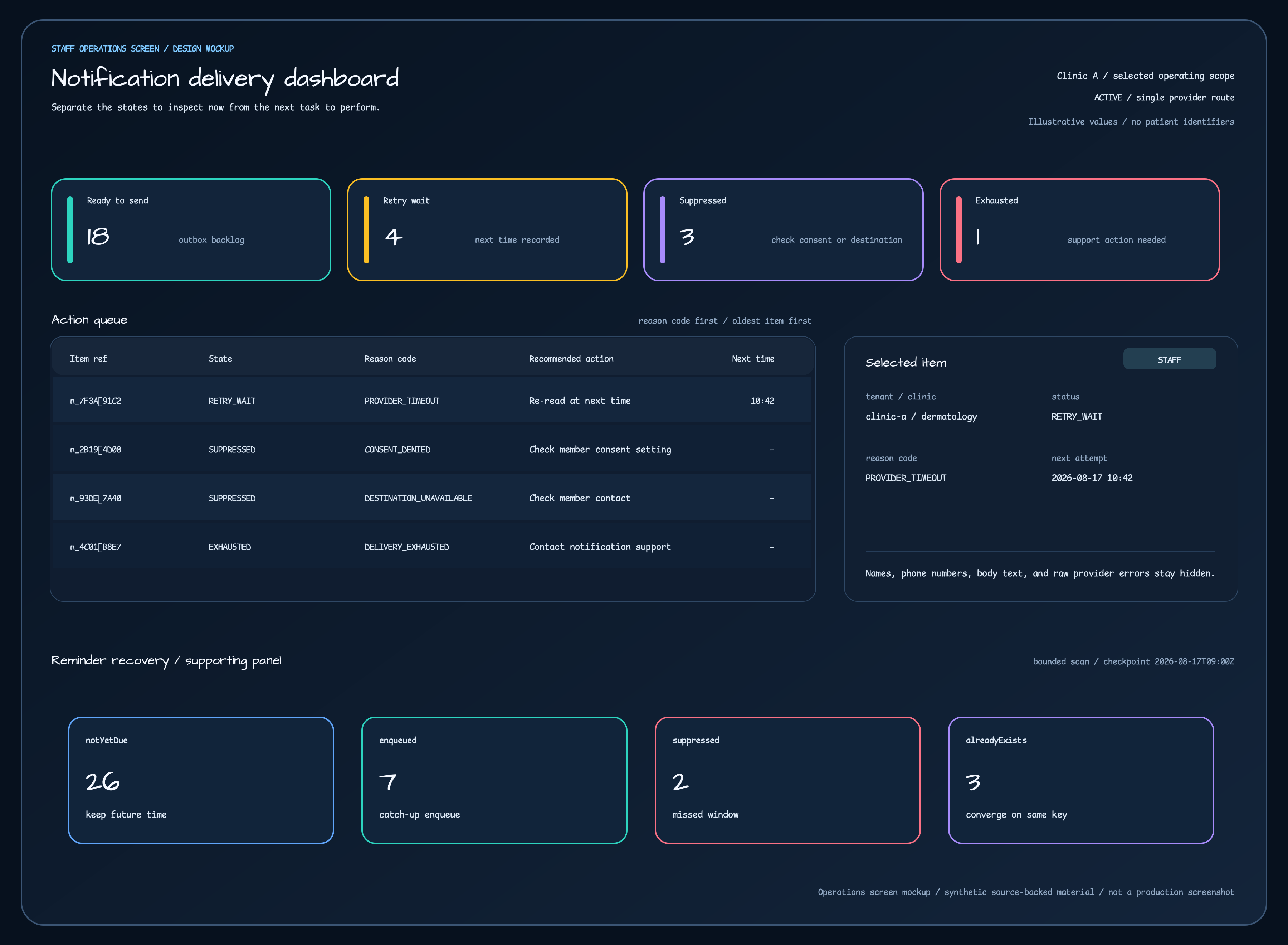
Synthetic design mockup. It shows no names, destinations, message bodies, or raw provider errors; values and identifiers are illustrative. The operations screen should provide clear information, not merely more information.
Each action-queue row includes a reason code and a recommended action instead of listing a status alone.
| Status or reason code | Recommended action on screen | What the system does not do automatically |
|---|---|---|
CONSENT_DENIED | Check member settings | Change consent or send again without a new decision |
DESTINATION_UNAVAILABLE | Check member contact | Copy an old destination into the outbox |
REMINDER_WINDOW_MISSED | Contact the patient directly | Send a late reminder automatically |
RETRY_WAIT | Wait until the next time | Make STAFF repeat the provider call |
EXHAUSTED | Contact notification support | Revive a terminal row without a new decision |
NotificationStatusQueryService restricts the STAFF response to closed fields: status, reason code, retry or exhaustion time,
and recommended action. It does not return outbox IDs, attempt IDs, member IDs, appointment IDs, or provider payloads. The query
also verifies tenantGroupId, clinicId, and appointmentId together so one clinic’s queue cannot be mixed with another’s.
Reminder recovery separates future, due, and missed work
Section titled “Reminder recovery separates future, due, and missed work”Day-before and same-day reminders are normally written to the outbox when an appointment is confirmed. A deployment, database outage, stopped worker, or reminder configuration change can still leave a slot unmaterialized. The recovery scanner does not create new notifications for every appointment; it reads confirmed appointments in bounded pages and materializes only the missing slots with their original idempotency keys.
Each candidate is compared with dueAt, the current time, and catch-up-window:
| Result | Meaning | Outbox behavior | What STAFF sees |
|---|---|---|---|
notYetDue | The send time has not arrived | Pre-record a future availableAt, or defer to the next scan | Nothing to act on yet |
enqueued | It is due and recoverable | Enqueue with the existing key | Waiting for the worker |
suppressed | It was discovered after the catch-up window | Record SUPPRESSED(REMINDER_WINDOW_MISSED) | Contact the patient directly |
alreadyExists | Another path recorded it first | Do not create a second row | Re-read the existing state |
Treating notYetDue as an error is dangerous. A long backlog scan could see a future slot, create nothing, and then miss the next
scan boundary. An adapter that supports a future availableAt records it now; otherwise the next bounded scan evaluates the same
key again.
The recovery run is limited by batch-size and a maximum candidate count. It stores a keyset cursor, runId, and the last
completed appointment ID in a durable checkpoint. A restart or leader change therefore continues from a bounded position instead
of rescanning the entire appointment table. If multiple instances see the same candidate, the outbox unique key and conditional
store operation converge on alreadyExists.
Change the delivery route only within the selected operational scope
Section titled “Change the delivery route only within the selected operational scope”Deploying the outbox worker does not mean that every clinic should switch provider routes immediately. NotificationDeliveryRouteGate
turns the selected clinic scope and rollout mode into one route decision.
| Mode | Transitional event route | Outbox worker route | Operational intent |
|---|---|---|---|
SHADOW | All clinics | No delivery | Validate the new lifecycle while the existing route owns provider calls |
CANARY | Clinics outside the allow-list | Allow-listed clinics only | Validate the worker in a selected scope |
ACTIVE | Disabled | All clinics | Complete the transition |
PAUSED | Disabled | Disabled | Stop provider calls during an incident while enqueue, recovery, and retention continue |
CANARY uses positive tenant-group-id and clinic-id pairs. If the deprecated clinic-only bridge is configured for rolling
compatibility, the clinic sets must match. Route changes are an operational action separate from code deployment, and both routes
must conditionally claim the same outbox row before calling the provider so a rolling deployment cannot send twice concurrently.
Keep implementation, approved design, and operations mockup separate
Section titled “Keep implementation, approved design, and operations mockup separate”| Boundary | What this article covers |
|---|---|
| Current implementation | Minimal outbox in the appointment transaction, lease and fencing claims, send-time profile lookup, typed template rendering, stable result codes, STAFF status query, bounded reminder recovery, and checkpoints |
| Approved design | Storage boundaries for provider payload and personal data, outbox unique key and fencing contract, rollout modes, catch-up window, and state-based retention |
| Operations mockup | Four state metrics, reason-code action queue, anonymized selected item, and reminder recovery results. It does not represent real patient or clinic metrics |
| Follow-up scope | Production provider adapter dashboards, clinic-specific notification policy editing, patient-message approval, and large SaaS leader optimization |
Do not expand SENT into “the patient read the message.” It means that the notification service and provider contract accepted the
delivery result; it does not mean read confirmation or a clinical outcome. Similarly, SUPPRESSED means that this notification was
not sent; it does not cancel the appointment.
Five checks before STAFF closes one item
Section titled “Five checks before STAFF closes one item”Before closing a row in the notification action queue, STAFF checks:
- Are the appointment confirmation and notification intent both recorded?
- Were current member consent and contact details read at send time?
- Was the next action selected according to the status and reason code?
- For a reminder, was it classified as early, recoverable, already present, or too late to send?
- Were the original appointment state and outbox idempotency key left untouched?
When these five facts are visible, STAFF can answer “the appointment is confirmed, but how far did notification delivery get?” The starting point for operational growth is to separate the facts owned by each service and show STAFF the next action, rather than making the appointment service own the provider as well.
Sources
Section titled “Sources”The following links are pinned to clinic-appointment develop commit f0c7614beed766efc4b88a1a59aa5c370f8fccf7.
- Operations 5: Attendance and Treatment Completion Are Different Facts
- Notification outbox requirements
- Notification outbox design
- Notification outbox operations runbook
- AppointmentOutboxWriter.kt
- NotificationOutboxEvents.kt
- NotificationOutboxWorker.kt
- NotificationStatusQueryService.kt
- NotificationReminderRecoveryScanner.kt
- NotificationDeliveryRouteGate.kt
- AppointmentReminderScheduler.kt
- NotificationSchedulingRunners.kt
Comments
Leave a note or reaction with your GitHub account.