
[Design 2] What Visit Commitment Does an Event Product Create?

It is tempting to describe an event product as “a product for one visit.” The reservation service has a harder job: it must reproduce which care obligation and which visit promise the purchase can create without turning the purchase into a calendar slot.
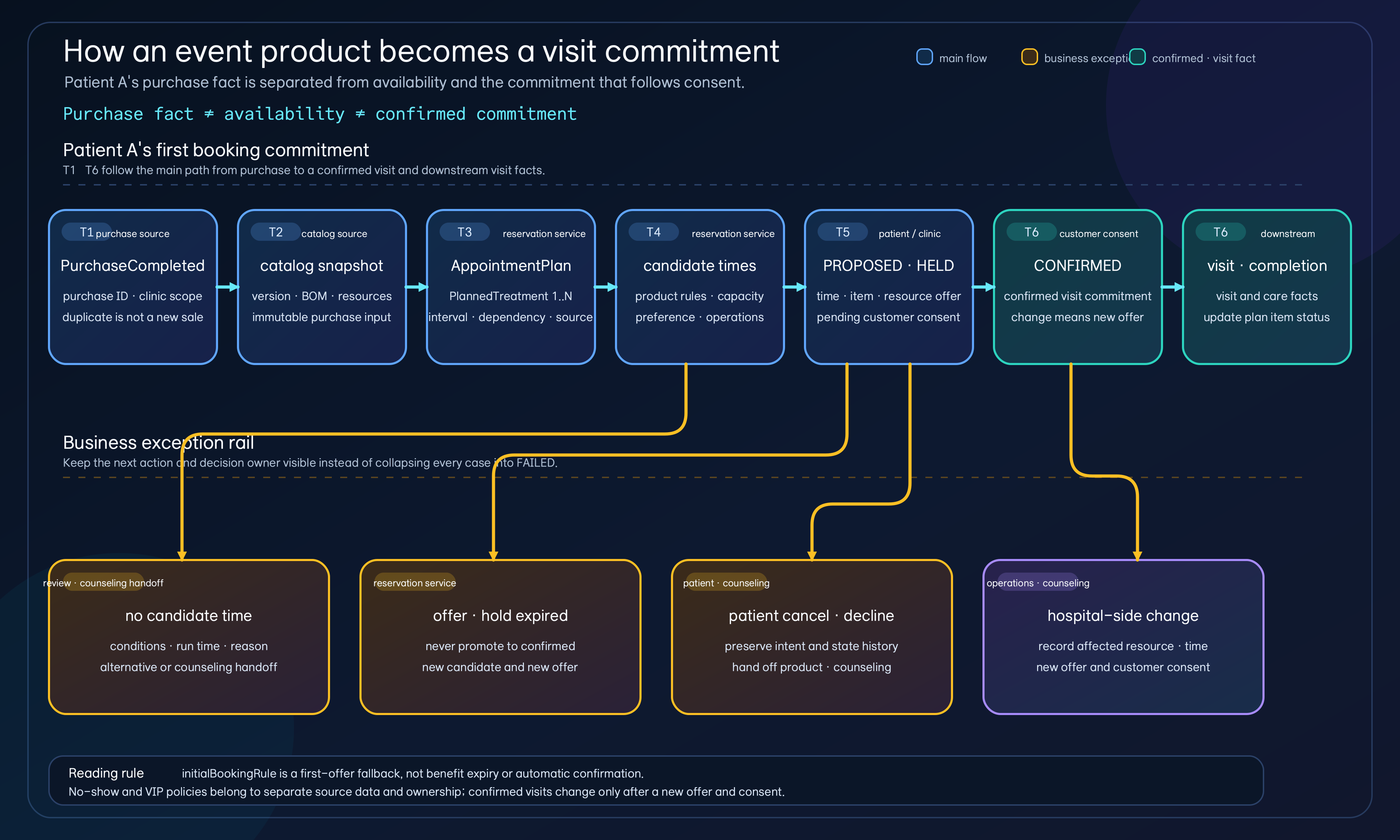
Suppose Patient A buys an event product. The payment does not automatically confirm a doctor and a time on the clinic calendar. The service first checks the catalog source and purchase source, calculates eligible availability, and creates a confirmed visit only after the customer consents to a proposal.
Purchase fact ≠ availability conditions ≠ confirmed commitment
This article follows the first booking commitment for an event product on Patient A’s timeline. N-visit and package products appear only as comparisons that show why the boundary matters. Full repeated-visit calculation, package migration, no-show penalties, and VIP priority remain separate product and operating policy work.
Why is an event product not a visit commitment yet?
Section titled “Why is an event product not a visit commitment yet?”Patient A may make three kinds of purchases in sequence.
| Time | Patient A action or event | Product and purchase meaning | What the reservation service preserves first |
|---|---|---|---|
| T1 | Buys an event product | A one-use product contract | Purchase ID and purchase-time product version |
| T2 | Adds an N-visit product | An obligation fulfilled across several visits | Per-visit PlannedTreatment and repeat interval |
| T3 | Buys a package of treatment items | An execution BOM with item, dependency, and resource requirements | Per-item version source and dependency |
| T4 | Requests a date, or provides no preference | Customer scheduling input | Immutable BookingPreferenceSnapshot |
| T5 | Consents to a candidate time | A commitment for a specific time, item, and resource | CONFIRMED state and policy snapshot |
| T6 | Arrives and receives care | Visit facts connect to clinical facts | Visit/completion event and unfinished item state |
The important boundary is that the three purchases do not become one Appointment row. One use of an event product,
the third visit in an N-visit product, and one package item have different remaining obligations and dependency rules.
Items from several purchases may be handled in the same visit, but the agreed AppointmentItem and each purchase’s
AppointmentPlan remain separately traceable.
A purchase is the commercial fact about what the patient contracted to use. An AppointmentPlan is the reservation
service’s interpretation of that contract as executable obligations. A confirmed visit is an agreement to fulfill
specific items with specific time and resources. Treating all three as one record lets a product or schedule change
silently rewrite a past promise.
The minimum catalog contract entering the reservation service
Section titled “The minimum catalog contract entering the reservation service”The reservation service must not read a product name and guess that it means “a 30-minute appointment.” The product management service publishes versioned source-of-record data, and the reservation service keeps the definition as an immutable purchase-time input.
The current ProductCatalogDefinition carries scheduling interpretation data such as:
| Source data | Meaning for the reservation service |
|---|---|
catalogVersion and schemaVersion | Which product contract and decoder were interpreted |
repeatCount on items | How many PlannedTreatment records can be created |
durationMinutes | Expected resource occupancy per visit |
minimumIntervalDays, preferredIntervalDays, maximumIntervalDays | Hard and soft intervals between repeated visits |
| Practitioner, equipment, and room types | Skills and resources needed for a candidate time |
dependencies | Which later item waits for a predecessor |
initialBookingRule | A limited fallback for the first proposal when no customer preference exists |
Product names and prices cannot replace this contract. sourceAuthority identifies the source of record that
published the catalog data, while catalogVersion identifies the immutable revision published by that source. This
is source ownership for interpretation, not an authentication or authorization field.
The purchase event also needs a purchase source and purchase ID. When the source’s PurchaseCompletedEvent arrives,
the reservation service checks the tenant, clinic, purchase source, and purchase ID scope before creating a plan. It
uses the catalog snapshot only when the purchase has not already been planned; receiving the same event again is not
evidence of a new purchase.
From a purchase fact to an AppointmentPlan
Section titled “From a purchase fact to an AppointmentPlan”In the current implementation, one purchase expands to one AppointmentPlan. The plan retains the following source
history:
sourcePurchaseAuthorityandsourcePurchaseId: the source of record and original purchase identifier for the purchase factcatalogSourceAuthority,productId, andcatalogVersion: which catalog definition was usedcatalogPayloadHash: ahashfor checking whether replay uses the same catalogsnapshotbookingPreference: the immutable customer preference submitted with the purchasePlannedTreatment: repeated BOM items with duration, resources, and intervalsTreatmentDependency: directed constraints between predecessor and successor visits
The product BOM is not a list the reservation service is free to redefine. It reads a validated snapshot, expands it into an execution plan, and preserves enough information to reproduce the result. If the catalog changes later, old plan items are not expanded again from the latest catalog.
PurchaseCompleted └─> AppointmentPlan └─> PlannedTreatment 1..N ── dependency/DAG ▲ │ fulfills / attemptsAppointment ──> AppointmentItem 1..N ──> ResourceAllocation 1..NThe lower Appointment is the actual visit unit. A single visit can group AppointmentItem records from several
plans, but each item must still identify which purchase and which PlannedTreatment it fulfills. Resource allocation
is a fact of an agreed visit; receiving a purchase event does not automatically occupy a resource.
Separate customer preference from the first-proposal fallback
Section titled “Separate customer preference from the first-proposal fallback”“Next Tuesday morning” is a preference, not a confirmed time. The current BookingPreferenceSnapshot keeps four
immutable input forms:
| Input | Meaning |
|---|---|
ExactDateTime | A local date-time preference normalized with the clinic time zone and UTC instant |
DateRange | An allowed range of local clinic dates |
PreferredWeekdaysAndWindows | Allowed weekdays and local time windows |
NotProvided | An explicit marker that no preference was supplied |
The product’s initialBookingRule is considered as a fallback only when the value is NotProvided. For example,
WithinDaysAfterPurchase(maximumDays) limits when the first provisional proposal may be calculated after the original
purchase date. It does not authorize automatic confirmation or override a preference the customer submitted.
Do not confuse the first-proposal horizon with the product benefit expiration date. The first is a reservation
calculation rule. The second is a commercial contract owned by product management. The current
ProductCatalogDefinition has the former as initialBookingRule; it does not automatically imply the latter.
From candidate time to confirmed commitment
Section titled “From candidate time to confirmed commitment”Candidate calculation reads product source data together with clinic operating data. Duration, practitioner, equipment, room, repeat intervals, and predecessor constraints may all be satisfied while clinic hours or capacity still rule out a candidate.
The current source contains plan, preference, and policy models. The visit commitment design defines the proposal, hold, and consent flow. Read the labels in the table as a deliberate separation between current implementation and approved design.
| Step | State | What happens for Patient A | Evidence label |
|---|---|---|---|
| Candidate calculated | candidate | Product eligibility and a concrete time candidate are both calculated | Approved design |
| Proposal generated | PROPOSED | A time, item, and resource combination the customer can review | Approved design |
| Resource held briefly | HELD | A policy-specific short hold, still before consent | Approved design |
| Customer consents to the exact proposal | CONFIRMED | The clinic and patient agree on a specific visit commitment | Approved design |
| Plan item moves into care | SCHEDULED · IN_PROGRESS · COMPLETED | Visit commitment and clinical completion progress as separate states | Current plan model |
PROPOSED and HELD represent a candidate or provisional capacity visible to the customer. If the patient wants a
different time, calculate a new proposal. Do not move an existing CONFIRMED visit silently. A confirmed change keeps
the existing commitment, creates a new proposal, and waits for new customer consent.
An exception is not one generic reservation failure
Section titled “An exception is not one generic reservation failure”If the reservation service stores every exception as FAILED, counseling and operations cannot choose the next action.
The same event product can produce four different facts for Patient A.
| Situation | What the reservation service preserves | Next business action |
|---|---|---|
| No candidate time | Conditions, calculation time, reason, and whether review is possible | Recalculate with changed conditions, offer an alternative, or hand off to counseling |
PROPOSED or HELD expires | The expired offer/hold and the fact that it never became a commitment | Calculate a new candidate and create a new proposal, or review operationally |
| Patient cancels or declines | Customer intent and prior state history | Hand the fact to the source of record that decides product, refund, or counseling action |
| Clinic-side change | Affected resource, time, plan item, and operating change | Create a new proposal and obtain customer consent with operations/counseling |
When a clinic-side change affects a confirmed visit, do not delete the existing CONFIRMED state first. Preserve
what changed and when, record that a new proposal is needed, and let counseling and operations explain the change and
obtain consent.
The same separation is why this article does not promise no-show penalties or VIP priority as implemented features. A clinic may require extra review on the next request or define an explainable priority policy. The source data and decision owner for that policy must remain separate from the reservation service’s time and resource facts. Automatic cancellation of an existing commitment or a permanent blacklist is outside this article’s scope.
Source-of-record and responsibility boundaries
Section titled “Source-of-record and responsibility boundaries”The reservation service does not own every fact about Patient A. Each service keeps its source-of-record data and responsibility, while the reservation service publishes objective scheduling facts.
| Business area | Source of record | Fact sent to the reservation service | Reservation service responsibility |
|---|---|---|---|
| Product management/development | Product version, BOM, duration, resource requirements, first-booking rule | Catalog projection or synchronization event | Validate and snapshot the purchase-time product definition |
| Commerce | Purchase contract and original purchase ID | PurchaseCompleted | Create one plan per purchase and retain purchase source history |
| Reservation | AppointmentPlan, candidate/proposal/hold/confirmation states, policy snapshot, and history | Objective reservation event and durable outbox | Preserve availability conditions, visit commitments, and state history |
| Clinical care | Actual start, completion, and partial completion | Completion/fulfillment fact | Reflect plan-item state and downstream scheduling impact |
| Counseling/CRM | Customer profile, counseling, complaints, and compensation decisions | Objective delay, cancellation, or rescheduling proposal facts | Provide reservation facts and handoff for counseling decisions |
| Notification | Contact, language, consent, and delivery history | Reservation event and outbox result | Keep channel delivery separate from the reservation transaction |
| Analytics/external consumers | Projections and metrics | Reservation event and schema contract | Do not transfer ownership of the source reservation state |
“Source of record” is not just a storage location. Product management explains what the product is, commerce explains what was bought, clinical care explains what was performed, and CRM explains which counseling or compensation decision was made. The reservation service connects only the parts needed to explain availability and the visit commitment.
Current implementation, approved design, awaiting operations, and roadmap
Section titled “Current implementation, approved design, awaiting operations, and roadmap”| Evidence label | Scope in this article | Question for the reader |
|---|---|---|
| Current implementation | Versioned catalog projection, one AppointmentPlan per purchase, PlannedTreatment, preference snapshot, and plan states | Can the contract be found in current source and tests? |
| Approved design | PROPOSED · HELD · CONFIRMED after candidate calculation, consent-based change, and four exception branches | Is a design document being overstated as a current API or operating feature? |
| Awaiting operations | Broker delivery, notification outbox canary, analytics backfill, and production readiness | Has delivery and recovery been verified outside the source tree? |
| Roadmap | A public patient channel for reviewing and consenting to a proposal, plus concrete no-show/VIP policy | Are undecided policies being promised as current behavior? |
These labels continue the distinction from the product-version article. The existence of an AppointmentPlan model
does not mean every clinic confirms a time immediately after purchase. Conversely, an approved visit commitment design
does not mean candidate calculation, notifications, and counseling channels are all deployed in production.
What comes next
Section titled “What comes next”This article followed the first booking commitment created by one event product and fixed the boundary between
catalog source data, purchase source data, a reservation plan, and customer consent. The next article,
Why an N-Visit Product Is Not One Appointment, expands to a
multi-visit product and examines how repeated PlannedTreatment items preserve remaining rights while visit
commitments are created one at a time.
Revisit the visual companions
Section titled “Revisit the visual companions”These companions supplement the source design; they do not replace it. They show how product source data expands into a product BOM and a reservation plan.
- Classifying product scheduling behavior
- Expanding a product BOM into scheduling
- Appointment plan and capacity
- Clinic appointment visual companion index
Evidence links
Section titled “Evidence links”- clinic-appointment repository
- Product catalog definition
- AppointmentPlan model
- Booking preference snapshot
- Booking commitment policy
- Purchase completion handler
- Product, purchase, and reservation data flow
- Visit commitment design
Comments
Leave a note or reaction with your GitHub account.