
bluetape4k-dependencies 1.3.0 in Practice Part 2: Selecting Modules by Service Boundary
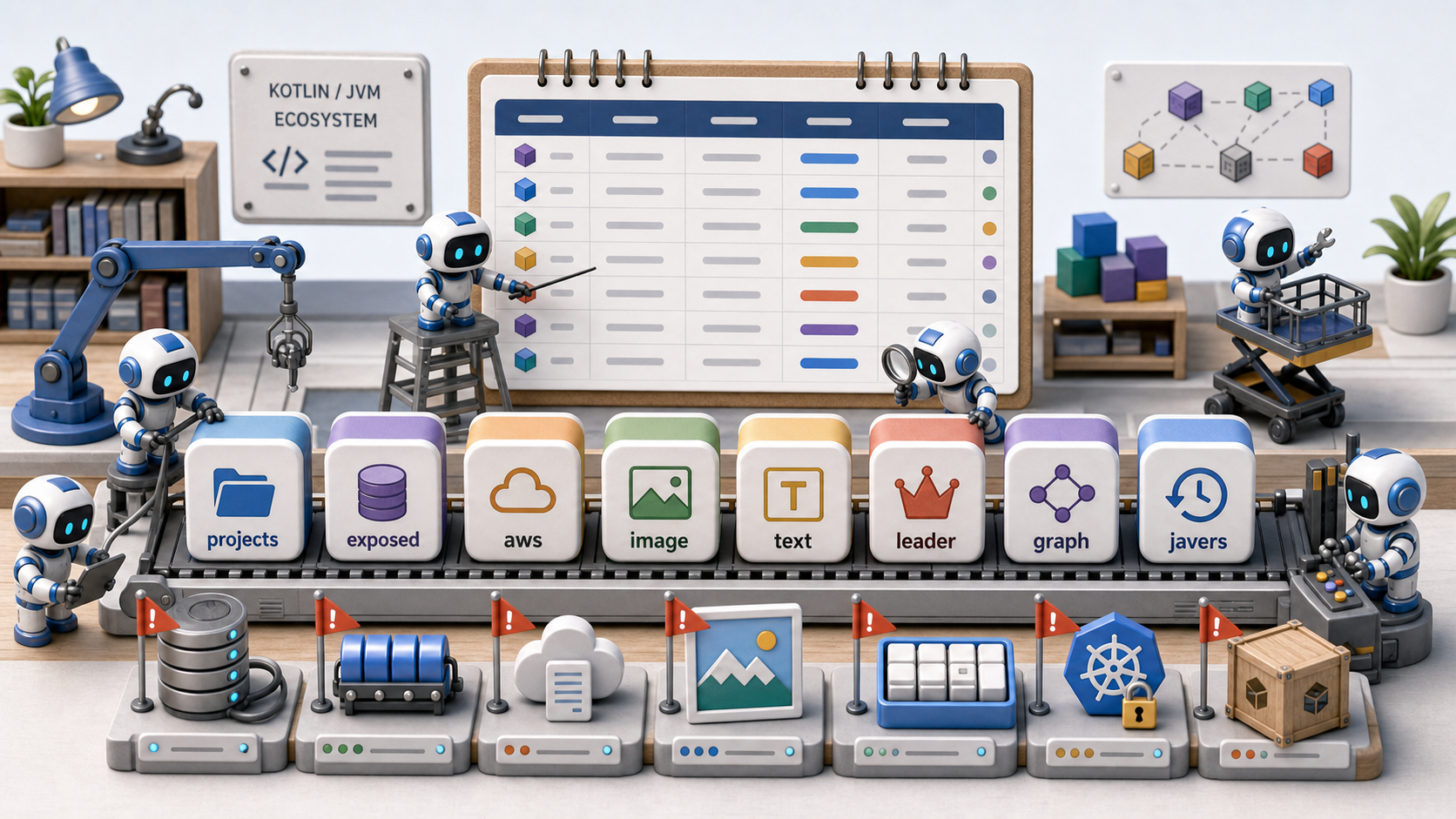
Importing bluetape4k-dependencies reduces version work, but it leaves a more practical question:
Which modules should this service actually use?
Some services only need Exposed. Some also need AWS. Scheduled work may need Leader. User input can bring in
Text, and file upload paths can bring in Image.
Import the BOM First
Section titled “Import the BOM First”Gradle imports the BOM with platform, and bluetape4k modules stay versionless.
dependencies {    implementation(platform("io.github.bluetape4k:bluetape4k-dependencies:1.3.0"))
    implementation("io.github.bluetape4k:bluetape4k-spring-boot-core")    implementation("io.github.bluetape4k.exposed:bluetape4k-exposed-spring-boot-jdbc")    implementation("io.github.bluetape4k.aws:bluetape4k-aws-spring-boot")}
The application chooses feature boundaries. The BOM chooses the compatible versions.
application -> bluetape4k-dependencies 1.3.0 -> projects 1.11.0 -> exposed 1.11.0 -> aws 0.4.0 -> image 0.3.0 -> text 0.2.1 -> leader 0.4.0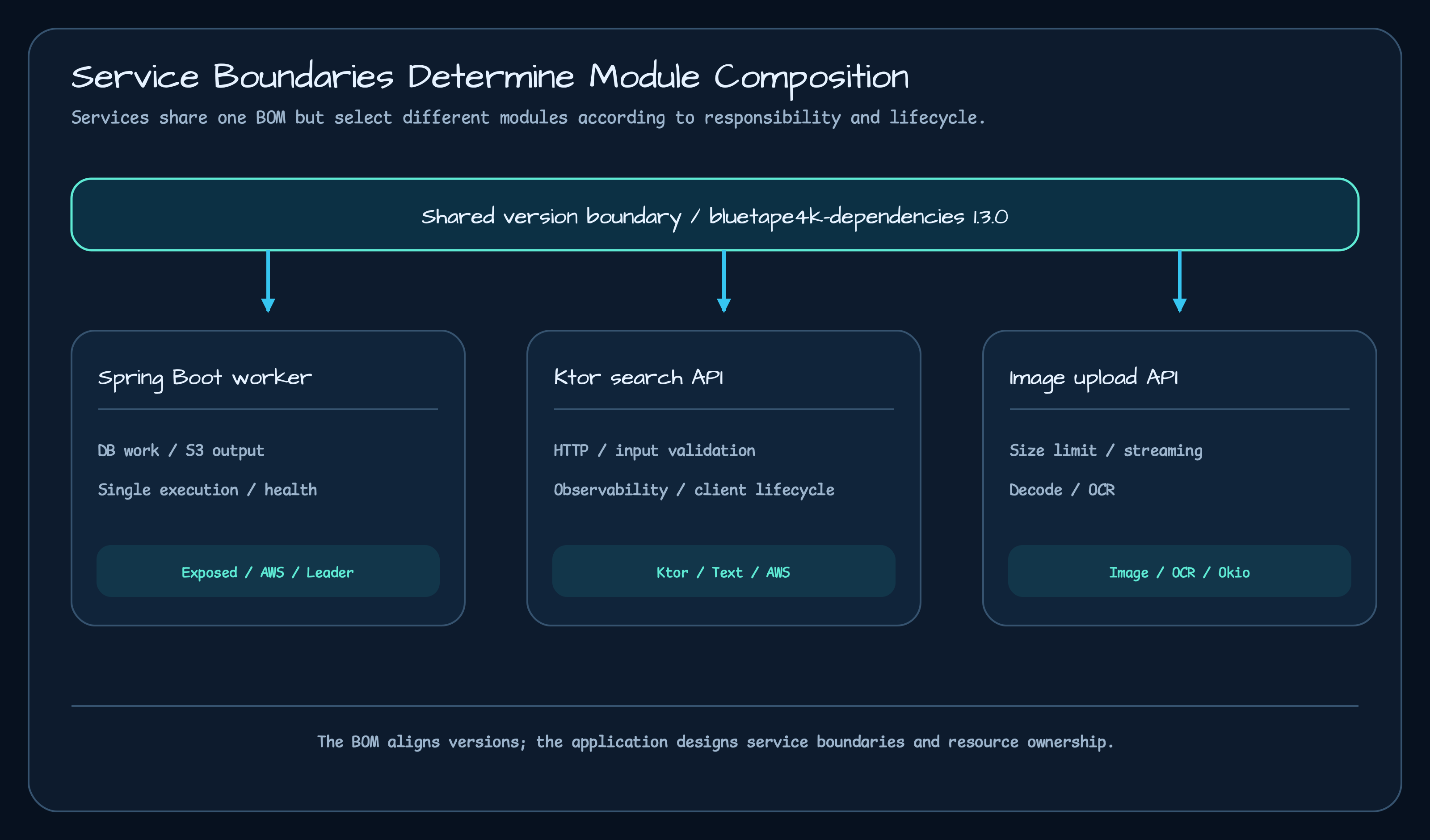
Example 1: Spring Boot Worker Service
Section titled “Example 1: Spring Boot Worker Service”Suppose a worker service:
- reads pending jobs from a database
- writes result files to S3
- must not run the same job from several instances
- preprocesses job names or input text with a tokenizer
- wants write-behind cache state visible through health
The dependency shape can start here:
dependencies {    implementation(platform("io.github.bluetape4k:bluetape4k-dependencies:1.3.0"))
    implementation("io.github.bluetape4k:bluetape4k-spring-boot-core")    implementation("io.github.bluetape4k.exposed:bluetape4k-exposed-spring-boot-jdbc")    implementation("io.github.bluetape4k.exposed:bluetape4k-exposed-cache")    implementation("io.github.bluetape4k.aws:bluetape4k-aws-spring-boot")    implementation("io.github.bluetape4k.leader:bluetape4k-leader-spring-boot")    implementation("io.github.bluetape4k.leader:bluetape4k-leader-redis-lettuce")    implementation("io.github.bluetape4k.leader:bluetape4k-leader-micrometer")    implementation("io.github.bluetape4k.text:tokenizer-korean")    implementation("io.github.bluetape4k.text:text-search")}
The code shape is service-specific, but the boundary is the important part.
@Scheduled(fixedDelayString = "PT30S")fun runPendingJobs() {    leader.runIfLeader("invoice-worker") {        transaction {            val jobs = jobRepository.findPending(limit = 100)
            jobs.forEach { job ->                val tokens = koreanTokenizer.tokenize(job.title)                val result = processor.render(job, tokens)
                s3Client.putObject(job.resultKey, result)                jobRepository.markDone(job.id)            }        }    }}
Leader is not decoration here. If three workers pick the same row, the deployment turns into an incident. The leader
boundary makes the ownership rule visible in code.
If Exposed cache is used, health should expose write-behind state.
{ "status": "OUT_OF_SERVICE", "components": { "exposedCache": { "status": "OUT_OF_SERVICE", "details": { "reports": [ { "name": "invoice-cache", "mode": "WRITE_BEHIND", "queueDepth": 128, "flushJobRunning": false, "lastFlushError": "Redis connection failed" } ] } } }}Example 2: Ktor API Service
Section titled “Example 2: Ktor API Service”A Ktor API has different lifecycle boundaries:
- HTTP requests enter through Ktor
- R2DBC or JDBC reads and writes data
- CloudWatch receives metrics and logs
- admin APIs or scheduled work may need leader election
- text input goes through tokenizers or blockword checks
dependencies {    implementation(platform("io.github.bluetape4k:bluetape4k-dependencies:1.3.0"))
    implementation("io.github.bluetape4k:bluetape4k-ktor-core")    implementation("io.github.bluetape4k:bluetape4k-ktor-observability")    implementation("io.github.bluetape4k.exposed:bluetape4k-exposed-ktor")    implementation("io.github.bluetape4k.exposed:bluetape4k-exposed-r2dbc")    implementation("io.github.bluetape4k.aws:bluetape4k-aws-ktor")    implementation("io.github.bluetape4k.leader:bluetape4k-leader-ktor")    implementation("io.github.bluetape4k.leader:bluetape4k-leader-redis-lettuce")    implementation("io.github.bluetape4k.text:tokenizer-korean")    implementation("io.github.bluetape4k.text:text-search")}
The sensitive part in Ktor is lifecycle. AWS clients, metric namespace, log group names, and stream names should not be spread across random call sites.
fun Application.module() {    install(CloudWatchKtorPlugin) {        namespace = "billing-api"    }
    install(CloudWatchLogsKtorPlugin) {        logGroupName = "/bluetape4k/billing-api"        logStreamName = environment.config.property("deployment.instanceId").getString()        flushInterval = Duration.ofSeconds(5)        shutdownFlushTimeout = Duration.ofSeconds(5)    }
    routing {        post("/documents/search") {            val request = call.receive<SearchRequest>()            // Application-owned input validation boundary            request.query.requireLength(max = 2_000)
            val tokens = koreanTokenizer.tokenize(request.query)            call.respond(documentService.search(tokens))        }    }}
The plugins register the CloudWatch integration and its lifecycle. They do not automatically publish metrics or log events; the application must submit each datum or append each buffered log event explicitly.
Example 3: Image Upload API
Section titled “Example 3: Image Upload API”Image upload paths add another boundary: the point where a file becomes memory.
dependencies {    implementation(platform("io.github.bluetape4k:bluetape4k-dependencies:1.3.0"))
    implementation("io.github.bluetape4k.image:bluetape4k-images")    implementation("io.github.bluetape4k.image:bluetape4k-images-ocr")    implementation("io.github.bluetape4k.image:bluetape4k-images-vips-api")    implementation("io.github.bluetape4k.image:bluetape4k-images-spring-boot")}
This is convenient for small samples and risky for production files:
// Convenient for small samples. Dangerous for large files.val bytes = multipartFile.bytesval text = ocr.read(bytes)The large-file path should care about streaming and limits before OCR options.
fun extractText(path: Path): OcrResult { return fileSystem.source(path).buffer().use { source -> imageReader .read(source) .resize(maxWidth = 2_000) .normalizeForOcr() .runOcr(language = "kor+eng") }}Module Selection Rules
Section titled “Module Selection Rules”| Service boundary | First module to inspect | Also check |
|---|---|---|
| Spring Boot foundation | bluetape4k-spring-boot-core | Spring Boot major line |
| Ktor API | bluetape4k-ktor-core, bluetape4k-ktor-observability | Ktor major line, plugin lifecycle |
| Exposed JDBC | bluetape4k-exposed-spring-boot-jdbc, bluetape4k-exposed-jdbc | transaction helper, datasource configuration |
| Exposed R2DBC | bluetape4k-exposed-spring-boot-r2dbc, bluetape4k-exposed-r2dbc | coroutine boundary, connection lifecycle |
| AWS integration | bluetape4k-aws-spring-boot, bluetape4k-aws-ktor | client lifecycle, emulator/runtime |
| Distributed leader election | bluetape4k-leader-spring-boot, bluetape4k-leader-ktor | provider/storage choice, metrics |
| Korean/Japanese text | tokenizer-korean, tokenizer-japanese, text-search | input length limit, error response |
| Image/OCR | bluetape4k-images, bluetape4k-images-ocr | file size, memory, native runtime |
The table is not a request to install everything. Pick the service boundary first, then add the modules required for that boundary. The BOM keeps the chosen modules on the intended version set.
Verify After Upgrade
Section titled “Verify After Upgrade”After moving to dependencies 1.3.0, check the runtime lines near the service boundary.
./gradlew compileTestKotlin./gradlew test./gradlew dependencyInsight --dependency exposed --configuration runtimeClasspath./gradlew dependencyInsight --dependency ktor --configuration runtimeClasspath./gradlew dependencyInsight --dependency aws --configuration runtimeClasspathClosing
Section titled “Closing”Importing the BOM reduces version-number work. It does not finish service design. The useful questions are still:
- What database boundary does this service own?
- Who owns AWS client and log/metric lifecycle?
- May a scheduled job run on several instances at once?
- Where is user input limited before tokenizers or blockword checks?
- When does an image file enter memory?
Let the BOM own versions. Let the service boundary decide modules.
Series
Section titled “Series”If you want the first import path, start with the usage guide.
- bluetape4k-dependencies 1.3.0 in Practice Part 1: Features and Cleanup
- bluetape4k-dependencies 1.3.0 in Practice Part 2: Selecting Modules by Service Boundary
- bluetape4k-dependencies 1.3.0 in Practice Part 3: Production Signals
- bluetape4k-dependencies 1.3.0 in Practice Part 4: Input Boundaries
Comments
Leave a note or reaction with your GitHub account.