
[Implementation 4] Real-Time Slot Search and Global Optimization Solve Different Problems

Part 3 intersected clinic and doctor hours, removed breaks, closures, and absences, then checked concurrent-patient and equipment capacity. That calculation answers a question such as, “When can this patient see this doctor next Tuesday?”
Choosing one valid time, however, does not prove that the choice is good for the clinic’s full schedule. A 30-minute appointment may fit at 10 a.m., but consuming that slot may prevent a later 90-minute examination from using the only continuous opening and required device. One doctor may become overloaded while another remains idle.
This article does not force both problems through the same algorithm. It separates their scope and response-time requirements, introduces Timefold Solver, and follows the two service boundaries through implementation and clinic- closure rescheduling.
Valid Time and Better Schedule Are Different Answers
Section titled “Valid Time and Better Schedule Are Different Answers”When a patient opens the booking screen, the API cannot make them wait for a clinic-wide optimization run. They have already selected a clinic, date, doctor, and treatment. The useful answer is the list of candidates that pass every required rule.
An administrator planning next week or moving appointments after a closure has a different problem. Several appointments compete for doctors and equipment, while requested dates and existing doctor relationships should be preserved when possible. The question is no longer only “Is this placement valid?” but “Which valid combination is better for the whole clinic?”
| Dimension | Real-time availability lookup | Global schedule optimization |
|---|---|---|
| Question | Which times may this patient choose? | How should many appointments be placed for a better overall schedule? |
| Scope | One clinic, date, doctor, and treatment | One clinic, a date range, many appointments, doctors, and devices |
| Decision | Does each candidate pass every mandatory rule? | Which valid schedule has the better overall score? |
| Timing | Return inside the patient’s API request | Search for a better solution within an execution budget |
| Result | List of available slots | Doctor, date, and start per appointment plus a total score |
Turning every lookup into an optimization problem makes a simple request unnecessarily expensive. Assigning many appointments one by one to the first valid space can produce a valid but poor overall schedule.
What Timefold Solver Does
Section titled “What Timefold Solver Does”Timefold Solver is a JVM optimization engine for planning work against limited people, time, and resources. It can run inside a Kotlin or Spring application, but it does not understand clinic operations automatically. Developers must define:
- the planning entities that the solver may change;
- the value ranges it may assign;
- the problem facts used for evaluation but not changed;
- the constraints and score that distinguish invalid and preferable schedules.
The clinic model maps these concepts as follows.
| Timefold concept | Clinic appointment meaning |
|---|---|
| Planning entity | An appointment that may be rescheduled |
| Planning variables | Assigned doctor, appointment date, start time |
| Problem facts | Clinic hours, doctor schedules and absences, treatment types, equipment, closures, holidays |
| Constraints and score | Prevent invalid timing and resource use, then prefer requested dates and existing doctors |
AppointmentPlanning
represents one planning entity. Timefold changes its doctorId, appointmentDate, and startTime. Appointments that
are already committed, checked in, in progress, or completed are pinned and remain fixed.
@PlanningEntityclass AppointmentPlanning(    @field:PlanningPin    val pinned: Boolean = false,
    @field:PlanningVariable(valueRangeProviderRefs = ["doctorRange"])    var doctorId: Long? = null,
    @field:PlanningVariable(valueRangeProviderRefs = ["dateRange"])    var appointmentDate: LocalDate? = null,
    @field:PlanningVariable(valueRangeProviderRefs = ["timeSlotRange"])    var startTime: LocalTime? = null,)
ScheduleSolution combines appointments with the clinic, doctor, treatment, equipment, operating-hour, break, absence, closure, and holiday facts needed to score them. Timefold compares scores while searching. It executes the priorities encoded by the application; it does not decide those priorities for the clinic.
“The model can hold a fact” and “the execution path supplies that fact” are separate claims. ScheduleSolution can
hold equipment-downtime facts and H11 defines the corresponding constraint, but SolverService.loadSolution() does not
currently load those facts. The isFeasible result from this entry point is valid only for the problem facts actually
supplied; it does not prove that the schedule avoids maintenance and failure windows. A defined constraint is not
evidence that an operational rule is active.
Keep the Service Boundaries Separate
Section titled “Keep the Service Boundaries Separate”The project gives real-time lookup and global optimization separate entry points. SlotCalculationService narrows one request and calculates valid candidates. SolverService loads many appointments and resources across a date range and compares complete solutions.
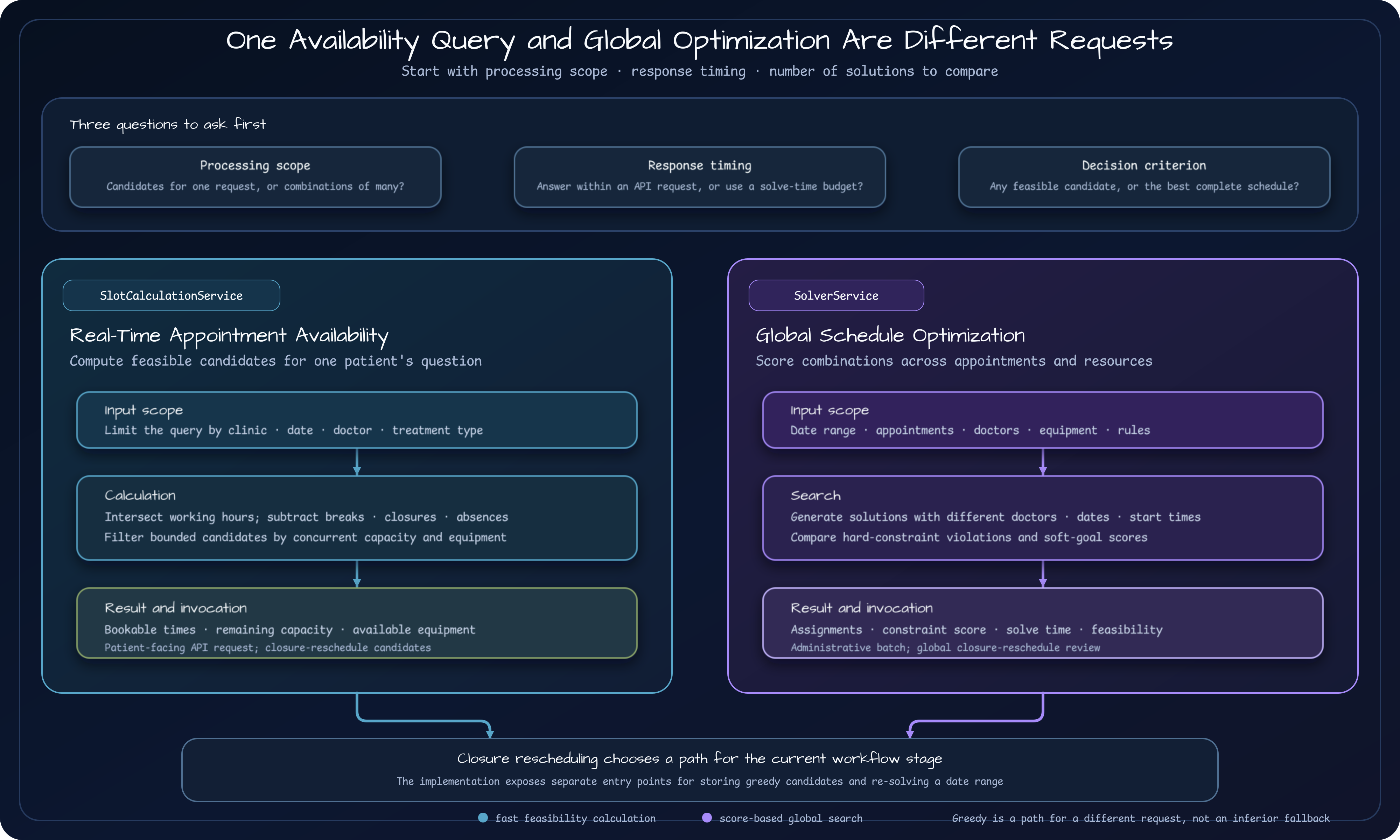
This boundary keeps patient-facing latency independent of optimization duration. It also lets the clinic change global score policy without changing the basic contract for “Can this appointment happen at this time?”
Calling the real-time path “greedy” requires care. The current service does not return only the first available time. It returns every candidate that passes the rules within the selected clinic, date, doctor, and treatment. It is called the fast candidate path because it does not create combinations across many appointments and compare global scores.
The Real-Time Path Limits the Search First
Section titled “The Real-Time Path Limits the Search First”The API packages clinic, doctor, treatment, and date into a SlotQuery. The service rejects holiday and full-day
closure conditions, intersects clinic and doctor hours, generates starts at the clinic interval, and filters them by
capacity and equipment.
fun getAvailableSlots(...): ResponseEntity<ApiResponse<List<AvailableSlot>>> { val query = SlotQuery(clinicId, doctorId, treatmentTypeId, date) val slots = slotCalculationService.findAvailableSlots(query) return ResponseEntity.ok(ApiResponse.success(slots))}The scope is small and termination is deterministic. Rejecting one candidate never triggers reassignment of unrelated appointments on another date.
The returned list is not a seat map that guarantees booking. Another user may reserve the same doctor or device before confirmation. The final booking path must revalidate current data and use transaction and concurrency controls. Neither slot calculation nor Timefold replaces database concurrency control.
The Solver Path Treats Many Appointments as One Solution
Section titled “The Solver Path Treats Many Appointments as One Solution”SolverService.optimize() accepts a clinic and date range, loads appointments and planning facts, builds a
ScheduleSolution, and runs the solver.
fun optimize(    clinicId: Long,    dateRange: ClosedRange<LocalDate>,    timeLimit: Duration = Duration.ofSeconds(30),): SolverResult {    val solution = loadSolution(clinicId, dateRange)    val factory = if (timeLimit != Duration.ofSeconds(30)) {        AppointmentSolverConfig.createFactory(timeLimit)    } else {        solverFactory    }
    val result = factory.buildSolver().solve(solution)    val score = result.score!!    return SolverResult(        score = score,        appointments = SolutionConverter.extractResults(result, originalMap),        isFeasible = score.isFeasible,        solveTimeMillis = solveTimeMillis,        entityCount = entityCount,        pinnedCount = pinnedCount,    )}
The default 30 seconds does not promise an optimal solution. The solver explores alternatives within its budget and returns the best solution found. The result includes assignments, score, feasibility, duration, total entities, and pinned count so an operator can understand the problem scope as well as the proposed schedule.
The current service is an independent execution path. Patient availability APIs do not invoke it, and closure rescheduling does not automatically persist its output. When optimization runs, who reviews it, and how results become stored appointments belong to an application workflow outside the solver itself. The same boundary must verify that all required problem facts, including equipment downtime, were loaded before the run.
Clinic Closure Exposes the Two Paths
Section titled “Clinic Closure Exposes the Two Paths”A sudden closure makes the distinction concrete.
ClosureRescheduleService
moves active appointments to PENDING_RESCHEDULE, calculates later candidates per appointment, and stores them ordered
by nearby date and time. An administrator can choose a candidate, or an automatic path can take the highest priority.
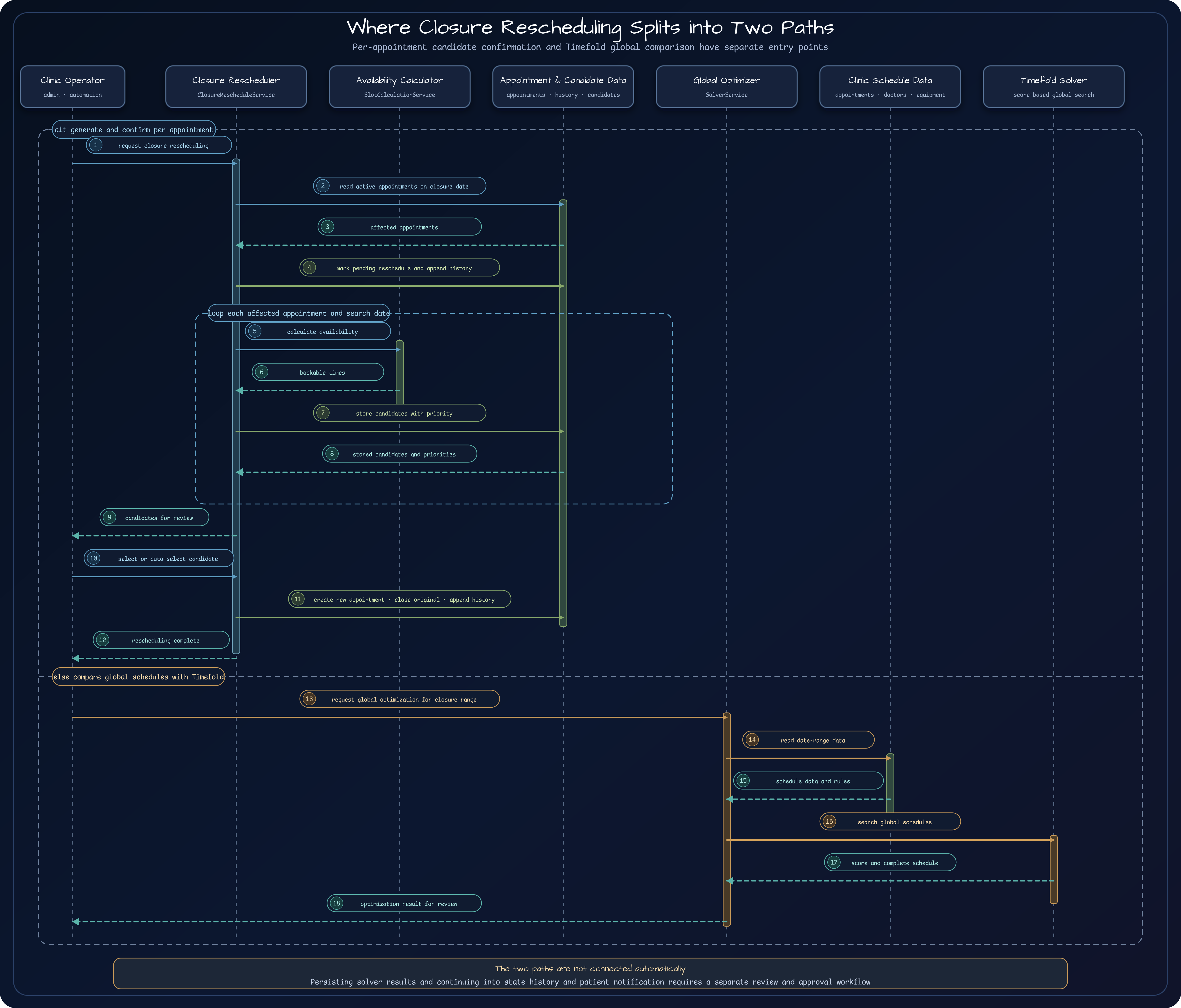
The per-appointment path is simple and easy for staff to review. It does not reconsider the whole schedule when an early appointment consumes an option that would have helped later appointments.
SolverService.optimizeReschedule() provides a separate whole-range path from the closure date through a search
horizon. It can compare interactions among appointments, doctors, and equipment, but it also needs an execution budget,
review, persistence, and patient-communication process.
The current implementation does not connect the two paths automatically. That keeps several product decisions visible.
- At what closure size should the solver run?
- Which states may move, and which existing appointments remain pinned?
- Are results persisted immediately or approved by staff?
- When are state history and patient notifications recorded?
Adding an optimization algorithm does not complete closure operations. Results must still flow through state, approval, history, and communication.
Choose the Path from the User’s Question
Section titled “Choose the Path from the User’s Question”| Scenario | Path | Why |
|---|---|---|
| Patient checks one doctor’s times on a date | SlotCalculationService | Small scope and immediate candidate list |
| Staff explores alternatives for one appointment | SlotCalculationService | A person can compare one appointment’s options |
| Clinic plans many appointments across doctors and devices | SolverService | Complete schedules need score comparison |
| Large closure moves many appointments | SolverService plus approval | Earlier choices affect later possibilities |
| User confirms one candidate | Transaction and concurrency control | Revalidate current data and prevent duplicate confirmation |
The paths may be composed. A fast filter can remove obviously impossible values before they become Timefold value ranges. The contracts must remain clear: one stage creates valid choices; the next compares combinations of those choices.
Test Boundaries, Not Only Assignments
Section titled “Test Boundaries, Not Only Assignments”SlotCalculationServiceTest checks that breaks, partial closures, absences, treatment duration, capacity, and equipment leave only valid candidates. That service owns candidate-list correctness.
SolverServiceTest checks that the date-range problem produces a result, keeps pinned appointments fixed, and supports a closure-to-horizon rescheduling range. Solver tests need to verify feasibility, pinning, and problem/result boundaries rather than only one appointment’s chosen time.
Review also corrected two easy misconceptions. “Greedy” does not mean that the current availability service returns the first candidate only. A closure-specific solver method does not mean the current closure workflow automatically runs global optimization. Describing the source boundary accurately gives product and engineering the same foundation for the next requirements.
The Next Requirement Is an Explainable Definition of Better
Section titled “The Next Requirement Is an Explainable Definition of Better”Timefold does not define a good clinic schedule. Doctor and device conflicts are clear mandatory rules, but requested date versus original doctor, compact schedules versus balanced workload, and other preferences compete.
clinic rules that must never be violated  → hard constraints and infeasibility penalties
operating goals that should be satisfied when possible  → soft constraints and weighted penalties
competing goals  → priorities and weights reviewed as clinic policy
Part 5 translates those clinic statements into Timefold Constraint Streams and a HardSoftScore.
Explore the Implementation and References
Section titled “Explore the Implementation and References”- Core appointment module: Real-time slot calculation and per-appointment closure candidates.
- Slot calculation service: Produces candidates that pass rules within one request.
- Closure rescheduling service: Creates and confirms replacement candidates.
- Schedule optimization module: Timefold model, constraints, and execution path.
- Solver service: Loads a clinic date range and runs global optimization.
- Planning entity: Defines doctor, date, start time, and pinning.
- Planning solution: Combines appointments with clinic, doctor, and resource facts.
- Timefold Solver introduction: Official overview of planning optimization.
- Modeling planning problems: Official guide to entities, variables, facts, and solutions.
Comments
Leave a note or reaction with your GitHub account.