
Connect OCR Results to the Combined Response: Distinguishing Empty, Unavailable, and Failed

Consider an API that extracts a visitor’s name, face regions, and entry QR code from one visitor-pass image. After shared
input qualification and one decode, the resulting ImmutableImage reaches an OCR provider. A blank OCR result does not
mean that the image was invalid. The OCR provider may also be unavailable, or it may time out while running.
If the service collapses those cases into null or one generic exception, the combined response loses information that the
next layer needs. The response must distinguish a provider that ran but found no text (Empty), a provider that cannot be
used (Unavailable), and an execution failure (Failed).
This article follows the OCR path in the
bluetape4k-image Spring Boot Image Intelligence API.
The earlier article Operating an OCR service in production covers Tesseract
installation and native-runtime operation, so this article focuses on the boundary where provider results become a combined
response contract.
Put a provider contract in front of the OCR engine
Section titled “Put a provider contract in front of the OCR engine”The example’s OcrAnalysisProvider
wraps the engine name and call shape in a small interface:
interface OcrAnalysisProvider {    val id: String
    suspend fun analyze(image: ImmutableImage): OcrStructuredResult}
OcrStructuredResult carries the full text and pages. When the engine and options support it, it also carries blocks, lines,
and words. TesseractOcrAnalysisProvider calls the real OCR engine, while FixtureOcrAnalysisProvider returns deterministic
visitor-pass data for the example. The workflow sees the same input and output shape either way.
This boundary does more than make engine replacement convenient. It keeps engine exceptions separate from the states that the public API is allowed to expose. The provider produces OCR data; the guarded execution boundary decides how that data becomes an integration state.
Apply timeouts and concurrency limits at the execution boundary
Section titled “Apply timeouts and concurrency limits at the execution boundary”GuardedAnalysisRunner
is the shared boundary for provider calls. The real implementation also carries logging and coroutine context details, but
the important order can be summarized as follows:
val result = runner.run( provider = ocrProvider, timeout = ocrTimeout, semaphore = ocrSemaphore, isEmpty = { it.text.isBlank() },) { ocrProvider.analyze(image)}run executes withTimeout inside semaphore.withPermit. Each OCR engine can therefore have its own concurrency permit
and timeout, while the permit is released after a timeout or exception. A native call may still occupy its thread until it
returns; as the README notes, an engine that needs process isolation requires an outer operational boundary.
Cancellation has a different meaning. GuardedAnalysisRunner maps only its own timeout to Failed(reasonCode = "timeout").
It rethrows a parent CancellationException. A cancelled request is not a damaged image or an OCR failure, and the two cases
have different lifecycle and retry semantics.
Empty, Unavailable, and Failed are not the same failure
Section titled “Empty, Unavailable, and Failed are not the same failure”The execution boundary normalizes provider values and exceptions into AnalysisResult:
| State | What happened | Fields in the OCR response |
|---|---|---|
Completed | The provider returned a result | status, provider, elapsedMillis, result.text, result.pageCount |
Empty | The provider ran but returned blank text | status, provider, elapsedMillis |
Unavailable | The provider is not configured or usable | status, provider, elapsedMillis, reasonCode |
Failed | A timeout or provider exception occurred | status, provider, elapsedMillis, reasonCode |
The OCR path passes isEmpty = { it.text.isBlank() }. A blank response therefore becomes Empty, whether the image has no
text or the provider could not read text at that resolution. ProviderUnavailableException becomes Unavailable; other
exceptions become Failed(reasonCode = "provider_failure").
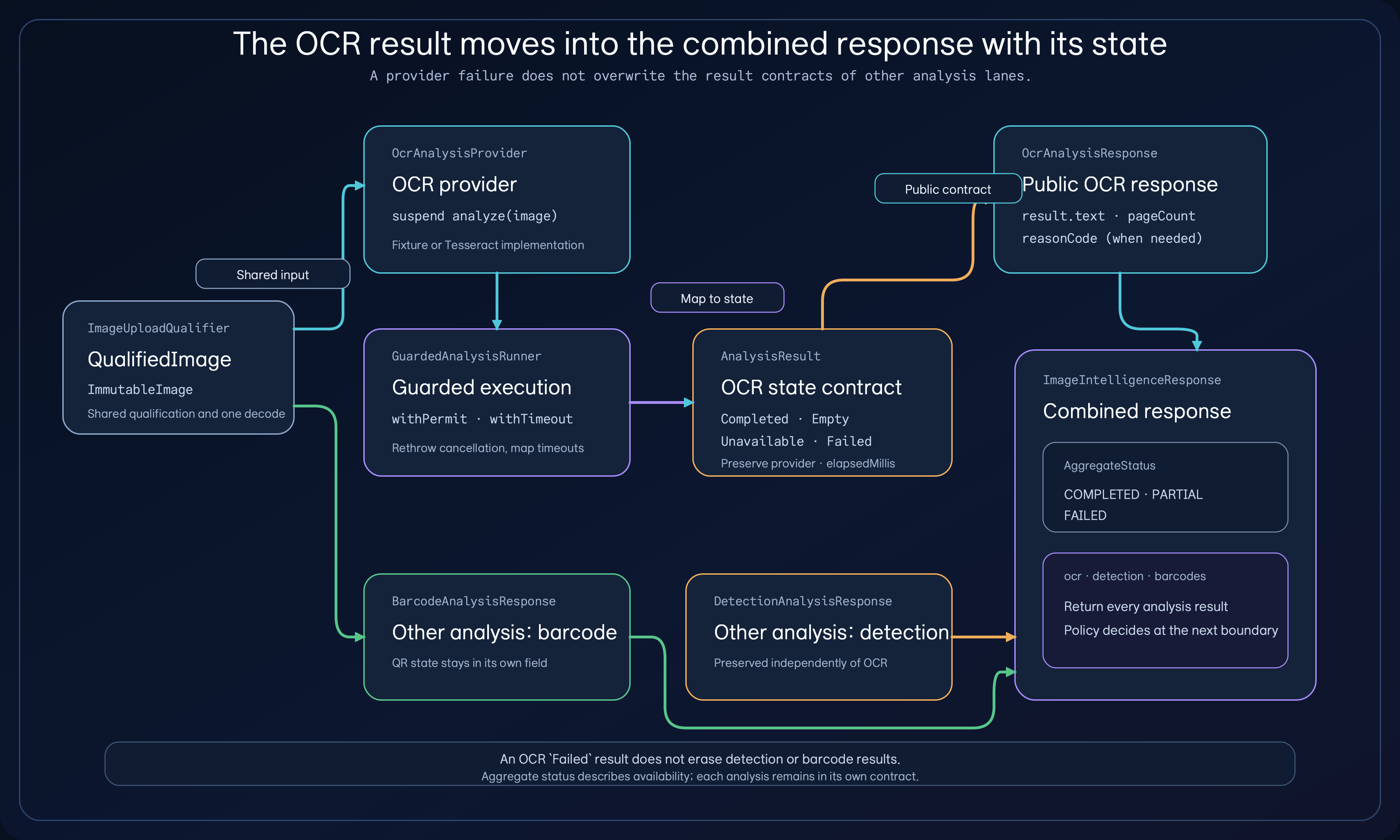
The responsibility of ImageIntelligenceService
is to choose public fields for each state. A completed result includes text and page count; an unavailable or failed result
includes a stable reasonCode. Native-library exception text and internal paths do not cross the API boundary.
Conceptually, the mapping looks like this:
when (analysis) {    is AnalysisResult.Completed ->        OcrAnalysisResponse(            status = COMPLETED,            provider = analysis.provider,            elapsedMillis = analysis.elapsedMillis,            result = OcrResponse(                text = analysis.value.text,                pageCount = analysis.value.pages.size,            ),        )
    is AnalysisResult.Empty ->        OcrAnalysisResponse(EMPTY, analysis.provider, analysis.elapsedMillis)
    is AnalysisResult.Unavailable ->        OcrAnalysisResponse(UNAVAILABLE, analysis.provider, analysis.elapsedMillis, reasonCode = analysis.reasonCode)
    is AnalysisResult.Failed ->        OcrAnalysisResponse(FAILED, analysis.provider, analysis.elapsedMillis, reasonCode = analysis.reasonCode)}
This is a shortened example showing the important response fields. The concrete types live in ApiModels.kt.
Keep an OCR failure from erasing other analysis results
Section titled “Keep an OCR failure from erasing other analysis results”In an OCR-only service, promoting Failed to a request-wide failure may not be obvious. The visitor-pass API also runs object
detection and barcode or QR analysis. ImageIntelligenceWorkflow
collects the three paths under separate result keys: analysis.ocr, analysis.detection, and analysis.barcode.
If OCR becomes Failed(provider_failure) while detection and QR complete, the service can return all three results. Only the
aggregate status becomes PARTIAL. The client can see that OCR produced no text and that the QR value is still available in
the same response.
If every path is Unavailable or Failed, there is no usable analysis and the aggregate becomes FAILED. COMPLETED
means that every path ended as Completed or Empty. Including Empty does not turn the whole request into a failure.
Aggregation does not decide the business action. VisitorPassPolicy decides whether the pass is allowed, sent to manual review,
or rejected. Part 4 will examine that policy boundary separately.
Read the four states as an API contract
Section titled “Read the four states as an API contract”Listing state names in documentation is not enough. Callers need to know which fields they can trust and what action follows.
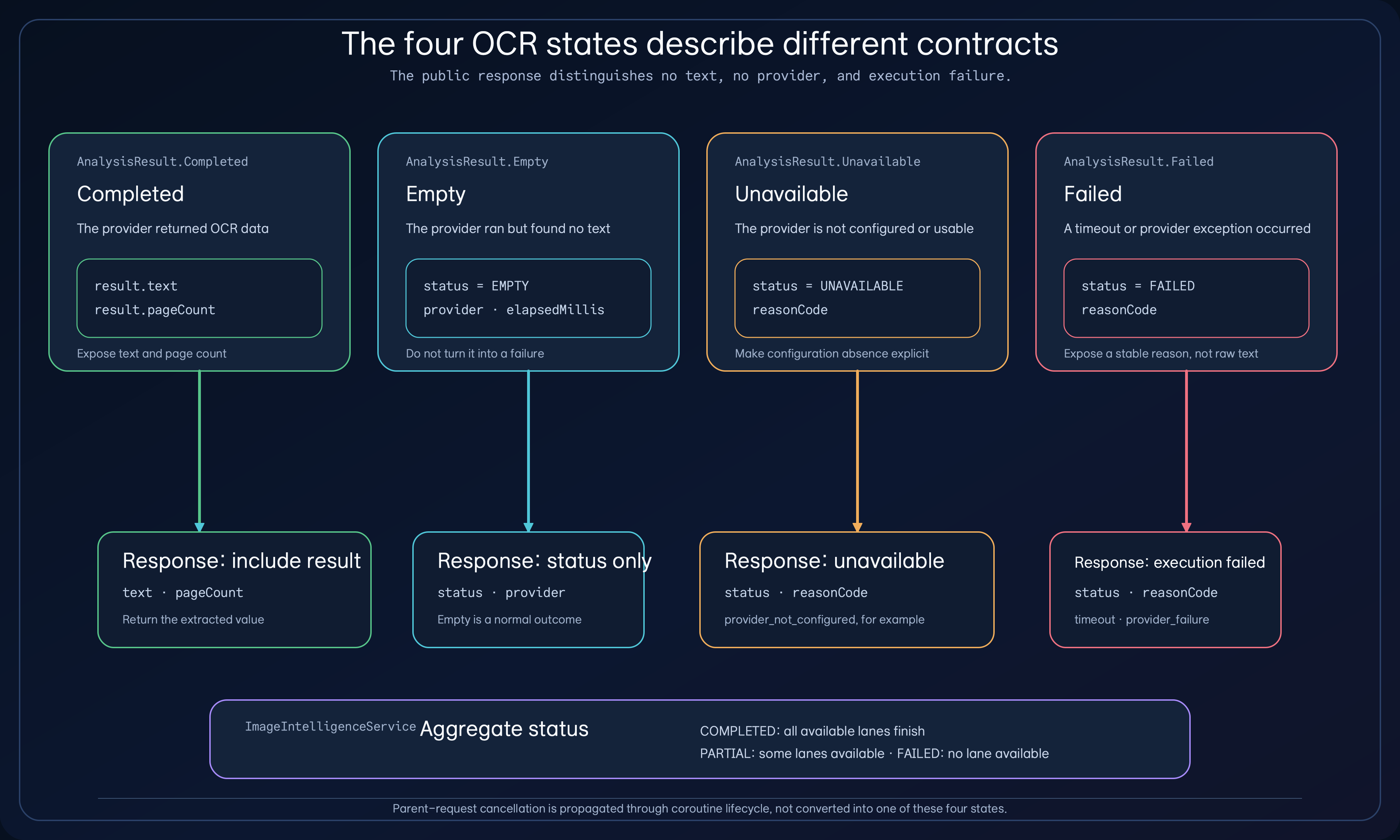
Completed carries the result, Empty says an executed analysis found no value, and the other two states carry an unavailable or failed reason.Completed: readresultand continue any downstream validation with the page count.Empty: the provider ran but found no text in this image. Use results from other analysis lanes if they are available.Unavailable: the default profile may leave OCR unconfigured. The client or operator can choose configuration or a fallback path.Failed: the provider timed out or raised an exception. Retry, circuit-breaking, and isolation are operational policy decisions.
All four states retain elapsedMillis and provider. Operations can distinguish a fast empty result from an unavailable provider
or a slow provider. These fields do not claim anything about OCR accuracy.
Tests must verify state values and response-mapping boundaries
Section titled “Tests must verify state values and response-mapping boundaries”GuardedAnalysisRunnerTest
checks that blank output becomes the Empty state value, provider exceptions become Failed, and timeouts normalize to the timeout reason.
Parent cancellation is rethrown, so it is tested separately from ordinary provider exceptions.
The boundary between state values and public response fields can be made explicit in one test flow:
val failed = runner.run<String>(provider = "broken", timeout = timeout, semaphore = semaphore) {    error("native-path=/private/secret")}failed.shouldBeInstanceOf<AnalysisResult.Failed>()    .reasonCode shouldBeEqualTo "provider_failure"
val response = service.analyze(visitorUpload())response.status shouldBeEqualTo AggregateStatus.PARTIALresponse.ocr.status shouldBeEqualTo AnalysisStatus.FAILEDresponse.detection.status shouldBeEqualTo AnalysisStatus.COMPLETEDresponse.barcodes.status shouldBeEqualTo AnalysisStatus.COMPLETED
The first assertion checks normalization from an internal exception to a stable state and reason code. The second checks which results survive a single-lane failure and how the aggregate status is calculated.
ImageIntelligenceWorkflowTest
checks that the three paths overlap and that one failure does not delete results from other analysis lanes. It also verifies that cancellation
reaches every child path.
Finally, ImageIntelligenceServiceTest
checks that an OCR failure with completed detection and barcode results returns PARTIAL together with all individual results.
It separately checks FAILED when no path is usable. These tests prove which data survives and how aggregate status is
calculated, rather than merely proving that an exception string reached the response.
What this contract does not guarantee
Section titled “What this contract does not guarantee”This article defines a baseline for turning OCR execution outcomes into stable response states. It does not decide the following:
| What the example defines | What needs a separate decision |
|---|---|
Completed, Empty, Unavailable, and Failed | Tesseract version, model quality, and accuracy targets |
| Timeouts and provider-specific permits | Retries, circuit breakers, and process isolation |
| Text, page count, and stable reason codes | Original-image retention, deletion, encryption, and masking |
| Preservation of OCR, detection, and barcode results | Visitor-pass allow, review, or reject rules |
“Needs a separate decision” does not mean that the concern has no implementation. It means that this response contract cannot choose the operational default. Retries should be limited to transient provider failures; a circuit breaker should stop calls after repeated failures; and process isolation should move an unstable native engine behind a separate execution boundary. In a Spring application, Resilience4j can provide Retry, CircuitBreaker, Bulkhead, and TimeLimiter primitives. The service still has to decide which errors are retryable, when the breaker opens, and whether process isolation belongs in the deployment design.
The response contract also cannot prevent a native OCR call from occupying a thread until it returns. Read the earlier Operating an OCR service in production article for large-image limits, OCR preprocessing, and native-runtime operating conditions.
Continue the series
Section titled “Continue the series”- Part 1: Extracting Multiple Signals from One Image
- Part 2: Qualify Before You Analyze
- Part 3: Connect OCR Results to the Combined Response
- Part 4: Separate Detection Facts from Processing Policy
- Part 5: A Barcode and QR Contract Unlike OCR
- Part 6: Represent parallel execution and partial failure in the response contract
- Part 7: Walk through the complete visitor-pass image API
Part 4 will separate object-detection facts from the visitor-pass handling policy in the same combined response.
Implementation and further reading
Section titled “Implementation and further reading”- Spring Boot Image Intelligence API: the complete execution path from input qualification through three analyzers and visitor-pass policy
ImageAnalysisProviders.kt: the OCR provider interface and fixture/Tesseract implementationsGuardedAnalysisRunner.kt: timeout, concurrency permits, and state mappingImageIntelligenceWorkflow.kt: collection of OCR, detection, and barcode resultsImageIntelligenceService.kt: public OCR response and aggregate-status mappingAnalysisModels.kt,ApiModels.kt: internal states and public response typesGuardedAnalysisRunnerTest.kt,ImageIntelligenceWorkflowTest.kt,ImageIntelligenceServiceTest.kt: state, cancellation, and partial-failure tests- Operating an OCR service in production: OCR engine operation, large-image limits, and native failure boundaries
Comments
Leave a note or reaction with your GitHub account.