
Keeping Reservation Capacity Correct Under Concurrent Requests

One reservation slot remains. Two users open the screen at almost the same time and both see available = 1. One
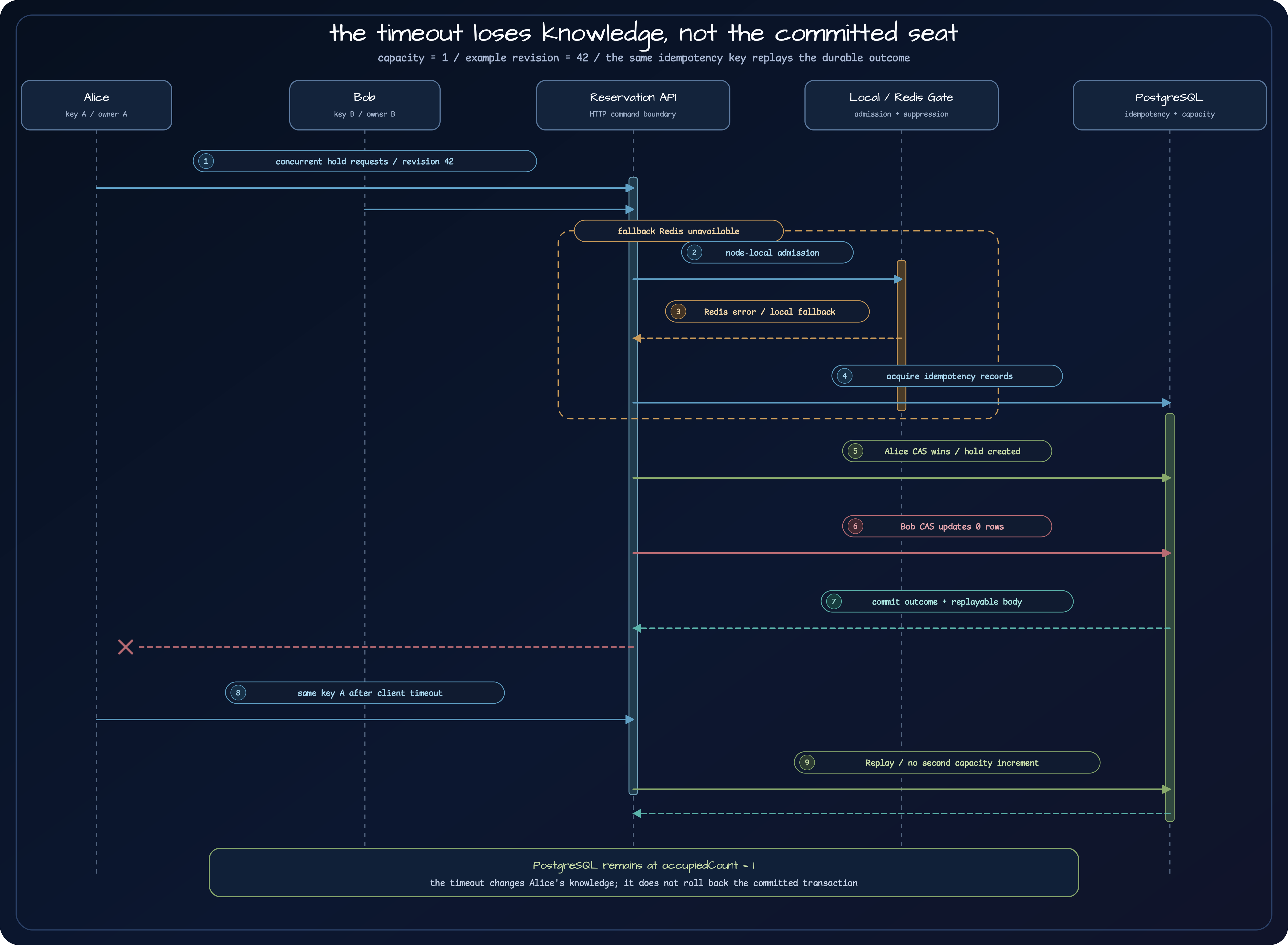
request may time out before the response and retry the same command. A hold may expire while the waitlist worker starts
offering the slot to the next user. Redis may be unavailable at exactly the wrong time.
The commerce/reservation-control-plane example in
bluetape4k-workshop
draws the boundary this way:
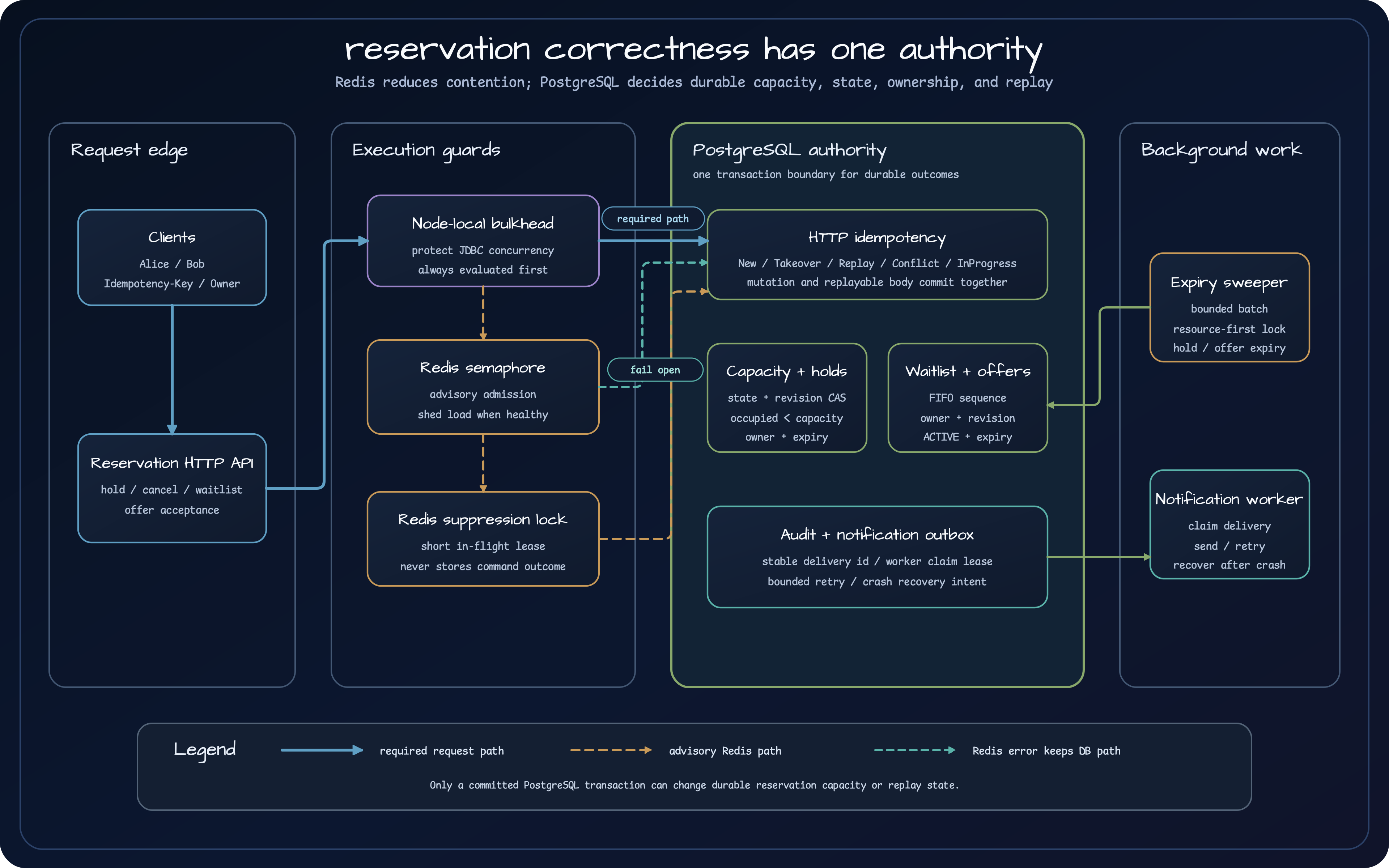
- PostgreSQL is the final authority for capacity, state transitions, ownership, and idempotent responses.
- A node-local bulkhead prevents one instance from consuming too many JDBC connections.
- Redis semaphores and locks reduce contention and duplicate in-flight work before requests reach PostgreSQL.
- Redis failure never bypasses the PostgreSQL checks.
First See the Whole Flow
Section titled “First See the Whole Flow”The example is a control plane, not a Redis-only counter. Redis can reject some excess load early, but the mutation that changes capacity is still a PostgreSQL transaction. That keeps concurrency, retry, waitlist, and expiry rules under one durable authority.
Protect the Last Slot with One Conditional Update
Section titled “Protect the Last Slot with One Conditional Update”The final capacity decrement is a conditional database update. The command succeeds only if the resource is active, capacity remains, and the expected revision still matches.
val updated = CapacityResourceTable.update({ (CapacityResourceTable.id eq resourceId) and (CapacityResourceTable.available greater 0) and (CapacityResourceTable.revision eq expectedRevision)}) { it[available] = available - 1 it[revision] = revision + 1}If the update count is zero, the command did not win the last slot. The application should not “repair” that with a Redis value. PostgreSQL already made the authoritative decision.
Cancellation Does Not Always Release Capacity Immediately
Section titled “Cancellation Does Not Always Release Capacity Immediately”Cancellation is not a single boolean state. The control plane has several objects with different ownership checks.
| Object | Role | Check on the next transition |
|---|---|---|
| hold | occupies capacity for a limited time | owner, state, revision, policy version, expiry |
| waitlist entry | waits FIFO for a slot | owner, WAITING state, sequence |
| offer | temporarily offers the slot to one waiter | owner, ACTIVE state, revision, expiry |
WaitlistCommandService
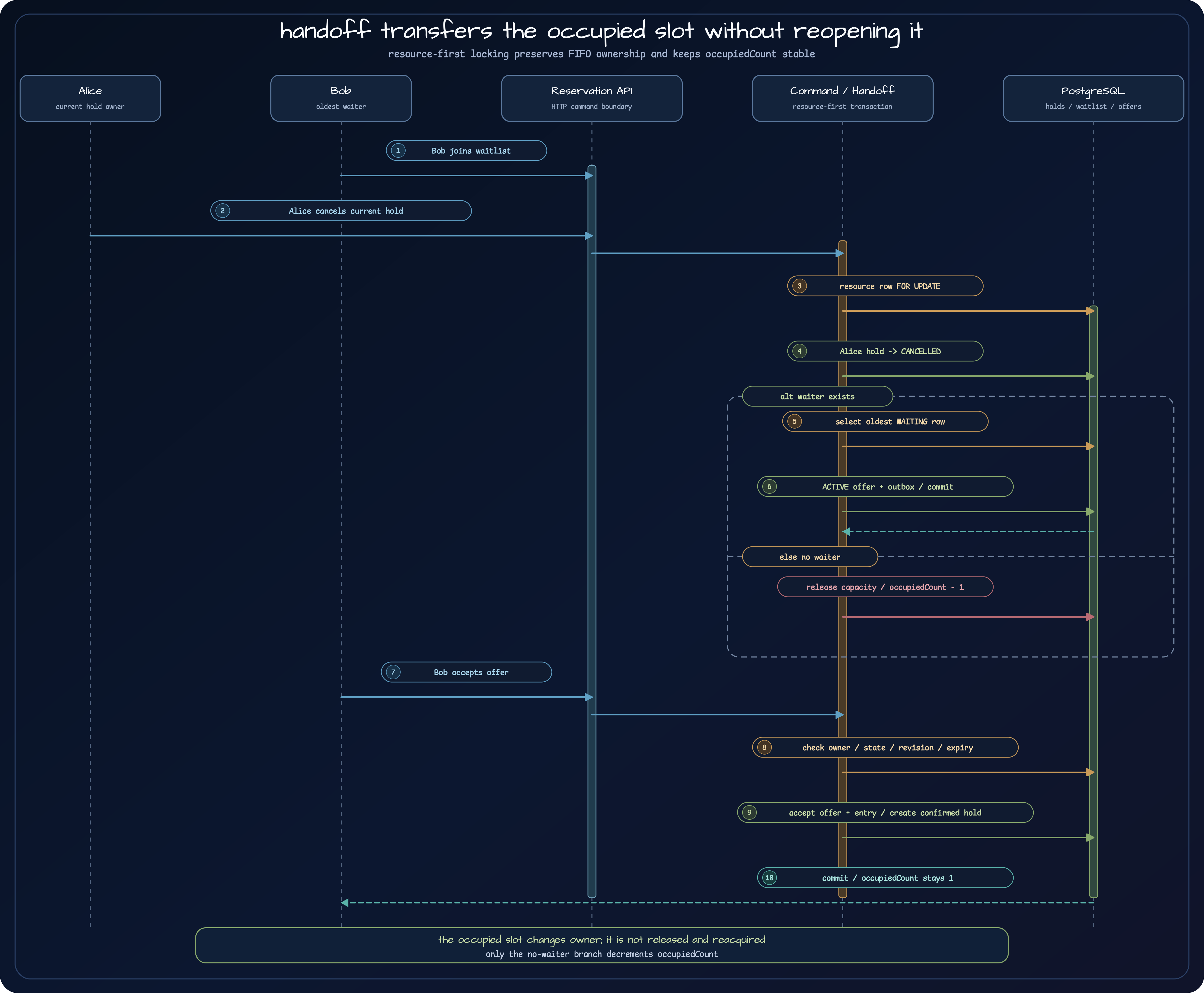
locks the resource row before reading waitlist and offer state. Knowing an offer URL is not enough to accept another
user’s slot; the owner digest, state, expiry, and revision still have to match.
occupiedCount decreases only when no waiter is available.Replay and Conflict Are Different Idempotency Results
Section titled “Replay and Conflict Are Different Idempotency Results”HttpIdempotencyRepository.acquire()
separates retry outcomes.
| Result | Meaning | HTTP boundary behavior |
|---|---|---|
New | first command in this scope | execute the command and store the response |
Takeover | previous processing lease expired | CAS owner token and deadline, then run again |
Replay | response is already stored | replay the original status/body and return Idempotency-Replayed: true |
FingerprintConflict | same key with a different request | return 409 Conflict |
InProgress | another owner is still processing | do not duplicate execution; return a retryable response |
IdempotentReservationCommandService.execute()
stores the mutation and the replayable HTTP body in the same PostgreSQL transaction. That narrows the gap where a
reservation exists but the retry response does not.
Redis Failure Does Not Remove the PostgreSQL Rule
Section titled “Redis Failure Does Not Remove the PostgreSQL Rule”Redis is useful in front of PostgreSQL, but it is not the authority.
| Boundary | Role | On failure |
|---|---|---|
| node-local bulkhead | limits concurrent JDBC work | reject when foreground permits are exhausted |
| Redis semaphore | advisory distributed admission | fallback locally on Redis errors; reject early when no permit is available |
| Redis lock | short duplicate in-flight suppression | fall back to PostgreSQL idempotency rows on Redis errors |
| PostgreSQL | final authority for capacity, state, ownership, and response | fail the command; never mutate only in Redis |
ReservationAdmissionGate
always passes through the local bulkhead first. If Redis throws, the result is LOCAL_FALLBACK and PostgreSQL work
continues. That is different from a healthy Redis semaphore saying no permit is available.
InFlightCommandSuppressor
blocks short duplicate execution when Redis locks are available. If Redis is broken, it does not drop the command; it
lets the PostgreSQL idempotency row decide.
What Tests Prove
Section titled “What Tests Prove”ReservationWebIntegrationTest
starts a real PostgreSQL server and calls the running HTTP server with WebTestClient.
Only One Request Gets the Last Slot
Section titled “Only One Request Gets the Last Slot”The concurrent request test proves that one request wins the final capacity update and the other request is rejected or moved into the non-winning path. The proof needs PostgreSQL, not mocks, because the conditional update and transaction isolation are the contract.
Same Command Replays, Different Command Conflicts
Section titled “Same Command Replays, Different Command Conflicts”The idempotency tests separate New, Replay, FingerprintConflict, InProgress, and Takeover. The important edge
is that the same idempotency key cannot be reused for a different fingerprint.
Cancellation Can Promote the First Waiter
Section titled “Cancellation Can Promote the First Waiter”When a hold is cancelled or expires and a waitlist entry exists, the resource transaction can create an offer for the first waiting owner instead of immediately returning capacity to the public pool.
The API Boots Without Redis
Section titled “The API Boots Without Redis”RedisUnavailableBootIntegrationTest
starts the application with an unreachable Redis URI. PostgreSQL APIs still boot because Redis is advisory.
Expiry and Notifications Are Still Bounded Work
Section titled “Expiry and Notifications Are Still Bounded Work”ReservationResourceTransactionServiceTest, ReservationExpirySweeperTest, and NotificationOutboxTest cover expired
holds/offers, leader-owned sweeper ranges, retryable notification delivery, and provider-level duplicate suppression.
These tests keep background work from becoming an unbounded “try again somehow” loop.
What This Example Does Not Prove Yet
Section titled “What This Example Does Not Prove Yet”- multi-region consistency under network partitions
- long-duration throughput and tail latency
- automatic detection and recovery of leaked Redis semaphore permits
- backlog reduction after a leader sweeper has been stopped for a long time
- takeover policy for
IN_PROGRESSidempotent requests during PostgreSQL failover - SLOs, alert thresholds, and dashboards
- binding
X-Reservation-Ownerto real user/service authentication - a dedicated worker for a real notification provider
Confirmation Happens Only After PostgreSQL Commit
Section titled “Confirmation Happens Only After PostgreSQL Commit”The example’s rule is simple: Redis can help before the transaction, and workers can notify after it, but reservation confirmation is a PostgreSQL commit boundary. That is what keeps retries, waitlists, expiry, and Redis failure from turning capacity into an advisory guess.
Related reading:
- Fast candidate lookup and global schedule optimization are different problems
- Transactional Outbox and Idempotency in Spring and Ktor Examples
- Transactional Outbox Part 2: Reducing Hot Transactions with a Kafka-First Fallback
Comments
Leave a note or reaction with your GitHub account.