
Building bluetape4k-dependencies Part 3: Maven Central Has No Rollback Button

Part 2 covered the public BOM contract for 1.0.0. After
the structure exists, release operation starts.
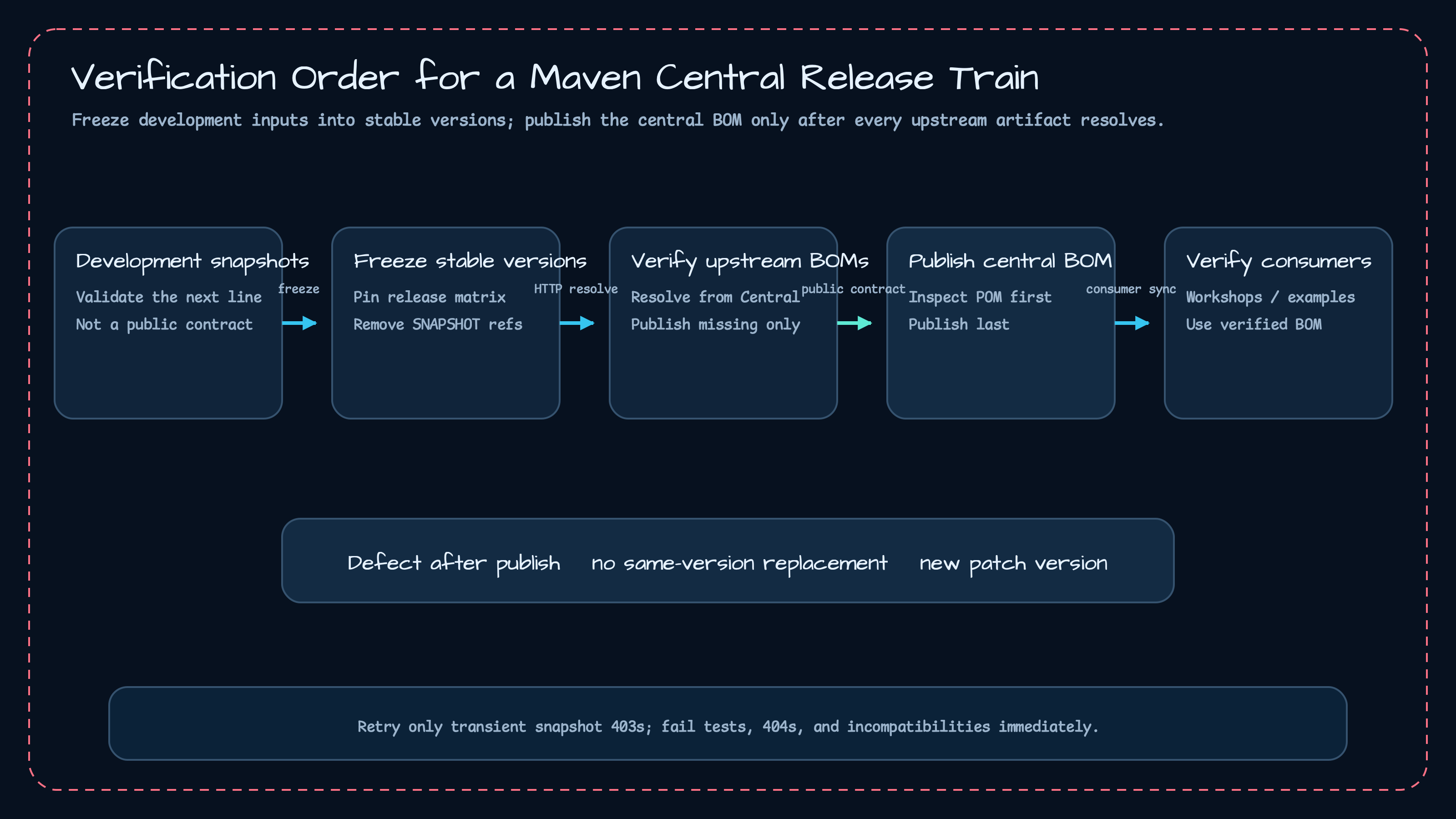
upstream repositories -> stable BOM artifacts -> central bluetape4k-dependencies BOM -> downstream workshops/examples/applicationsSnapshot Matrix Is Not Release Matrix
Section titled “Snapshot Matrix Is Not Release Matrix”The next development line may already point at snapshots or unreleased refs. A stable BOM cannot use that as release input.
| Upstream BOM | 1.2.0 input | 1.3.0 stable candidate |
|---|---|---|
bluetape4k-bom | 1.10.0 | 1.11.0 |
bluetape4k-aws-bom | 0.3.1 | 0.4.0 |
bluetape4k-exposed-bom | 1.10.0 | 1.11.0 |
bluetape4k-image-bom | 0.2.0 | 0.3.0 |
bluetape4k-text-bom | 0.2.0 | 0.2.1 |
bluetape4k-graph-bom | 0.5.0 | 0.5.1 |
bluetape4k-leader-bom | 0.3.1 | 0.4.0 |
bluetape4k-javers-bom | 0.2.0 | 0.2.1 |
The release checklist needs to pin the stable matrix separately from snapshot development work.
It Is Not Release Input Until Central Shows It
Section titled “It Is Not Release Input Until Central Shows It”The central BOM should not point at an upstream BOM until Maven Central can serve it.
dependencies BOM points at aws 0.4.0aws 0.4.0 BOM is not visible on Central yet -> user dependency resolution failsThat check is simple and necessary: verify every upstream artifact with an HTTP 200-level result before making it a stable input.
Snapshot 403 Is Different from a Test Failure
Section titled “Snapshot 403 Is Different from a Test Failure”Transient repository errors can be retried. Test failures, 404s, and binary incompatibilities should not be treated as the same class of failure.
./scripts/retry-snapshot-resolution.shThe retry helper is useful only for the narrow class it owns.
Retry:  transient snapshot 403
Do not retry as if transient:  test failure  stable artifact 404  binary incompatibility  bad POM metadata
Conflating those cases creates noise and hides the real release blocker.
Catalog Is Not a Maven Central Artifact
Section titled “Catalog Is Not a Maven Central Artifact”Another cleanup was wording. The catalog and BOM both carry versions, but they are not the same thing.
BOM:  Maven Central artifact  imported by users  controls dependency resolution
Catalog:  git-ref build contract  used by maintainers  controls aliases and build-authoring versions
Documentation should reflect that split. If users are told to think about the catalog first, the public import path is harder than it needs to be.
Maven Central Has No Rollback Button
Section titled “Maven Central Has No Rollback Button”This is the release rule that matters most:
Published release version -> cannot be overwritten with the same versionIf 1.3.0 has a metadata or dependency-combination problem, the repair is a patch version.
1.3.0 is publishedproblem foundsame 1.3.0 cannot be replaced -> publish 1.3.1That is why the release train needs missing-only publication behavior and pre-publication POM inspection.
./gradlew publishToMavenLocalThe Central BOM Is Published Last
Section titled “The Central BOM Is Published Last”The release train should flow in one direction.
projects/exposed/aws/image/text/graph/leader/javers -> verify stable upstream BOMs on Central -> publish bluetape4k-dependencies -> upgrade downstream consumersPublishing the central BOM early only moves the failure to users. Publish it after the upstream artifacts are visible.
Applying This to Your Release Train
Section titled “Applying This to Your Release Train”| Question | Check |
|---|---|
| Are snapshot and release matrices separate? | Do not mistake the next development line for stable input. |
| Are upstream artifacts visible on Central? | Check every upstream BOM before publishing the central BOM. |
| Are you trying to republish an existing version? | Default to missing-only release and patch versions. |
| Do you separate transient from real failures? | Retry snapshot 403s only; do not retry test failures as transient. |
| Did you describe catalog and BOM as the same thing? | BOM is Maven Central; catalog is a git-ref build contract. |
| Did you inspect the POM locally? | Check license, SCM, snapshot refs, and empty versions before release. |
| Is there a downstream sync rule? | Workshops and examples move to the verified BOM version. |
Conclusion
Section titled “Conclusion”- Users import the BOM and omit module versions.
- Each repository BOM owns its modules; the central BOM combines sub-BOMs.
- The catalog is a maintainer build contract, not a Maven Central artifact.
- A release BOM must not point at snapshots or invisible upstream artifacts.
- A Maven Central release cannot be fixed by overwriting the same version.
Series
Section titled “Series”For the user-facing import path, start with the usage guide.
- Building bluetape4k-dependencies Part 1: Why the BOM Became Necessary
- Building bluetape4k-dependencies Part 2: Making the 1.0.0 BOM a Public Contract
- Building bluetape4k-dependencies Part 3: Maven Central Has No Rollback Button
Comments
Leave a note or reaction with your GitHub account.