
Spring WebFlux Multi-tenancy: From Reactor Context Propagation to Tenant Onboarding

Do not select a database simply because X-TENANT-ID has a valid shape. The caller may not be authorized for that tenant, and a just-created tenant may still be preparing its database and connection pool. Multi-tenancy is less about reading a header than deciding when a validated tenant may enter the request path and the operational routing set.
This post follows the Spring WebFlux examples in exposed-r2dbc-workshop and joins two flows into one design.
- Identify and authorize a tenant for every request, carry it through Reactor Context and Kotlin coroutines, and select the right database connection.
- Persist preparation ownership and lifecycle state for a new tenant, verify its resources, and publish it safely to the set that live requests may route to.
The previous Ktor multi-tenant routing post covered ApplicationCall.attributes and explicit value passing. This post applies the same invariants to WebFlux’s asynchronous request boundary and to the lifecycle before a tenant enters that boundary.
Multi-tenancy does not start with a header
Section titled “Multi-tenancy does not start with a header”An HTTP header is client input. A tenant is a domain value that binds data isolation, access permission, database connection, and operational state. Treating them as the same thing lets a string such as X-TENANT-ID: acme flow through controllers, services, and repositories. Each layer then validates it differently—or forgets to validate it at all.
The request path must answer four questions early.
| Question | What goes wrong when it remains unresolved |
|---|---|
| Does the header identify exactly one valid tenant? | Blank, duplicate, or unknown values reach the database too late. |
| May the authenticated user access that tenant? | A caller can name another customer’s tenant and read its data. |
| Can the current execution flow retrieve the tenant? | The tenant disappears after an asynchronous boundary. |
| Are the tenant’s DB resources ready? | Routing selects a connection that is still being prepared. |
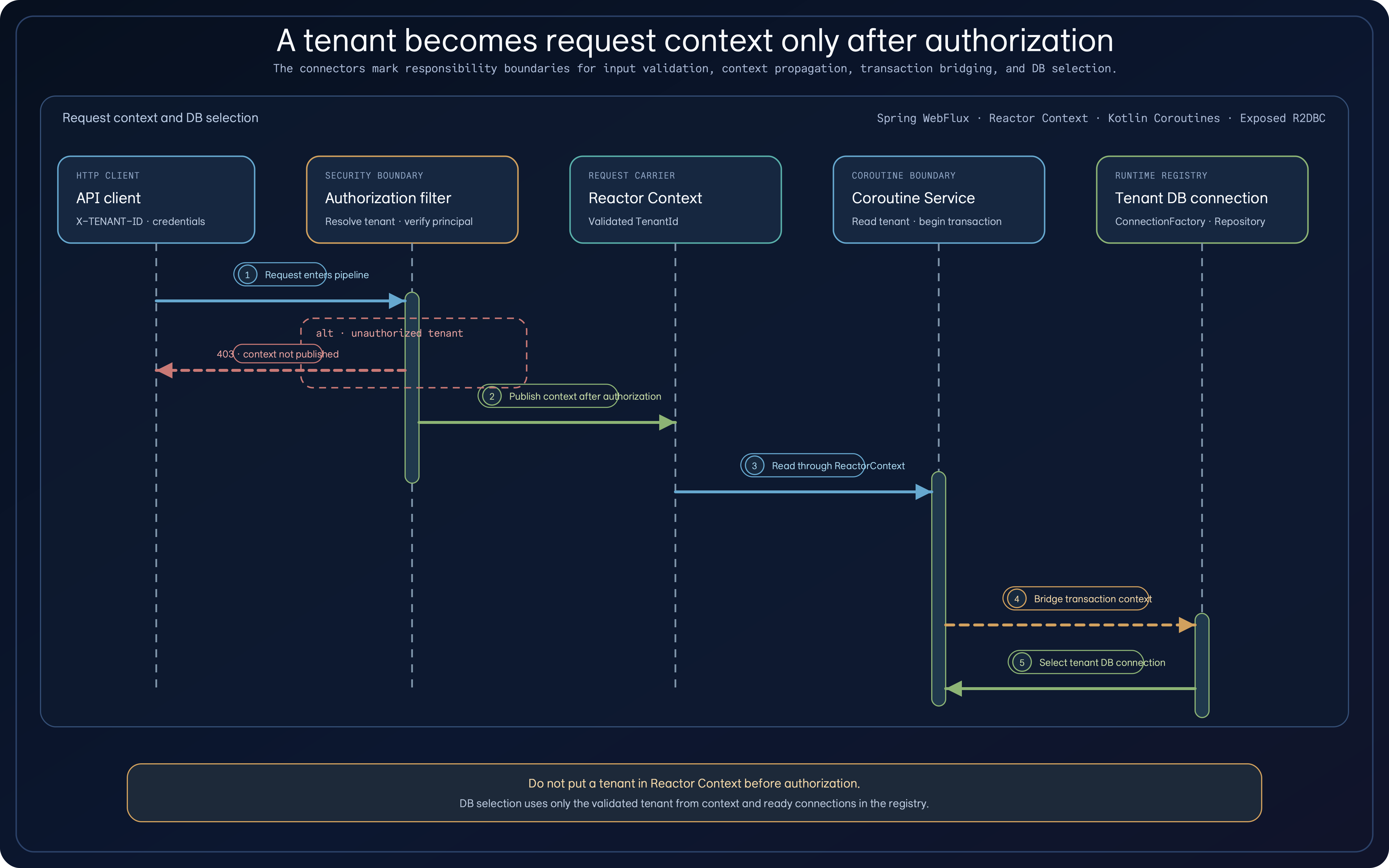
The header is only the starting point. After parsing it, use a validated TenantId, and publish it to request-scoped context only after authorization succeeds.
In WebFlux, a request is not a thread
Section titled “In WebFlux, a request is not a thread”Traditional server code can make it tempting to assume that a request remains on one thread until it finishes. That assumption does not hold in WebFlux. A request can move through several asynchronous execution points, so hiding tenant state in a ThreadLocal is not a safe propagation mechanism.
Project Reactor’s Context is an immutable, subscriber-attached key/value carrier. Once a tenant is in that carrier, it stays available inside the request’s reactive chain even when execution threads change. Entering a Kotlin suspend function is a separate boundary, however: the code must explicitly receive that context there.
Carry the tenant from Reactor Context into a coroutine
Section titled “Carry the tenant from Reactor Context into a coroutine”The basic WebFlux workshop resolves the header to a TenantId in a filter and attaches it to the next chain’s Reactor Context. This is the essential shape.
override fun filter(exchange: ServerWebExchange, chain: WebFilterChain): Mono<Void> = mono {    val tenant = resolveTenant(exchange.request.headers)
    chain.filter(exchange)        .contextWrite { context ->            context.put(TenantId.TENANT_ID_KEY, TenantId(tenant))        }        .awaitSingleOrNull()}
suspend fun currentReactorTenant(): Tenants.Tenant =    coroutineContext[ReactorContext]        ?.context        ?.get<TenantId>(TenantId.TENANT_ID_KEY)        ?.value        ?: error("Tenant context is required")
ReactorContext exposes Reactor context as a CoroutineContext element. A suspend controller or service can therefore read the same tenant from coroutineContext[ReactorContext]. Applying a quiet default tenant to an HTTP request with no tenant is not a safe fallback; fail the request at the boundary.
The per-tenant connection-factory example has one more bridge. TenantTransactionExecutor obtains the current Reactor Context with Mono.deferContextual, attaches it again through mono(bridgedContext), and then runs suspendTransaction. The transaction begins in coroutine code, so that point must reconnect the tenant rather than lose it.
Tenant identification and tenant authorization are different problems
Section titled “Tenant identification and tenant authorization are different problems”Being able to resolve tenant=acme is not the same as proving that the current user may read acme data. Keeping those concerns separate in one filter makes the order explicit.
authenticate(request)requestedTenant = resolveTenant(request)authorize(principal, requestedTenant)publishTenantToReactorContext(requestedTenant)continueFilterChain()AuthorizedTenantContextWebFilter obtains authentication, compares the requested tenant with the tenants allowed for that principal, and does not pass a mismatch to the next filter or controller. The required order is authorize before publishing to Reactor Context. Publishing an unauthenticated or unauthorized value gives downstream code something it might trust.
The authorization model varies by service: a user may belong to one tenant, while an administrator may manage several. The request-boundary order does not vary. Identification → authentication → authorization → context publication lets the data layer assume it receives only a validated tenant.
A validated tenant selects the DB connection
Section titled “A validated tenant selects the DB connection”Tenant isolation has more than one implementation. The workshop shows both changing schemas and selecting a ConnectionFactory per tenant. The choice balances isolation strength against operational cost.
| Strategy | Isolation unit | Benefit | Operational cost |
|---|---|---|---|
| Shared DB, schema per tenant | Schema | Shares one database resource | Connection reuse requires schema-setting and leak tests. |
ConnectionFactory per tenant | Pool, database | Isolates connection and failure scope more strongly | Manages a pool and lifecycle for each tenant. |
In the second approach, TenantRoutingConnectionFactory works with a registry. The transaction executor reads a tenant from context, looks it up in the registry, and selects only that tenant’s registered connection factory. Selecting another tenant as a default is not a recovery strategy. It can violate data isolation, so an unregistered or provisioning tenant must be rejected or reported as not ready.
How does a new tenant enter the routing set?
Section titled “How does a new tenant enter the routing set?”Request routing is enough for tenants that already exist. A SaaS system must apply the same boundary when a customer signs up. Creating a row in a metadata table and preparing the connection factory a live request will use are different events.
Ignoring that difference creates two partial tenants:
- a tenant present in metadata but unable to serve requests because its pool or schema is not ready;
- a tenant with a created pool but no registry entry, so requests cannot find it.
Onboarding bridges those states. Operators must be able to tell whether a tenant is still preparing, can accept requests, or needs recovery.
Separate preparation from publication
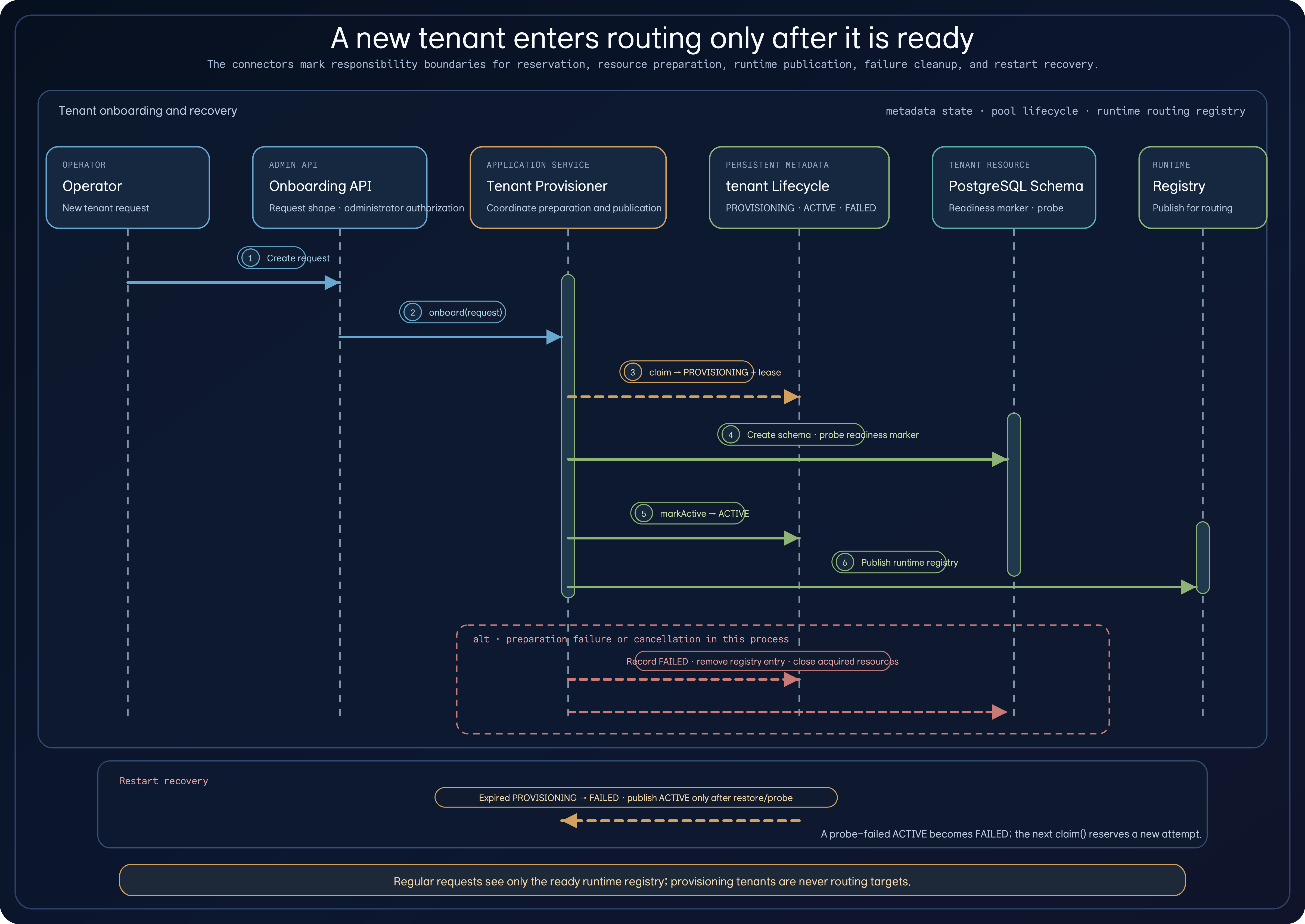
Section titled “Separate preparation from publication”The recovery-oriented example’s ResilientTenantProvisioner first reserves preparation ownership in metadata as PROVISIONING. While renewing a lease, it prepares the actual resources. Only after probing a readiness marker and recording ACTIVE does it publish to the runtime registry. This pseudocode focuses on names and order.
suspend fun onboard(command: TenantOnboardingCommand): TenantOnboardingResult { val owner = lifecycleRepository.claim(...) // PROVISIONING + lease val renewed = lifecycleRepository.renewLease(owner, ...) val resources = resourceFactory.create(renewed.metadata) // schema + readiness marker resourceFactory.probe(resources) val active = lifecycleRepository.markActive(renewed, ...) // ACTIVE runtimeRegistry.publish(resources) // publish for routing return Created(active)}runtimeRegistry.publish() is the in-process publication boundary. Before it runs, a tenant may exist in metadata but no ordinary request can select it. ACTIVE records that durable resources are ready; the runtime registry records that this process can route to resources that passed a probe. Separating preparation and publication makes it possible to reconcile the two again after a restart.
Leave onboarding failure in an operable state
Section titled “Leave onboarding failure in an operable state”Failure handling has two distinct paths. Collapsing them into “store a failed state” hides the operational decision. The example stores stable failure categories in metadata, not raw exception messages or connection details.
| Moment | Workshop behavior | Operational meaning |
|---|---|---|
| Onboarding fails or is cancelled in the same process | Record FAILED and a failure category, remove the registry entry, and close acquired resources | Keep a partial tenant out of the request path while retaining evidence for a retry. |
| After a process restart | Turn expired PROVISIONING into FAILED(RECOVERY); restore and probe ACTIVE before republishing | Reconcile a vanished in-memory registry with durable metadata. |
| A recovery probe fails | Turn the ACTIVE row into FAILED(RECOVERY) and do not publish it | Do not route requests from an old ACTIVE record alone. |
| Onboarding later retries | Update the FAILED row with a new PROVISIONING attempt | Bind retry count and ownership to the new attempt. |
With the PostgreSQL profile, lifecycle metadata lives in public.tenant_lifecycle, while tenant business resources and readiness markers live in a tenant_<tenant-id> schema. A failed probe after schema creation does not automatically drop that schema. It remains for diagnosis and idempotent retry, while the lifecycle row becomes FAILED so ordinary requests cannot select it. An operational service can attach audit logs, alerts, and retry policy to that distinction.
Tests must prove boundaries, not only successful responses
Section titled “Tests must prove boundaries, not only successful responses”A multi-tenant test that merely finds an actor is incomplete. It must prove that values do not leak across tenants and that an unauthorized or unready tenant never reaches the data layer.
| Boundary to prove | Expected result |
|---|---|
| Header and tenant resolution | Missing, blank, and unknown tenants are rejected early. |
| Authenticated tenant and requested tenant | A mismatch is rejected before context publication. |
| Reactor → coroutine propagation | The same tenant is read in a suspend service and transaction. |
| Connection-factory selection | A tenant A request never uses tenant B’s pool or database. |
| Onboarding publication point | Only an ACTIVE tenant published in the current runtime registry is routable. |
| Failure and cancellation | FAILED recording, registry removal, and resource cleanup finish in NonCancellable cleanup. |
| Restart recovery | Expired PROVISIONING and probe-failed ACTIVE become FAILED(RECOVERY); only healthy ACTIVE tenants are republished. |
Boundary 1: an unauthorized tenant is never published to context
Section titled “Boundary 1: an unauthorized tenant is never published to context”Checking only for 403 cannot show where the request stopped. This boundary says that components after authorization must not be able to see the tenant. The workshop’s architecture test permits only AuthorizedTenantContextWebFilter to write the tenant into Reactor Context.
given a principal without access to tenant-a
when GET /actors with X-TENANT-ID = tenant-a
then the response is FORBIDDENand Reactor Context has no TENANT_IDand TenantTransactionExecutor is not calledand tenant-a's ConnectionFactory is not selected
The pseudocode checks the HTTP status and the internal boundary together. An implementation that publishes the raw header first and authorizes later may pass the first FORBIDDEN assertion, but it fails this contract.
Boundary 2: concurrent requests do not mix at DB selection
Section titled “Boundary 2: concurrent requests do not mix at DB selection”Tenant isolation cannot be proved with one request. Alternate tenant A and B under a deliberately small pool, where connection reuse is most frequent, to expose schema or connection-factory leaks.
given connection pool size = 1and tenant-a and tenant-b have distinct actor markers
when requests for A and B run repeatedly and concurrently
then every A response contains only the A markerand every B response contains only the B markerand each request selects its own tenant resourceand no request falls back to another tenant's default resource
The question is not whether both requests return 200. Their response markers and selected resources must match the validated tenant all the way through. The unknown-tenant failure and disabled lenient fallback in TenantRoutingConnectionFactory serve the same purpose.
Boundary 3: provisioning and recovery-failed tenants are not routing targets
Section titled “Boundary 3: provisioning and recovery-failed tenants are not routing targets”An onboarding test that checks only the ACTIVE string is insufficient. Publication to the runtime registry is the real moment the request path can see a tenant, so test the probe and registry together.
given tenant-x is PROVISIONINGor tenant-x is ACTIVE but its readiness probe fails after restart
when the application reconciles durable lifecycle records
then tenant-x is absent from the runtime registryand no ConnectionFactory is selected for tenant-xand lifecycle is retained or changed to FAILED(RECOVERY)
when tenant-y is ACTIVE and its readiness probe succeedsthen tenant-y alone is published to the runtime registry
This proves more than the happy path where a tenant is visible after restart. It proves that incomplete resources cannot leak into ordinary requests. TenantLifecycleReconciler publishes only after probing, and the PostgreSQL restart integration tests lock that contract in place.
Using a small pool and alternating tenant requests is useful for the same reason: connection reuse is frequent enough to reveal a mixed schema or connection-factory choice.
Ktor differs only in the carrier
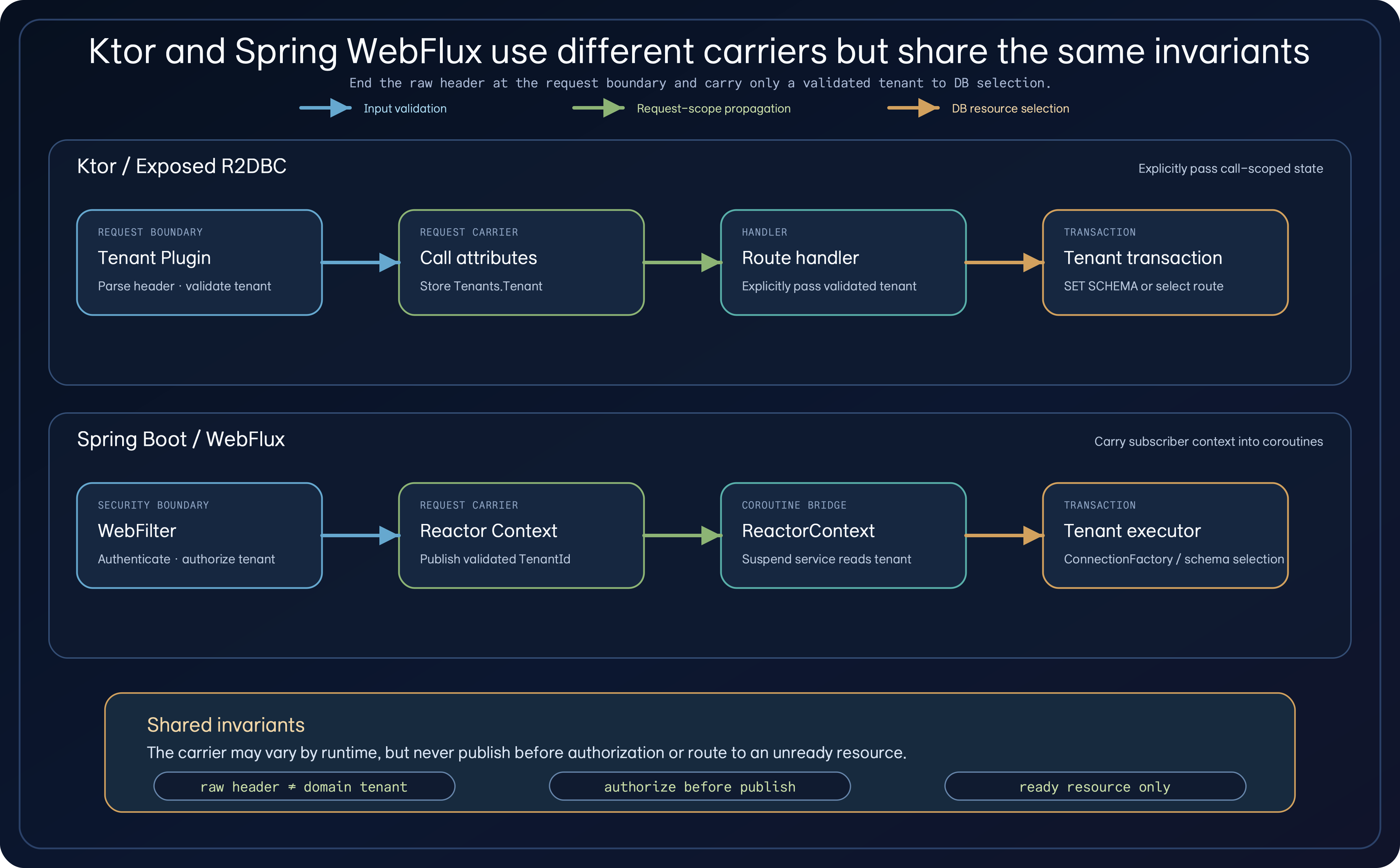
Section titled “Ktor differs only in the carrier”The Ktor post stores request-scoped state in ApplicationCall.attributes and passes validated values explicitly. In WebFlux, Reactor Context and CoroutineContext are the carriers. The invariants are the same.
| Principle | Ktor | Spring WebFlux |
|---|---|---|
| Input validation | Parse the header in a plugin | Parse the tenant in a filter |
| Request-scope propagation | ApplicationCall.attributes | Reactor Context → ReactorContext |
| Authorization boundary | Before the route or in a plugin | Before context publication |
| DB selection | Explicit route or tenant value | Validated tenant read from context |
| New-tenant publication | The registry must be ready before selection | The registry must be ready before selection |
The point is not to copy a carrier. It is to carry only validated values, publish them after authorization, and never select an unready resource—then express those invariants in the runtime’s own tools.
Resources
Section titled “Resources”- Project Reactor Context documentation: explains why subscriber-scoped context differs from thread storage.
- The
ReactorContextAPI in kotlinx-coroutines-reactor: documents the bridge that lets coroutine code read Reactor context. - Spring WebFlux tenant-context workshop: shows the basic path from a header to
ReactorContext. - Per-tenant
ConnectionFactoryworkshop: shows the transaction context bridge and connection-factory selection. - Spring Security tenant-authorization workshop: shows the filter that publishes tenant context after authorization.
- Recovery-oriented tenant-onboarding workshop: covers durable ownership, leases,
FAILEDretry, PostgreSQL schema isolation, and restart recovery. ResilientTenantProvisioner: the concrete order of preparation, validation, activation, runtime publication, and cancellation cleanup.TenantLifecycleReconciler: the restart boundary that rereads metadata and publishes only healthy tenants to the registry.
Closing
Section titled “Closing”The hard part of WebFlux multi-tenancy is not adding another asynchronous API. It is turning a tenant from input into trustworthy request context, preserving that context through coroutines and transactions to DB selection, and keeping a new tenant out of the request path until it is ready.
The request path and onboarding path become easier to reason about when they share the same contract. Put only authorized tenants into context. Put only resources that were validated and published by this process into the registry. With those two publication points made explicit, data isolation and restart recovery can grow with the tenant count.
Comments
Leave a note or reaction with your GitHub account.