How to Keep Multiple Servers from Running the Same Job

Imagine that a rolling deployment finishes and three servers start their schedulers at once. Every server begins aggregating tenant metrics. Every server also tries to run the same schema migration during startup. Code that behaved perfectly on one server now runs the aggregation three times and races the same DDL.
Pinning the work to a configured primaryNode can quiet the system for a while. It also stops the work when that node goes
down. Electing one global leader for the whole cluster solves a different problem: the migration may become exclusive, but
unrelated tenant jobs now wait behind one another.
This post uses the tenant-aggregator
and migration-gate examples from
bluetape4k-leader to separate those two cases. Before asking who the leader is, decide which jobs must never execute at the
same time.
Group the Jobs That Must Not Overlap Under One Key
Section titled “Group the Jobs That Must Not Overlap Under One Key”Leader election allows one owner among callers competing for the same coordination key. The key should therefore describe the conflicting work, not the server that happens to run it.
- Tenant A aggregations must not overlap:
tenant-aggregator:metrics-tenant-A - Tenant B may run beside Tenant A:
tenant-aggregator:metrics-tenant-B - One schema migration must guard the whole cluster:
schema-v3
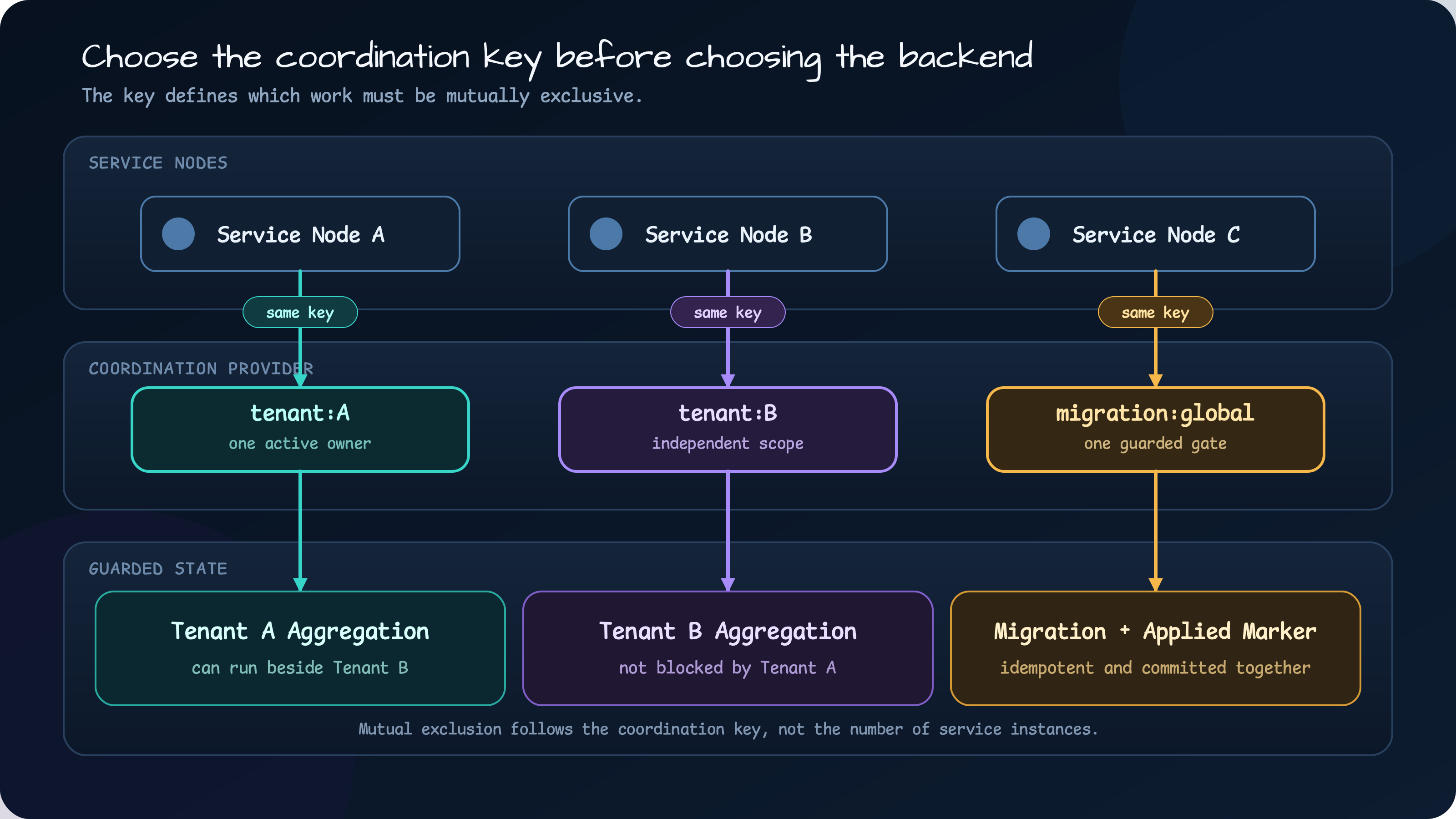
A single global-leader key is easy to explain. It also lets a slow Tenant A aggregation block Tenant B and lets a startup
migration pause scheduled jobs that do not touch the schema. Excessively narrow keys fail in the opposite direction. Two jobs
that update the same state can both enter if they use different keys. A useful key continues to describe the same business
conflict as the number of instances changes.
Serialize Only Work for the Same Tenant
Section titled “Serialize Only Work for the Same Tenant”TenantAggregator
creates a child coroutine and a SuspendLeaderElector for each tenant. It derives the lock name directly from the tenant
scope.
private suspend fun tenantLoop(tenantId: String) {    val lockName = "${options.lockNamePrefix}-$tenantId"    val elector = electorFactory(lockName, electionOptions)
    while (currentCoroutineContext().isActive) {        elector.runIfLeader(lockName) {            runAggregate(tenantId)        }        delay(options.pollInterval)    }}
This is also why the example does not use LeaderGroupElector with several leader slots. A caller cannot control which
tenant receives which slot. Independent lock names encode the intended rule without an assignment layer: one active runner
for the same tenant, concurrent runners for different tenants.
The test proves the concurrency contract instead of relying on its name. It starts three aggregators, tracks the number of coroutines inside each tenant’s action, and records any value above one. Every tenant must make progress while the violation count remains zero.
// arrangeval aggregators = createAggregators(nodes = 3, tenants = DEFAULT_TENANTS)val concurrentRunners = trackConcurrentRunnersByTenant()
// actaggregators.forEach { it.start(scope) }waitUntil { DEFAULT_TENANTS.all { aggregateCount(it) >= 1 } }.shouldBeTrue()delay(2.seconds) // leave time for overlap to surface in later cycles
// assertconcurrentRunners.violations.get() shouldBeEqualTo 0DEFAULT_TENANTS.forEach {    aggregateCount(it) shouldBeGreaterOrEqualTo 1}
One failed aggregation does not poison the polling loop. The example isolates ordinary exceptions from
aggregateFunction and tries again in the next cycle. It rethrows CancellationException, because swallowing cancellation
would prevent stopGracefully from stopping the worker. A supervisorScope keeps one tenant’s failure from cancelling the
other tenant coroutines.
This design proves mutual exclusion for one tenant. It does not make the aggregation exactly once. If the process dies after writing to an external system but before recording completion, the next leader can process the same input. The application still needs a replay-safe boundary such as an aggregation watermark, checkpoint, or idempotent upsert.
A Migration Needs Both a Global Lock and a Completion Marker
Section titled “A Migration Needs Both a Global Lock and a Completion Marker”A migration has a different conflict scope. Three instances changing the same schema should not receive three independent
keys. They should compete for one cluster-wide key such as schema-v3.
The global lock is still not a durable completion record. It says who owns the work now; it does not say that schema-v3
finished during a previous deployment. MigrationGate
uses three marker checks to close that gap.
fun runMigration(id: String): Outcome {    if (isApplied(id)) return Outcome.AlreadyApplied(id)       // precheck
    val outcome = elector.runIfLeader(options.lockName) {        if (isApplied(id)) return@runIfLeader Outcome.AlreadyApplied(id)        migration()                                           // includes marker        Outcome.Migrated(id, elapsedMs())    }
    if (outcome != null) return outcome    return if (isApplied(id)) Outcome.AlreadyApplied(id)       // post-skip    else Outcome.Skipped(id, "lock not acquired")}
The precheck avoids lock contention for completed migrations. The in-lock check catches a migration completed by another
instance after the precheck. An instance that fails to acquire the lock checks the marker again so it can distinguish
AlreadyApplied from Skipped. If the marker lookup itself fails, the gate returns Outcome.Failed; an unknown state is
not equivalent to an unapplied migration.
The three-instance test expects exactly the result implied by that sequence.
// arrange + actval outcomes = runConcurrently(instances = 3) {    gate.runMigration(        migrationId = migrationId,        isApplied = { markerExists(migrationId) },        migration = { migrateAndMarkApplied(migrationId) },    )}
// assertmigrationCalls.get() shouldBeEqualTo 1outcomes.count { it is Outcome.Migrated } shouldBeEqualTo 1outcomes.count { it is Outcome.AlreadyApplied } shouldBeEqualTo 2
There is an important limit. The example’s MigrationGate does not enable autoExtend, so it does not auto-extend its lease. If a migration runs
longer than leaseTime, another instance can acquire the same lock. The migration should therefore be idempotent, and the
schema or data change should be committed with its completion marker in one transaction whenever possible. “A leader ran
it” is not proof of exactly-once execution.
The Next Candidate Can Take Over After the Lease Expires
Section titled “The Next Candidate Can Take Over After the Lease Expires”A leased lock does not survive forever when its owner cannot release it. If Node A stops, Node B first receives a busy result. It can obtain ownership with a new token after the lease expires.
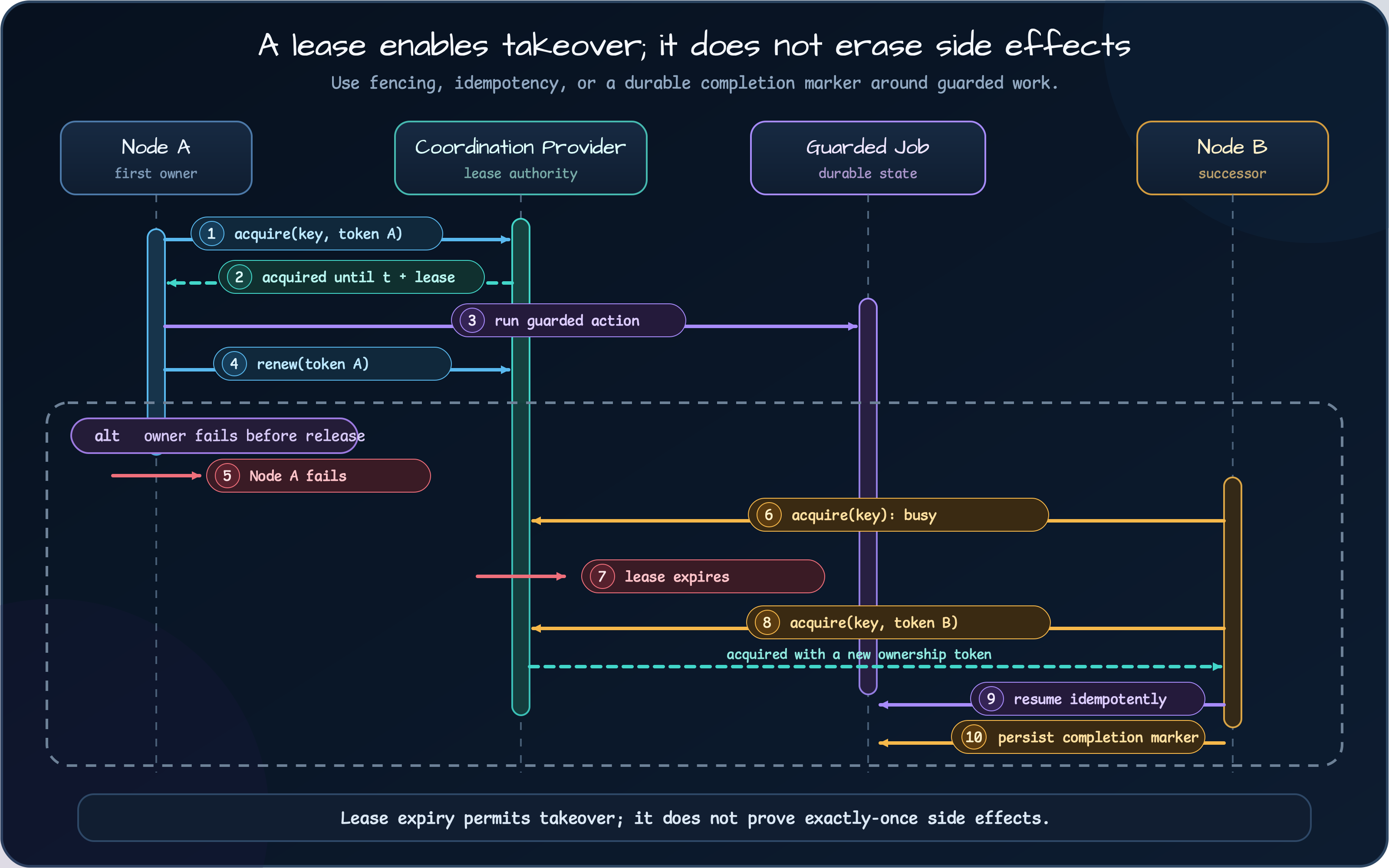
That handoff is often overstated in three ways.
- Failover is not immediate. A successor waits for release or lease expiry.
- It is not exactly once. Node A may complete an external write and die before recording the result, allowing Node B to repeat it.
- Long-running work is not automatically safe. If the action can outlive the lease, add the appropriate combination of extension, fencing tokens, checkpoints, and idempotency.
TenantAggregatorTest starts Node A first, starts Node B while A owns the lock, then stops A and waits for B’s execution
count to increase. The contract being proved is that a candidate takes over and polling continues. It does not prove that
every side effect happened only once.
Cache Warm-Up and Webhook Polling Need Different Boundaries Again
Section titled “Cache Warm-Up and Webhook Polling Need Different Boundaries Again”The same leader API produces different designs when the job stores progress differently.
The cache-warmer example uses one
lock per cache partition. A failed warm-up for one partition does not stop other partitions. It needs parallelism like tenant
aggregation, but the coordination key describes a cache partition instead of a tenant.
The webhook-poller does more than
elect one poller. It atomically claims database rows, reclaims rows after a claim lease, and moves an item to FAILED after
maxAttempts. Leader election reduces overlapping pollers. Durable row state carries the at-least-once delivery and retry
contract.
The coordination key protects entry into the work. A job-specific durable record must still own progress, completion, attempt count, and terminal failure.
Choose a Provider by the Failure Behavior the Job Needs
Section titled “Choose a Provider by the Failure Behavior the Job Needs”A provider ranking drops the conditions that matter most. Consider existing infrastructure, consistency and lease models, recovery behavior, observability, and the operational cost your team can sustain.
| Scenario | Coordination key | Required state | Provider families to consider | Main caution |
|---|---|---|---|---|
| Tenant aggregation | one key per tenant ID | checkpoint or aggregation watermark | Redis, RDB/Exposed, etcd, Consul, ZooKeeper, DynamoDB | tenant count and polling frequency become backend load |
| Schema or data migration | one global key per migration version | applied marker | RDB/Exposed, Kubernetes Lease, etcd, Consul, ZooKeeper | compare execution time with lease time and keep migrations idempotent |
| Cache warm-up | one key per cache partition | partition completion and failure | Redis, RDB/Exposed, Kubernetes Lease | isolate one failed partition from the others |
| Webhook polling | poller or shard key | claim lease, attempts, terminal status | RDB/Exposed plus an election provider suited to the deployment | election and row claims solve different problems |
| One job inside Kubernetes | key includes namespace and job | separate completion state when needed | Kubernetes Lease | k8s-lease is a K3s-backed example, not a separate production backend module |
Redis may be a natural fit when it is already critical infrastructure and the service uses many short-lived locks. An RDB can provide an understandable boundary when completion state belongs beside the job data. Kubernetes Lease suitability depends on whether the same coordination contract is needed outside Kubernetes and how control-plane failures should affect application jobs. etcd, Consul, ZooKeeper, and DynamoDB should be narrowed by the system’s failure model and the team’s operational capacity, not selected because they appear in a support list. Part 5 covers backend implementations and benchmark conditions separately.
Frequent Leadership Changes Are an Operational Signal
Section titled “Frequent Leadership Changes Are an Operational Signal”It is not enough to see that one node ran successfully. Watch for acquisition attempts with no successes, growing backend errors, execution time approaching the lease, and an active gauge outside its expected range.
The prometheus-dashboard
example exposes leader_aop_attempts_total, leader_aop_acquired_total, leader_aop_active, and execution duration from
/actuator/prometheus. Its example alerts cover missing acquisitions, backend errors, task failures, and long executions.
Because leader_aop_active is JVM-local, a cluster dashboard should use
max by (lock_name) (leader_aop_active) instead of summing the gauge.
Lock names can contain tenant IDs, user data, URLs, or values with dangerous cardinality. The example therefore uses
REDACT for metric lock labels by default. Expose only bounded hashes or separate low-cardinality tags when correlation is
necessary. Also note that LockExtender currently provides no direct success or failure metric. An alert based on execution
time approaching the lease is a conservative symptom, not direct evidence of an extension failure.
Six Situations Leader Election Alone Does Not Cover
Section titled “Six Situations Leader Election Alone Does Not Cover”The examples so far show where to place coordination keys, leases, and completion markers. Those rules do not make every job safe automatically. The following cases need contracts owned by the job itself rather than another leader-election option.
- Different jobs update the same state. Suppose the daily aggregation uses
daily-aggregatewhile a historical backfill usesaggregate-backfill. Different names do not prevent both jobs from updating the same summary row. Derive a shared key from the real write conflict, or contain the conflict with database constraints and explicit state transitions. - The action outlives its lease. A two-minute aggregation can overlap a successor when its lease lasts only 30 seconds. Plan for extension failure and combine the appropriate fencing, checkpoint, and idempotency boundaries. A fencing token rejects a stale owner only when the guarded resource validates that token.
- The tenant set changes after startup. The current
TenantAggregatorcreates one coroutine for every entry inoptions.tenantswhenstart()runs. A newly added tenant receives no worker, and a removed tenant’s worker is not retired automatically. A production scheduler needs reconciliation between the desired tenant set and its running workers. - The deployment crosses regions or a network partition. These examples do not establish how each backend behaves under inter-region latency or a partition. Define whether an existing action stops, acquisition fails closed, and retries resume after recovery, then exercise those choices under realistic failure conditions.
- Old and new worker versions run together. A shared key elects one owner during a rolling deployment, but it does not prove that v1 and v2 interpret markers and payloads identically. Giving each version a different key can instead let them overlap. Schema compatibility, marker versions, and drain order belong in the rollout contract.
- An external side effect cannot validate a fencing token. Payment APIs, mail servers, and external webhooks normally cannot consume an internal leader token. A delayed request from a stale owner can still take effect after lease expiry. Use idempotency keys, a durable outbox, result lookup, and reconciliation at that boundary.
Before deployment, ask:
- Can differently named jobs update the same state?
- Can the tenant or shard set change while workers are running?
- Does the worst-case runtime, including pauses, fit inside the lease budget?
- Can the system identify and reconcile a replayed external side effect?
- Do old and new versions interpret the key, marker, and payload the same way?
- Has the selected backend been exercised under latency, disconnection, and recovery?
Operations should reveal more than one successful election: whether acquisitions keep failing, leadership changes more often than expected, work consumes the lease budget, or a takeover repeats a side effect.
Leader election reduces overlapping ownership among servers. The rest of the safety boundary comes from the coordination key, handling for work longer than the lease, durable markers, idempotency, and observability. Before opening a provider matrix, write down which jobs must not overlap and what must remain durable after a failure. The implementation choices then become much more concrete.
This article stops at identifying those boundaries. The follow-up requirements were recorded in
bluetape4k-workshop issue #548. That issue is now
closed, and the proposed integration lab is not present in the repository. Cross-job collisions, lease-overrun
duplication, dynamic tenant membership, network partitions, mixed-version rollouts, and duplicate external side effects
therefore remain boundaries that require separate validation.
Sources
Section titled “Sources”- TenantAggregator.kt
- TenantAggregatorTest.kt
- MigrationGate.kt
- MigrationGateTest.kt
- Cache warmer example
- Webhook poller example
- Kubernetes Lease example
- Prometheus dashboard example
Comments
Leave a note or reaction with your GitHub account.