
[Implementation 2] Appointment State Is More Than an Enum

Part 1 showed that one appointment must satisfy clinic-specific hours, doctors, treatments, equipment, and operating policies. Now we can move to what happens after an appointment exists.
Staff confirm appointment requests and check patients in when they arrive. A treatment room records when care starts and finishes. A patient who never arrives becomes a no-show. A clinic closure moves affected appointments into a rescheduling queue. The Cancel button is not valid at every stage: cancelling completed care or checking in an unconfirmed request may update a database row, but it produces a business record that no longer makes sense.
Appointment state therefore cannot end as a list of strings for a status column. The current state, the business
action that changes it, the allowed next state, the reason, and the history form one contract. This article follows
that contract from requirements to a state machine and API, then shows how implementation review added missing history
queries and cancellation reasons back to the requirements.
Write the Workflow Before Naming the States
Section titled “Write the Workflow Before Naming the States”The repository’s domain model defines the following lifecycle.
| State | Meaning in clinic operations | Typical next action |
|---|---|---|
PENDING | Draft or unsubmitted appointment | Request, cancel |
REQUESTED | Patient request waiting for clinic review | Confirm, request rescheduling, cancel |
CONFIRMED | Clinic has accepted the appointment | Check in, no-show, reschedule, cancel |
CHECKED_IN | Patient has arrived | Start treatment, cancel |
IN_PROGRESS | Treatment is underway | Complete treatment |
COMPLETED | Treatment has finished | Terminal state |
NO_SHOW | Confirmed patient did not arrive | Terminal state |
PENDING_RESCHEDULE | A new time is required after an operational change | Confirm rescheduling, cancel |
RESCHEDULED | Appointment was moved to another schedule | Terminal state |
CANCELLED | Appointment was cancelled | Terminal state |
The first column looks like an enum. The other columns reveal the real problem. CONFIRMED → CHECKED_IN is valid,
but PENDING → CHECKED_IN is not. IN_PROGRESS may move only to COMPLETED, and COMPLETED must not change again.
If the code defines only state values, these rules spread across controller and service if statements. Adding one
path may update some call sites and miss others, and the complete workflow becomes difficult to review. State names and
transition rules need separate representations.
Separate State from Event
Section titled “Separate State from Event”AppointmentState.kt
models states as a Kotlin sealed class. Their names still appear in the database and API, while application code gets
a closed type hierarchy such as AppointmentState.CONFIRMED.
The cause of a change lives separately in
AppointmentEvent.kt.
Request, Confirm, CheckIn, StartTreatment, and Complete need no additional data. Cancel(reason) and
RequestReschedule(reason) carry the reason for the change.
sealed class AppointmentEvent : Serializable { data object Confirm : AppointmentEvent() data object CheckIn : AppointmentEvent() data class Cancel(val reason: String) : AppointmentEvent() data class RequestReschedule(val reason: String) : AppointmentEvent()}This keeps “the current value is CANCELLED” separate from “the user cancelled for this reason.” State is the current
result; an event is the business action that produced it.
AppointmentStateMachine.kt
collects the (current state, event type) → next state rules in one place.
private val transitions = buildMap { put(PENDING to Request::class.java, REQUESTED) put(REQUESTED to Confirm::class.java, CONFIRMED) put(CONFIRMED to CheckIn::class.java, CHECKED_IN) put(CHECKED_IN to StartTreatment::class.java, IN_PROGRESS) put(IN_PROGRESS to Complete::class.java, COMPLETED)}The complete map also covers no-show, rescheduling, and cancellation. transition() throws an
IllegalStateException for an undefined pair, which the API’s
GlobalExceptionHandler
maps to HTTP 409 Conflict.
That distinction from 400 Bad Request matters. COMPLETED is a valid state name. It is simply incompatible with an
appointment that is currently PENDING. The request format is valid; the requested change conflicts with current
resource state.
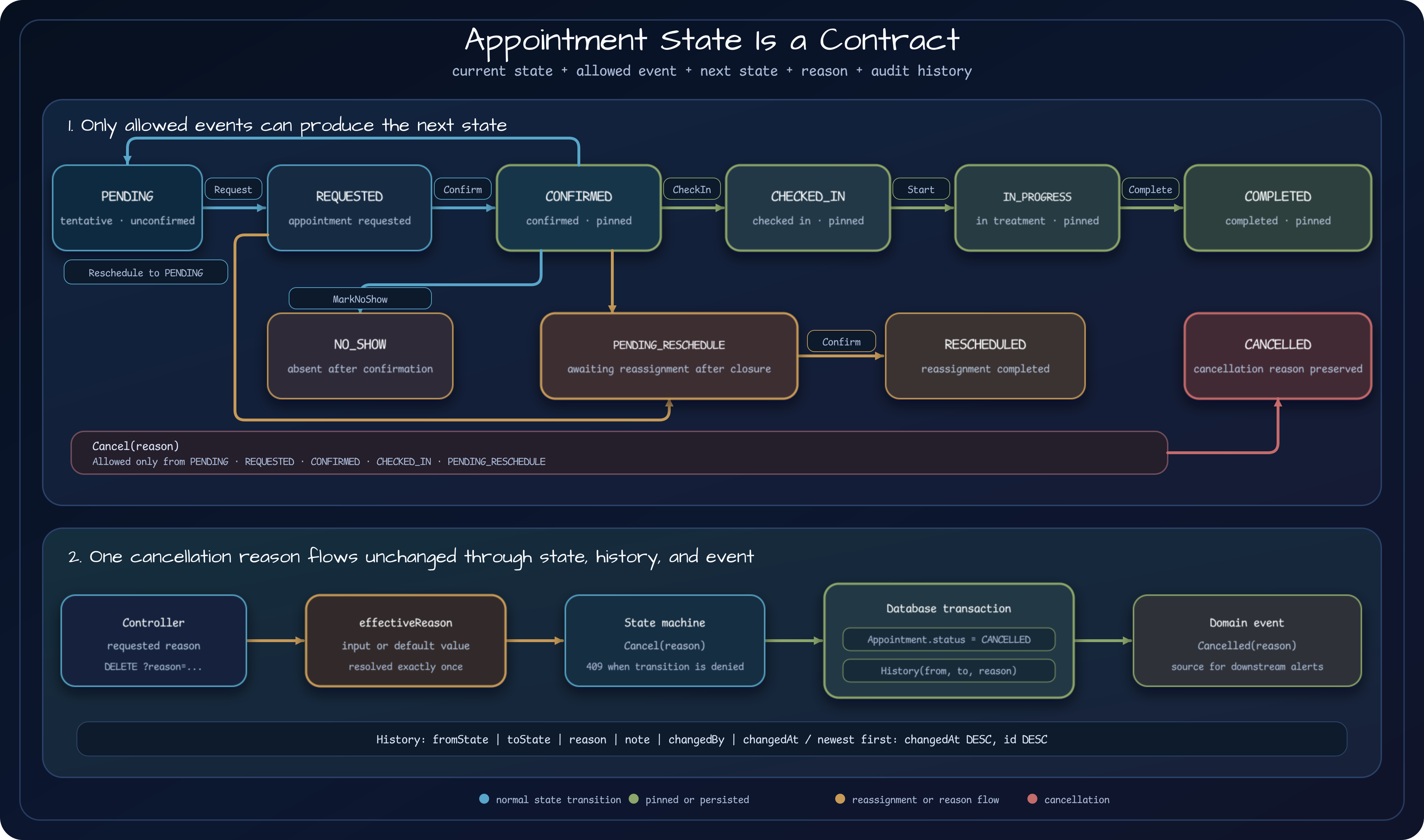
Store Current State and History in One Transaction
Section titled “Store Current State and History in One Transaction”Calculating the next state is not enough. AppointmentService loads the appointment, converts the requested target into an event, and asks the state machine to validate the transition. For an allowed transition, it updates current state and appends history inside one database transaction.
val currentState = record.statusval event = parseEvent(targetStatus, reason)val nextState = stateMachine.transition(currentState, event)
transaction {    appointmentRepository.updateStatus(id, nextState)    stateHistoryRepository.save(        AppointmentStateHistoryRecord(            appointmentId = id,            fromState = currentState,            toState = nextState,            reason = reason,        )    )}
Without the transaction, current state can change while history is lost, or history can claim a change that never became current. History is not auxiliary logging. It is business data that explains how the current value came to be.
AppointmentStateHistory
stores fromState, toState, reason, an optional note, changedBy, and changedAt. The current model makes
reason, note, and changedBy optional. Providing columns for these values and populating them on every transition
are separate completion criteria.
After persistence, the service publishes AppointmentDomainEvent.StatusChanged or Cancelled. The current-state row
supports fast reads, history explains the past, and domain events let other modules react. They carry related facts but
serve different purposes.
That publication has another transaction boundary. The current code commits state and history before calling
Spring’s ApplicationEventPublisher. A listener failure does not roll back the committed database records. This is
useful for in-process reactions, but it is not durable delivery. If notifications must recover together with the state
change, the application needs a transactional outbox, retry, and replay policy. Passing the same reason through every
step is not the same guarantee as committing every step atomically.
A Stored History Still Needs a Read Path
Section titled “A Stored History Still Needs a Read Path”The first implementation appended every transition to history. That seemed to satisfy the requirement until a staff workflow exposed the missing half: when a patient asks, “When and why was this cancelled?”, staff had no way to view the stored records.
The requirement became more concrete:
An authorized user must be able to see when an appointment changed state and in what order.
The project added an appointment-scoped history query that returns transitions, reasons, and timestamps in reverse chronological order. Existing tenant boundaries apply, so one clinic cannot inspect another tenant’s history. This was not an unrelated feature. It completed the operational meaning of “retain state-change history.” Data existing in a table and staff being able to use it are different definitions of done.
One Cancellation Reason Must Reach Every Consumer
Section titled “One Cancellation Reason Must Reach Every Consumer”Cancellation exposed a similar gap. The early path changed the appointment to CANCELLED and recorded a fixed default
reason. Cancellation technically worked, but the API did not capture whether the patient requested it or clinic
operations forced it.
That omission affects more than display text. If history and notification code evolve separately, history may say “patient request” while a notification says “clinic circumstances.” A cancellation reason is shared business data for one action, not optional decoration.
The revised path accepts an actual reason, falls back to the legacy default only when it is absent, and carries the same value through transition validation, history, and the domain event used by notification work. The lower lane of the diagram makes that propagation explicit.
State Also Limits What Timefold May Move
Section titled “State Also Limits What Timefold May Move”State policy reaches beyond the API.
AppointmentState.PINNED_STATUSES
defines CONFIRMED, CHECKED_IN, IN_PROGRESS, and COMPLETED as pinned.
Timefold Solver must not move these appointments just to improve a schedule score. A clinic has already promised a confirmed time, a checked-in patient is physically present, treatment in progress cannot move, and completed care is immutable history. State becomes a boundary on the optimization search space, not merely a rule for which button the UI should show.
Choosing pinned states is therefore an operating policy, not a performance tuning knob. It separates work that the solver may propose from work that people have already committed to.
The Next Requirement Is Transition Identity
Section titled “The Next Requirement Is Transition Identity”History queries and cancellation reasons are now present, but changedBy remains optional and not every transition
path records an actor. If an audit must distinguish automated rescheduling, clinic staff, and a patient request, the
authenticated or system identity must travel all the way into history.
manage appointment state → define allowed transitions in one state machine → persist current state and history together → discover missing read paths and reasons in real workflows → extend the contract with actor identity and tenant boundariesFinishing implementation does not close the requirement. Review must still ask whether users can consume the data, whether every record tells the same story, and how other modules interpret the state.
Correct transitions also do not prove that an appointment time is available. Part 3 combines clinic hours, breaks, doctor schedules, treatment duration, and equipment availability to calculate slots that can actually be booked.
Explore the Implementation
Section titled “Explore the Implementation”- Core appointment module: Appointment states, the state machine, and history models.
- Appointment API module: API workflows that request and persist state changes.
- Appointment state machine: Selects an allowed next state from current state and event.
- Appointment service: Connects transition validation, appointment mutation, and history persistence.
Comments
Leave a note or reaction with your GitHub account.