
[Operations 9] Retries and Replay Must Change an Appointment Only Once

Suppose a client sends POST /appointments and never receives a response. It sends the same request again. The first request may
already have committed an appointment, and its outbox row may already have been relayed. If the relay delivers the event again, the
consumer sees a duplicate. If an exception moved the event to quarantine and STAFF replays it, the same appointment and notification
could be changed twice unless each boundary keeps its own identity.
“The network was unreliable, so run it one more time” is not a sufficient rule. Retrying execution and changing an appointment again are different operations. The service must bind the request, event, and replay to logical identities and reuse results that already exist.
The conclusion is simple:
At the HTTP boundary,
Idempotency-Keyand a request fingerprint connect one request to one appointment create or change. The appointment transaction commits the appointment row and outbox intent together. A consumer useslogicalConsumerIdand event identity to prevent inbox duplicates. A failure becomesRETRYABLE, thenQUARANTINEDafter the attempt limit; STAFF replay is allowed only after checkingrequestId, tenant and clinic scope, and provenance. The flow ends with an explicit Final State Decision:PROCESSED,DUPLICATE,RETRYABLE, orQUARANTINED.
The diagram and operations screen below are synthetic design visuals. They contain no real patient or clinic data. The article also separates what the HTTP idempotency conformance tests prove from operational boundaries that still need process-restart and external provider validation.
A missing response does not tell you that the appointment was unchanged
Section titled “A missing response does not tell you that the appointment was unchanged”When a client receives a timeout after POST /appointments, it should preserve the Idempotency-Key before retrying the same body.
Changing the key gives the server a new command. Reusing it lets the server distinguish these cases:
| Situation | Values checked | Appointment operation | Result returned to the caller |
|---|---|---|---|
| First request | Tenant and clinic scope, Idempotency-Key, request fingerprint | Store the appointment and idempotency record in one transaction | New appointment result |
| Same key and same fingerprint | Existing idempotency record and its appointment | Read the existing result without a new change | Replay the stored appointment result |
| Same key and different fingerprint | Existing record versus the new request | Apply no additional appointment change | Key-reuse conflict (409) |
The current AppointmentService.create looks up tenantGroupId, clinicId, and Idempotency-Key together. A new request stores the
appointment and idempotency row, then leaves the notification intent and appointment outbox in the same transaction. An existing key
is accepted only when its fingerprint matches. If two requests race and one hits a unique constraint, the service reads the stored
result and converges on it.
This boundary does not mean that every retry returns 201. It means that the service checks how the first request ended, whether the key is still within its retention window, and whether the fingerprint is the same before deciding what to return. Once a key expires, the same string may represent a new request, so a caller must retain a key for the life of one business command and understand its expiry policy.
The one-change boundary has three parts
Section titled “The one-change boundary has three parts”Retries and replay cannot be handled by one deduplication table. Three boundaries own different identities:
- HTTP command boundary:
Idempotency-Keyand the fingerprint decide whether two requests are the same command. - Appointment and outbox transaction boundary: the appointment change and the intent to publish its event commit together. The system must not leave an appointment without its outbox row, or an outbox row without the appointment change.
- Consumer and replay boundary:
logicalConsumerId, event identity, replayrequestId, and provenance determine whether a handler and its follow-up side effect may run.
The HTTP key and the consumer inbox key must not be collapsed into one identifier. The HTTP key says that a caller sent the same
command again. The inbox identity says whether one logical consumer already processed one event. A replay requestId records which
scope STAFF approved for another bounded read. Each answer is different, so each identity stays visible in its own contract.
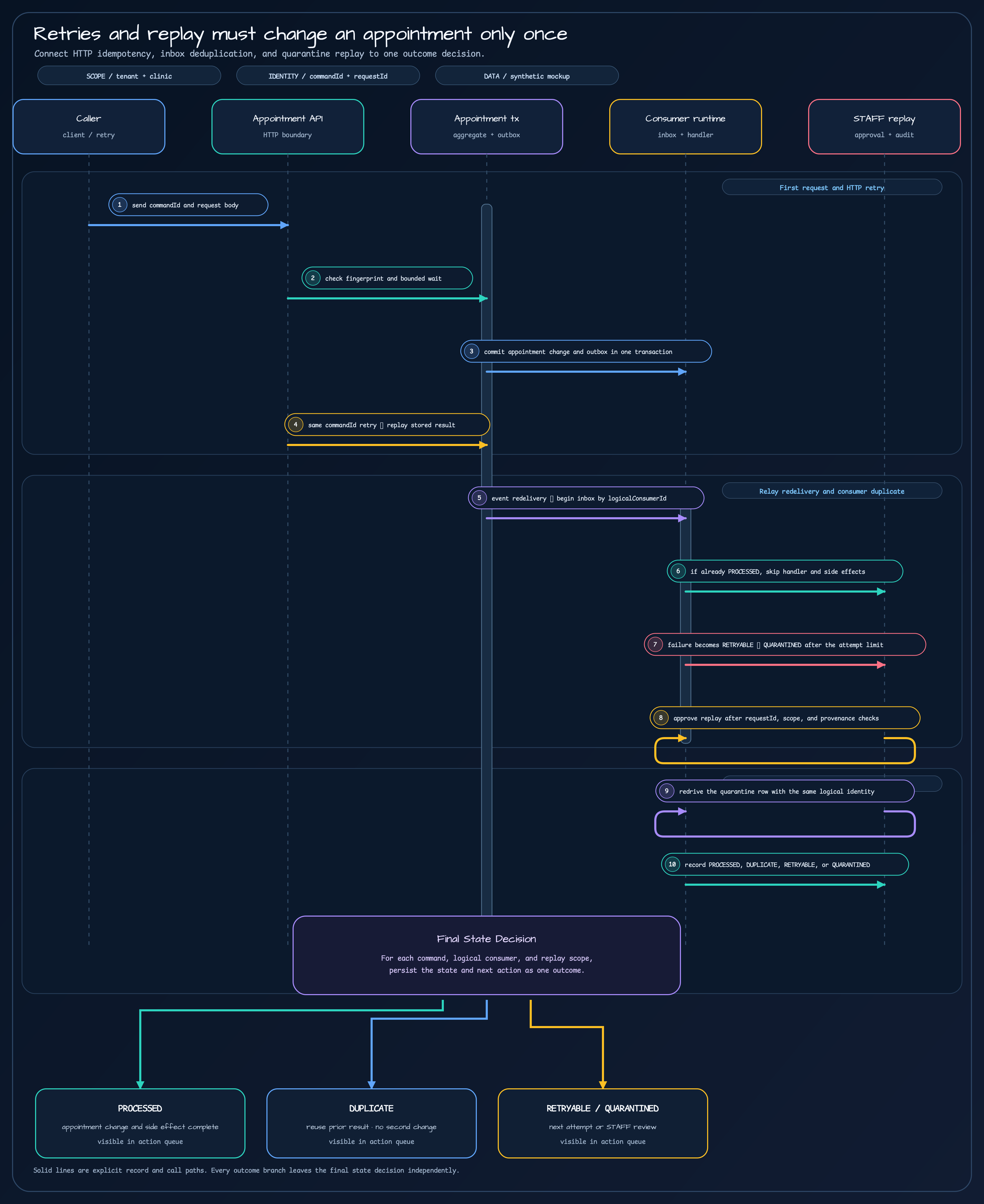
RETRYABLE and QUARANTINED share the STAFF review route but remain distinct states.The appointment transaction records the change and its publication intent together
Section titled “The appointment transaction records the change and its publication intent together”Saving an appointment and then publishing an event through a separate asynchronous call creates a gap between the two operations. A timeout in that gap can leave an appointment changed without an event, while a later retry can publish the event twice and invoke a downstream action twice.
The current implementation keeps these facts in one appointment transaction:
transaction { val appointment = appointmentRepository.save(newAppointmentRecord(request)) idempotencyRepository.save(idempotencyRecord(appointment, requestFingerprint)) notificationWriter.appointmentCreated(tenantGroupId, appointment, appointment.version, resolution) appointmentOutboxWriter.created( scope = TenantClinicScope(tenantGroupId, request.clinicId), appointment = appointment, context = AppointmentMessagingContext.from(commandContext), )}This code does not claim that a provider has already delivered a notification. It records the durable fact that the appointment transaction created the notification intent and the event to be relayed. A relay or consumer can run again later and still decide from the appointment state and outbox identity that already exist.
The consumer inbox turns a duplicate message into a normal outcome
Section titled “The consumer inbox turns a duplicate message into a normal outcome”Kafka and a relay may deliver at least once. Receiving the same event twice is therefore an expected input, not an exceptional
condition. AppointmentConsumerRuntime checks the inbox before calling the handler:
| Inbox state | Meaning | Next handling |
|---|---|---|
PROCESSING | Another worker holds a lease | Wait while the lease is valid or finish as a duplicate |
PROCESSED | This logical consumer already completed the event | Skip the handler and side effect; return DUPLICATE |
RETRYABLE | A temporary error can be attempted again | Check the bounded attempt and lease, then retry |
QUARANTINED | A schema, scope, or handler failure needs review | Stop normal delivery and create a STAFF task |
The identity is not just the event ID. logicalConsumerId and the event identity together express “consumer A processed it while
consumer B has not.” The inbox stores metadata, state, attempt count, lease, and reason without retaining the raw Kafka payload. That
keeps the replay scope narrow and prevents raw patient data from leaking into the operations screen.
After a successful handler call, only the worker that still owns the lease may mark the inbox PROCESSED. A late worker whose lease
expired cannot overwrite the result of the worker that finished first. A temporary database failure instead becomes RETRYABLE, with
its next attempt time and reason available to STAFF.
Quarantine replay is an approved execution of the same logical work
Section titled “Quarantine replay is an approved execution of the same logical work”The most dangerous replay implementation puts a quarantined payload back into the normal consumer path as if it were a new message. That loses the original deduplication identity and scope, so an already completed appointment change or notification can run again.
The current replay boundary checks these values first:
- The STAFF actor is the approver and has the required
APPOINTMENT_REPLAY_OPERATORrole. requestIdhas the canonical form, and a reused request ID matches its existing audit row.- Tenant, clinic, consumer, partition, and offset range match the original provenance.
- The range, maximum records, and maximum execution time are bounded.
- A separate replay consumer group is used without moving the operating consumer group’s offsets.
- The original logical inbox identity is preserved so replay cannot bypass normal deduplication.
Replay is therefore not a new appointment-change command. It is an approved, bounded execution of the same logical work. If any replay
item remains RETRYABLE or QUARANTINED, the result is not wrapped as a success; STAFF receives the next task. DUPLICATE is a
normal outcome because it says that an earlier execution already completed and no second change was applied.
An operations screen should lead with state, evidence, and next action
Section titled “An operations screen should lead with state, evidence, and next action”Showing only “two failures” does not tell STAFF what to do. Every queue row should answer these questions:
- Which tenant and clinic own the appointment?
- Which logical consumer handled the event?
- Did the appointment actually change, was an existing result reused, or can the item be attempted again?
- For quarantine, do
requestIdand provenance fit the approved replay scope? - Is the next action to read, schedule a retry, approve replay, or keep the item quarantined?
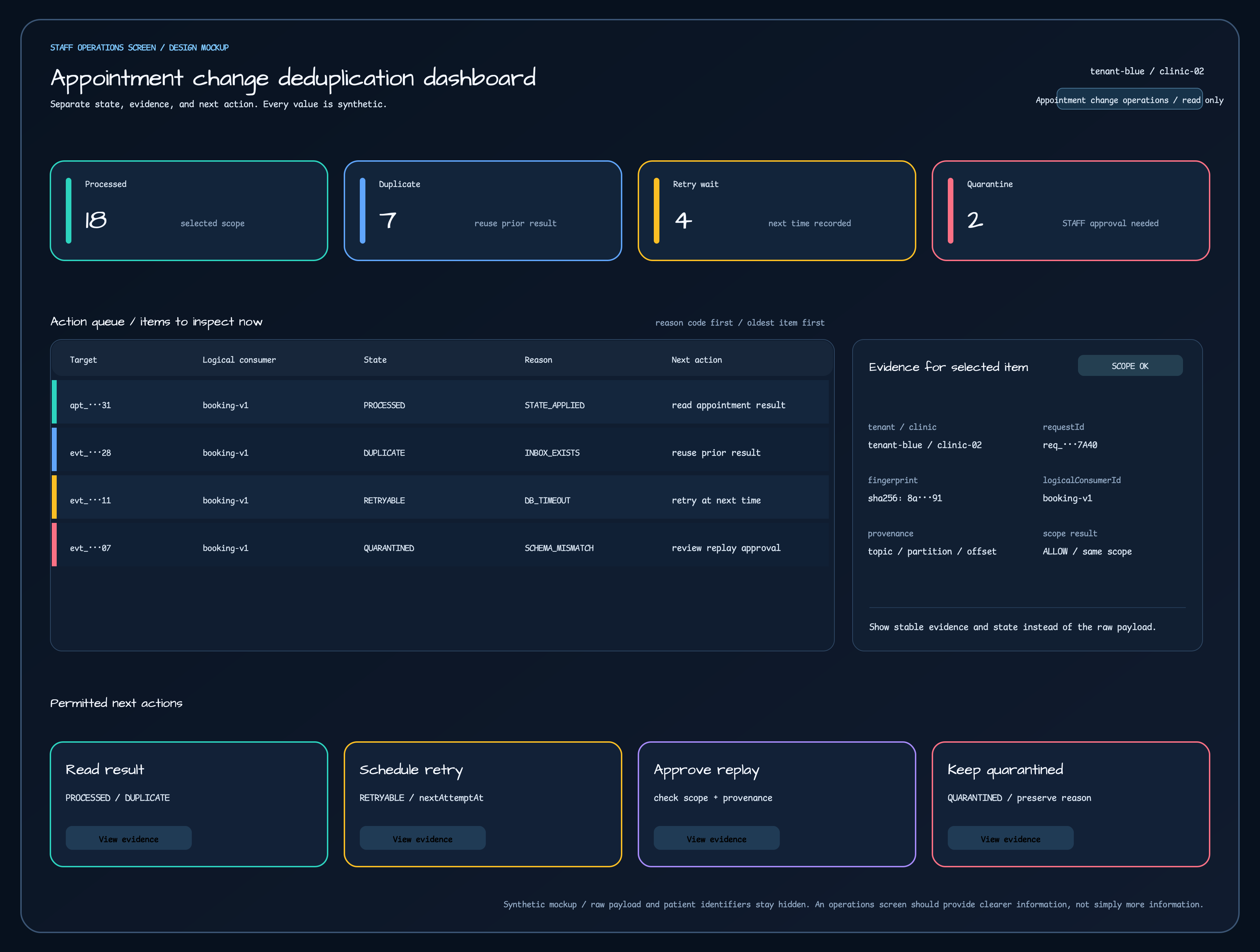
This is a synthetic operations screen. The queue separates rows that may be retried from rows that only need a result read, and shows scope, fingerprint, and provenance instead of the raw payload.
The four metrics also carry different meanings:
| Metric | What STAFF should read | Immediate action |
|---|---|---|
| Processed | The appointment change and required follow-up finished | Read the result and audit evidence |
| Duplicate | An existing inbox or HTTP result was reused | Do not attempt a second change |
| Retry wait | A temporary error and next time are recorded | Recheck at the next attempt time |
| Quarantine | Normal delivery stopped while reason and provenance were retained | Check scope, then approve replay or keep it quarantined |
DUPLICATE does not mean “the operation failed.” It means the system reused a completed result and did not apply a second appointment
change. QUARANTINED does not mean “STAFF must press replay.” If the schema, scope, or provenance cannot be verified, keeping the item
quarantined is the correct next action.
Read implementation, design boundaries, and operational evidence separately
Section titled “Read implementation, design boundaries, and operational evidence separately”Mixing implemented code and unverified production contracts in one claim makes both the article and the operations screen harder to trust. The current evidence divides as follows:
| Category | What this article can verify |
|---|---|
| Implemented now | Tenant and clinic scoped idempotency in AppointmentService, fingerprint conflict, expiry handling, concurrent convergence, and the appointment, notification-intent, and outbox transaction boundary |
| Implemented now | Consumer inbox states PROCESSING, PROCESSED, RETRYABLE, and QUARANTINED, with leases, bounded attempts, and scope checks |
| Implemented now | Replay request audit, a separate replay group, bounded partition/range execution, and preservation of the original logical inbox identity |
| Proven by current tests | Spring MVC HTTP conformance for no-key, terminal replay, fingerprint conflict, expiry, and one appointment under concurrent requests, plus existing durable database replay tests |
| Requires separate operational proof | Recovery after process restart, real broker and database failure recovery, external-provider exactly-once behavior, authorization and rate limits under production traffic |
| Next hardening work | Connect every command and side effect to the same logical identity, then add metrics, alerts, and STAFF drills for replay and quarantine queues |
Passing the HTTP conformance fixture does not prove exactly-once behavior after a process restart or at an external provider. The conformance boundary repeatedly verifies bounded wait, owner/waiter behavior, cancellation, fingerprint handling, and replay-header safety. Durable database and messaging-runtime proofs remain separate tests. This distinction prevents “the test passed” from being read as “every production failure is solved.”
Five checks before STAFF approves a replay
Section titled “Five checks before STAFF approves a replay”- Does the selected tenant and clinic match the event’s replay scope?
- Does
requestIdmatch the audit request already bound to this range and provenance? - Is the logical consumer the original consumer rather than an unrelated group used as a shortcut?
- Is the inbox
QUARANTINEDor an allowedRETRYABLEstate, rather than an alreadyPROCESSEDitem? - Will the result be recorded as
PROCESSED,DUPLICATE,RETRYABLE, orQUARANTINED, with a next action left on the screen?
If any check fails, disable replay and record the reason. Reliability does not come from permitting more retries; it comes from being able to explain how many times one business command was executed and why.
Sources
Section titled “Sources”- Operations 8: Data Boundaries for Running Multiple Clinics in One Appointment Service
- Operations 7: How Appointment Results Reach External Systems and Statistics
- Operations 6: Why Notifications and Reminders Are Separate Services
- HTTP idempotency conformance design
- HTTP idempotency conformance implementation plan
AppointmentService.ktAppointmentConsumerRuntime.ktAppointmentConsumerInboxStore.ktAppointmentReplayService.ktKafkaAppointmentReplaySource.ktAppointmentReplayAuthorization.ktAppointmentConsumerContracts.kt
Comments
Leave a note or reaction with your GitHub account.