
Usage Billing Part 2: Event Sourcing, Replay, and Projection Operations

Part 1 used an immutable ledger to handle duplicate usage, occurrence-time pricing, resumable closing, and post-finalization corrections. That design is enough for many SaaS billing systems.
New requirements change the trade-off: reproduce the aggregate immediately before last month’s close, build another read model from the same facts, or replace a query model without interrupting service. A current-state model can support these requests, but each one needs additional history and restoration logic. Event Sourcing makes replay the primary model while adding permanent responsibility for event contracts, projections, and their failures.
This article uses the
bluetape4k-workshop event-sourced usage-billing example
to define what is authoritative, what can be rebuilt, and where processing must stop when evidence is incomplete.
Preserve the ledger invariants first
Section titled “Preserve the ledger invariants first”Changing persistence does not change the billing rules. The same producer usage must be accepted once, pricing still uses the
version effective at occurredAt, and finalized amounts are corrected by appending adjustments rather than rewriting them.
To make this article readable on its own, here is the complete ledger workflow from Part 1. This is not merely a recap; it is the baseline that must remain valid after adopting Event Sourcing.
- Ingest usage. Receive the tenant, subject, metric, quantity, occurrence time in
occurredAt, and producer event ID. - Accept one fact once. Use the producer event ID and request fingerprint to identify retries. Return the saved result for the same request, but reject a different payload under the same ID.
- Select occurrence-time pricing. Calculate the charge with the price version effective at
occurredAt, not ingestion or processing time, so late-arriving usage still follows the contract that applied when it occurred. - Append the rated result to an immutable ledger. Preserve the usage, price-selection evidence, and calculated amount. Updating only a running total cannot later explain how that amount was produced.
- Close a billing period in resumable stages. Freeze the closing scope and persist the batch cursor so work resumes after interruption without rerunning the entire close or issuing duplicate charges.
- Do not overwrite finalized money. When a post-close error or retroactive change appears, append an
Adjustmentand keep both the original fact and the correction evidence. - Verify the ledger and execution state. Check deduplication, price version, closing cursor, and adjustment relationships, rather than treating a matching total as sufficient proof.
Part 1: Duplicate ingestion, resumable closing, and the ledger explains these invariants and the resumable close in detail. This article repeats that baseline before moving final authority from normalized rows to domain events.
What changes is the unit that records those rules.
| Question | Ledger model | Event Sourcing model |
|---|---|---|
| Final authority | Normalized business rows and immutable ledger | Ordered domain events |
| Current state | Query authoritative tables directly | Replay events or query the ACTIVE projection |
| Historical state | Separate audit query and restoration logic | Replay through a selected stream version |
| Read-model change | Schema and data migration | Rebuild a new projection generation, then switch |
| Operational responsibility | Close, ledger, and correction | Everything on the left plus event contracts, replay, lag, and poison events |
Event Sourcing does not remove the ledger’s meaning. Financial facts such as UsageRated, InvoiceIssued, and
AdjustmentPosted express that ledger as events, while the ledger-oriented query view becomes a projection of those facts.
Make the Event Store the only write authority
Section titled “Make the Event Store the only write authority”The example’s event envelope preserves tenant and stream identity, streamVersion, a monotonically increasing
globalPosition, event type and schema version, canonical payload and metadata, occurrence and recording time, and the
previous and current hashes.
Its two ordering fields solve different problems:
streamVersionprotects aggregate transitions and optimistic concurrency inside one stream.globalPositiongives projections a cursor across multiple streams.
A command replays its stream and appends new events with the expected version. If another command has advanced that stream, the append fails. The caller must replay the latest state and make the business decision again.
transaction {    receipt = commandReceipts.acquire(idempotencyKey, requestFingerprint)    if (receipt is Replay) return receipt.savedResponse
    current = replay(eventStore.load(stream))    newEvents = decide(current.state, command)
    appended = eventStore.append(        stream = stream,        expectedVersion = current.streamVersion,        events = newEvents,    )
    commandReceipts.complete(receipt.ownerToken, responseFor(appended))}
Keeping the command receipt and domain append in one transaction prevents a retry after a lost response from creating a second fact. A different request fingerprint under the same idempotency key is rejected at the transport boundary. A command that loses the race for a stream version is rejected at the business-state boundary. The two safeguards do not pretend these are the same failure.
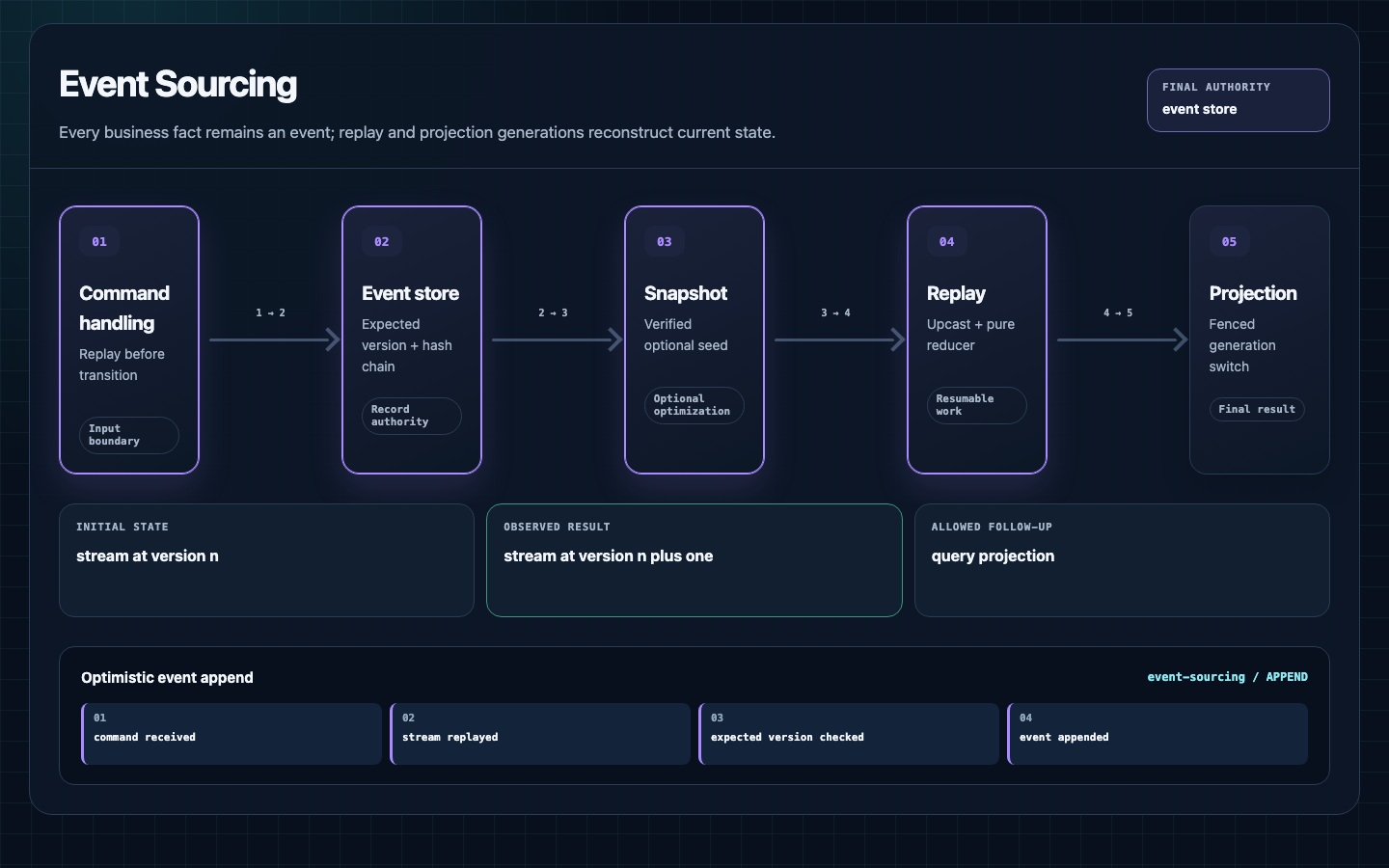
Explore the Event Sourcing flow interactively
Replay is more than iterating over events
Section titled “Replay is more than iterating over events”If replay reconstructs billable state, it cannot silently accept damaged history or a stale snapshot. The example fixes the following validation procedure:
- Load the latest snapshot. If none exists, begin with the initial state and stream version
0. - Validate whether the snapshot is usable. Its reducer version must match the current code, and the event hash at its
stream version must equal
lastEventHash. - Discard a snapshot that fails validation. Do not patch selected fields or continue from it. Return to the initial state and replay the complete stream.
- Read later events in order. Start after the valid snapshot’s
streamVersion, or at the beginning when no snapshot was accepted. - Verify the hash chain before applying each event. The current event’s
previousHashmust connect to the preceding event hash. Stop immediately on a mismatch. - Convert to the current schema and calculate state. Apply the ordered upcasters, decoder, and pure reducer.
- Advance the verification baseline. Update the state,
streamVersion, and final event hash. After replay, these values become the input for snapshots and reconciliation.
The following pseudocode shows where snapshot acceptance and per-event verification occur in that procedure:
snapshot = snapshotStore.latest(stream)seed = snapshot.takeIf {    it.reducerVersion == currentReducerVersion &&        eventStore.hashAt(stream, it.streamVersion) == it.lastEventHash}
state = seed?.state ?: initialStateversion = seed?.streamVersion ?: 0previousHash = seed?.lastEventHash
for (stored in eventStore.load(stream, afterVersion = version)) {    verifyHashChain(stored, previousHash)    currentEvent = eventCodecs.upcastAndDecode(stored)    state = reducer.evolve(state, currentEvent)    version = stored.streamVersion    previousHash = stored.eventHash}
A snapshot is an optional replay optimization, not authority. If its reducer version or last event hash does not match, the system discards it and replays from genesis. The same event sequence must always produce the same state, version, and final hash.
The hash chain detects later changes to payload, metadata, or ordering. It is not a signature or an independent trust anchor, however. Defending against an actor who can rewrite both the database and its hashes requires a separate security design such as key management, signatures, or external retention.
Event contracts must keep old history readable
Section titled “Event contracts must keep old history readable”A conventional migration can rewrite old rows into a new schema. Event Sourcing preserves the original fact, so today’s code must still understand yesterday’s schema version.
The example’s EventCodecRegistry registers one latest decoder per event type and a chain of single-version upcasters. A move
from UsageAccepted v1 to v3 therefore requires both v1 → v2 and v2 → v3. Startup validation detects a missing link, and
replay fails instead of skipping an unknown version.
This produces four operating rules:
- Do not bulk-rewrite stored event payloads into the latest schema.
- An upcaster adapts an old payload to today’s decoder input without inventing new business meaning.
- Before deploying a reducer, replay representative streams and old snapshots in tests.
- A broken upcast chain or hash mismatch stops processing instead of producing a partial bill.
A projection is persistent derived data that can be verified repeatedly
Section titled “A projection is persistent derived data that can be verified repeatedly”Replaying every event on every billing-summary request makes latency proportional to stream length. Queries therefore use a projection built by applying events in order. The projection is not authority: when it disagrees with the Event Store, rebuild the projection rather than altering events to match the view.
An online rebuild must not empty the table that serves current traffic. The example preserves the ACTIVE generation and
builds a new generation under a separate key space.
1. Capture the Event Store high watermark.2. Create generation N+1 in BUILDING state.3. Apply events in global-position batches.4. Verify that the checkpoint reached the high watermark.5. Revalidate the current lease owner and fencing token.6. Conditionally switch the ACTIVE alias from N to N+1.7. Keep N as RETIRED while monitoring lag and reconciliation.Each applied event is unique by (projectionName, generation, eventId), and only the current lease owner may advance the
checkpoint. The switch also checks that the expected ACTIVE generation has not changed. Fencing prevents a stale worker from
overwriting a checkpoint or alias after its ownership has expired.
Isolate an unprocessable event from the healthy read path
Section titled “Isolate an unprocessable event from the healthy read path”If a decoder, upcaster, or handler cannot process an event, skipping it is unsafe. The resulting projection may answer quickly while omitting money.
The worker records the failed event ID, type, global position, and failure digest, then moves the generation it was building to
FAILED. A failed shadow generation does not replace the existing ACTIVE generation or its query alias.
| Failure | Detection signal | Protective behavior | Operator action |
|---|---|---|---|
| Invalid snapshot | Reducer version or last event hash mismatch | Discard the snapshot and replay from the beginning | Investigate snapshot creation and compare it with replay |
| Event hash mismatch | Hash-chain validation error | Stop replay immediately | Investigate Event Store integrity and mutation paths |
| Broken upcast path | Unknown schema version | Fail processing | Add the missing single-version upcaster and regression test |
| Projection handler error | Failed event and failure digest recorded | Quarantine the event and mark the generation FAILED | Fix the cause and rebuild a new generation |
| Growing projection lag | Gap between checkpoint and high watermark; bounded read-your-write returns 409 | Do not present stale data as current | Inspect lease, checkpoint, and capacity; catch up at a bounded rate |
| No ACTIVE generation | The query alias has no valid target | Keep an incomplete BUILDING generation hidden | Restore a verified RETIRED generation temporarily or rebuild from the beginning |
| Failed switch condition | Expected ACTIVE generation or fencing token mismatch | Preserve the ACTIVE alias | Revalidate the high watermark and current lease ownership |
Forcing a FAILED generation to ACTIVE or deleting the problematic event is not recovery. Repair the contract, build a new
generation from the beginning, reconcile its totals with authoritative replay, and switch only after those checks pass.
A running worker is not sufficient evidence of recovery. Verify these conditions in order:
- Fix the Event Store high watermark and create a new
BUILDINGgeneration. - Repair the cause of every quarantined event without deleting or overwriting the original Event Store record.
- Replay the new generation from the beginning and verify that its checkpoint reaches the high watermark.
- Reconcile aggregate replay, ledger totals, and projection totals.
- Switch the ACTIVE alias conditionally with the current lease owner and fencing token.
- After the switch, observe lag and bounded read-your-write failures and close the quarantine record.
Do not edit a FAILED state or remove the existing ACTIVE generation before all six conditions pass. A verified RETIRED
generation may preserve the read path while a new generation is built, but responses and telemetry must expose the gap between
that generation’s position and the current high watermark.
When not to choose Event Sourcing
Section titled “When not to choose Event Sourcing”Event Sourcing is not a higher maturity level for billing. If most answers below are “no,” the immutable ledger from Part 1 is the better model.
- Must the system reproduce aggregate state at a specific historical version?
- Must it repeatedly create different read models from the same source facts?
- Must event causality be retained as evidence for audits or disputes?
- Can the team operate projection lag, rebuilds, upcasters, and poison-event runbooks?
Normalized tables are simpler when the system needs current-state queries plus an auditable ledger. When replay and multiple projections are core requirements, the cost of Event Sourcing becomes the operational cost of satisfying those requirements, not incidental complexity.
Where the series goes next
Section titled “Where the series goes next”- Usage Billing Part 1: Duplicate Ingestion, Resumable Closing, and the Ledger
- Usage Billing Part 2: Event Sourcing, Replay, and Projection Operations
- Usage Billing Part 3: Microservices, Outbox, and Inbox
- Usage Billing Part 4: Detection, Isolation, Reprocessing, and Reconciliation
- Integrated interactive visualization
Part 3 will cross the boundary of one application and examine how Meter, Usage, Billing, and Invoice services divide delivery and deduplication responsibilities with Outbox, Kafka, and Inbox while owning separate data.
Implementation and related resources
Section titled “Implementation and related resources”- Usage Billing Part 1: Duplicate Ingestion, Resumable Closing, and the Ledger: The idempotency, occurrence-time pricing, immutable ledger, resumable close, and adjustment contracts that remain valid before and after Event Sourcing.
- Event-sourced usage-billing README: The complete authority model, execution guide, and failure runbook.
AggregateReplayer.kt: Snapshot validation, hash-chain verification, upcast and decode, and pure reducer application.EventSourcingControllers.kt: The transaction boundary around command receipts and event append, plus projection position and bounded read-your-write waits.ProjectionWorker.kt: Batched application, leases, checkpoints, and failed-event quarantine.ProjectionRecoveryPostgresIntegrationTest.kt: PostgreSQL evidence that a failed generation is isolated while the healthy ACTIVE read path remains available.- Interactive usage-billing evolution: Compare the ledger, Event Sourcing, and microservice structures through the same billing scenario.
- Martin Fowler’s Event Sourcing overview: The foundational model of retaining event sequences as the record and reconstructing state through replay.
- Microsoft Azure Architecture Center: Event Sourcing pattern: A practical summary of event stores, optimistic concurrency, materialized views, event versioning, and adoption trade-offs.
Comments
Leave a note or reaction with your GitHub account.