
Building bluetape4k-dependencies Part 1: Why the BOM Became Necessary

Version management is simple when there is only one library.
implementation("io.github.bluetape4k:bluetape4k-core:1.11.0")Release a new version, write the note, and let users choose that version. The problem starts when the library family is not one repository anymore.
bluetape4k is split across projects, exposed, aws, image, text, graph, leader, and javers. Each
repository has its own development pace and release version. That creates two different questions.
Maintainer:  projects 1.11.0 is out,  exposed 1.11.0 is out,  aws 0.4.0 is out,  image 0.3.0 is out...
User:  Which combination is safe to use together?
Once that question appears, version management is no longer one build.gradle.kts line. The maintainers need to publish
the train, not just the individual cars. Otherwise every user project becomes a dependency puzzle.
The Familiar Model Is Spring Boot Dependencies
Section titled “The Familiar Model Is Spring Boot Dependencies”JVM developers already use this model. A Spring Boot application usually does not choose every Spring, Jackson, Tomcat, Netty, and Micrometer version by hand.
dependencies {    implementation(platform("org.springframework.boot:spring-boot-dependencies:4.1.0"))
    implementation("org.springframework.boot:spring-boot-starter-web")    implementation("org.springframework.boot:spring-boot-starter-actuator")}
Maven imports the same contract through dependencyManagement.
<dependencyManagement> <dependencies> <dependency> <groupId>org.springframework.boot</groupId> <artifactId>spring-boot-dependencies</artifactId> <version>4.1.0</version> <type>pom</type> <scope>import</scope> </dependency> </dependencies></dependencyManagement>The point is not that Spring Boot chooses every dependency in the world. The point is the published combination.
spring-boot-dependencies 4.1.0 -> use the dependency version set expected by that Spring Boot linebluetape4k-dependencies solves the same shape of problem at a smaller scale.
Split Repositories Scatter Versions
Section titled “Split Repositories Scatter Versions”Each repository can manage its own release line well enough inside its boundary.
bluetape4k-projects -> 1.11.0bluetape4k-exposed -> 1.11.0bluetape4k-aws -> 0.4.0bluetape4k-image -> 0.3.0bluetape4k-text -> 0.2.1bluetape4k-graph -> 0.5.1bluetape4k-leader -> 0.4.0bluetape4k-javers -> 0.2.1But a user application brings those repositories back onto one classpath.
dependencies { implementation("io.github.bluetape4k:bluetape4k-core:1.11.0") implementation("io.github.bluetape4k.exposed:bluetape4k-exposed-jdbc:1.10.0") implementation("io.github.bluetape4k.aws:bluetape4k-aws-spring-boot:0.4.0") implementation("io.github.bluetape4k.leader:bluetape4k-leader-spring-boot:0.3.1")}This can compile. That is what makes it risky. Runtime failures from a mixed Spring Boot, Ktor, Netty, Fabric8, or storage-client line are much less pleasant than an immediate compile failure.
A BOM Publishes the Version Set
Section titled “A BOM Publishes the Version Set”The central BOM is the contract users import.
upstream library repositories -> each repository publishes its own BOM -> bluetape4k-dependencies combines those sub-BOMs -> users import one bluetape4k-dependencies BOM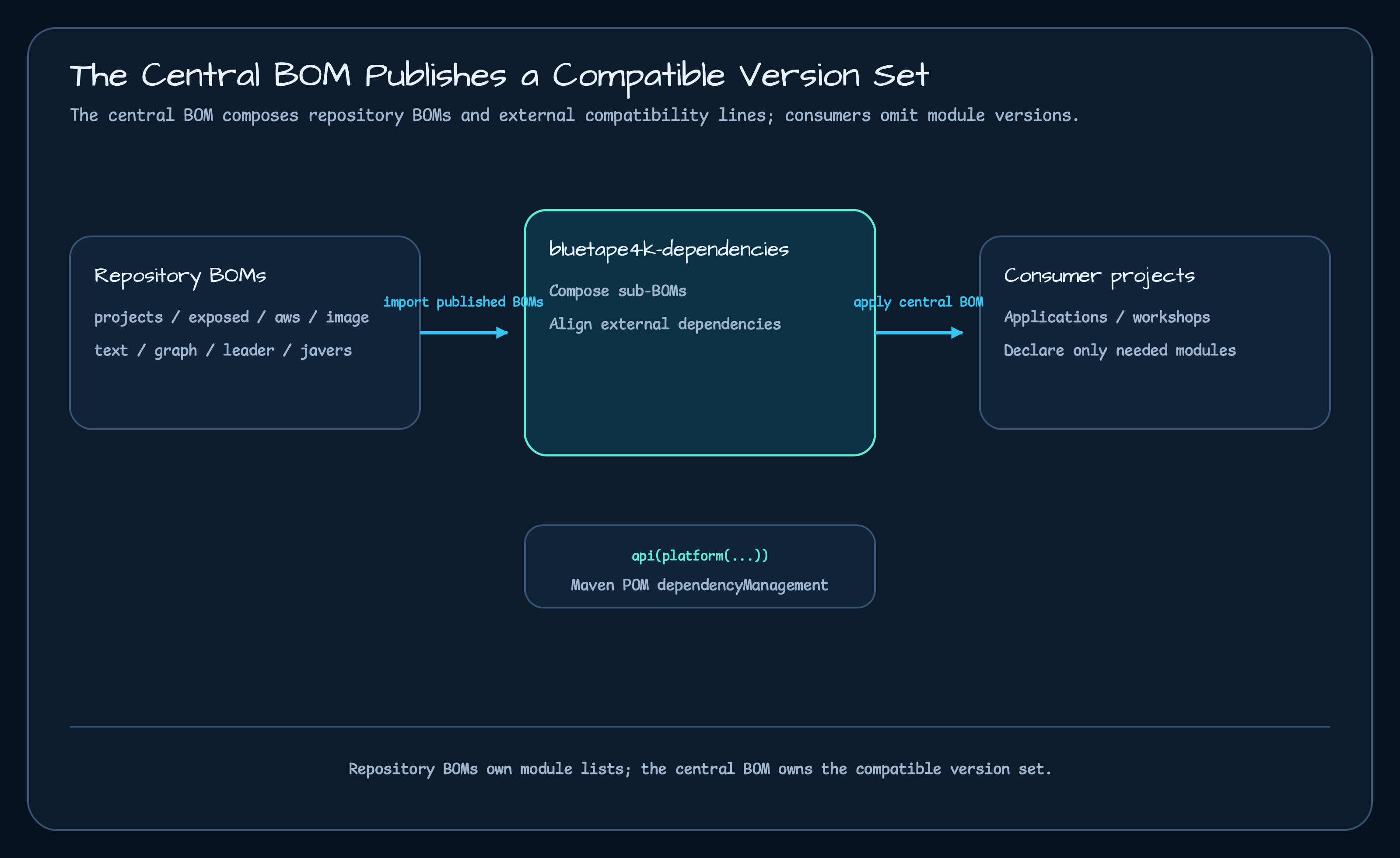
bluetape4k-dependencies publishes the combination, and user projects omit versions on individual modules.bluetape4k-dependencies 1.3.0 means a combination like this:
| Included BOM | Version |
|---|---|
io.github.bluetape4k:bluetape4k-bom | 1.11.0 |
io.github.bluetape4k.exposed:bluetape4k-exposed-bom | 1.11.0 |
io.github.bluetape4k.aws:bluetape4k-aws-bom | 0.4.0 |
io.github.bluetape4k.image:bluetape4k-image-bom | 0.3.0 |
io.github.bluetape4k.text:bluetape4k-text-bom | 0.2.1 |
io.github.bluetape4k.graph:bluetape4k-graph-bom | 0.5.1 |
io.github.bluetape4k.leader:bluetape4k-leader-bom | 0.4.0 |
io.github.bluetape4k.javers:bluetape4k-javers-bom | 0.2.1 |
Users should not have to memorize that table. That is the job of the BOM.
dependencies {    implementation(platform("io.github.bluetape4k:bluetape4k-dependencies:1.3.0"))
    implementation("io.github.bluetape4k:bluetape4k-core")    implementation("io.github.bluetape4k.exposed:bluetape4k-exposed-jdbc")    implementation("io.github.bluetape4k.aws:bluetape4k-aws-spring-boot")    implementation("io.github.bluetape4k.leader:bluetape4k-leader-spring-boot")}
The First 1.0.0 Contract
Section titled “The First 1.0.0 Contract”The first decision for bluetape4k-dependencies 1.0.0 was not automation. It was the public contract.
| Item | Audience | Artifact |
|---|---|---|
| BOM | User dependency resolution | io.github.bluetape4k:bluetape4k-dependencies |
| Gradle Version Catalog | bluetape4k repository build aliases and plugin/library versions | gradle/libs.versions.toml |
Both matter, but they do not have the same reader. Application developers import the BOM. Maintainers coordinating several bluetape4k repositories also need the catalog because it is the build-authoring source of truth.
BOM:  published to Maven Central  imported by applications and external users  directly affects dependency resolution
Catalog:  used by bluetape4k repositories in build scripts  pinned by git ref  owns Gradle plugin/library aliases and shared version lines
Mixing those explanations makes both sides harder to understand.
Use java-platform for the BOM
Section titled “Use java-platform for the BOM”The implementation uses Gradle’s java-platform plugin.
plugins {    `java-platform`    `maven-publish`    signing}
javaPlatform {    allowDependencies()}
dependencies {    api(platform(libs.bluetape4k.bom))    api(platform(libs.bluetape4k.aws.bom))    api(platform(libs.bluetape4k.image.bom))    api(platform(libs.bluetape4k.text.bom))    api(platform(libs.bluetape4k.graph.bom))    api(platform(libs.bluetape4k.leader.bom))    api(platform(libs.bluetape4k.exposed.bom))    api(platform(libs.bluetape4k.javers.bom))
    constraints {        api(libs.exposed.core)        api(libs.fabric8.kubernetes.client)        api(libs.ktor.bom)        api(libs.netty.bom)        api(libs.testcontainers.bom)    }}
The central BOM should not repeat every artifact when each repository already publishes its own BOM.
Weak direction:  list every bluetape4k artifact version again in the central BOM
Better direction:  each repository BOM owns its modules  the central BOM combines sub-BOMs and common external dependency lines
Maintainer Workflow Gets Stricter
Section titled “Maintainer Workflow Gets Stricter”The BOM makes users’ build files simpler, but it makes the release workflow less forgiving.
1. Publish upstream repositories.2. Confirm upstream BOM artifacts are visible on Maven Central.3. Update bluetape4k-dependencies to those BOM versions.4. Validate the central BOM with build and publishToMavenLocal.5. Publish bluetape4k-dependencies last.6. Move workshops/examples/applications by changing the BOM version.If bluetape4k-dependencies points at aws 0.4.0 before the AWS BOM is visible on Maven Central, user dependency
resolution fails. That is not a user code bug. It is a release-order bug.
Maven Central Has No Rollback Button
Section titled “Maven Central Has No Rollback Button”Local builds and snapshots can be fixed and retried. A released Maven Central artifact cannot be overwritten with the same version.
1.3.0 was released.The POM metadata or dependency combination is wrong.The same 1.3.0 cannot be uploaded again. -> release a new version such as 1.3.1That is why 1.3.1 followed 1.3.0 as a patch around metadata and release guidance. It was not glamorous feature
work, but it made the next user’s path cleaner.
Applying This to Another Library Family
Section titled “Applying This to Another Library Family”If you maintain several libraries that are meant to be used together, start with these questions.
| Question | What to check |
|---|---|
| Do users need more than one library together? | Publish the combination as an artifact, not only as documentation. |
| Does each repository have its own BOM? | Let the central BOM import sub-BOMs instead of repeating every artifact. |
| Are the public contract and internal build aliases separate? | Separate BOM and catalog audiences. |
| Is release order explicit? | Verify upstream artifacts before publishing the central BOM. |
| Are you assuming a release can be overwritten? | Recover Maven Central releases with patch versions. |
The point is not more automation first. The first decision is the version combination you are willing to promise.
Read Next
Section titled “Read Next”This post covered why bluetape4k-dependencies exists and what public contract was set in 1.0.0. The next parts cover
the 1.0.0 public BOM shape and the release-train mistakes that were removed by the 1.3.x line.
Series
Section titled “Series”For the user-facing import path, start with the usage guide.
- Building bluetape4k-dependencies Part 1: Why the BOM Became Necessary
- Building bluetape4k-dependencies Part 2: Making the 1.0.0 BOM a Public Contract
- Building bluetape4k-dependencies Part 3: Maven Central Has No Rollback Button
Comments
Leave a note or reaction with your GitHub account.