
Coroutine and Flow Extensions
Archived Based on Bluetape4k release 1.11.0
Problem
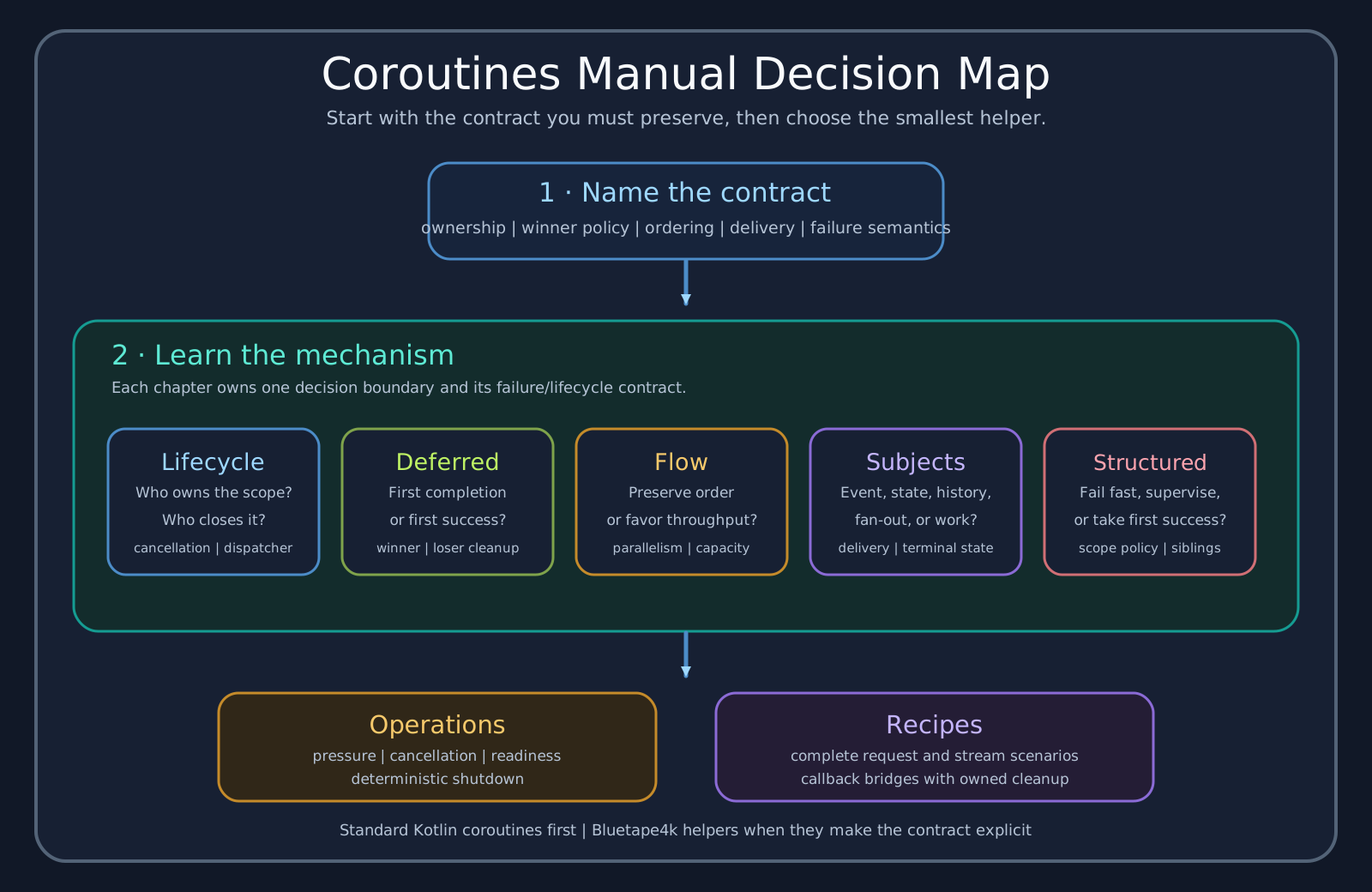
Section titled “Problem”Kotlin coroutines provide the primitives, but backend code still repeats scope ownership, Deferred coordination, Flow windowing and parallel mapping, subject-like multicast behavior, and bridges to Java structured concurrency. Repeating those pieces makes cancellation and shutdown behavior inconsistent. bluetape4k-coroutines packages the repository’s shared contracts.
When to use
Section titled “When to use”Use this module when the required operator or lifecycle abstraction already exists here and its cancellation contract matches the caller. Keep plain coroutineScope, async, and standard Flow operators when they solve the problem directly. Choose a caller-owned scope when work must stop with a request; do not create a long-lived helper scope for request-scoped work.
Coordinates
Section titled “Coordinates”dependencies { implementation(platform("io.github.bluetape4k:bluetape4k-dependencies:<version>")) implementation("io.github.bluetape4k:bluetape4k-coroutines")}The module exposes core and virtual-thread API integration. Java structured-concurrency bridges require a compatible JDK implementation at runtime.
Concepts
Section titled “Concepts”DefaultCoroutineScope, IoCoroutineScope, ThreadPoolCoroutineScope, and VirtualThreadCoroutineScope own dispatchers/jobs and must be closed. DeferredValue starts one eager async computation and offers suspending access through await(); its blocking value property is deprecated for coroutine code. Flow extensions cover batching, ranges, races, backpressure policies, parallel transforms, and multicast subjects.
Structured task scopes provide fail-fast, first-success, and supervised policies. The policy determines which failure cancels siblings and what result can be returned.
Quick start
Section titled “Quick start”import io.bluetape4k.coroutines.deferredValueOf
suspend fun loadAnswer(): Int { val value = deferredValueOf { 21 * 2 } return try { value.await() } finally { value.close() }}DeferredValue owns a DefaultCoroutineScope. Closing it is important when the caller may abandon the computation.
API by task
Section titled “API by task”| Task | Start with |
|---|---|
| Transform one eager async value | DeferredValue, map, flatMap |
| Wait for or coordinate plain deferred values | support.awaitAny, awaitAnyAndCancelOthers, zip |
| Batch or window a Flow | chunked, windowed, bufferUntilChanged |
| Preserve order while processing asynchronously | flow.async |
| Run bounded parallel transforms | mapParallel |
| Multicast state or events | BehaviorSubject, PublishSubject |
| Own a closeable scope | DefaultCoroutineScope, IoCoroutineScope, VirtualThreadCoroutineScope |
| Select structured failure policy | taskScope, firstSuccessTaskScope, supervisedTaskScope |
Choosing the first abstraction
Section titled “Choosing the first abstraction”| Requirement | Default choice | Choose a bluetape4k helper when |
|---|---|---|
| Combine two or three suspend calls inside one request | The caller’s coroutineScope and async | The same winner or zip rule appears in several places; use DeferredSupport. |
| Transform a Flow asynchronously while preserving input order | map or flow.async | Element computations should overlap but emission order must remain stable. |
| Bound a transform where throughput matters more than result order | mapParallel | parallelism can be derived from downstream capacity. |
| Let a component own both a dispatcher and a scope | A framework lifecycle scope | If you create the dispatcher too, close the CloseableCoroutineScope from that lifecycle. |
| Select the first replica to finish | awaitAny | Use awaitAnyAndCancelOthers when losers must be cancelled. Both select first completion, not first success. |
| Model a hot stream with terminal completion or error | StateFlow/SharedFlow | Use a subject when explicit complete() or emitError() semantics are required. |
| Bridge a JDK structured-task policy | coroutineScope/supervisorScope | Use structured helpers for direct virtual-thread fail-fast or first-success policies. |
Practical recipes
Section titled “Practical recipes”1. Keep request work in the caller scope
Section titled “1. Keep request work in the caller scope”suspend fun loadDashboard(userId: String): Dashboard = coroutineScope { val profile = async { profileClient.load(userId) } val notices = async { noticeClient.load(userId) } Dashboard(profile.await(), notices.await())}Keeping children out of a separate application scope propagates caller cancellation to both requests. Create a closeable scope only when a component truly owns background work, and connect it to the owner’s close().
2. Separate ordering from throughput
Section titled “2. Separate ordering from throughput”val ordered = ids.asFlow() .async { id -> client.load(id) } .toList() // preserves input order
val throughput = ids.asFlow() .mapParallel(parallelism = 8) { id -> client.load(id) } .toList() // completion order may differmapParallel(parallelism = 1) takes the plain map path and preserves order. Values above one use flatMapMerge, so output order must not become an API contract.
3. Select the fastest replica and cancel losers
Section titled “3. Select the fastest replica and cancel losers”suspend fun <T> fastestReplica( requests: List<Deferred<T>>,): T = requests.awaitAnyAndCancelOthers()The winner is the first task to complete. If that task fails or is cancelled, its result is propagated and all losers are cancelled. Use firstSuccessTaskScope when the requirement is the first successful result.
4. Do not lose the first PublishSubject event
Section titled “4. Do not lose the first PublishSubject event”val subject = PublishSubject<Event>()coroutineScope { val collector = launch { subject.collect(::handle) } subject.awaitCollector() subject.emit(Event.Started) subject.complete() collector.join()}PublishSubject does not replay old values, so an event emitted before registration is lost. Use awaitCollector() in tests and adapters where startup order matters. Terminal calls after complete() or emitError() are ignored.
Patterns
Section titled “Patterns”Use structured scopes at the narrowest lifecycle boundary. Rethrow CancellationException before broad exception handling. For parallel Flow work, set concurrency from the downstream service capacity rather than CPU count alone. Prefer await() over blocking bridges. If a type owns a scope, make the owner Closeable and connect it to application shutdown.
Integrations
Section titled “Integrations”The module integrates with bluetape4k-core, virtual-thread dispatchers, Reactor context helpers, Java CompletableFuture/streams, and Kotlin Flow. Reactor-specific helpers stay in the coroutines.reactor package so applications that do not use Reactor can avoid coupling their code to that model.
Configuration
Section titled “Configuration”There is no central property file. Configure dispatcher, parallelism, buffer size, timeout/deadline, and subject capacity at the call or owning component. The benchmark configuration in the module build is for repository measurements and is not an application runtime default.
Failures
Section titled “Failures”await() propagates the original computation failure and cancellation. Fail-fast task scopes cancel remaining work after the first failure; first-success scopes fail when every branch fails; supervised scopes retain partial results. Deadline-based joins throw TimeoutException. Blocking access from a constrained coroutine dispatcher can deadlock or starve the pool, which is why DeferredValue.value is deprecated.
Cancellation checklist
Section titled “Cancellation checklist”- Rethrow
CancellationExceptionbefore a broadcatch (e: Exception)branch. - Check that request children do not escape into an application scope and lose caller cancellation.
- Document the owner and close point of every dispatcher, scope, and channel created directly.
- Distinguish a timeout that cancels remote I/O from one that only stops the local wait.
- Use
supervisorScopewhen a test intentionally observes child failure without cancelling its body.
Troubleshooting table
Section titled “Troubleshooting table”| Symptom | Check first | Response |
|---|---|---|
| Computation continues after the caller finishes | An unclosed DeferredValue or manually created scope | Prefer await() and call close() from the owning lifecycle. |
mapParallel changes result order | Whether parallelism is two or greater | Use flow.async or plain map when ordering is contractual. |
| A remote call remains after timeout | Whether the client maps coroutine cancellation to actual I/O cancellation | Verify the client contract and add explicit deadline/idempotency policy. |
| The first subject event disappears | Whether emit ran before collector registration | Use awaitCollector() or select a replaying subject/StateFlow. |
| One child failure cancels every sibling | Whether fail-fast is the intended policy | Use supervisorScope or supervisedTaskScope when partial results are valid. |
| Threads remain after shutdown | A scope such as ThreadPoolCoroutineScope owns its dispatcher | Connect the component’s close() to application shutdown. |
Operations
Section titled “Operations”Observe active jobs, queue/buffer growth, downstream latency, cancellation rate, and timeout count. Close owned scopes and channels during shutdown. A high parallelism value can move the bottleneck into a database or remote service; capacity limits belong at that boundary.
Testing
Section titled “Testing”Use runTest for suspending contracts and supervisorScope when a test intentionally observes child failure without cancelling the test body. Representative suites include DeferredSupportTest, StructuredConcurrencyTest, AsyncFlowTest, subject tests, and each Flow operator test.
./gradlew :bluetape4k-coroutines:test --no-configuration-cacheWorkshops
Section titled “Workshops”Repository examples use these APIs through higher-level Ktor and Spring modules. For focused experiments, start from StructuredConcurrencyTest or a single Flow operator test and vary failure order, cancellation, timeout, and parallelism.
Limitations
Section titled “Limitations”Custom Flow operators do not remove the need to understand cold versus hot streams, buffering, and cancellation. Subject-like APIs can hide ownership if exposed globally. Virtual-thread bridges depend on the selected JDK implementation and should not be assumed to improve every CPU-bound workload.
Release diagrams
Section titled “Release diagrams”These diagrams are loaded directly from README assets published with the 1.11.0 release and pinned to its immutable commit. They describe this manual’s released structure and runtime flows, not later Snapshot changes. Select a preview to open the SVG at the same release commit.
Module Overview diagram
Section titled “Module Overview diagram”
Release README: bluetape4k/coroutines/README.md
Coroutines Class Structure diagram
Section titled “Coroutines Class Structure diagram”
Release README: bluetape4k/coroutines/README.md
1. Flow Extension Categories diagram
Section titled “1. Flow Extension Categories diagram”
Release README: bluetape4k/coroutines/README.md
DeferredValue Usage Flow diagram
Section titled “DeferredValue Usage Flow diagram”
Release README: bluetape4k/coroutines/README.md
2. chunked(n) — Fixed-Size Chunks diagram
Section titled “2. chunked(n) — Fixed-Size Chunks diagram”
Release README: bluetape4k/coroutines/README.md
3. windowed(size, step) — Sliding Window diagram
Section titled “3. windowed(size, step) — Sliding Window diagram”
Release README: bluetape4k/coroutines/README.md
4. sliding(n) / bufferedSliding(n) — One-Step Sliding Window diagram
Section titled “4. sliding(n) / bufferedSliding(n) — One-Step Sliding Window diagram”
Release README: bluetape4k/coroutines/README.md
5. mapParallel(parallelism) — Parallel Transformation diagram
Section titled “5. mapParallel(parallelism) — Parallel Transformation diagram”
Release README: bluetape4k/coroutines/README.md
6. concatMapEager { } — Order-Preserving Eager Parallel Collection diagram
Section titled “6. concatMapEager { } — Order-Preserving Eager Parallel Collection diagram”
Release README: bluetape4k/coroutines/README.md
7. bufferingDebounce(timeout) — Debounced Batching diagram
Section titled “7. bufferingDebounce(timeout) — Debounced Batching diagram”
Release README: bluetape4k/coroutines/README.md
8. throttleLeading / throttleTrailing / throttleBoth — Throttle Windows diagram
Section titled “8. throttleLeading / throttleTrailing / throttleBoth — Throttle Windows diagram”
Release README: bluetape4k/coroutines/README.md
9. takeUntil(notifier) / skipUntil(notifier) — Gate Control diagram
Section titled “9. takeUntil(notifier) / skipUntil(notifier) — Gate Control diagram”
Release README: bluetape4k/coroutines/README.md
10. merge(flows) — Unordered Merge diagram
Section titled “10. merge(flows) — Unordered Merge diagram”
Release README: bluetape4k/coroutines/README.md
11. pairwise() / zipWithNext() — Adjacent Pairs diagram
Section titled “11. pairwise() / zipWithNext() — Adjacent Pairs diagram”
Release README: bluetape4k/coroutines/README.md
12. scanWith(initial) { } — Lazy Scan Seed diagram
Section titled “12. scanWith(initial) { } — Lazy Scan Seed diagram”
Release README: bluetape4k/coroutines/README.md
13. AsyncFlow — Ordered Async Results diagram
Section titled “13. AsyncFlow — Ordered Async Results diagram”
Release README: bluetape4k/coroutines/README.md