
Storage and messaging
Latest stable Based on AWS release 1.0.0
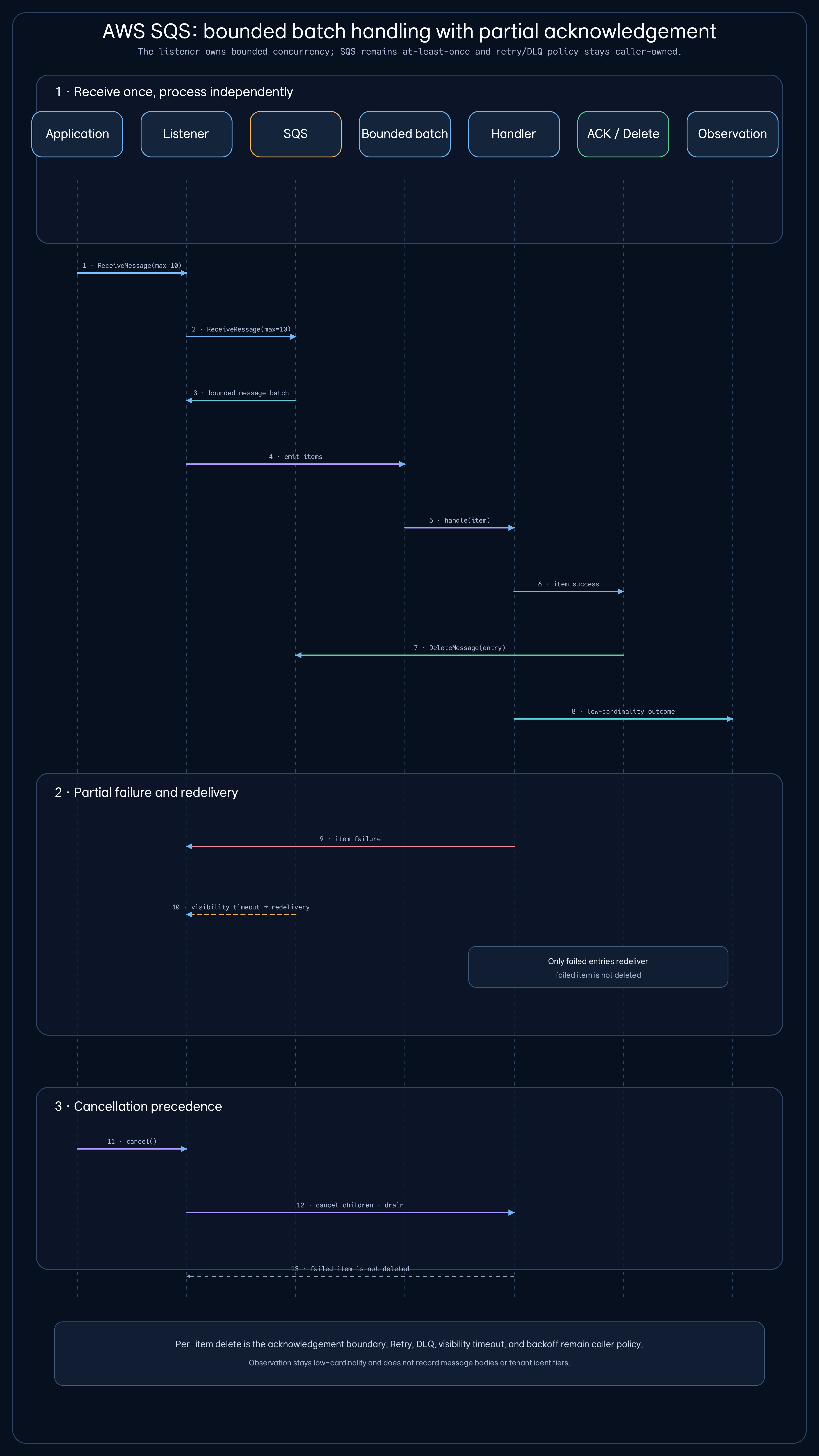 SQS batch reliability Flight Recorder Play normal delivery, partial handler failure, delete failure, cancellation, and observation failure. Open interactive visual companion →
 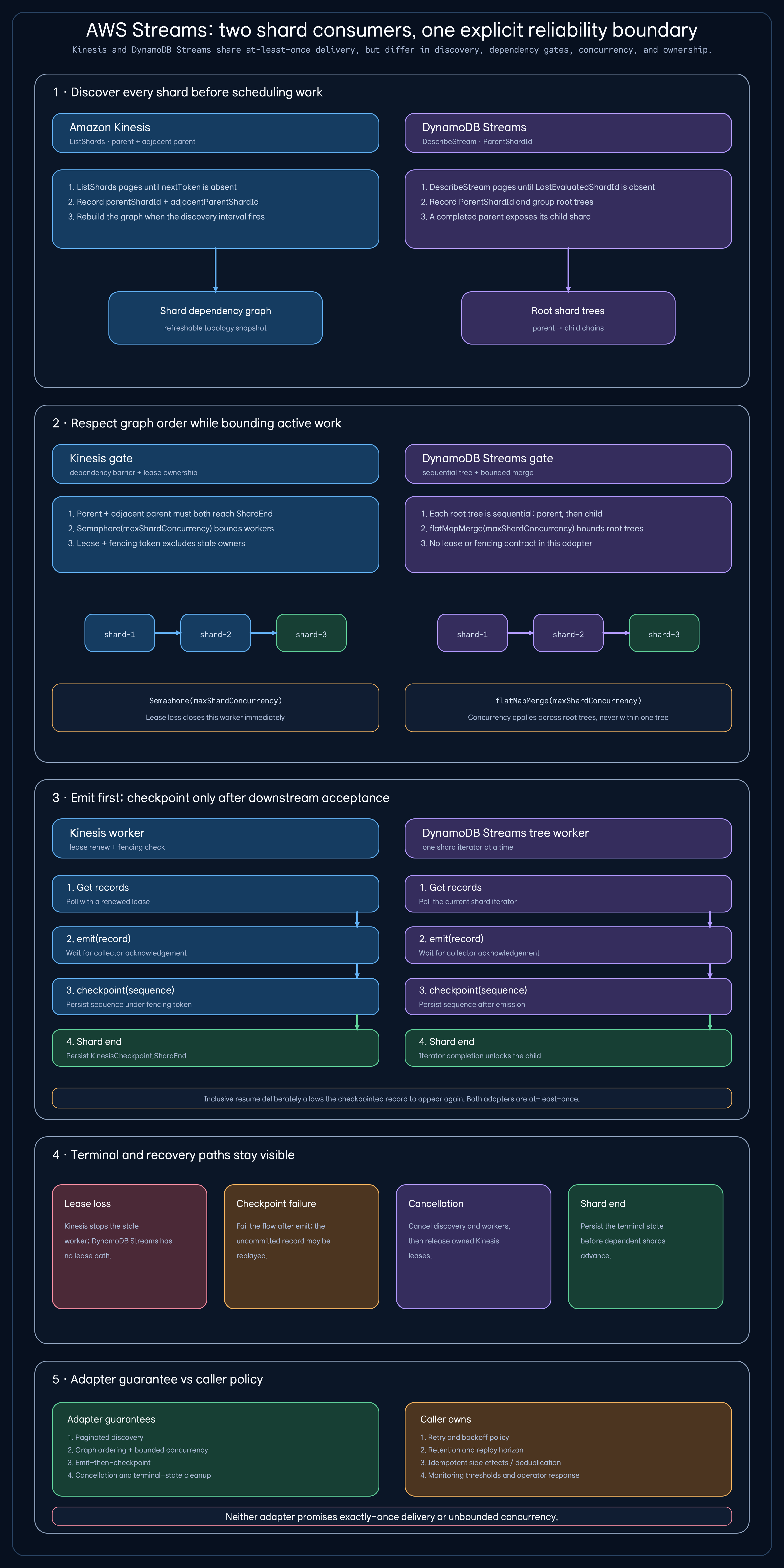 AWS Streams shard consumer lab Compare discovery, graph ordering, bounded concurrency, emit-then-checkpoint, and failure boundaries for Kinesis and DynamoDB Streams. Open interactive visual companion →
 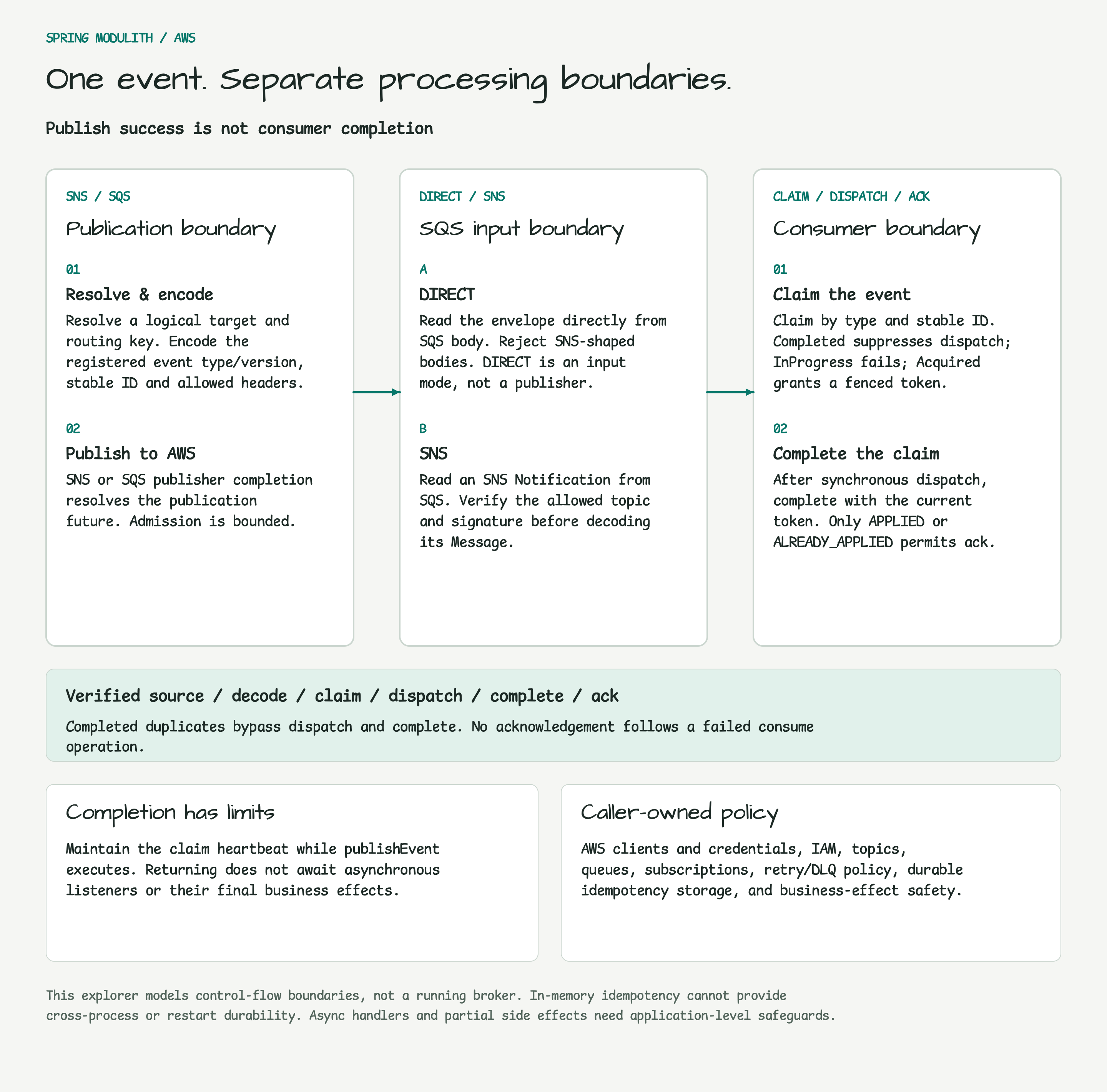 Spring Modulith event externalization Trace outbound SNS/SQS publishers and inbound DIRECT-body or SNS-wrapped-SQS-body envelopes through version validation, idempotency, dispatch, and acknowledgement boundaries. Open interactive visual companion →
 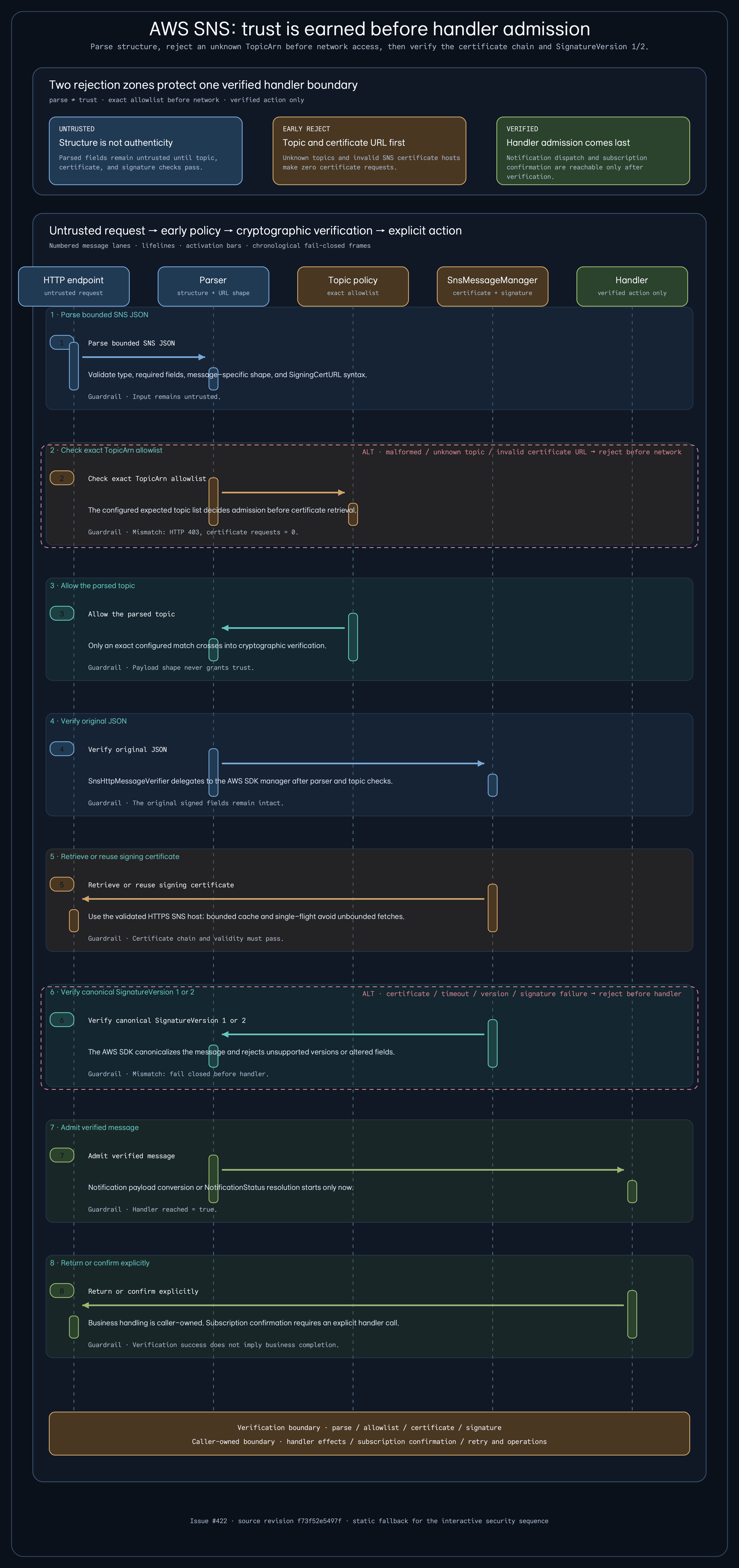 AWS SNS signature verification Trace structural parsing, exact TopicArn allowlisting before network access, certificate retrieval and caching, SignatureVersion 1/2 verification, and fail-closed handler admission. Open interactive visual companion →
 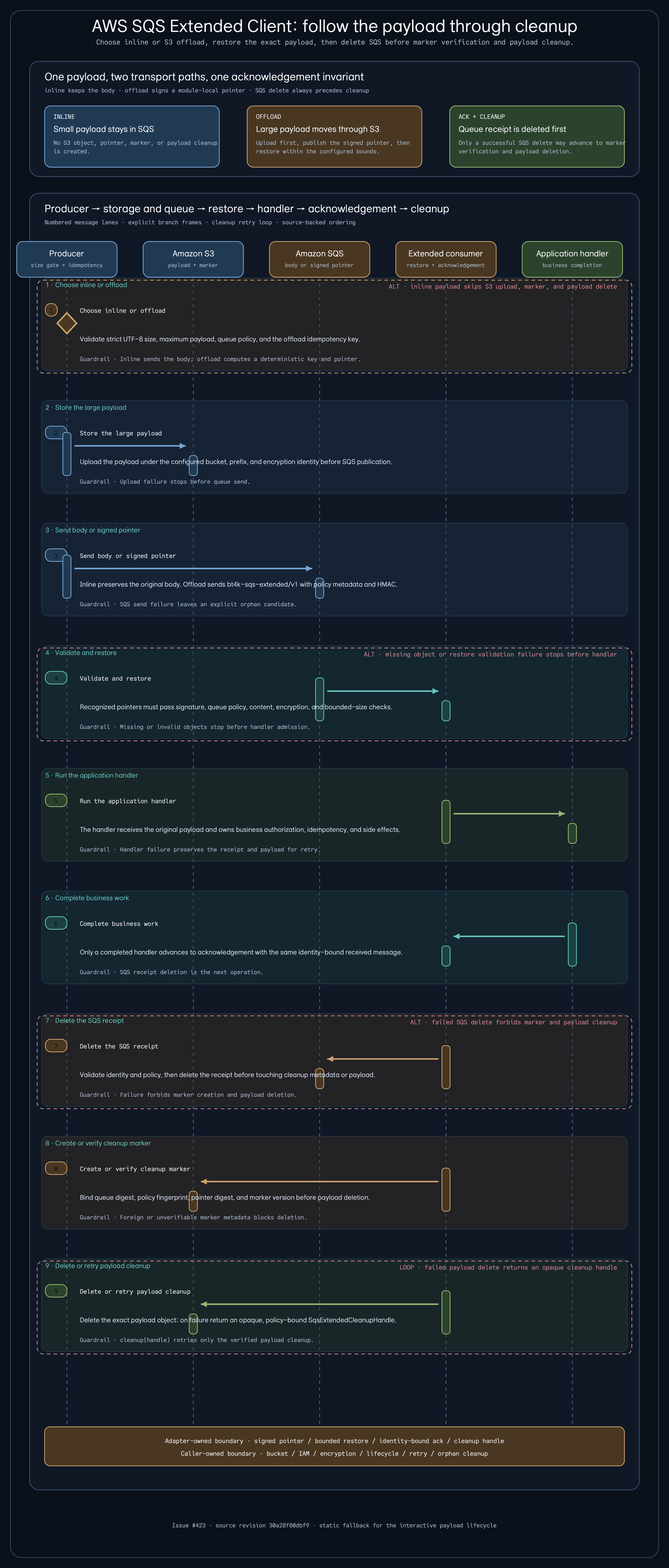 AWS SQS Extended Client lifecycle Trace inline and S3-offloaded payloads through signed pointers, bounded restore, handler completion, SQS acknowledgement, and retryable cleanup. Open interactive visual companion →
 Spring-facing operations wrap AWS async clients with suspend APIs and framework lifecycle. They do not remove the service’s delivery and consistency rules.
S3 paths
Section titled “S3 paths”Use S3Operations for common object work and presigned URLs. Use S3TransferOperations for large or multipart transfers; it activates only when Transfer Manager is present. Treat copy-then-delete moves and presigned URL expiry as explicit application decisions.
DynamoDB repositories
Section titled “DynamoDB repositories”AbstractCoroutinesDynamoDbRepository provides typed enhanced-client access. Resolve table names through DynamoDbTableNameResolver so environment naming stays outside entity code. Batch and query operations still need pagination, unprocessed-item, index, and capacity handling.
SQS listeners
Section titled “SQS listeners”@SqsListener( queue = "${orders.queue-url}", maxMessages = 10, waitTimeSeconds = 20, visibilityTimeoutSeconds = 60,)suspend fun receive(order: OrderMessage) { orderService.process(order)}Successful completion acknowledges according to the configured policy. On failure, visibility and redelivery rules decide the next attempt. Set processing timeout below visibility or enable an extension/heartbeat strategy.
Batch listeners and partial acknowledgement
Section titled “Batch listeners and partial acknowledgement”Batch delivery is explicit:
@SqsListener(queue = "orders", batch = true, acknowledgementMode = SqsAcknowledgementMode.MANUAL)suspend fun receive( messages: List<SqsReceivedMessage>, acknowledgement: SqsBatchAcknowledgement,) { val accepted = messages.filter(::isAccepted) if (accepted.isNotEmpty()) { acknowledgement.acknowledge(accepted) } val rejected = messages - accepted.toSet() if (rejected.isNotEmpty()) { acknowledgement.nack(rejected, timeoutSeconds = 0) }}The payload list may be List<SqsReceivedMessage>, List<software.amazon.awssdk.services.sqs.model.Message>,
or one concrete non-null List<T>. Raw, nullable, wildcard, nested, and broad element types are
rejected during context initialization. SQS accepts at most ten messages per receive or batch
delete; SqsBatchAcknowledgementResult reports operation, status, successful message IDs, and
item failures. nack defaults to visibility timeout 0; changeVisibility accepts 0..43_200.
ON_SUCCESS deletes pending items after a normal return, while MANUAL deletes or changes
visibility only when the handler calls the acknowledgement API. FIFO groups keep a contiguous
successful prefix, and only unconfirmed items remain eligible for retry/redelivery. Delivery is
at-least-once, so side effects need idempotency or message-id deduplication. Receipt handles,
bodies, and raw message IDs are not included in toString(), logs, metric tags, or
SqsListenerBatchCorrelation.
SqsBatchDeleteProtocolException, SqsBatchVisibilityProtocolException, and
SqsMessageConversionException indicate an untrusted or incomplete response; callers should keep
the affected items pending and apply the retry/DLQ policy. The optimized AWS SDK path uses one
batch request; old SqsOperations implementations use a sequential fallback.
For canary rollback, stop receiving, drain in-flight work, and wait for
STOPPING_RECEIVE -> DRAINING -> STOPPED before deploying the last known-good single-message
handler. Re-drive the DLQ at a bounded rate only after the control-plane response reports
drained=true and inFlight=0, then verify idempotency. Stop the canary when partial failures
exceed 1%/5m, retry exhaustion exceeds 0.1%/5m, redelivery age p95 exceeds 80% of visibility,
or DLQ visible count is non-zero. The on-call owner is bluetape4k-sqs-oncall and release approval
belongs to bluetape4k-release-approvers.
SQS Observation
Section titled “SQS Observation”Activation and prerequisites
Section titled “Activation and prerequisites”SQS Observation is an opt-in lifecycle path and is disabled by default. Enable it
only when bluetape4k.aws.enabled, bluetape4k.aws.sqs.enabled, and
bluetape4k.aws.sqs.observation.enabled are all true; the equivalent YAML is:
bluetape4k: aws: enabled: true sqs: enabled: true observation: enabled: trueActivation requires a real ObservationRegistry bean (not
ObservationRegistry.NOOP) and at least one Spring-managed
ObservationHandler that supports SqsObservationContext. The
io.micrometer.context.ContextSnapshot class must also be available. A user
SqsObservationFactory does not bypass these registry and supporting-handler
prerequisites; if a prerequisite is absent, the listener keeps the ordinary
non-observation path. The activation property is read during context creation,
so enablement and disablement require a restart or redeploy. Runtime property
rebind and observation-runtime reattachment are not supported.
The prerequisite probe is a sanitized PROCESS SqsObservationContext; a
handler that accepts only generic Micrometer contexts but rejects this concrete
context does not activate the feature.
Observation names and privacy
Section titled “Observation names and privacy”The default observations have three bounded names:
| Stage | Observation name | Boundary |
|---|---|---|
| Receive | bluetape4k.aws.sqs.receive | One SQS receive attempt, including an empty poll. |
| Process | bluetape4k.aws.sqs.process | Message conversion and handler processing, including retry and cancellation outcome. |
| Acknowledgement | bluetape4k.aws.sqs.acknowledgement | Delete, nack, or visibility-change I/O, including manual acknowledgement and heartbeat calls. |
Low-cardinality tags are limited to messaging.system,
messaging.operation, messaging.destination.name,
bluetape4k.aws.sqs.listener.id, bluetape4k.aws.sqs.outcome,
bluetape4k.aws.sqs.ack.action, bluetape4k.aws.sqs.batch.size,
bluetape4k.aws.sqs.delivery, and bluetape4k.aws.sqs.failure.stage. The
queue dimension is only the final allowlisted path segment: one to 80 ASCII
letters, digits, _, -, and an optional .fifo; invalid, blank, or
account-like values become unknown. A blank listener ID also becomes
unknown, and listener IDs must remain bounded operator configuration rather
than values derived from each message.
For a non-batch process or acknowledgement observation, high-cardinality values may contain the message ID, FIFO group ID, deduplication ID, and attempt. Receive observations and every batch observation suppress these identifiers, even when a batch contains one message. The context exposes no raw message body, receipt handle, message attribute, system-attribute, or complete queue-URL accessor. Do not add those values through a customizer or factory. If custom code adds external data to the generic observation context, privacy and cardinality remain the application’s responsibility. Inbound SQS carrier propagation is not supported; coroutine context propagation is limited to the observation scope and child observations.
Customization contract
Section titled “Customization contract”Customizers run once in Spring Ordered/@Order order before the factory. A
factory must return a not-started observation bound to the supplied context and
registry; the runtime owns start, error, and stop. Returning a different
context or registry fails before lifecycle execution. Returning an already
started observation is unsupported because Micrometer exposes no public started
state check. Observation.NOOP is the explicit direct-path result and has no
observation lifecycle. A stage-specific SqsObservationConvention or factory
can replace the PROCESS observation name while preserving the same context and registry.
The following example adds only bounded custom context values:
@Order(1)private class DeploymentEnvironmentCustomizer : SqsObservationContextCustomizer {    override fun customize(context: SqsObservationContext) {        context.put("deployment.environment", "production")    }}
@Order(2)private class ObservationOwnerCustomizer : SqsObservationContextCustomizer {    override fun customize(context: SqsObservationContext) {        val environment = context.get<String>("deployment.environment")        context.put("observation.owner", "$environment:sqs-platform")    }}
fun sqsObservationFactory(): SqsObservationFactory = SqsObservationFactory { context, registry ->    val observationName = when (context.metadata.stage) {        SqsObservationStage.RECEIVE -> "custom.sqs.receive"        SqsObservationStage.PROCESS -> "custom.sqs.process"        SqsObservationStage.ACKNOWLEDGEMENT -> "custom.sqs.acknowledgement"    }    Observation.createNotStarted(observationName, { context }, registry)}
Legacy metrics migration
Section titled “Legacy metrics migration”Keep the existing instrumentation paths separate during migration:
| Path | Measures | Migration use |
|---|---|---|
MicrometerSqsListenerInterceptor | Listener receive, handler, acknowledgement, and batch callback timers/counters. | Keep it automatic in the control cohort. Observation activation suppresses the automatic bean in the candidate cohort. |
MicrometerSqsOperations | Low-cardinality timers around SqsOperations calls such as receive, send, delete, and visibility changes. | Keep as the request-operation meter; it does not replace listener lifecycle observations. |
| SQS Observation | receive, process, and acknowledgement observations with coroutine scope and bounded context. | Enable after the canary and switch dashboards only after the runtime evidence passes. |
Compare separate control and candidate cohorts. The control keeps the automatic
legacy listener meter with Observation disabled; the candidate enables
Observation and therefore suppresses that automatic listener interceptor. A
manually registered MicrometerSqsListenerInterceptor in the candidate creates
duplicate listener instrumentation and is an explicit diagnostic choice, not
the default migration procedure.
Coroutine context and manual ACK
Section titled “Coroutine context and manual ACK”A manual acknowledgement invoked after the process observation has ended is detached from that completed process span. Its acknowledgement observation uses only the observation that is current at invocation time as its parent; it never reuses a stale process parent.
Failure precedence and redelivery
Section titled “Failure precedence and redelivery”| Boundary | Primary result |
|---|---|
| Observation setup fails before business or ACK I/O | The setup failure is primary and the operation fails closed. |
| Business or ACK I/O fails and observation cleanup also fails | The business/I/O failure stays primary; cleanup is suppressed. |
| Business or ACK I/O succeeds and foreground observation stop fails | The stop failure is primary and the existing retry/redelivery policy applies. ACK I/O may already have succeeded, so handlers must tolerate idempotent replay and ambiguous redelivery. |
| Visibility-heartbeat observation setup fails | BT4K-SQS-OBS-202 reason=heartbeat_telemetry_setup is logged without the original throwable or queue URL. The current visibility extension is skipped, but the background handler continues, so duplicate delivery is possible. |
| Visibility-heartbeat observation cleanup fails | BT4K-SQS-OBS-202 is logged without payload, queue URL, or throwable text; the heartbeat result remains primary and cleanup fails open. |
BT4K-SQS-OBS-101 context-propagation-missing identifies a missing
ContextSnapshot prerequisite. BT4K-SQS-OBS-202 also reports bounded
foreground telemetry setup failures with reason=telemetry_setup; it never
includes the original throwable or full queue URL. Heartbeat setup uses the distinct
reason=heartbeat_telemetry_setup fail-open diagnostic described above.
Evidence boundary
Section titled “Evidence boundary”The runtime uses context-propagation:1.2.1 as a transitive runtime
dependency. That dependency does not appear in public observation signatures,
and enabling the feature requires no schema or persisted-state migration. Local
acceptance uses the FlociServer.Launcher.floci test server and the Floci SQS
matrix; verification against an actual AWS account and an OpenTelemetry
exporter is N/A for this path.
SQS Extended Client
Section titled “SQS Extended Client”The Extended Client is opt-in. It keeps small messages inline and stores larger payloads in S3 behind an authenticated pointer. The producer and consumer gates are independent, but enable the consumer and drain it before enabling producer offload during a rollout.
bluetape4k: aws: sqs: extended: enabled: true producer-enabled: true consumer-enabled: true default-queue-urls: - https://sqs.ap-northeast-2.amazonaws.com/123456789012/orders default-policy: bucket: orders-extended-payloads key-prefix: bluetape4k/sqs/orders offload-threshold-bytes: 262144 max-inline-bytes: 1048576 max-offload-payload-bytes: 67108864 orphan-retention-hours: 168 delete-on-ack: false pointer-signing-key-ref: defaultUse SqsExtendedClientOperations with an idempotency key for payloads above
the threshold. A received extended message must be acknowledged through the
same identity-bound SqsExtendedReceivedMessage instance. delete-on-ack
creates and verifies a marker before deleting the S3 payload; a failed delete
returns an opaque retry handle. The default keeps payloads for lifecycle
cleanup, so the S3 marker and payload must share a prefix and retention age.
The supported Jackson 3 module serializes only safe DTO fields. It does not
serialize raw AWS requests/responses, pointer bucket/key/signature, receipt
handles, encryption context, or cleanup handles. An ordinary @SqsListener
legacy consumer and the AWS Java Extended Client do not restore this pointer
format; do not attach either to an extended pointer queue.
Optional client-side encryption reuses the existing bounded S3 encryption capability and requires an exact key identity/context match. Its wire format is local to this module and is not interoperable with the AWS Java Extended Client.
For rollback, disable the producer, stop the legacy consumer, drain the
extended adapter, and wait for two empty visibility-window probes. Verify
ApproximateReceiveCount, RedrivePolicy, DLQ/quarantine counts, and the
global rollback deadline before rehydrating pointers into an inline legacy-safe
queue. A deadline or redrive-budget failure remains ROLLBACK_BLOCKED and does
not start the legacy consumer.
The Floci-first local check is:
./gradlew :bluetape4k-aws-spring-boot:test \ --tests '*SqsExtendedClientAwsEmulatorTest' \ -Dbluetape4k.aws.emulator=floci --no-daemonUse LocalStack only as an explicit fallback. The low-cardinality counters are
bluetape4k.aws.sqs.extended.offload.total, ...orphan.total,
...payload-read.failure, and ...cleanup.failure; queue URLs, bucket/key,
payload, and diagnostic codes are never tags. External publisher latency and
cleanup telemetry, plus heap/throughput measurements, are tracked separately
in follow-up issue #515 and are not completion evidence for this feature.
SNS and SES
Section titled “SNS and SES”SNS publish helpers and HTTP parsing are separate concerns. Verify SNS signatures before processing callbacks. SES senders expose coroutine and JavaMail-style adapters; do not retry non-idempotent sends blindly.
SNS topic ARN resolver and cache
Section titled “SNS topic ARN resolver and cache”SnsOperations.findTopicArn accepts a topic name or an explicit SNS ARN. Name
lookups use SnsTopicArnResolver with paginated ListTopics, a bounded
scope-aware TTL/LRU cache, and a per-topic single-flight. The default cache is
enabled with 256 entries and a five-minute TTL; topic-arn-cache.enabled=false
disables persistent entries but not duplicate lookup suppression. A successful
topic create invalidates the name entry so eventual consistency remains visible
as a documented null or SDK failure instead of a stale negative value.
Configure account-id to enforce same-account checks. Explicit ARN input fails
closed when the account is unknown unless
allow-cross-account-topic-arn=true is an intentional opt-in. ListTopics
results are still checked for SNS ARN shape and configured region/account; an
effective region is required for explicit ARN validation. A custom
SnsTopicArnCache or SnsTopicArnResolver bean takes precedence as a scoped
configuration override, but it is not a behavior-preserving rollback by itself.
For rollback, provide a custom SnsOperations implementation or redeploy the
last-known-good artifact; bluetape4k.aws.sns.enabled=false disables the
complete SNS auto-configuration. Terminal lookup failures emit only hashed
scope/topic dimensions and exception type; raw ARN, topic name, endpoint
credentials, and AWS error messages are not logged.
bluetape4k: aws: sns: enabled: true region: ap-northeast-2 account-id: 123456789012 allow-cross-account-topic-arn: false topic-arn-cache: enabled: true max-size: 256 ttl: 5mSNS batch conversion
Section titled “SNS batch conversion”SnsBatchMessageConverter is an opt-in, no-network conversion boundary from
Spring Message<*> values to a typed SnsPublishBatchRequest. Its no-argument
constructor accepts only String payloads; the second constructor accepts an
explicit suspend SnsPayloadSerializer for structured payloads. The converter
uses only the allowlisted SnsBatchMessageHeaders constants
MESSAGE_ID, SUBJECT, MESSAGE_ATTRIBUTES, MESSAGE_GROUP_ID, and
MESSAGE_DEDUPLICATION_ID. Explicit IDs must be UUID; otherwise the
MessageHeaders.ID UUID is used. All entries are converted before the request
is built, input order is preserved, and a conversion error never invokes an
SNS client. Errors are cause-free and redact payloads, headers, ARNs, and
serializer exceptions; cancellation rethrows the original
CancellationException instance.
val converter = SnsBatchMessageConverter(SnsPayloadSerializer { payload -> "{\"orderId\":\"${(payload as Order).id}\"}"})val request = converter.convertAll( topicArn = topicArn, messages = orders.map { order -> MessageBuilder.withPayload(order) .setHeader(SnsBatchMessageHeaders.SUBJECT, "order-created") .build() },)The converter requires applications to add
org.springframework:spring-messaging at runtime because this module keeps it
compileOnly. The guarded strategy port does not expose the AWS client or its
lifecycle and does not automatically retry an uncertain partial publish.
262,144-byte SNS byte-size preflight, a Jackson 3 adapter, and ByteArray
payload support are follow-up scope rather than current behavior.
Spring Modulith SNS/SQS externalization
Section titled “Spring Modulith SNS/SQS externalization”The optional adapter externalizes registered Spring Modulith events to SNS or SQS and restores SQS messages as local application events. Import the root BOM once and keep all coordinates versionless:
dependencies {    implementation(platform("io.github.bluetape4k:bluetape4k-dependencies:<version>"))    implementation("io.github.bluetape4k.aws:bluetape4k-aws-spring-boot")    implementation("org.springframework.modulith:spring-modulith-starter-jpa")    implementation("org.springframework.modulith:spring-modulith-events-jackson")
    runtimeOnly("software.amazon.awssdk:sns")                 // SNS producer    runtimeOnly("software.amazon.awssdk:sqs")                 // SQS producer/consumer    runtimeOnly("software.amazon.awssdk:sns-message-manager") // verified SNS consumer}
The application owns the Spring Modulith publication repository choice. This module keeps the Modulith and service SDK dependencies optional. Register every external event with a stable type, version, final concrete JVM class, and event ID:
data class OrderCreated(val orderId: String, val tenant: String)
@Beanfun awsModulithEventTypes(): AwsModulithEventTypeRegistry =    AwsModulithEventTypeRegistry.of(        AwsModulithEventTypeRegistration(            type = "order.created",            version = 1,            eventClass = OrderCreated::class.java,            eventId = OrderCreated::orderId,            allowedHeaderNames = setOf("tenant"),            headers = { mapOf("tenant" to it.tenant) },        )    )
Spring Modulith routing must return a logical alias such as order-events, not
an ARN or URL. The alias maps to one service destination:
bluetape4k: aws: modulith: events: enabled: true producer: enabled: true targets: order-events: service: sns destination: order-eventsProducer-only applications leave consumer.enabled=false. A direct SQS
consumer receives the adapter envelope and requires a queue redrive policy by
default:
bluetape4k.aws.modulith.events: enabled: true consumer: enabled: true queue: direct-order-events source-mode: direct redrive-required: trueAn SNS fanout consumer receives an SNS notification through SQS. It additionally
requires sns-message-manager, a verifier bean, and an exact TopicArn allowlist:
bluetape4k.aws.sns: region: ap-northeast-2bluetape4k.aws.modulith.events: enabled: true consumer: enabled: true queue: sns-order-events source-mode: sns expected-topic-arns: - arn:aws:sns:ap-northeast-2:123456789012:order-events redrive-required: trueOne built-in listener handles one queue and one source mode per application
context. Deploy separate contexts when DIRECT and SNS sources must be consumed
together. For FIFO publication, configure an SQS destination ending in .fifo
and make Spring Modulith provide RoutingTarget.key; the adapter uses that key
as messageGroupId and the stable registered event ID as deduplication ID.
Standard destinations reject a routing key, while FIFO destinations require it.
The built-in in-memory idempotency store is application-scoped and loses its
claims on restart. For durable multi-instance processing, implement
AwsModulithEventIdempotencyStore and expose exactly one bean; auto-configuration
backs off when that bean exists. A successful handler or an already-completed
duplicate is acknowledged. An active claim, handler failure, claim renewal or
completion failure, and source verification failure are not acknowledged, so
SQS visibility, redelivery, and the queue redrive policy govern retry and DLQ
delivery. An uncertain claim mutation is left for lease-expiry takeover instead
of being released eagerly, which preserves fencing against duplicate dispatch.
Run the local transport contract with Floci:
./gradlew :bluetape4k-aws-spring-boot:test \ --tests 'io.bluetape4k.aws.spring.modulith.*' \ -Dbluetape4k.aws.emulator=floci --no-daemonThis proves the local SQS path, SNS-to-SQS fanout transport, redrive preflight,
acknowledgement, and claim/fencing behavior supported by FlociServer. It does
not prove production SNS certificate/signature telemetry, IAM, cross-account
policies, or real AWS timing. Keep LocalStack as an explicit fallback for a
Floci API gap; no real AWS account is required for this local contract.
| Documented contract | Source-backed symbol |
|---|---|
| Stable event type, version, final concrete class, ID, allowed headers | AwsModulithEventTypeRegistration, AwsModulithEventTypeRegistry |
| Logical SNS/SQS target | AwsModulithEventsProperties.Target, AwsModulithTargetService |
| DIRECT or verified SNS source | AwsModulithSourceMode, AwsModulithSqsEventConsumer |
| Lease/fencing duplicate suppression | AwsModulithEventIdempotencyStore |
| Normal processing or completed duplicate | AwsModulithConsumeOutcome |
Test what can fail
Section titled “Test what can fail”Test serialization, queue lookup, redelivery, duplicate delivery, DLQ behavior, S3 pagination, multipart cancellation, and DynamoDB partial batch success. A successful send-only test is insufficient.