
Spring Boot integration
Latest stable Based on Leader release 1.0.0
Auto-configure electors and guard invocations with AspectJ compile-time weaving.
Interactive visual companions
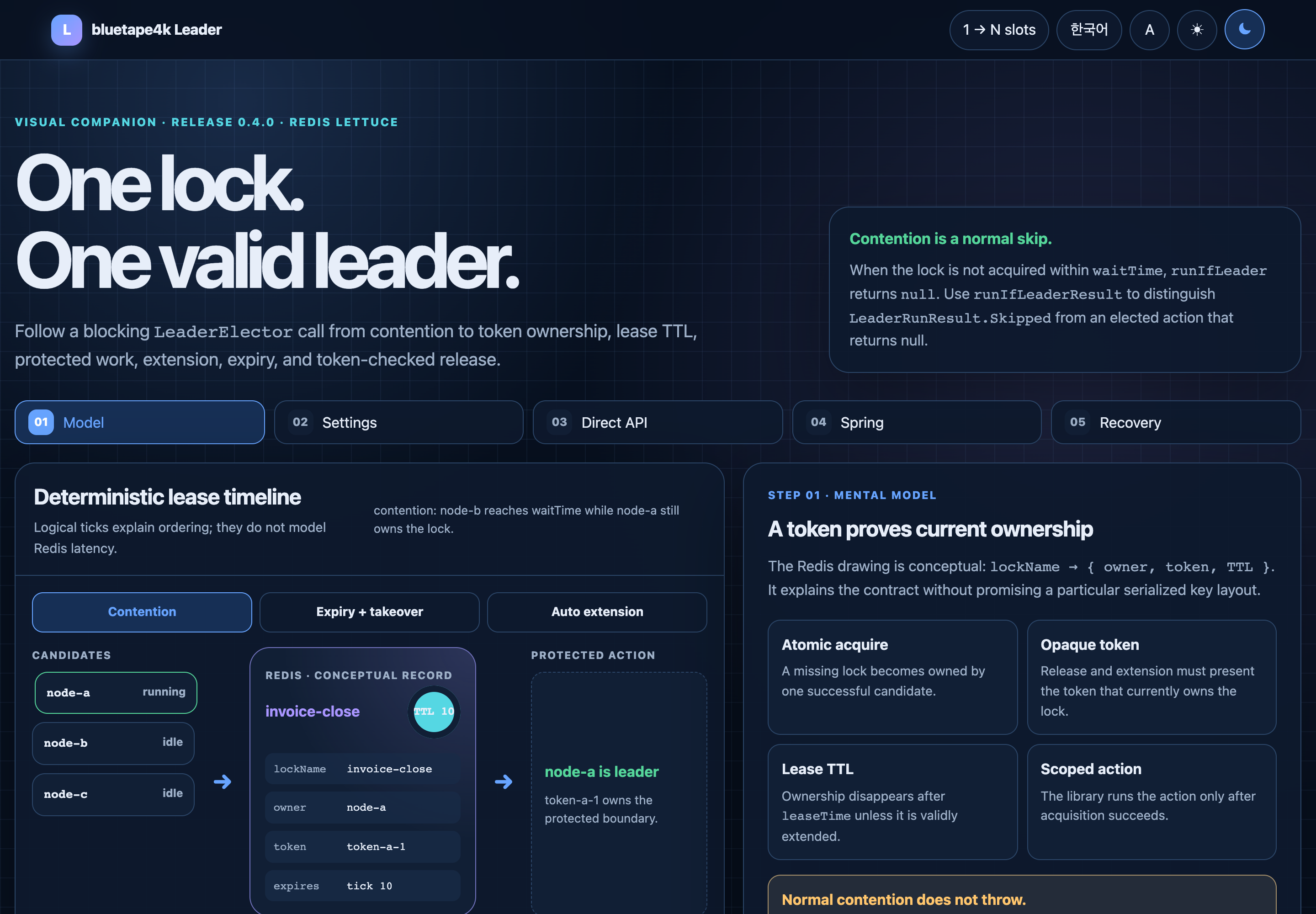
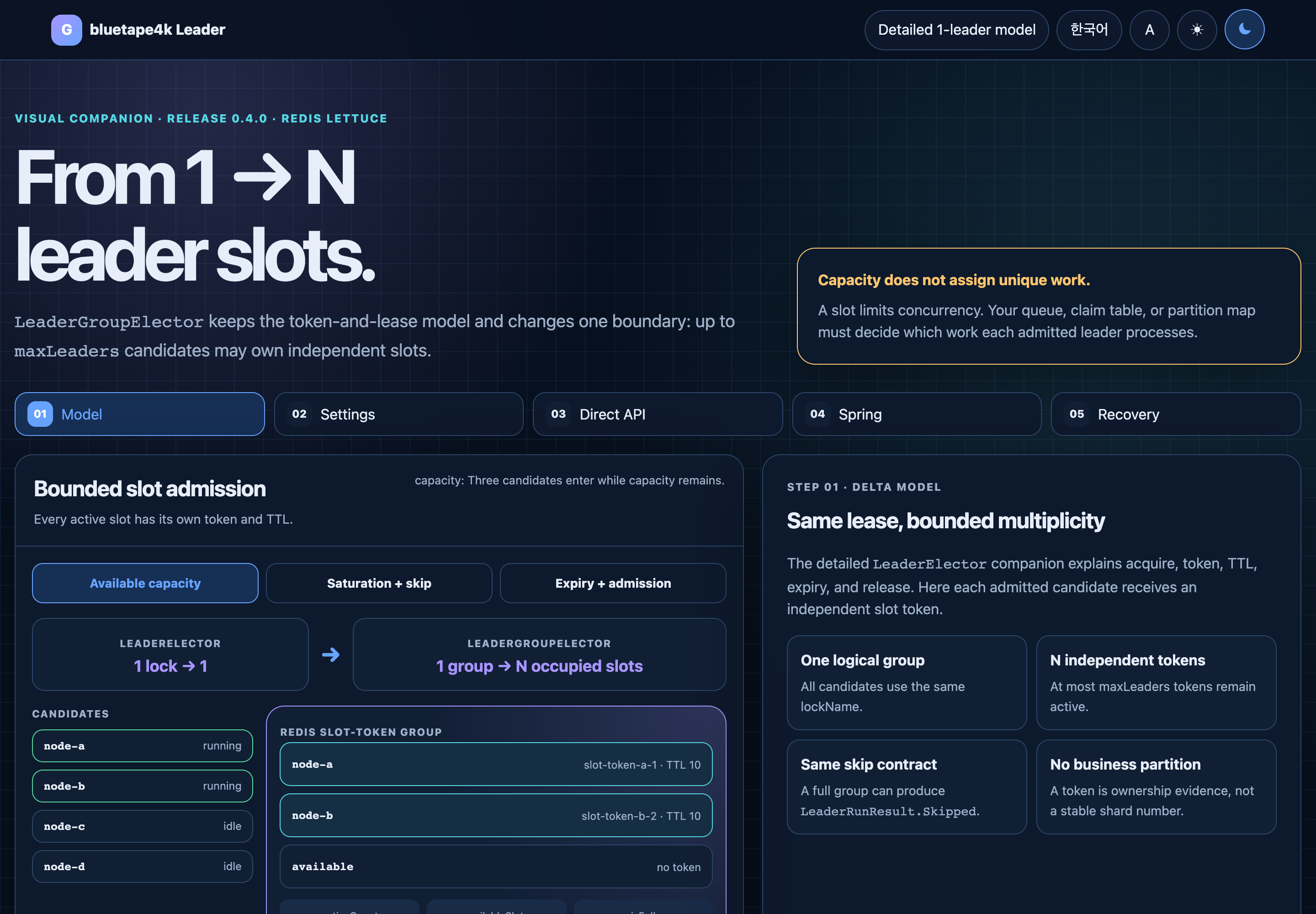
Section titled “Interactive visual companions”The detailed LeaderElector walkthrough connects lock, token, TTL, lease expiry, autoExtend, the direct API, and @LeaderElection. The LeaderGroupElector delta adds bounded maxLeaders slots and the @LeaderGroupElection constraints without repeating the single-leader model.
Weaving model
Section titled “Weaving model”Release 1.0.0 uses Freefair post-compile AspectJ weaving. Do not add @EnableAspectJAutoProxy, and Kotlin methods do not need to be open. Private methods are not intercepted; startup validation reports invalid declarations. Verify the woven application artifact, not only a plain unit test.
Annotations
Section titled “Annotations”@LeaderElection supports nullable synchronous and suspend results plus Mono, Flux, and Flow. Long streams require autoExtend=true, or streamBounded=true only when completion is guaranteed inside the lease. @LeaderGroupElection supports synchronous, suspend, and Mono, but rejects Flux and Flow because per-slot stream extension is undefined.
Configuration safety
Section titled “Configuration safety”Use valid SpEL such as "'prefix-' + #param". Invalid expressions and impossible group settings fail validation. Auto-configuration orders elector creation, AOP factories, Micrometer, then aspects so instrumentation sees the same execution boundary.
Group database server time (0.6.0+ develop)
Section titled “Group database server time (0.6.0+ develop)”The current develop Spring integration exposes the Exposed group
LeaderGroupElectionOptions.useDbTime policy through the common property and
the group annotation:
bluetape4k: leader: group: use-db-time: trueThe common property defaults to false. A method may opt in with
@LeaderGroupElection(..., useDbTime = true). The effective value is
commonProperty || annotationValue; therefore a common true enables every
group annotation, while the Boolean annotation does not provide a per-method
false override. Only Exposed JDBC and Exposed R2DBC group electors consume
the flag; other group backends ignore it.
With the flag enabled, Exposed evaluates ownership and active-slot expiry using
the database server clock. If the timestamp query is unavailable, the Exposed
path remains fail-closed and does not claim a slot. For AOP calls,
failure-mode still controls backend-error handling (RETHROW, SKIP, or
FAIL_OPEN_RUN). Route all participants to one authoritative database clock,
and account for provider-specific timestamp precision plus the extra timestamp
query in the JDBC/R2DBC pool budget.
Readiness and recent acquisition failures
Section titled “Readiness and recent acquisition failures”The opt-in leaderElectionReadiness contributor reads only the JVM-local lock-name registry. Configure the bounded observation window for backend acquisition failures with:
bluetape4k: leader: observability: health: enabled: true acquisition-failure-window: 5mThe default window is 5m, with a fixed retention capacity of 1024 timestamps. Only AOP BACKEND_ERROR skips are counted; CONTENTION and FAIL_OPEN_FORCED are intentionally excluded. Readiness details expose recentAcquisitionFailures, lastAcquisitionFailureAt, acquisitionFailureWindow, acquisitionFailureWindowCapacity, and acquisitionFailureWindowOverflowed. An overflowed window makes the count a lower bound. Once all retained failures expire, lastAcquisitionFailureAt is null.
This recorder is best-effort and aggregate-only. Recent failures do not change the contributor status (UP, OUT_OF_SERVICE, DOWN, or UNKNOWN), and the detail never retains lock names or exception messages. Protect Actuator endpoints and keep dynamic lock-name registration bounded because each registered name still causes one backend state read per health evaluation.
Release sources
Section titled “Release sources”leader-spring-boot/README.mdleader-core/src/main/kotlin/io/bluetape4k/leader/annotation/LeaderElection.ktleader-core/src/main/kotlin/io/bluetape4k/leader/annotation/LeaderGroupElection.kt