Spring Boot image intelligence API workshop
Latest stable Based on Image release 1.0.0
Runnable example
Problem
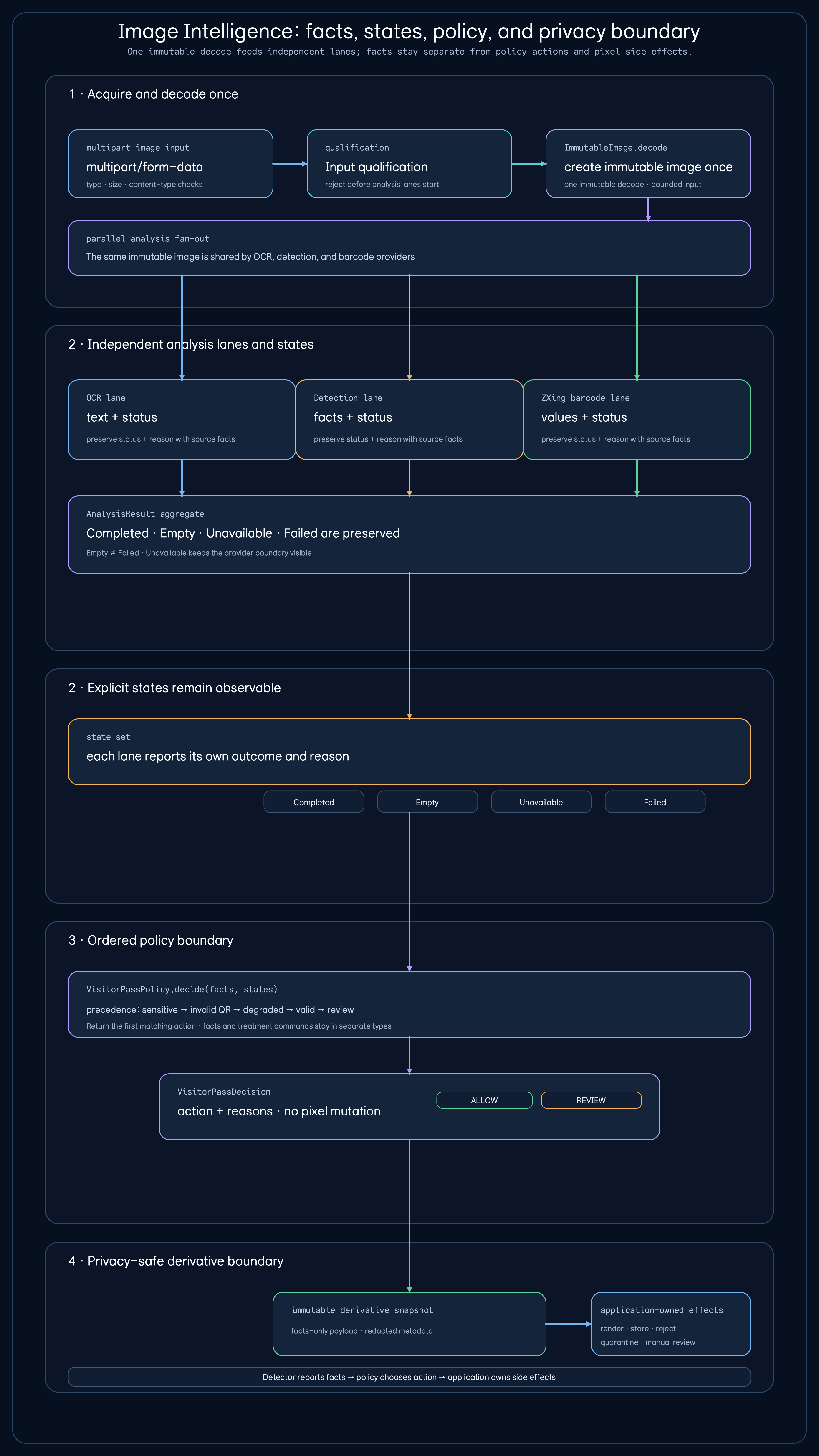
Section titled “Problem”This Spring Boot 4 example validates and decodes one uploaded image once, then
fans the immutable value out to OCR, object detection, and barcode/QR analysis.
It demonstrates shared qualification, isolated provider execution, partial
results, and a replaceable business policy without choosing a particular ML
model. A visitor pass is the reference scenario: text, a face region, and a
visitor: QR value are facts that a policy can evaluate together.
When to use it
Section titled “When to use it”Use this workshop when several image analyses must share one guarded decode and still remain independently observable. It is useful for shipping labels, product labels, and intake documents as well as visitor passes. It is a teaching boundary, not a complete service: authentication, retention, malware scanning, and production model governance remain application responsibilities.
Coordinates
Section titled “Coordinates”The workshop is not published and has no Maven coordinate. Select one
bluetape4k-dependencies version for published image modules; run the example
from this repository with :spring-boot-image-intelligence-api.
Core concepts
Section titled “Core concepts”- Qualification checks the declared media type, compressed size, signature,
dimensions, and decoded pixel budget before the single
ImmutableImagedecode. ImageIntelligenceWorkflowruns OCR, detection, and ZXing lanes throughsuspendParallelFlow; each lane writes a distinctWorkContextkey.AnalysisResultdistinguishesCompleted,Empty,Unavailable, andFailed. A provider failure is domain data and does not discard successful siblings.- The aggregate is
COMPLETEDwhen every lane is available or empty,PARTIALwhen some results coexist with unavailable/failed lanes, andFAILEDwhen no lane produced an available result. VisitorPassPolicyconsumes provider-neutral facts. Replace that policy for a different domain without rewriting qualification or orchestration.
Quick start
Section titled “Quick start”The default profile needs no external OCR or ML service. Start it with:
./gradlew :spring-boot-image-intelligence-api:bootRunFor deterministic OCR and detection fixtures while keeping real ZXing decoding, use the demo profile:
./gradlew :spring-boot-image-intelligence-api:bootRun \ --args='--spring.profiles.active=demo'Then submit a PNG, JPEG, or WebP image:
curl -X POST \ -F "file=@visitor-pass.png;type=image/png" \ http://localhost:8080/api/images/intelligenceThe optional native-ocr profile requires host Tesseract and traineddata. Do
not activate it together with demo; provider ownership is deliberately
exclusive.
API by task
Section titled “API by task”| Task | Example boundary |
|---|---|
| Submit an image | POST /api/images/intelligence, multipart field file |
| Guard input | ImageUploadQualifier checks type, bytes, signature, dimensions, and pixels |
| Run analyses | ImageIntelligenceWorkflow coordinates OCR, detection, and ZXing |
| Preserve partial results | AnalysisResult plus ImageIntelligenceAggregator |
| Apply business rules | VisitorPassPolicy maps facts to ALLOW or MANUAL_REVIEW |
Recommended patterns
Section titled “Recommended patterns”Decode once and share an immutable image; never let each provider reopen the
upload. Keep provider timeouts and semaphores separate, and treat
Empty (“ran and found nothing”) differently from Failed (“could not
verify”). Propagate external CancellationException instead of turning it
into a business failure. A native call that ignores interruption may still hold
its thread until it returns, so a production deployment can add process
isolation and a process-level timeout.
Integrations
Section titled “Integrations”The example combines bluetape4k-images decoding, the OCR contract, the
provider-neutral barcode API, and the ZXing provider with Spring Boot 4 and
bluetape4k-workflow. It intentionally keeps the detection adapter local so a
real model can be introduced without changing the HTTP or aggregate contract.
Configuration
Section titled “Configuration”The release defaults are five MiB compressed input, 8,192 pixels per side, 16,777,216 decoded pixels, and independent provider timeouts/concurrency:
example: image-intelligence: max-input-bytes: 5242880 max-input-pixels: 16777216 max-input-side: 8192 ocr-timeout: 3s detection-timeout: 2s barcode-timeout: 2s ocr-concurrency: 1 detection-concurrency: 2 barcode-concurrency: 4 tessdata-path: nullKeep host paths such as tessdata-path in application configuration. Never
accept them from an upload request.
Failure modes
Section titled “Failure modes”400indicates an empty upload, unsupported media type, signature mismatch, malformed image, or a dimension/pixel qualification failure.413indicates that the compressed input limit was exceeded.- A provider-level timeout or unavailable native dependency is represented in
the response as
FailedorUnavailable; successful sibling results remain. - Missing workflow keys or unexpected programming errors are workflow failures, not normal provider results.
Responses expose a stable status/reason code and do not log or return the uploaded payload. Inspect provider configuration and sanitized application logs when a lane is unavailable; do not expose tessdata paths or native exception details to callers.
Operations
Section titled “Operations”Add authentication, authorization, tenant quotas, rate limiting, request
timeouts, antivirus/content-disarm scanning, retention/deletion, encryption,
and audit policy before exposing this endpoint to untrusted traffic. Size and
pixel limits protect decode memory, while per-provider semaphores protect CPU
and native resources. Measure provider latency and partial-result rates rather
than treating PARTIAL as an infrastructure crash.
Testing
Section titled “Testing”Run the workshop tests with:
./gradlew :spring-boot-image-intelligence-api:testThe release suite covers real ZXing extraction from a generated QR, qualification boundaries, profile ownership, parallel overlap, partial failures, workflow keys, the policy decision table, external cancellation, permit recovery, payload-free logs, and the HTTP error contract. Native OCR smoke testing remains environment-dependent.
Workshops and learning path
Section titled “Workshops and learning path”- Read the immutable-image and OCR module guides, then run this workshop’s fake-provider tests.
- Run the
demoprofile to observe a complete aggregate without native OCR. - Compare the Ktor and Spring OCR workshops to separate transport concerns from provider orchestration.
- Replace
VisitorPassPolicywith a shipping-label or product-label policy and retain the same qualification and partial-result boundaries.
Limitations
Section titled “Limitations”The example does not provide authentication, persistence, queues, batch processing, preprocessing policy, malware scanning, tenant isolation, retry or circuit-breaker policy, model selection, quality measurement, or drift monitoring. Coroutine cancellation cannot forcibly terminate a non-cooperative native function; use process isolation when a hard native execution bound is a requirement.