
Reactor Tenant Context Adapter
Latest stable Based on Bluetape4k release 2.0.0
Problem
Section titled “Problem”JDK 25 adapter for immutable TenantId propagation in Reactor subscriber Context. It installs no default tenant, global hook, or automatic context propagation. This manual connects that purpose to the current build, source entry points, tests, configuration resources, and lifecycle evidence instead of duplicating the README feature list.
When to use
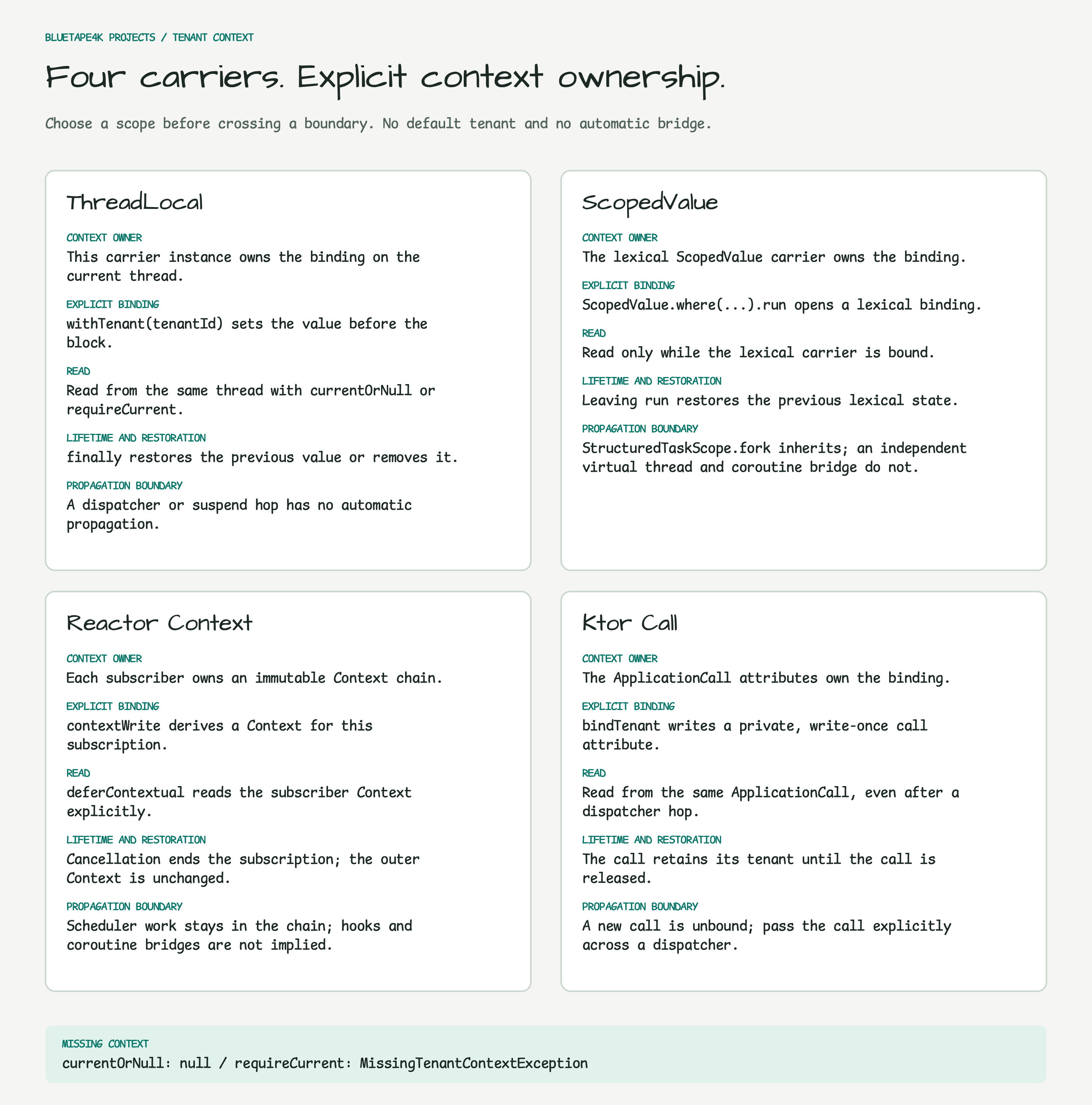
Section titled “When to use”Use bluetape4k-tenant-reactor when a reactive pipeline must carry an authorized TenantId in Reactor subscriber Context. Bind once at the subscription boundary and read through ContextView downstream. The adapter is appropriate when explicit propagation is preferred over global hooks or automatic context propagation.
Coordinates
Section titled “Coordinates”dependencies { implementation(platform("io.github.bluetape4k:bluetape4k-dependencies:<version>")) implementation("io.github.bluetape4k:bluetape4k-tenant-reactor")}Gradle project path: :bluetape4k-tenant-reactor. Source directory: bluetape4k/tenant-reactor.
Concepts
Section titled “Concepts”The first source-level concepts to inspect are ReactorTenantContext. File names are navigation anchors; read each declaration and its tests before treating it as a public contract.
Quick start
Section titled “Quick start”Bind at contextWrite and read lazily with deferContextual:
val result = Mono.deferContextual { context -> service.find(ReactorTenantContext.requireCurrent(context))}.contextWrite { context -> ReactorTenantContext.withTenant(context, TenantId("clinic-a"))}withTenant returns a derived immutable Context; it does not mutate the input context.
API by task
Section titled “API by task”| Entry point | What to verify |
|---|---|
ReactorTenantContext.currentOrNull | Read an optional TenantId from a ContextView. |
ReactorTenantContext.requireCurrent | Require the binding and fail with the common missing-context exception when absent. |
ReactorTenantContext.withTenant | Derive a new Context containing the canonical TenantId. |
Patterns
Section titled “Patterns”Call withTenant once near the subscription boundary and use deferContextual where a downstream component needs the tenant. Do not call Context.put for every signal, install a global Hooks bridge, or copy the tenant into a mutable registry.
Integrations
Section titled “Integrations”The current build declares these integration edges:
api(project(":bluetape4k-tenant"))api(libs.reactor.core)Both dependencies are public API edges: consumers receive the common tenant contract and Reactor Context types with this adapter.
Configuration
Section titled “Configuration”The adapter has no configuration properties, global registration, or automatic-propagation switch. The application chooses the subscription boundary explicitly in the pipeline.
Failures
Section titled “Failures”currentOrNull returns null for an unbound ContextView; requireCurrent throws the common MissingTenantContextException. Cancellation ends the subscriber lifecycle together with its context. The adapter provides no default, fallback, or duplicate-recovery policy.
Operations
Section titled “Operations”Do not expose tenant values through logs, exceptions, MDC, or metric tags. Binding-failure telemetry should use bounded carrier/stage labels and existing correlation or trace identifiers.
Testing
Section titled “Testing”Run the module test task:
./gradlew :bluetape4k-tenant-reactor:test --no-configuration-cacheRepresentative test anchors:
Workshops
Section titled “Workshops”No dedicated workshop path is registered in the manual manifest. Use the module README and the representative tests above as runnable evidence.
Limitations
Section titled “Limitations”The adapter does not authenticate tenants, parse headers, map HTTP errors, install Reactor hooks, or bridge automatically to coroutine ReactorContext. Each boundary must opt into propagation explicitly.